| Below is a summarized version from the Korean Software Engineering Community. If you want to see the original version from Steve Yegge, please visit https://sourcegraph.com/blog/revenge-of-the-junior-developer Part 1: Six Waves of AI Coding- "Vibe coding" is a humorous nickname given to a conversation-based coding method, where you ask an LLM to write code and iterate by providing feedback on the results.
- This is a very different concept from traditional coding or auto-completion-focused coding. While it was initially used without a clear definition, it spread rapidly after Andrej Karpathy named it “vibe coding.”
- Currently, vibe coding exists in three simultaneous states:
- 80% of the industry is unaware of the existence of vibe coding. Many haven't even heard the term “coding agent.”
- There's explosive growth centered around media and social media. Despite debate and differing opinions, many developers recognize it as a future technology.
- Existing chat-based coding is already considered outdated. Some developers are enthusiastic about newer, faster methods and are no longer interested in chat.
- This article describes the stages of AI-based coding development in a total of six waves:
- Traditional Coding (2022)
- Auto-Completion-Based Coding (2023)
- Conversational Coding (2024)
- Coding Agents (First Half of 2025)
- Agent Clusters (Second Half of 2025)
- Agent Fleets (2026)
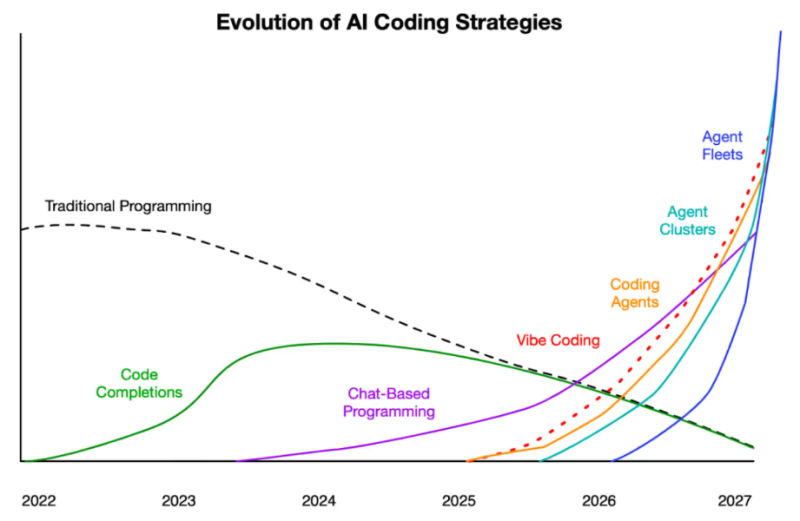
- Traditional coding and auto-completion-based coding are gradually declining, while the methods that follow are spreading at increasingly faster rates.
- Vibe coding appears as a dotted line separately from these waves.
- Vibe coding coexists on top of all the above methods and is not a specific method but a concept that encompasses the entire situation where AI writes most of the code.
- The soon-to-emerge "Agent Clusters" is a concept of managing multiple agents in parallel, and "Agent Fleets" expands into a structure where an AI manager supervises subordinate agents.
The FY26 organization chart depicts this, where one developer operates multiple agent groups, each performing various roles such as bug fixing, new feature development, and architecture refactoring. 
- Currently, humans must intervene when an agent stops or goes in the wrong direction, but soon, a supervisor agent will take over that role.
- Ultimately, it will be possible to handle dozens or more agents simultaneously, becoming an automated system for processing vast amounts of legacy code.
- These agent fleets are expected to emerge by early 2026, and the technology to efficiently organize parallel tasks is already prepared.
Part 2: Where Are You Right Now?- If you're still using AI only as a code auto-completion tool or focusing on Completion Acceptance Rate (CAR), you're on the traditional programming curve in Figure 1.
- This curve is expected to disappear completely around 2027.
- Auto-completion was popular a year ago, but it's no longer a core technology.
- If you're more progressive, you may be using IDE-based chat coding tools like Copilot, Cursor, Sourcegraph, or Windsurf.
- This is a good position, and you've adopted a more productive method than code auto-completion.
- Chat-based coding still has many users, but it's not the standard for the latest technology.
- Recently emerging coding agents (Aider.chat, Claude Code, etc.) show the potential to overwhelm all these methods.
- They will be seamlessly integrated into IDEs and will be much faster and more efficient than the existing conversation-based methods.
- Once you use an agent, it's difficult to go back to the previous method.
- Agent-based coding is also a type of vibe coding.
- Vibe coding means "all methods by which AI writes code" and is not a specific technology (modality).
- The difference is that agents can work alone without frequent conversations.
- The changes in each coding method show the following productivity multiple patterns:
- Chat-based coding is about 5 times more productive than manual work.
- Agent-based can be 5 times more productive than chat again.
- Each wave can achieve 10x productivity over time, but the curve flattens out as new technologies emerge faster.
- We are currently in the middle of a vast AI ocean and need to ride the increasingly powerful waves (new technologies).
- Every company is located on at least one of the adoption curves in Figure 1.
- It's necessary to ask yourself which curve you are on.
- Vibe coding is not a specific technology but a new philosophy and reality of development.
- The key is that you no longer write code directly.
- Code writing is delegated to AI, and humans are moving to a structure where they only review and coordinate the results.
- In the next part, we'll look at the financial impact of this technological change.
- Coding agents are not magic; they become smarter by burning costs.
- If you haven't tried it yet, it's important to try it now or observe someone using it.
Part 3: New Camel User Manual- The latest coding agents are very new technologies that have emerged in just a few weeks, and most of them work on a terminal basis.
- It's like receiving a camel after walking all your life. It's convenient, but difficult to handle and costs a lot of money.
- Having "one" is much faster than walking, but it can also spit, bite, and run away.
- Many developers are still skeptical about AI coding and still want to write code directly.
- Some even clearly claim, “I'm a code writer!”
- But this idea is now out of touch with reality.
- The more skeptical you are, the more we recommend you download and try the latest coding agent (released after March 1st) right away.
- A few weeks ago, I was surprised by the progress I saw firsthand.
- Agents have the same principle as vibe coding, but you don't need to exchange prompts directly with the person.
- It performs complex tasks on its own and contacts the user again when it is completed or there is a problem.
- It automatically performs 90-99% of the entire work, so people are relieved from bottlenecks.
- Differences from chat-based methods:
- Agents can handle larger units of work at once.
- During that time, developers are free to do other tasks (e.g., eat snacks, browse Hacker News).
- Example: If you just say, “Resolve this JIRA ticket,”
- Find the JIRA CLI and request installation if necessary
- Write a temporary program to read the ticket fields
- Code analysis → Bug discovery → Suggest correction → Write and run tests → Repeat loop
- As a result, the agent is like a human developer working at breakneck speed, but with a slight lack of sense of direction.
- Disadvantages:
- Still only able to handle small units of work stably.
- Excessive expectations lead to failure, and task decomposition skills are essential.
- Too much work will not be performed properly and will get lost.
- Therefore, delicate problem selection and supervision are currently required, and agents must be treated like stubborn animals.
- But this situation will change soon:
- Agents will soon be seamlessly integrated into IDEs and will evolve into easier-to-use and familiar tools.
- It will evolve from a camel to a saddled horse and soon to a chariot.
- Conclusion: Now is the best time to learn how to work with agents, and
- More features, better interfaces, and greater productivity improvements will follow soon.
Part 4: I Thought There Was No Math- This section is for CIOs and financial officers.
- Now that you've just finished the FY26 budget, how much have you allocated for LLM usage per developer?
- $25 a day seems pretty bold, but it's actually close to appropriate.
- The reality is more serious:
- Coding agents are very expensive — they consume tokens at a rate of $10-12 per hour.
- If the existing coding assistant license is about $30 a month, this means a cost difference of dozens of times or more.
- However, in calculation, coding agents have a similar productivity to hiring one junior developer when used for 8-10 hours a day.
- $10 per hour is very cheap, and developers can run two agents at the same time.
- Spending about $100 per day on LLMs can increase developer productivity by more than 2 times.
- But the real change is the soon-to-emerge Agent Clusters (scheduled for Q3 2025).
- One developer can operate multiple agents in parallel.
- Each agent independently performs various tasks such as bug fixing, new feature development, and documentation.
- As a result, one developer performs like multiple developers.
- Of course, the more skilled the person, the greater the effect.
- The emergence of Agent Clusters will be an opportunity to convert the software development environment to the cloud.
- Dozens to hundreds of agents cannot be handled on a local desktop.
- A cloud-based development environment is becoming the de facto standard.
- Therefore, you must secure additional cloud budget.
- For example, if a developer runs 5 agents:
- $50 per hour → Approximately $100,000 per year (excluding cloud costs)
- This is no longer a ‘cheap investment’ but a significant expense.
- However, productivity can increase by more than 5 times, so high ROI can be expected in the long term.
- The problem is that most companies probably did not include these LLM costs in the 2026 operating budget.
- This creates a gap between companies: companies with budgets secure a technological advantage, and companies without budgets are at risk of becoming obsolete.
- Conclusion:
- Software development is now a pay-to-play hyperloop train.
- If you don't have a ticket (budget), you run the risk of falling out of the group.
Part 5: The Agent Fleet is Coming- From here on, we deal with a somewhat uncomfortable truth.
- If you're not ready, take a break and read it again.
- The next step in Agent Clusters is “Agent Fleets,” which means an environment where developers operate 100 or more agents simultaneously.
- At this time, a supervisor agent that controls from the top appears to manage the lower-level agent groups, and humans intervene only when problems arise.
- The role of developers in the future is no longer code writers,
- It is changing to operating and supervising dashboards with agents and AI managers displayed.
- Some may sarcastically call it "AI baby care," but this is the new face of software development.
- From a CIO's perspective, in the Agent Fleet era, LLM costs per developer can be thousands of dollars per day.
- Even if the inference cost decreases, the increase in usage offsets the cost savings according to Jevons' Paradox.
- Ex: Remember that your bug backlog is endless
- But this is not a waste but an investment of tremendous value.
- Finally, the engineering organization can move at the speed that management wants.
- We are entering an era where we can surprise and delight customers as nimbly as a startup.
- The downside is that it requires a lot of budget.
- Some large companies have already secured LLM experimental budgets in the form of slush funds, but
- Many companies may not have considered this at all in this budget allocation.
- If you can't secure an additional budget of $50,000 per developer by the end of the year, you may have no choice but to restructure.
- This change may actually benefit agile startups.
- An era is coming where the presence or absence of a budget determines corporate competitiveness rather than the technology gap.
- And if you can't raise a budget, it's clear which is the only department that can be reduced.
- We leave the answer to the reader's judgment.
- Fortunately, this prediction may be a bit exaggerated.
- After discussing with Claude (LLM), it may be more realistic to delay the prediction by about 6 months.
- The good news is it starts now.
- The bad news is over, and all that remains is one thing: sweet revenge.
Part 6: The Revenge of the Junior Developer- The future is not bleak. Rather, there are still many jobs in the software industry.
- However, the traditional developer role of writing code manually will disappear.
- One pattern observed over the past year is that junior developers are much more proactive in adopting AI than senior developers.
- Some are worried that AI will take their jobs, but most are adapting quickly.
- They are learning O'Reilly's AI Engineering book and are proficient in chat coding and coding agents.
- On the other hand, senior developers have rarely dealt with LLMs or have only experienced them indirectly.
- There are also cases of blatant rejection of AI technology.
- Example: A developer at a famous company submitted a PDF slide saying “Let's give up AI and go back to traditional coding.”
- This reaction stems from anxiety about new technologies and the loss of investment in existing knowledge.
- Learning a new language or tool inherently involves the fear of 'having to start over from scratch'.
- But the reality is clear:
- Those who have turned away from AI have already been pushed out of the game.
- Junior developers are cheaper, more adaptable, and learn faster.
- When companies need to adjust their developer workforce, it is clear which developers they will choose.
“You don't have to prove that AI is better than you. You have to be better at handling AI.”
- In other words, the junior developer is now standing on the hill holding the sword of light,
- He is shouting to senior developers to adapt to change.
- The lessons we can learn from all this:
- Whether you are an individual or a company - act like a junior
- Now is the time to embrace and adapt to AI technology.
- Sourcegraph analyzes the evolution of this technology every day, and
- Connecting coding agents to enterprise code assets is the next generation core strategy.
- Overall, as AI adoption increases, software-related jobs will increase instead.
- The current stagnation in hiring is simply because companies are being cautious because they don't know how to respond yet.
- Historically, productivity surges and GDP also rises during each technological transition.
- Therefore, what you should do now:
- Learn and master coding agents
- PMs and other technical positions are no exception
- LLM-based development is not just about writing prompts. It will change actual development practices such as verification, testing, and coordination.
- Warning:
- Coding agents are powerful but are like tunnel boring machines.
- Expensive, stoppable, and can lose direction
- Continuous guidance and realistic expectations are required
- Vibe coding is a fun way to work, as its name suggests.
- The fact that you don't have to write code directly is surprisingly liberating.
- It is dangerous to think, “Let's wait now because it will be better in 6 months.”
- In the end, the departure is delayed, and the arrival is the latest.
- Agents are coming. Not just coding agents, but
- Hundreds of task agents are already being introduced across the company's business.
- Conclusive action guidelines:
- Switch to chat
- Ditch auto-completion
- Reduce direct coding
- Learn verification/review/execution in an AI-based environment
- Continue to experiment and apply according to the latest technology trends
- Coding agents that seem difficult and incomplete now will soon become commonplace
- It is a productivity machine that is much cheaper than humans, and the company's choice is clear.
- By the end of 2025, the job title "software engineer" will almost never code directly.
- Instead, the focus will be on agent operation, coordination, and verification management.
- Finally: If you don't know what to do now, ask a junior developer for help.
It's already been two years since I wrote "Cheating is all you need," and everything has changed in the meantime.
We are right in the midst of that change now, and it's time to get on board with this trend.
|