Technical Hierarchy of AI Agents

CK CK 3788 
Created at
Updated at  
826 0 0

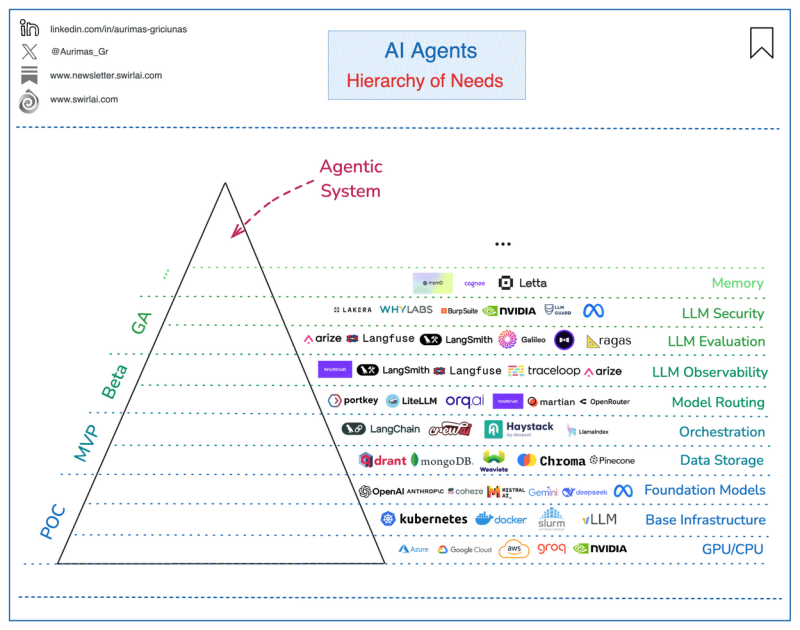
Below is from Aurimas Griciลซnas showing hierarchical layers for AI Agents

Sometimes ๐—”๐—œ ๐—”๐—ด๐—ฒ๐—ป๐˜๐˜€ might seem simple from the outside. They are not ๐Ÿ‘‡

There are many moving pieces that production ready Agentic Systems rely on. 

I like to split the ๐—›๐—ถ๐—ฒ๐—ฟ๐—ฎ๐—ฟ๐—ฐ๐—ต๐˜† ๐—ผ๐—ณ ๐—ก๐—ฒ๐—ฒ๐—ฑ๐˜€ of an AI Agent according to the maturity of the product:

๐™‹๐™Š๐˜พ.

We usually start building and experimenting with Raw Model APIs. These already rely on complex underlying infrastructure.

โžก๏ธ ๐˜Ž๐˜—๐˜œ/๐˜Š๐˜—๐˜œ Resources.
โžก๏ธ ๐˜‰๐˜ข๐˜ด๐˜ฆ ๐˜๐˜ฏ๐˜ง๐˜ณ๐˜ข๐˜ด๐˜ต๐˜ณ๐˜ถ๐˜ค๐˜ต๐˜ถ๐˜ณ๐˜ฆ that orchestrates Model deployment. Think Kubernetes, Slurm, vLLM.
โžก๏ธ ๐˜๐˜ฐ๐˜ถ๐˜ฏ๐˜ฅ๐˜ข๐˜ต๐˜ช๐˜ฐ๐˜ฏ ๐˜”๐˜ฐ๐˜ฅ๐˜ฆ๐˜ญ๐˜ด themselves that required tens of millions of dollars to be trained.

๐™ˆ๐™‘๐™‹.

To produce a reliable MVP you will need some internal data and stability to your system. This will require you to make choices in how you:

โžก๏ธ ๐˜š๐˜ต๐˜ฐ๐˜ณ๐˜ฆ the data: Vector DBs, Graph DBs etc.
โžก๏ธ ๐˜–๐˜ณ๐˜ค๐˜ฉ๐˜ฆ๐˜ด๐˜ต๐˜ณ๐˜ข๐˜ต๐˜ฆ the system: LLM Orchestration frameworks help with solving issues like retries, chaining your prompts, tool calling etc.

๐˜ฝ๐™š๐™ฉ๐™–.

Scaling up for Beta requires more stability and insights into what is happening inside of the system.

โžก๏ธ ๐˜”๐˜ฐ๐˜ฅ๐˜ฆ๐˜ญ ๐˜™๐˜ฐ๐˜ถ๐˜ต๐˜ช๐˜ฏ๐˜จ helps in choosing best LLMs for your prompts, prompt management, fallback mechanisms in case of unresponsive LLM APIs or hitting API limits. Etc.
โžก๏ธ ๐˜“๐˜“๐˜” ๐˜–๐˜ฃ๐˜ด๐˜ฆ๐˜ณ๐˜ท๐˜ข๐˜ฃ๐˜ช๐˜ญ๐˜ช๐˜ต๐˜บ allows you to see into the actions your system is performing. You will need this for debugging and evolving your Agents.

๐™‚๐˜ผ.

To expose your application to the general public you would need additional automations and guardrails to prevent disasters that could shut your business in seconds.

โžก๏ธ ๐˜Œ๐˜ท๐˜ข๐˜ญ๐˜ถ๐˜ข๐˜ต๐˜ช๐˜ฐ๐˜ฏ helps you to go beyond passively observing the system to proactively monitoring it by bringing automation via evaluation rules that are applied against steps performed by your Agents.
โžก๏ธ ๐˜š๐˜ฆ๐˜ค๐˜ถ๐˜ณ๐˜ช๐˜ต๐˜บ is critical to avoid disasters related to data leakage. Think Guardrails, Red Teaming etc.

โ—๏ธAnd these are just basic requirements, there is more ๐Ÿ™‚

Come in the emerging requirements:

โžก๏ธ Memory.
โžก๏ธ Computer Use.
โžก๏ธ Complex integrations. (MCP!)
โžก๏ธ ...
 

Technical Hierarchy of AI Agents

Tags AI Agents Aurimas Griciลซnas Base Infrastructure CPU Foundation Models GPU Graph DB Hierarchy K8S Kubernetes LLM LLM Evaluation LLM Observability LLM Orchestration LLM Security MVP Slurm Vector DB vLLM Facebook X
Comments 0
Similar posts
  1. The Ultimate Data Engineering Roadmap
    1,082
  2. Why Reranking is Crucial for RAG and Agentic AI Systems?
    275
  3. VLM vs. LLM: How Vision-Language Models Are Revolutionizing Real-Time Media Processing
    50
  4. Understanding Amazon Bedrock Agent for AI-based ChatBot
    647
  5. Learn SLM if you have interent in the next after LLM
    4921
  6. Rust-GPU-tools for interacting with various GPU APIs
    756
  7. Difference between CPU and GPU - Why GPU is faster than CPU?
    809
  8. Milvus and LLM Integration - Very Smart Approach!
    304
  9. Integrating VectorDB stored in S3 with Amazon Bedrock
    429
  10. TensorRT for LLMs: Speed, Scale, and Why Startups Choose It Over TensorFlow
    467
  11. Is PyTorch Dead? Deep Learning's Enduring Role Beyond LLMs & Essential Skills
    699
  12. Getting Started with FAISS: A CentOS 7 Installation Guide
    288
  13. Beyond Prompt Engineering: Why Loop Engineering is the Future of Autonomous AI
    310
  14. Is a Used M1 or M2 MacBook Pro a Smart Buy Over M4?
    298
  15. Microsoft AutoGen: Next-Generation Multi-Agent Framework
    318
  16. LLM Application Development with LangGraph: Features and Architectures for Stateful Multi-Actor LLM Applications
    363
  17. Semantic Kernel: Microsoft's GenAI Orchestration SDK
    416
  18. Messaging Platform with Limited TPS based on the vendor
    202
  19. How to Build a Python Chatbot That Writes and Runs Code Using Microsoft AutoGen (With Sample Code)
    244
  20. Conversation Multi-Agent Chatbot with On-the-Fly Code Execition via Microsoft AutoGen
    305
  21. Embeddings on the Lakehouse: What Snowflake and Databricks Actually Do (and Don't)
    303
  22. Building GPU Clusters on GCP, Azure, and AWS: A Practical Guide and Head-to-Head Comparison
    387
  23. Architecting an LLM-Powered Multi-Agent Orchestration System: Design and Requirements
    260
  24. GPU & LLM Cluster Infrastructure & Task Scheduling Architecture
    255
  25. Beyond Static Pipelines: Architecting LLM Multi-Agent Systems for Autonomous Workflow Orchestration
    596
  26. The Concept of Scaffolding in AI Agents
    244
  27. Recommended Vector DB Structure for Amazon Bedrock Integration
    393
  28. NVIDIA CUDA library which can be integrated with C/C++
    377
  29. Why Kubernetes? Core Features and Microservice Orchestration Strategies
    578
  30. Kubernetes, aka K8s, is an open-source container orchestration platform
    542
  1. Why AI-DLC is the New Paradigm for Development?
    343
  2. Autonomous Vehicle Machine Learning (AV ML): An Architectural Review
    421
  3. AI-based workflow innovation - it's not just an optimizing cost/process but also a matter of survival!
    394
  4. Cloud-Based AI Architecture Proposals for US Auto Finance Industry
    584
  5. Netflix's Recommendation System
    429
  6. Coding Revolution with Claude Code & MoAI ADK(Agent Development Kit)
    738
  7. Curiousity if OpenAI Engineers use Cursor.ai
    6761
  8. Building my own ChatGPT based on SageMaker and Milvus that is specialized to Shopping Mall
    281
  9. Your Blueprint for an LLM & Vector DB Insurance Product Q&A
    267
  10. The Core of Vector Databases: Embeddings and LLM Dependency
    267
  11. Original Purpose of Markdown File - why Engineers love it?
    772
  12. Switch to using Claude Sonnet 4 (Claude-4-sonnet) in the Amazon Q Developer CLI
    646
  13. Amazon Q CLI for Debugging - What You Can Do
    450
  14. Vibe coding with Amazon Q in CLI combined with Claud AI Sonet 4
    474
  15. How do you create AI-based commit message with scope and action in Cursor AI?
    813
  16. MCP vs A2A
    606
  17. Vulnerabilities of MCP
    594
  18. The Revenge of the Junior Developer
    2,311
  19. A Complete Guide to LLM Dataset Formats: From Pre-Training to DPO in JSONL
    223
  20. Comparison of ChatGPT, Gemini, and Grok
    565
  21. MLOps Explained: Spark, Flink, and Reference Architecture Deep Dive
    247
  22. AI-based Image Creation based on Bing Image Creator
    991
  23. ChatGPT App (flowGPT) to create images with text
    1,042
  24. TikTok's Recommendation System - Monolith
    300
  25. Things to Know for AI-driven, Multimodal Content Personalization.
    206
  26. Deep Dive into Vector Databases: Understanding Collections (Not Tables) and Embeddings
    240
  27. Image Embeddings for Vector Databases
    254
  28. Vector Databases: From Embeddings to Application
    322
  29. Scaling Vector Search: How to Architect FAISS on AWS EKS and ECS
    196
  30. Reinforcement Learningโ€“Based Methods for CTR Improvement based on Recommendation System
    273
Recently updated
  1. Google OAuth Token Expiration: Causes and Solutions
    29
  2. Why 100% SEO Guarantees Better User Engagement and How to Achieve It in Your Service
    55
  3. Why SPF and DKIM Are Essential for Linux Email Servers?
    49
  4. How do I create animated background for Google Meet?
    22,918
  5. MaxMind GeoLite2 vs. DB-IP Lite vs. ip-api.com: Choosing the Right Free IP Geolocation Solution
    271
  6. Meet Valkey: Why Redis Changed Its License, Why Valkey is Better, and How to Use It as a Drop-in Replacement
    103
  7. How Rogue Web Scrapers Are Stealing My Content and Destroying My Server
    168
  8. Array of arguments passed to script in PHP
    97
  9. Invalid Auction Storms in Ad Tech
    106
  10. Building MRC-Compliant Instrumentation in Ad Tech: Implementation Steps and Key Challenges
    207
  11. The Two Clocks of Ad Server Architecture
    77
  12. Frequency Cap Architecture Overview
    526
  13. Collecting Proof-of-Play from 100,000 Screens
    152
  14. Vector Search in Relational Databases (RDBs): Trends & Usage Environments
    302
  15. What is RedisVL?
    114
  16. Designing a Skill Registry Architecture: Minimize Token Usage and Maximize AI Performance
    246
  17. TPU & GPU Cluster Management Tools
    257
  18. AI-DLC vs. AI-SDLC: Model-Centric vs. System-Centric AI Development
    267
  19. Fine-Tuning Open-Weight LLMs: Training, Licensing, and Deploying Custom Models with Ollama
    353
  20. Inside the Next-Generation Streaming Architecture: Ultra-Low Latency, SGAI, and AI Codecs
    206
  21. Machine Learning: Training vs. Ranking
    229
  22. The Continuous Learning Machine: Designing a Loop That Actually Turns
    228
  23. The Next-Gen Low-Latency Standards: LL-HLS & MoQ
    202
  24. Designing a Data Curation System Around a Vector Database
    230
  25. Extracting Context from Live Video: The Architecture Got Simpler When We Stopped Building Features
    263
  26. The New Ad Stack Behind Live Sports Streaming: Inside SGAI, EABN, and the Standards Race to Fix Live Monetization
    672
  27. Designing MLOps Architectures to Handle Seasonal Data Drift in EV Fleet Models
    201
  28. From 15 to 40+ FPS: Accelerating PyTorch Object Detection on Automotive ECUs
    232
  29. Understanding Data Lineage
    272
  30. System Requirements and Architecture: Intelligent Priority-Based Scheduler
    175