Learn SLM if you have interent in the next after LLM

CK CK 3788 
Created at
Updated at  
493 1 0

Both SLMs (Small Language Models) and LLMs (Large Language Models) are types of language models, but they differ primarily in size (number of parameters) and consequently, in their capabilities and scope. LLMs, with their massive parameter counts, possess a wider range of knowledge and can handle more complex tasks like intricate reasoning, nuanced understanding, and generation of diverse content. SLMs, being smaller, often focus on specific tasks or domains, offering advantages in efficiency, speed, and lower resource requirements, but with a narrower coverage and potentially less sophisticated understanding compared to LLMs.
 

Below is from Manthan Patel that shows some insight:

LLMs are overkill for 80% of business tasks. Enter SLMs:

Most companies are burning cash on GPT-4 when a specialized Small Language Model would do the job better, faster, and cheaper.

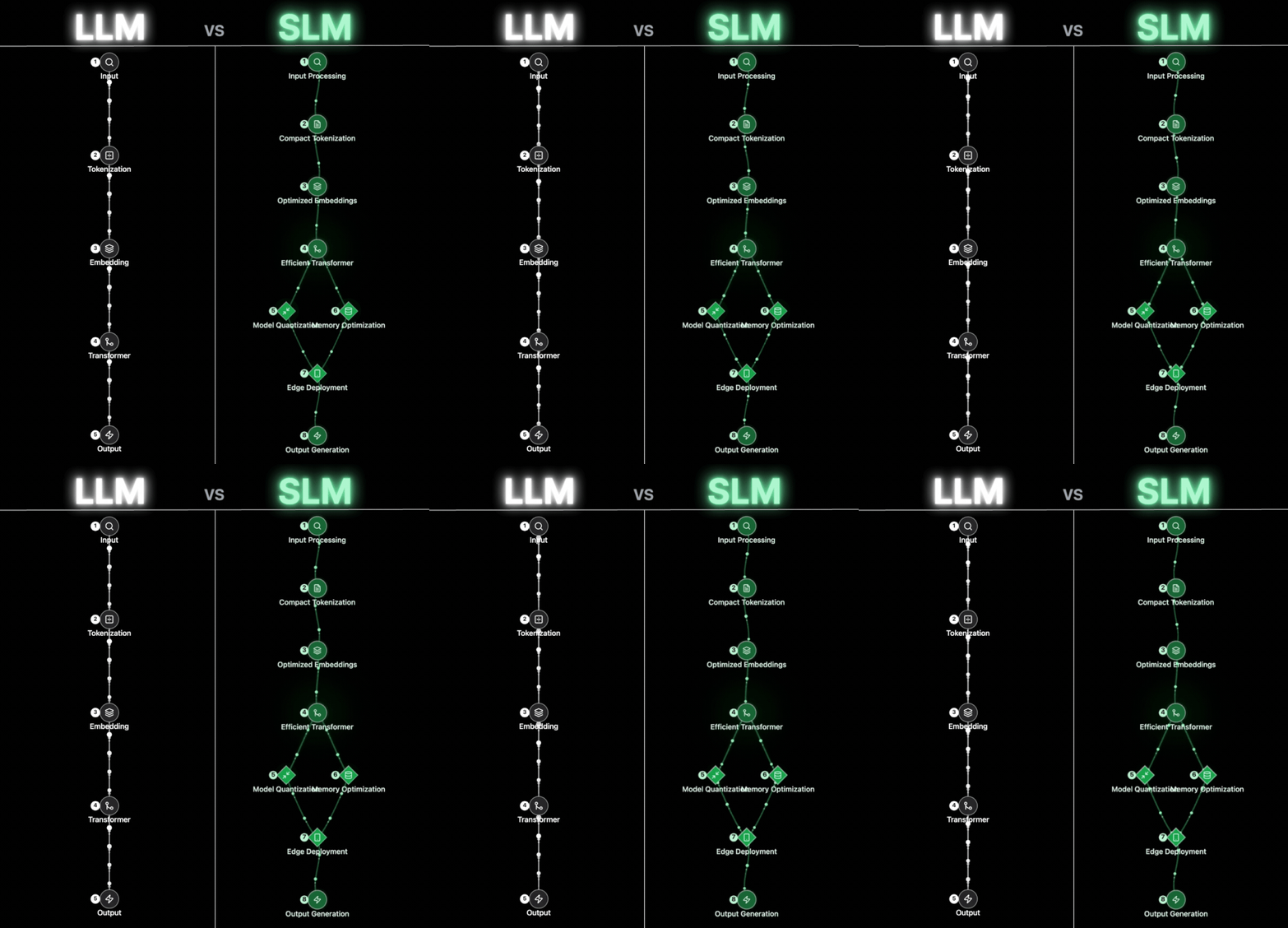
Here's the architecture difference:

Traditional LLMs: Simple linear pipeline that processes everything with maximum resources. Like using a Ferrari for grocery runs.

Smart SLMs: Optimized parallel processing with compact tokenization, task-specific embeddings, and model quantization. Built for edge deployment and real-world efficiency.

Real Cost Comparison:
- GPT-4: $30/million input tokens, $60/million output tokens
- GPT-4.1-nano: $0.10/million input, $0.40/million output (OpenAI's cheapest)
- Llama 3.2 (1B): $0.03-0.05/million tokens
- Custom fine-tuned SLMs can cost even less

Where SLMs Win:
SLMs excel at customer service handling 90% of repetitive queries, document classification, sentiment analysis, code completion for specific languages, and IoT/edge device applications.

Where LLMs Still Rule:
LLMs remain superior for creative writing, complex reasoning tasks, multi-domain applications, and research assistance.

Real Business Case:
Switching from GPT-4 to a specialized SLM for invoice processing:
- Latency: 2s → 0.3s
- Cost: Over 90% reduction
- Accuracy: Improved with domain-specific training

Quick Start Guide:
1. Identify repetitive tasks in your workflow
2. Calculate current LLM costs
3. Test open-source SLMs (Phi-3, TinyLlama, Llama 3.2)
4. Fine-tune on your specific data
5. Deploy locally or on edge

The future isn't about bigger models. It's about smarter, specialized ones that run anywhere.

Over to you: What task are you overpaying LLMs to handle?
Learn SLM if you have interent in the next after LLM

Tags AI LLM SLM Smart SLM Facebook X
Comments 1
CK CK 45.**.173.227
Microsoft Phi-3.5 is a representative SLM (Small Language Model).
Similar posts
  1. VLM vs. LLM: How Vision-Language Models Are Revolutionizing Real-Time Media Processing
    50
  2. Milvus and LLM Integration - Very Smart Approach!
    304
  3. Technical Hierarchy of AI Agents
    826
  4. TensorRT for LLMs: Speed, Scale, and Why Startups Choose It Over TensorFlow
    467
  5. Is PyTorch Dead? Deep Learning's Enduring Role Beyond LLMs & Essential Skills
    699
  6. Beyond Prompt Engineering: Why Loop Engineering is the Future of Autonomous AI
    310
  7. Is a Used M1 or M2 MacBook Pro a Smart Buy Over M4?
    298
  8. Microsoft AutoGen: Next-Generation Multi-Agent Framework
    318
  9. LLM Application Development with LangGraph: Features and Architectures for Stateful Multi-Actor LLM Applications
    364
  10. How to Build a Python Chatbot That Writes and Runs Code Using Microsoft AutoGen (With Sample Code)
    244
  11. GPU & LLM Cluster Infrastructure & Task Scheduling Architecture
    255
  12. Vector Databases: From Embeddings to Application
    323
  13. Mastering Supervised Machine Learning with Python: A Comprehensive Guide
    1,060
  14. Mastering AI: A Beginner's Guide to Python Programming and Beyond
    1,041
  1. Why AI-DLC is the New Paradigm for Development?
    343
  2. Autonomous Vehicle Machine Learning (AV ML): An Architectural Review
    422
  3. AI-based workflow innovation - it's not just an optimizing cost/process but also a matter of survival!
    394
  4. Cloud-Based AI Architecture Proposals for US Auto Finance Industry
    586
  5. Netflix's Recommendation System
    429
  6. Coding Revolution with Claude Code & MoAI ADK(Agent Development Kit)
    747
  7. Curiousity if OpenAI Engineers use Cursor.ai
    6761
  8. Building my own ChatGPT based on SageMaker and Milvus that is specialized to Shopping Mall
    281
  9. Your Blueprint for an LLM & Vector DB Insurance Product Q&A
    267
  10. The Core of Vector Databases: Embeddings and LLM Dependency
    267
  11. Original Purpose of Markdown File - why Engineers love it?
    773
  12. Switch to using Claude Sonnet 4 (Claude-4-sonnet) in the Amazon Q Developer CLI
    648
  13. Amazon Q CLI for Debugging - What You Can Do
    450
  14. Vibe coding with Amazon Q in CLI combined with Claud AI Sonet 4
    474
  15. How do you create AI-based commit message with scope and action in Cursor AI?
    813
  16. Why Reranking is Crucial for RAG and Agentic AI Systems?
    276
  17. MCP vs A2A
    606
  18. Vulnerabilities of MCP
    594
  19. The Revenge of the Junior Developer
    2,313
  20. A Complete Guide to LLM Dataset Formats: From Pre-Training to DPO in JSONL
    226
  21. Comparison of ChatGPT, Gemini, and Grok
    565
  22. MLOps Explained: Spark, Flink, and Reference Architecture Deep Dive
    247
  23. AI-based Image Creation based on Bing Image Creator
    991
  24. ChatGPT App (flowGPT) to create images with text
    1,042
  25. TikTok's Recommendation System - Monolith
    302
  26. Things to Know for AI-driven, Multimodal Content Personalization.
    206
  27. Deep Dive into Vector Databases: Understanding Collections (Not Tables) and Embeddings
    240
  28. Image Embeddings for Vector Databases
    257
  29. Scaling Vector Search: How to Architect FAISS on AWS EKS and ECS
    196
  30. Reinforcement Learning–Based Methods for CTR Improvement based on Recommendation System
    273
Recently updated
  1. Google OAuth Token Expiration: Causes and Solutions
    31
  2. Why 100% SEO Guarantees Better User Engagement and How to Achieve It in Your Service
    57
  3. Why SPF and DKIM Are Essential for Linux Email Servers?
    51
  4. How do I create animated background for Google Meet?
    23,211
  5. MaxMind GeoLite2 vs. DB-IP Lite vs. ip-api.com: Choosing the Right Free IP Geolocation Solution
    273
  6. Meet Valkey: Why Redis Changed Its License, Why Valkey is Better, and How to Use It as a Drop-in Replacement
    104
  7. How Rogue Web Scrapers Are Stealing My Content and Destroying My Server
    170
  8. Array of arguments passed to script in PHP
    99
  9. Invalid Auction Storms in Ad Tech
    107
  10. Building MRC-Compliant Instrumentation in Ad Tech: Implementation Steps and Key Challenges
    208
  11. The Two Clocks of Ad Server Architecture
    78
  12. Frequency Cap Architecture Overview
    527
  13. Collecting Proof-of-Play from 100,000 Screens
    153
  14. Vector Search in Relational Databases (RDBs): Trends & Usage Environments
    303
  15. What is RedisVL?
    116
  16. Designing a Skill Registry Architecture: Minimize Token Usage and Maximize AI Performance
    247
  17. TPU & GPU Cluster Management Tools
    258
  18. The Concept of Scaffolding in AI Agents
    245
  19. Beyond Static Pipelines: Architecting LLM Multi-Agent Systems for Autonomous Workflow Orchestration
    598
  20. AI-DLC vs. AI-SDLC: Model-Centric vs. System-Centric AI Development
    268
  21. Fine-Tuning Open-Weight LLMs: Training, Licensing, and Deploying Custom Models with Ollama
    354
  22. Inside the Next-Generation Streaming Architecture: Ultra-Low Latency, SGAI, and AI Codecs
    207
  23. Machine Learning: Training vs. Ranking
    229
  24. The Continuous Learning Machine: Designing a Loop That Actually Turns
    228
  25. The Next-Gen Low-Latency Standards: LL-HLS & MoQ
    203
  26. Designing a Data Curation System Around a Vector Database
    230
  27. Extracting Context from Live Video: The Architecture Got Simpler When We Stopped Building Features
    263
  28. The New Ad Stack Behind Live Sports Streaming: Inside SGAI, EABN, and the Standards Race to Fix Live Monetization
    674
  29. Designing MLOps Architectures to Handle Seasonal Data Drift in EV Fleet Models
    201
  30. From 15 to 40+ FPS: Accelerating PyTorch Object Detection on Automotive ECUs
    233