Curiousity if OpenAI Engineers use Cursor.ai

CK CK 3788 
Created at  
677 1 0

What is Cursor.ai?

Cursor.ai is an AI-powered code editor designed to deeply integrate large language models (LLMs) into the development workflow. It functions as an evolution of traditional code editors, aiming to enhance developer productivity by providing AI assistance directly within the coding environment.


Research if OpenAI engineers use Cursor.ai

There is no public "official" confirmation that Cursor is the standard mandated editor for all OpenAI employees, but there are strong indicators that it is widely used and supported there.

Curiousity if OpenAI Engineers use Cursor.ai

Here is the breakdown of the relationship between OpenAI and Cursor:

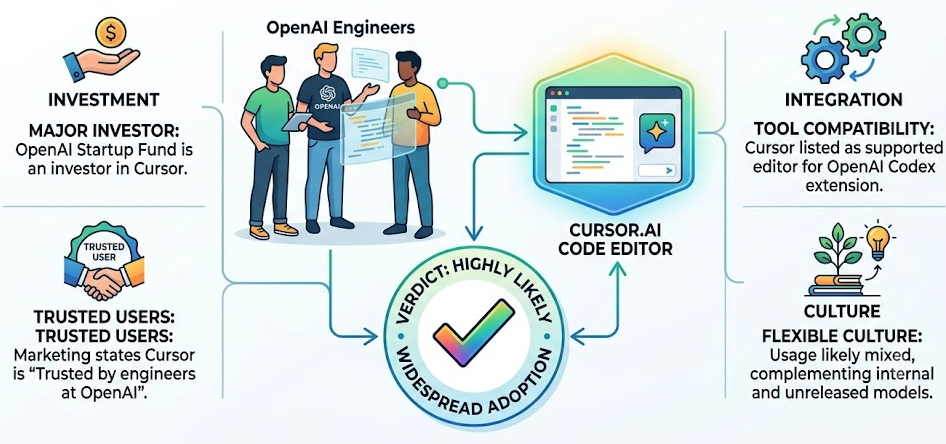
  • They are a major investor: OpenAI is an investor in Cursor (through the OpenAI Startup Fund). The companies have a close partnership, which often leads to internal adoption.
  • They are "Trusted Users": Cursor’s own marketing materials and third-party reports explicitly state that Cursor is "Trusted by engineers at OpenAI".
  • Integration with OpenAI's new tools: OpenAI recently launched its own coding agent product called Codex (distinct from the model name). Interestingly, the official documentation for the Codex IDE extension explicitly lists Cursor as a supported editor alongside VS Code. This suggests that even if they use their own AI agents, they likely support using them inside Cursor.
  • Internal Culture: Like many tech companies, engineers often have the flexibility to choose their own IDEs (VS Code, Cursor, Vim, etc.), so usage is likely mixed rather than 100% standardized.

The Verdict: It is highly likely that many OpenAI engineers use Cursor, especially given the investment and the fact that their own internal tools are built to be compatible with it. However, they likely combine it with their own internal, unreleased models and agents.


Research on NVIDIA Engineers and Cursor.ai

Research indicates that there is no publicly available, confirmed information or official statement from either NVIDIA or Cursor.ai indicating that NVIDIA engineers widely or officially use Cursor.ai.

  • Public Awareness: Cursor.ai is a newer AI-powered code editor that has gained some traction among individual developers and small teams due to its integration of large language models for code generation, editing, and explanation.
  • Enterprise Adoption: For large corporations like NVIDIA, the adoption of new, third-party development tools often involves significant internal evaluation, security assessments, and integration processes. Such adoptions are typically announced internally or occasionally through developer blogs if the tool becomes a standard.
  • Confidentiality: Even if individual NVIDIA engineers were experimenting with or using Cursor.ai on their personal projects or for certain internal tasks, this information would likely not be public due to company policies regarding tool usage and competitive intelligence.
  • Focus on Internal Tools & Ecosystem: Large tech companies often have a suite of internal tools or preferred commercial tools with extensive internal support and customizations. NVIDIA's deep involvement in AI development also means they might leverage their own AI technologies or highly customized solutions in their engineering workflows.


Cursor AI Engineer Usage Statistics (2025)

MetricValueSource/Notes
Total Users1+ millionWithin 16 months of launch, it amassed 1 million users TapTwice Digital
Paying Customers360,000+Over 360,000 paying customers TapTwice Digital
Enterprise Teams50,000+Serving over 50,000 teams globally Business Wire
Fortune 500 Adoption50-60%Over 50% of the Fortune 500 now use Cursor Digital Applied
Annual Recurring Revenue$1B+Cursor crossed $1 billion in annual recurring revenue with millions of developers using the platform Digital Applied

Tags Cursor.ai NVIDIA OpenAI Facebook X
Comments 1
CK CK 98.**.204.45
As of today, I have a doubt that OpenAI developers may not use Cursor.AI because they already have their own development environment.
Similar posts
  1. TensorRT for LLMs: Speed, Scale, and Why Startups Choose It Over TensorFlow
    467
  2. CUDA versus OpenCL
    584
  3. Comparison of ChatGPT, Gemini, and Grok
    565
  4. xAI aims its goal to achieve AGI - Artificial General Intelligence


    795
  5. Machine Learning Models for Ad Detection from a Video Stream
    195
  6. Deep Dive into Vector Databases: Understanding Collections (Not Tables) and Embeddings
    240
  7. NVIDIA CUDA library which can be integrated with C/C++
    377
  1. Building GPU Clusters on GCP, Azure, and AWS: A Practical Guide and Head-to-Head Comparison
    390
  2. Embeddings on the Lakehouse: What Snowflake and Databricks Actually Do (and Don't)
    303
  3. Vector Database Integration on Fully Managed Multi-Agent Environment
    319
  4. AWS Multi-Agent Collaboration Approach: Fully Managed vs. Code-based Implementation
    292
  5. Semantic Kernel: Microsoft's GenAI Orchestration SDK
    416
  6. LLM Application Development with LangGraph: Features and Architectures for Stateful Multi-Actor LLM Applications
    365
  7. Microsoft AutoGen: Next-Generation Multi-Agent Framework
    318
  8. Beyond SDLC: Why the Entertainment Sector Needs an AI Development Life Cycle Now
    299
  9. Why AI-DLC is the New Paradigm for Development?
    343
  10. Autonomous Vehicle Machine Learning (AV ML): An Architectural Review
    422
  11. AI-based workflow innovation - it's not just an optimizing cost/process but also a matter of survival!
    394
  12. Cloud-Based AI Architecture Proposals for US Auto Finance Industry
    586
  13. Netflix's Recommendation System
    429
  14. Is PyTorch Dead? Deep Learning's Enduring Role Beyond LLMs & Essential Skills
    699
  15. Coding Revolution with Claude Code & MoAI ADK(Agent Development Kit)
    747
  16. Building my own ChatGPT based on SageMaker and Milvus that is specialized to Shopping Mall
    281
  17. Your Blueprint for an LLM & Vector DB Insurance Product Q&A
    267
  18. The Core of Vector Databases: Embeddings and LLM Dependency
    267
  19. Original Purpose of Markdown File - why Engineers love it?
    773
  20. Switch to using Claude Sonnet 4 (Claude-4-sonnet) in the Amazon Q Developer CLI
    648
  21. Amazon Q CLI for Debugging - What You Can Do
    450
  22. Vibe coding with Amazon Q in CLI combined with Claud AI Sonet 4
    474
  23. How do you create AI-based commit message with scope and action in Cursor AI?
    813
  24. Learn SLM if you have interent in the next after LLM
    4931
  25. VLM vs. LLM: How Vision-Language Models Are Revolutionizing Real-Time Media Processing
    50
  26. Why Reranking is Crucial for RAG and Agentic AI Systems?
    276
  27. Technical Hierarchy of AI Agents
    826
  28. MCP vs A2A
    606
  29. Vulnerabilities of MCP
    594
  30. The Revenge of the Junior Developer
    2,313
Recently updated
  1. Google OAuth Token Expiration: Causes and Solutions
    31
  2. Why 100% SEO Guarantees Better User Engagement and How to Achieve It in Your Service
    57
  3. Why SPF and DKIM Are Essential for Linux Email Servers?
    51
  4. How do I create animated background for Google Meet?
    23,255
  5. MaxMind GeoLite2 vs. DB-IP Lite vs. ip-api.com: Choosing the Right Free IP Geolocation Solution
    273
  6. Meet Valkey: Why Redis Changed Its License, Why Valkey is Better, and How to Use It as a Drop-in Replacement
    104
  7. How Rogue Web Scrapers Are Stealing My Content and Destroying My Server
    170
  8. Array of arguments passed to script in PHP
    99
  9. Invalid Auction Storms in Ad Tech
    108
  10. Building MRC-Compliant Instrumentation in Ad Tech: Implementation Steps and Key Challenges
    209
  11. The Two Clocks of Ad Server Architecture
    78
  12. Frequency Cap Architecture Overview
    527
  13. Collecting Proof-of-Play from 100,000 Screens
    153
  14. Vector Search in Relational Databases (RDBs): Trends & Usage Environments
    303
  15. What is RedisVL?
    117
  16. Designing a Skill Registry Architecture: Minimize Token Usage and Maximize AI Performance
    247
  17. TPU & GPU Cluster Management Tools
    258
  18. The Concept of Scaffolding in AI Agents
    245
  19. Beyond Static Pipelines: Architecting LLM Multi-Agent Systems for Autonomous Workflow Orchestration
    598
  20. AI-DLC vs. AI-SDLC: Model-Centric vs. System-Centric AI Development
    269
  21. Fine-Tuning Open-Weight LLMs: Training, Licensing, and Deploying Custom Models with Ollama
    355
  22. Inside the Next-Generation Streaming Architecture: Ultra-Low Latency, SGAI, and AI Codecs
    207
  23. Machine Learning: Training vs. Ranking
    230
  24. The Continuous Learning Machine: Designing a Loop That Actually Turns
    229
  25. The Next-Gen Low-Latency Standards: LL-HLS & MoQ
    204
  26. Designing a Data Curation System Around a Vector Database
    230
  27. Extracting Context from Live Video: The Architecture Got Simpler When We Stopped Building Features
    263
  28. The New Ad Stack Behind Live Sports Streaming: Inside SGAI, EABN, and the Standards Race to Fix Live Monetization
    674
  29. Designing MLOps Architectures to Handle Seasonal Data Drift in EV Fleet Models
    201
  30. From 15 to 40+ FPS: Accelerating PyTorch Object Detection on Automotive ECUs
    233