| The realm of software development is undergoing an unprecedented transformation, largely driven by the advent of artificial intelligence. AI-powered coding assistants like Claude Code, when integrated with innovative architectural patterns such as Moai, are empowering developers with sophisticated tools to significantly accelerate workflows, elevate code quality, and unlock novel creative avenues. This synergy marks a pivotal shift in how software is conceptualized, designed, and brought to life. Claude Code: The AI Coding AssistantClaude Code represents a paradigm shift in development assistance, leveraging cutting-edge language models to act as an intelligent co-pilot for developers. It translates natural language intentions into functional code, providing a dynamic and responsive environment for crafting software. Core Capabilities- Intelligent Code Generation from Natural Language: Developers can articulate their desired functionality in plain English, and Claude Code interprets these descriptions to generate robust, well-structured code snippets or entire functions. This capability abstracts away the need for precise syntax recall, allowing a focus on logic and intent.
- Multi-Language Support: With broad compatibility across popular programming languages including Python, JavaScript, C++, Java, Go, Ruby, and more, Claude Code offers versatility, enabling teams to maintain consistency across diverse technology stacks.
- Smart Debugging and Error Analysis: Beyond merely identifying syntax errors, Claude Code offers insightful debugging assistance. It can analyze runtime issues, suggest potential root causes for complex bugs, and provide recommendations for remediation, streamlining the troubleshooting process.
- Code Optimization and Refactoring Recommendations: The assistant can critically evaluate existing code for potential improvements. This includes identifying inefficient algorithms, suggesting cleaner code structures, applying design patterns, and recommending refactoring strategies to enhance performance, readability, and maintainability.
- Context-Aware Suggestions: Integrating deeply with the developer's integrated development environment (IDE) and understanding the surrounding project structure, Claude Code provides highly relevant and context-sensitive suggestions. It learns from the project's existing codebase, libraries, and architectural choices to offer tailored guidance.
Where can I download Moai-ADK?https://github.com/modu-ai/moai-adk 
Moai: The Architectural FrameworkMoai is more than just a framework; it's an innovative architectural philosophy designed to complement and enhance AI-driven development. It champions principles that promote scalable, maintainable, and easily integrated software systems. Foundational Principles- Modularity: Moai emphasizes breaking down complex systems into smaller, independent, and self-contained modules. Each module has a clear responsibility, fostering better organization, easier development, and isolated testing.
- Maintainability: By promoting clear separation of concerns and structured component design, Moai inherently improves the long-term maintainability of software. It reduces technical debt and makes it simpler for new team members to understand and contribute.
- Seamless Integration: The framework is designed for harmonious interaction with modern development tools and practices, including continuous integration/continuous deployment (CI/CD) pipelines, containerization technologies (like Docker and Kubernetes), and cloud-native environments.
- Stateless, Composable Components: A cornerstone of Moai is the emphasis on creating components that do not retain state between interactions. These stateless components are highly flexible and can be easily composed together to build complex functionalities, leading to greater scalability and easier reasoning about system behavior.
- Architectural Consistency: Moai provides a guiding structure, ensuring that components, regardless of their origin, adhere to a unified architectural vision, which is crucial for large-scale projects and team collaboration.
The Synergy: Claude Code Meets MoaiThe combined power of Claude Code and Moai creates a formidable synergy, addressing some of the most pressing challenges in modern software development and unlocking new levels of productivity and innovation. - 1. Rapid Prototyping: Claude Code's ability to quickly generate code from natural language dramatically accelerates the initial development of features or modules. Moai, in turn, ensures that these prototypes are not just throwaway code but are built upon a clean, scalable, and evolution-friendly architecture, allowing for smoother transitions from proof-of-concept to production.
- 2. Consistent Code Quality: Moai's structured patterns and best practices serve as a powerful set of guardrails for AI-generated code. This guarantees that code produced by Claude Code adheres to the project's architectural principles, style guides, and quality metrics, minimizing the need for extensive manual review and refactoring, thereby increasing overall code quality and consistency across the project.
- 3. Reduced Cognitive Load: By entrusting Claude Code with routine, repetitive, or boilerplate coding tasks, developers are liberated from the minutiae of syntax and standard implementations. This allows them to allocate their mental resources to higher-level challenges, such as intricate business logic, complex architectural decisions, system design, and fostering innovative solutions, with Moai providing the foundational scaffolding.
- 4. Scalability: Moai's inherently modular and stateless design provides an excellent foundation for building scalable applications. When combined with Claude Code's efficiency in generating new modules or extending existing ones within this structured framework, development efforts can scale rapidly. This facilitates efficient team expansion and the ability to handle increased project complexity without compromising speed or quality.
What happens if I run moai init on the source root?moai init
Running moai init starts an interactive 10-step setup wizard that configures MoAI-ADK for your project. Here's what happens: The 10-Step Interactive Setup Wizard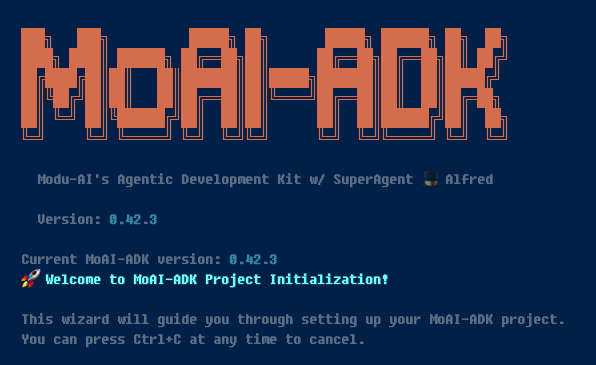
Step 1: Language Selection - You choose your conversation language (Korean, English, Japanese, or Chinese). All subsequent instructions will be displayed in your selected language. Step 2: Name Input - You enter your user name so the AI can provide personalized responses. Step 3: GLM API Key Input - You optionally enter your GLM (z.ai GLM 4.7) API key for cost-efficient AI development, or you can skip this to use Claude only. Step 4: Project Setup - You enter your project name, which becomes the root for your MoAI project structure. Step 5: Git Setup - You select your Git mode: manual (local only), personal (GitHub personal account), or team (GitHub team/organization). Step 6: GitHub Username - If you selected personal or team mode, you enter your GitHub username. Step 7: Commit Message Language - You select the language for Git commit messages (English, Korean, Japanese, or Chinese). Step 8: Code Comment Language - You choose the language for code comments in your implementation. Step 9: Documentation Language - You select the language for generated documentation. Step 10: TAG System Activation - You enable the TAG system (recommended for TDD) and choose validation mode: "warn" (default), "enforce" (blocks commits on missing TAGs), or "off" (no validation). Real-World ApplicationsModern development teams are increasingly leveraging this powerful combination to streamline operations and enhance project outcomes across various domains: - Building Microservices Architectures: Accelerating the creation of independent service components. Claude Code generates the initial service logic, while Moai ensures each microservice maintains a consistent, modular pattern, simplifying deployment and management in distributed systems.
- Automating Boilerplate Code Generation: Efficiently generating repetitive code for common patterns like API endpoints, data models, or CRUD operations. Claude Code handles the heavy lifting, with Moai guaranteeing that the generated code integrates seamlessly and adheres to the overall system design.
- Accelerating Full-Stack Development: Streamlining the development process for both frontend and backend components. AI assists in generating code for user interfaces, data access layers, and API logic, while Moai harmonizes communication patterns and architectural principles across the entire application stack.
- Enhancing Legacy System Modernization: Aiding in the analysis of existing legacy code, suggesting refactoring strategies, or generating new, modern replacement modules. Moai provides a clear target architecture for the modernized components, making the transition smoother and more structured.
- Rapid Development of Internal Tools and Utilities: Quickly spinning up custom tools, scripts, and utilities that adhere to internal standards, reducing the time and effort traditionally required.
Challenges and ConsiderationsWhile the integration of AI coding assistants and architectural frameworks offers tremendous potential, developers must remain mindful of certain challenges and considerations to ensure responsible and effective adoption. - Over-reliance on AI-Generated Code Without Proper Review: Blindly accepting AI output can inadvertently introduce subtle bugs, inefficiencies, or security vulnerabilities. Developers must act as the final arbiters, critically reviewing and validating all generated code to ensure it meets project requirements and quality standards.
- Ensuring Generated Code Aligns with Security and Performance Standards: AI models, trained on vast datasets, may not always produce code optimized for specific security policies or stringent performance benchmarks. It is crucial to implement robust code reviews, integrate security scanning tools (SAST/DAST), and conduct performance profiling to audit AI-generated code against organizational standards.
- Maintaining Team Knowledge and Skills Despite Automation: Excessive automation could potentially diminish developers' fundamental understanding of underlying programming languages, frameworks, and architectural principles over time. Fostering a culture of continuous learning and encouraging developers to understand why AI generates certain code is vital to retaining core competencies.
- Understanding the Limitations and Potential Biases in AI Suggestions: AI assistants, while powerful, lack true understanding, creativity, or contextual nuance. Their suggestions can sometimes be plausible but incorrect, reflect biases present in their training data, or fail to provide the most idiomatic or innovative solutions for complex, domain-specific problems. Developers must apply critical thinking, domain expertise, and human judgment.
The Future of Software DevelopmentThe convergence of AI assistants like Claude Code with robust architectural frameworks like Moai is undeniably shaping the future trajectory of software development. We are entering an era where the developer's role is evolving, shifting focus from mere syntax manipulation to higher-order cognitive tasks. Developers will increasingly concentrate on innovation, strategic problem-solving, architectural design, user experience, and managing the overall project vision. The drudgery of boilerplate code and repetitive tasks will be largely handled by AI, freeing human creativity to tackle complex business challenges and push the boundaries of what's possible. This evolution promises to accelerate the pace of innovation across industries, democratize access to sophisticated development tools, and fundamentally redefine human-computer collaboration in the creation of software. ConclusionThe coding revolution is not a distant prospect but a present reality, with tools like Claude Code and Moai at its vanguard. By skillfully combining the intelligence of AI-powered code generation with the solidity of sound architectural principles, development teams are empowered to achieve unprecedented levels of productivity, dramatically enhance code quality, and channel their energies towards truly innovative endeavors. The future belongs to those who can effectively harness these powerful tools, maintaining professional excellence, critical oversight, and adherence to best practices, thereby sculpting the next generation of software solutions. |