| While Large Language Models (LLMs) have undeniably transformed AI capabilities across numerous tasks, they do not diminish the critical need for direct deep learning implementation using frameworks such as PyTorch, TensorFlow, or JAX. LLMs are powerful generalists, but their scope doesn't negate the demand for specialized, custom, and highly optimized deep learning solutions. 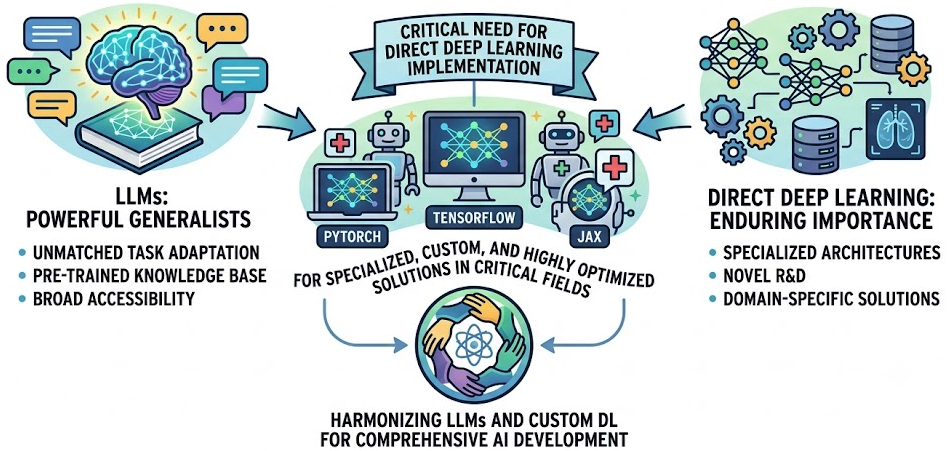
Why Direct Deep Learning Implementation Remains EssentialThe necessity for direct deep learning implementation stems from several key limitations and requirements that LLMs cannot adequately address: 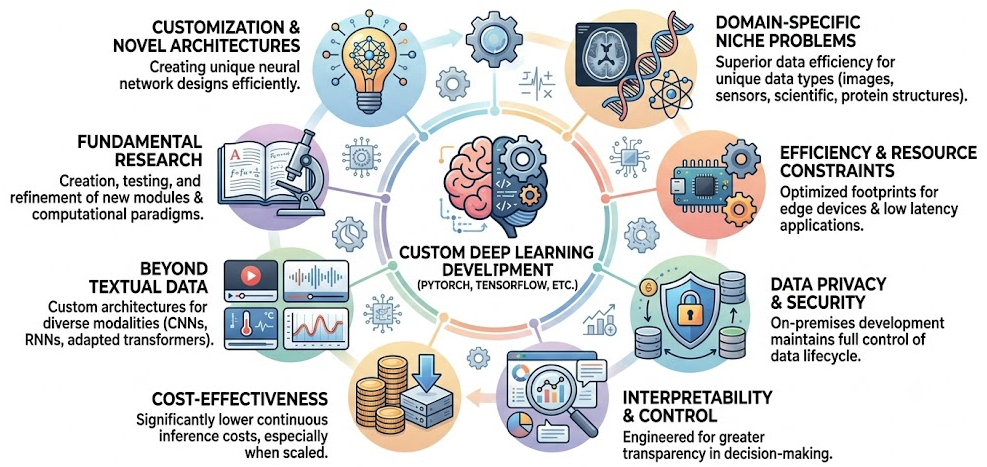
implementing deep learning modules in these specialized areas typically need - Customization and Novel Architectures: Many advanced problems demand the creation of entirely new neural network architectures or significant, specialized modifications to existing ones. These innovative designs are often challenging or inefficient to achieve within the confines of pre-trained LLMs, making direct deep learning frameworks indispensable for cutting-edge research and development.
- Domain-Specific Niche Problems: For highly specialized fields involving unique data types (e.g., medical images, complex sensor readings, scientific simulations, intricate protein structures), adapting a massive LLM is often less effective and less data-efficient. Training a custom model from scratch or fine-tuning a smaller, purpose-built model specifically for the domain's unique characteristics proves far superior.
- Efficiency and Resource Constraints: LLMs are computationally intensive, demanding substantial processing power and memory. For applications targeting edge devices, embedded systems, or those with stringent latency requirements, smaller, custom-trained deep learning models are frequently the only viable solution due to their optimized resource footprint.
- Data Privacy and Security: The deployment or fine-tuning of LLMs often involves reliance on cloud providers or external APIs, potentially necessitating the transmission of sensitive data. For highly confidential information, developing and training models on-premises, maintaining full control over the data lifecycle, becomes paramount, thereby requiring custom deep learning development.
- Interpretability and Control: In high-stakes applications like healthcare or finance, understanding the rationale behind a model's decision is crucial. Custom deep learning models can be specifically engineered with interpretability in mind, offering greater transparency and control compared to the often "black-box" nature of large-scale LLMs.
- Cost-Effectiveness: For specific tasks, the operational and maintenance costs of a custom, smaller deep learning model can be significantly lower than incurring continuous inference costs associated with large commercial LLMs, especially when scaled.
- Beyond Textual Data: LLMs are predominantly designed for textual data. A vast spectrum of deep learning applications involves other modalities such as images, audio, video, sensor readings, or time series data. These diverse data types necessitate custom convolutional neural networks (CNNs), recurrent neural networks (RNNs), transformers adapted for non-text data, or other specialized architectures.
- Fundamental Research: The advancement of AI, including the development of next-generation LLMs and other sophisticated systems, is deeply rooted in fundamental deep learning research. This research inherently involves the creation, testing, and refinement of new modules, algorithms, and computational paradigms, all built within frameworks like PyTorch.
Areas Where Direct Deep Learning Implementation is NecessaryDirect deep learning implementation using frameworks such as PyTorch is not merely beneficial but often critical across a diverse array of fields: 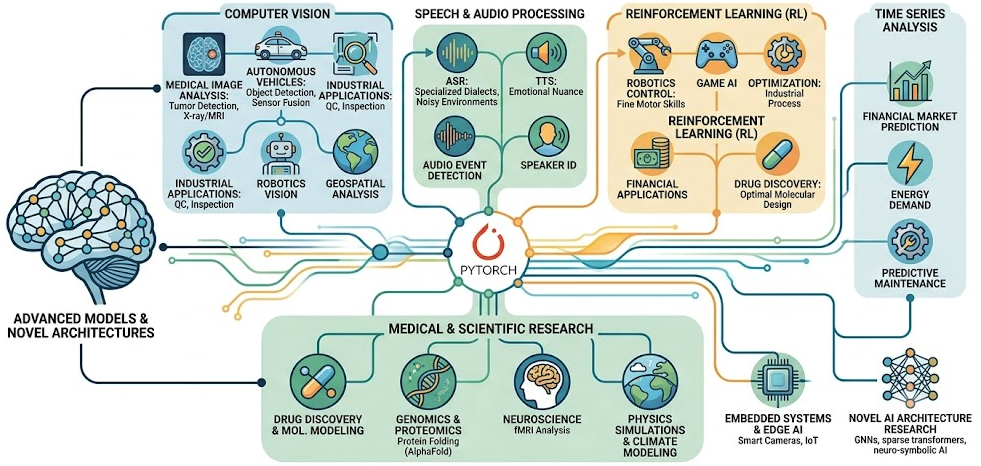
- Computer Vision:
- Medical Image Analysis: Tasks like tumor detection, disease diagnosis from X-rays, MRIs, and CT scans.
- Autonomous Vehicles: Core functionalities including object detection, semantic segmentation, lane detection, and multi-sensor data fusion.
- Industrial Applications: Quality control, automated inspection, and defect detection.
- Robotics Vision: Enabling capabilities such as grasping, navigation, and object manipulation.
- Geospatial Analysis: Satellite imagery analysis and remote sensing for environmental monitoring or urban planning.
- Video Analytics: Behavior analysis, surveillance, and event detection.
- Generative Models: Image and video synthesis, style transfer, and advanced editing.
- Speech and Audio Processing:
- Automatic Speech Recognition (ASR): Tailored for specialized dialects, noisy environments, or specific vocal characteristics.
- Text-to-Speech (TTS): Synthesis with unique voices, emotional nuances, or specific linguistic styles.
- Audio Event Detection: Identifying specific sounds such as breaking glass, machinery failure, or animal calls.
- Speaker Verification and Identification: Security and personalization applications.
- Music Generation and Analysis: Creating new compositions or dissecting musical structures.
- Reinforcement Learning (RL):
- Robotics Control: Learning complex motor skills, fine-tuning precise movements, and adapting to dynamic environments.
- Game AI Development: Creating intelligent agents for complex strategic games (e.g., AlphaGo, OpenAI Five).
- Optimization: Industrial process optimization, dynamic control systems, and resource allocation.
- Financial Applications: Algorithmic trading strategies and complex financial decision-making.
- Drug Discovery: Exploring optimal molecular structures and drug design.
- Medical and Scientific Research:
- Drug Discovery and Molecular Modeling: Predicting drug efficacy, designing new compounds, and understanding molecular interactions.
- Genomics and Proteomics: Protein folding prediction (e.g., AlphaFold), DNA sequencing analysis, and genetic disease identification.
- Neuroscience: Brain signal processing (e.g., EEG, MEG), fMRI analysis, and understanding neural pathways.
- Physics Simulations: Accelerating complex physical simulations and material science research.
- Climate Modeling: Predicting climate patterns and analyzing environmental data.
- Time Series Analysis and Forecasting:
- Financial Market Prediction: Stock price forecasting, currency exchange rate prediction.
- Energy Demand Forecasting: Predicting electricity or fuel consumption for grid management.
- Predictive Maintenance: Anticipating machinery failures based on sensor data.
- Healthcare Monitoring: Real-time analysis of ECG, EEG, and other physiological signals.
- Embedded Systems and Edge AI:
- Real-time Processing: Deploying AI on low-power devices like smart cameras, IoT sensors, and wearables.
- On-device Machine Learning: Ensuring privacy for sensitive applications by processing data locally.
- Novel AI Architecture Research:
- Developing new types of neural networks, such as Graph Neural Networks (GNNs), sparse transformers, capsule networks, or neuro-symbolic AI.
- Advancing techniques for training optimization, regularization methods, and loss functions.
- Research into multimodal AI systems that effectively integrate and process different data types (e.g., combining vision, language, and audio).
Required Technical Skill StacksIndividuals directly involved in implementing deep learning modules within these specialized areas typically require a robust and comprehensive skill set: Programming Languages- Python: The foundational language for deep learning, scientific computing, data manipulation, and scripting.
- C++/CUDA: Essential for high-performance computing, optimizing custom operations, and low-level GPU programming, particularly crucial for novel architectures or performance-critical systems.
Deep Learning Frameworks- PyTorch: A deep understanding of its API, dynamic computation graph, custom module creation, efficient data loading, and distributed training strategies.
- TensorFlow/Keras: Familiarity is often advantageous, especially for production deployment, existing codebases, or specific tooling ecosystems.
- JAX: Growing importance in research due to its powerful composable function transformations, automatic differentiation, and high performance, particularly for scientific computing and advanced models.
Mathematical Foundations- Linear Algebra: Proficient understanding of vector and matrix operations, eigenvalues, eigenvectors, and singular value decomposition.
- Calculus: Strong grasp of differentiation (especially gradients for backpropagation), partial derivatives, and optimization techniques.
- Probability and Statistics: Knowledge of Bayesian inference, common probability distributions, hypothesis testing, and statistical modeling.
- Optimization Theory: Deep understanding of various gradient descent variants (SGD, Adam, RMSprop), convexity, loss functions, and regularization techniques.
Machine Learning Fundamentals- Core ML Concepts: Solid understanding of supervised, unsupervised, and reinforcement learning paradigms.
- Model Evaluation: Proficiency in various model evaluation metrics, understanding the bias-variance trade-off, and identifying overfitting/underfitting.
- Data Preprocessing: Techniques for feature engineering, dimensionality reduction, and handling imbalanced datasets.
Data Handling and Preprocessing- NumPy: Essential for efficient numerical computation and array manipulation.
- Pandas: For robust data manipulation, analysis, and cleaning of tabular data.
- Data Augmentation: Knowledge of domain-specific techniques for various modalities (images, audio, text) to improve model generalization.
- Data Loading Pipelines: Expertise in creating efficient data loading mechanisms (e.g., PyTorch
Dataset and DataLoader).
Hardware and Performance Optimization- GPU Computing (CUDA): Understanding how to effectively leverage GPUs for accelerated training and inference, including memory management and kernel optimization.
- Distributed Training: Knowledge of strategies like data parallelism, model parallelism, and mixed-precision training for scaling models across multiple GPUs or nodes.
- Model Optimization for Deployment: Techniques such as model quantization, pruning, and knowledge distillation for deploying models on resource-constrained hardware (e.g., edge devices).
- Profiling and Debugging: Tools and methodologies for identifying and resolving performance bottlenecks in deep learning pipelines.
Software Engineering Practices- Version Control (Git): Indispensable for collaborative development, tracking changes, and managing codebases.
- Code Quality: Emphasis on modularity, readability, maintainability, and robust documentation.
- Testing and Debugging: Methodologies for unit testing, integration testing, and effective debugging of complex deep learning models.
- CI/CD Pipelines: Understanding continuous integration and continuous deployment principles for automated model development and release.
Deployment and MLOps- Containerization (Docker, Kubernetes): For creating consistent, reproducible, and scalable environments for training and serving models.
- Cloud Platforms: Familiarity with major cloud providers (AWS, GCP, Azure) for scalable training, deployment, and infrastructure management.
- Model Serving Frameworks: Experience with tools like FastAPI, Flask, TorchServe, or TensorFlow Serving for deploying models as APIs.
- Experiment Tracking: Utilization of tools such as Weights & Biases, MLflow, or Comet ML for logging, visualizing, and comparing experiment results.
Domain Expertise- Problem Understanding: Crucial for accurately framing the problem, understanding data characteristics, selecting relevant metrics, and interpreting model results within a specific application area. This expertise often guides architectural choices and data preprocessing strategies.
Research and Problem-Solving Skills- Academic Literacy: Ability to read, comprehend, and critically evaluate academic papers and research publications.
- Algorithm Implementation: Capacity to implement novel algorithms from scratch or adapt existing solutions to new contexts.
- Critical Thinking and Experimentation: Skills in iterative development, hypothesis testing, designing experiments, analyzing results, and drawing valid conclusions.
|