Common Recommendation Service Architecture | ||
| ||
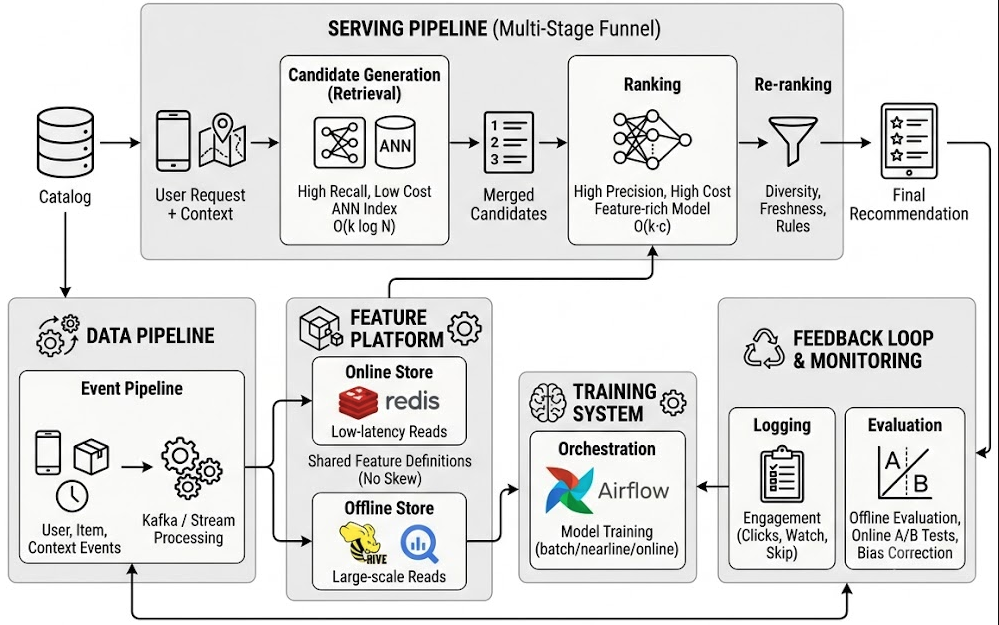
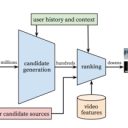
| Almost every large-scale recommendation service — TikTok, YouTube, Amazon, Netflix, Spotify — is built on the same architectural skeleton, regardless of which specific model it uses. Understanding this skeleton is more valuable than memorizing any single algorithm: once you know where each piece fits, the individual models (matrix factorization, two-tower, Wide & Deep, sequence models, and so on) are just interchangeable parts that slot into named stages. The skeleton is a multi-stage funnel that turns a catalog of millions or billions of items into a short, ordered list for one user in tens of milliseconds. The defining pattern is two-stage retrieval then ranking: a cheap, high-recall stage narrows the catalog to a few hundred candidates, then an expensive, high-precision stage scores and orders that shortlist. Around this funnel sit four supporting subsystems that make it work in production: a data pipeline, a feature platform, a training system, and a feedback loop.
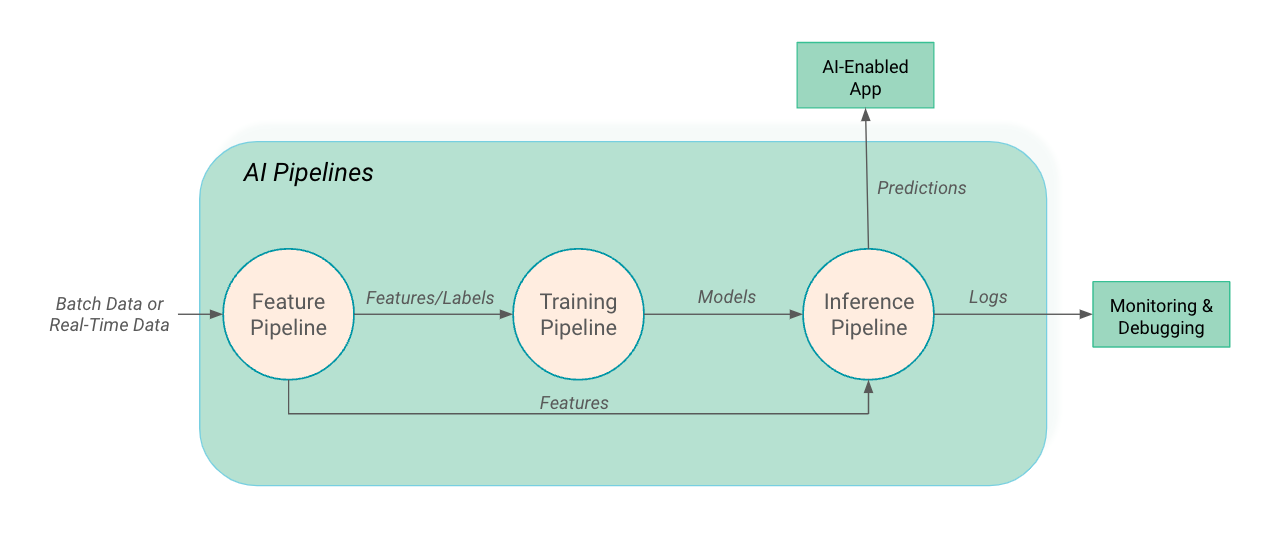
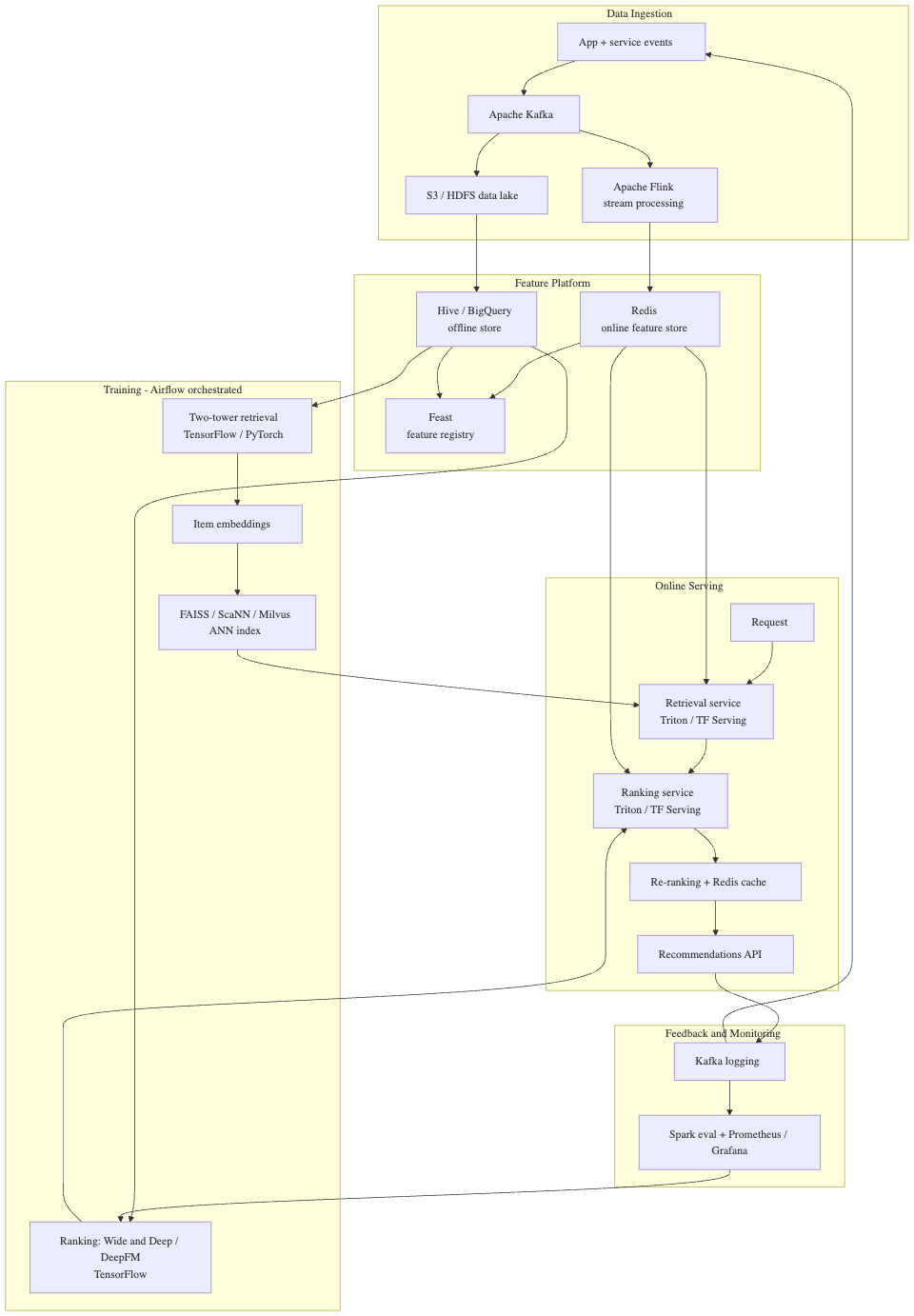
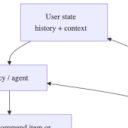
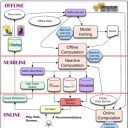
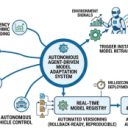
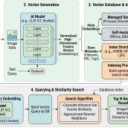
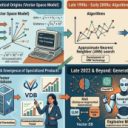
Below is an improved AI pipeline similar to common recommendation service architecture.
I hope that you have some insight based on above pipeline. Why Two Stages? (The Core Idea)The reason for the split is computational. Suppose the catalog has The funnel breaks this into stages with very different cost/accuracy profiles:
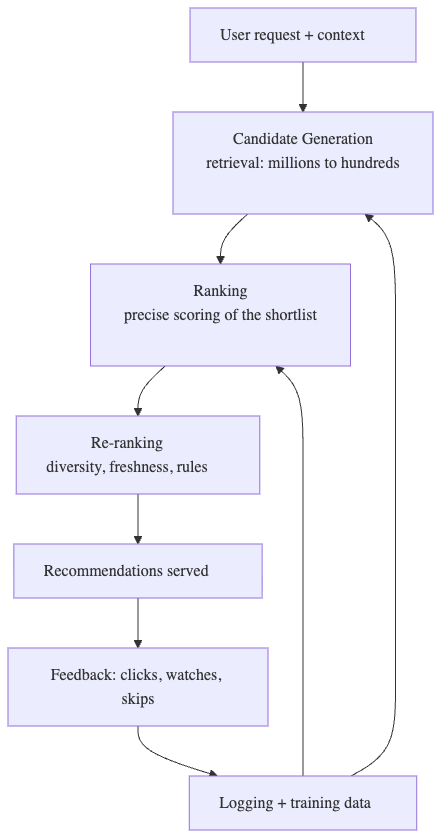
Formally, retrieval reduces the candidate set from A typical third step, re-ranking, then adjusts the ranked list for objectives the pointwise ranker does not capture: diversity, freshness, de-duplication, and business or policy rules.
RequirementsTo stand up a recommendation service you need:
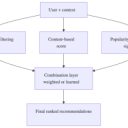
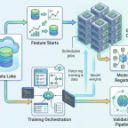
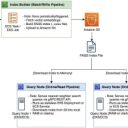
Simplified Architecture
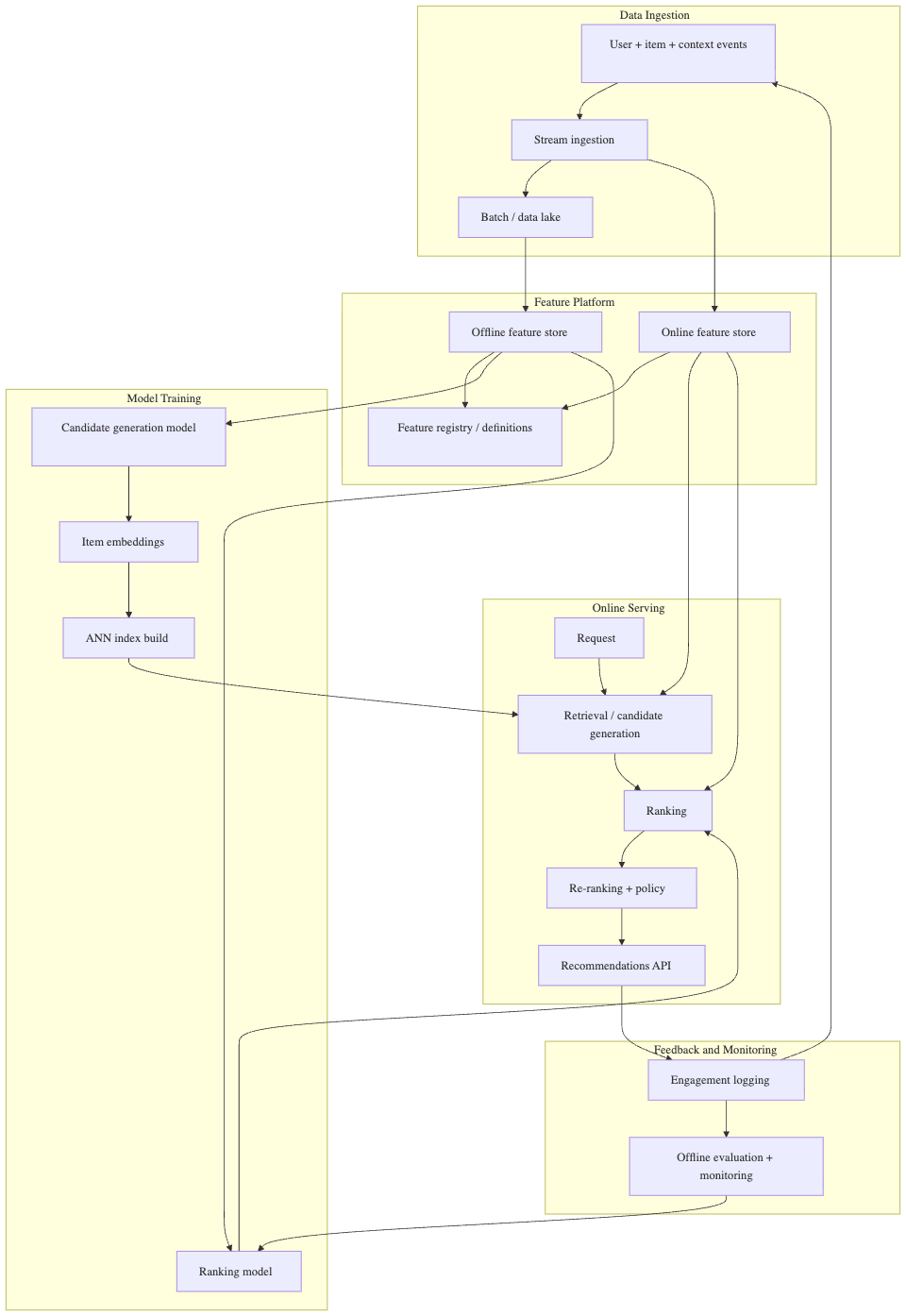
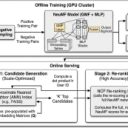
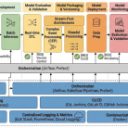
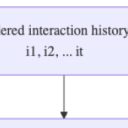
Reference Architecture
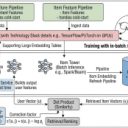
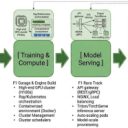
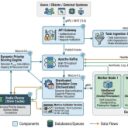
PRO Reference Architecture (with Technology Stack)The same blueprint mapped onto common production technologies — Kafka and Flink for ingestion, Redis plus Feast for features, TensorFlow/PyTorch for training, FAISS/ScaNN for the vector index, and Triton/TF Serving behind the API.
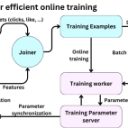
Stage-by-Stage WalkthroughData ingestion. Every interaction (impression, click, watch, purchase, skip) and every item/profile change is published as an event, typically to Apache Kafka. A stream processor (Apache Flink or Spark Streaming) computes near-real-time aggregates, while raw events land in a data lake (S3/HDFS) for batch processing and training. Feature platform. Features are served from two stores kept in sync: an online store (Redis) for millisecond reads during serving, and an offline store (Hive/BigQuery) for generating training data. A feature framework such as Feast registers definitions so the same transformation runs in both places — preventing train/serve skew, one of the most common and damaging bugs in production ML. Candidate generation (retrieval). One or more retrievers each propose candidates: a two-tower embedding model queried via ANN, plus complementary sources like co-visitation, trending/popularity, and recent-history rules. Their outputs are merged into a single candidate pool. The goal here is recall, not precise order. Ranking. A heavy model (Wide & Deep, DeepFM, a deep ranking network, or an Multi-gate Mixture-of-Experts model for multiple objectives) scores each candidate using rich user, item, and context features. Modern systems are usually multi-objective, predicting several outcomes (click, watch time, satisfaction) and blending them. Re-ranking. The ordered list is adjusted for whole-list properties the pointwise ranker ignores: diversity, freshness, de-duplication, fatigue/seen-item filtering, and business or policy constraints. Reinforcement-learning policies sometimes act here to optimize long-term engagement. Feedback loop. Served impressions and the user’s responses are logged back to Kafka, closing the loop: they become training data for the next model refresh and the basis for evaluation and monitoring.
Signals & FeaturesThe architecture is signal-agnostic, but the common families are: user features (IDs, demographics, long-term and session history embeddings), item features (IDs, content embeddings, category, creator, age/freshness), context features (device, time, location, query, position in feed), and interaction signals (clicks, watch fraction, dwell, likes, skips). The feature platform’s job is to make all of these available consistently offline (for training) and online (for serving) at the latency the funnel demands.
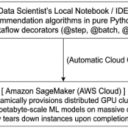
Training & Serving ConsiderationsProduction systems blend three training cadences. Batch (offline) retraining on a daily/hourly schedule via Airflow-orchestrated Spark and TensorFlow/PyTorch jobs is the baseline. Nearline updates refresh embeddings or counters within minutes. Online (continuous) training updates parameters from the streaming feedback in near real time — the approach TikTok’s Monolith takes for maximum freshness. On the serving side, the funnel’s latency budget is split across stages: retrieval must be sub-linear (hence ANN), and ranking is bounded by how many candidates
EvaluationEach stage is judged differently. Retrieval is measured by recall@k — did the relevant items make it into the candidate pool? Ranking is measured by ordering metrics: NDCG (Normalized Discounted Cumulative Gain), MAP (Mean Average Precision), and, for click models, AUC (Area Under the ROC Curve) and LogLoss. End-to-end, the authoritative signals come from online A/B tests on engagement, watch time, and long-term retention. Because logged data is biased by what was previously shown, mature systems apply position- and selection-bias correction and use off-policy/counterfactual estimators before trusting offline numbers.
Strengths & WeaknessesStrengths: the staged funnel makes precise ranking affordable at catalog scale; stages are modular, so each model family in this series can be swapped into the retrieval or ranking slot independently; the feature platform and feedback loop are reusable across products. Weaknesses (common pitfalls): train/serve skew when offline and online features diverge; feedback loops and popularity bias that narrow recommendations over time; ANN index staleness; latency pressure that pushes feature assembly to the edge of the budget; and the substantial MLOps (Machine Learning Operations) burden of running multiple models, an index, and bias correction together.
How the Model Families Map onto This ArchitectureThis blueprint is where every other document in the series fits:
Read those docs through this lens: each one is a deep dive into a single box in the diagrams above. | ||
| | ||
| |