Neural Collaborative Filtering (NCF) for Recommendation Service

CK CK 3788 
Created at  
236 0 0

Neural Collaborative Filtering (NCF) generalizes matrix factorization by replacing the fixed dot product with a learned neural interaction function. Where MF assumes that a user’s affinity for an item is a simple inner product of two latent vectors, NCF lets a neural network learn an arbitrary, non-linear function of those embeddings.

Introduced by He et al. (2017), NCF reframes collaborative filtering as a supervised learning problem on implicit feedback and shows that the dot product is just one special case the network can represent — but not the only useful one.

Neural Collaborative Filtering (NCF) for Recommendation Service


How It Works (The Math)

Each user u and item i is mapped to an embedding via lookup on its one-hot ID:

pᵤ = Pᵀ · one_hot(u), qᵢ = Qᵀ · one_hot(i)

NCF then has three notable architectures:

1. Generalized Matrix Factorization (GMF)

Applies an element-wise product followed by a learned linear layer with activation:

ŷ_{u,i} = σ( hᵀ ( pᵤ ⊙ qᵢ ) )

With h = 1 and σ the identity, this recovers classic MF exactly — hence “generalized”.

2. Multi-Layer Perceptron (MLP)

Concatenates the embeddings and passes them through stacked non-linear layers, learning a flexible interaction:

z₁ = [ pᵤ ; qᵢ ], z_{ℓ+1} = ReLU( W_ℓ z_ℓ + b_ℓ ), ŷ = σ( hᵀ z_L )

3. NeuMF (Neural Matrix Factorization)

Fuses GMF and MLP, each with its own embeddings, concatenated before the output layer to combine linear and non-linear strengths:

ŷ = σ( hᵀ [ GMF_vector ; MLP_vector ] )

Loss

Trained on implicit feedback as binary classification with binary cross-entropy (BCE), sampling negatives from unobserved interactions:

L = − Σ_{(u,i) ∈ pos} log ŷ_{u,i} − Σ_{(u,j) ∈ neg} log(1 − ŷ_{u,j})


Requirements

  • Implicit (or explicit) interaction data with user and item IDs.
  • A negative-sampling strategy — there are no explicit negatives in implicit feedback, so unobserved pairs are sampled (uniform or popularity-based).
  • Embedding tables sized to the user/item ID space, plus an MLP — i.e., a GPU-capable training stack.
  • Hyperparameter tuning: embedding dimension, MLP depth/width, negative-sampling ratio, regularization, learning rate.
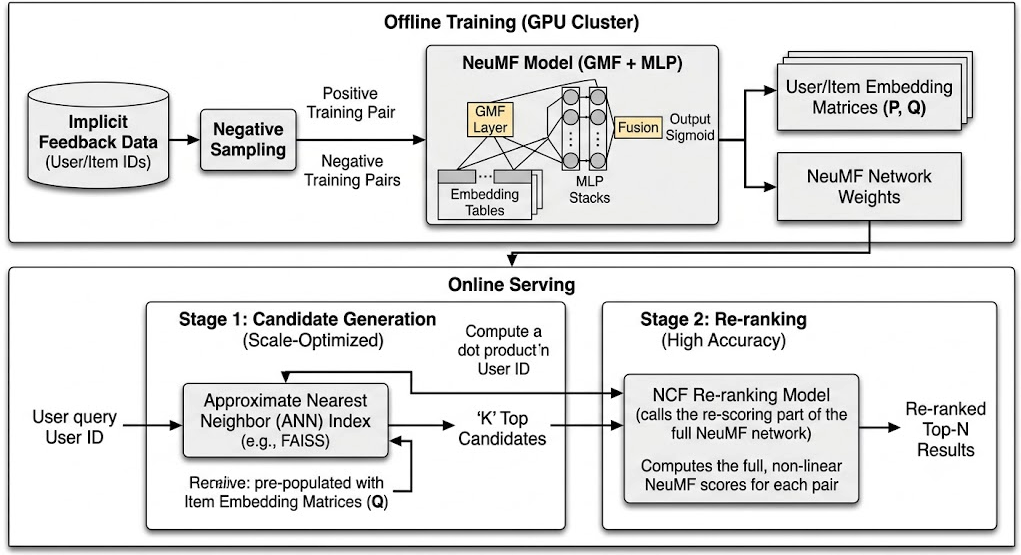
  • A serving plan. Unlike pure MF, NeuMF’s scoring is not a clean dot product, so exact ANN retrieval does not directly apply (see Serving).


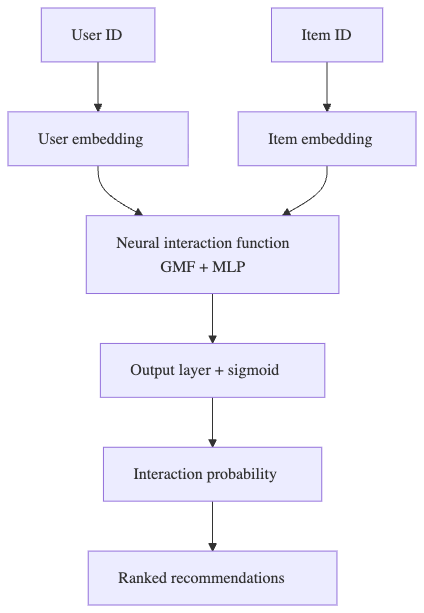
Simplified Architecture

Neural Collaborative Filtering (NCF) for Recommendation Service


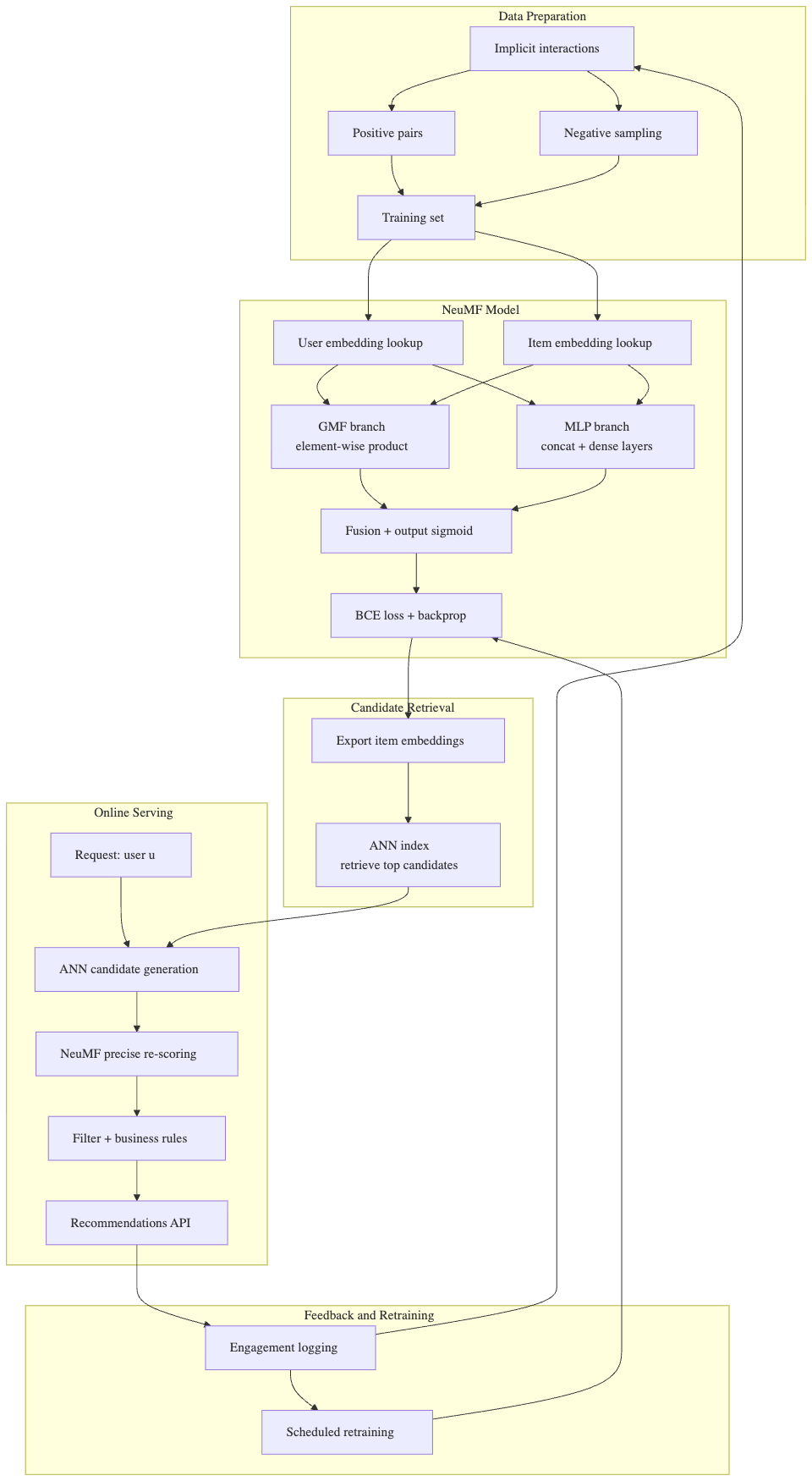
Reference Architecture

Neural Collaborative Filtering (NCF) for Recommendation Service


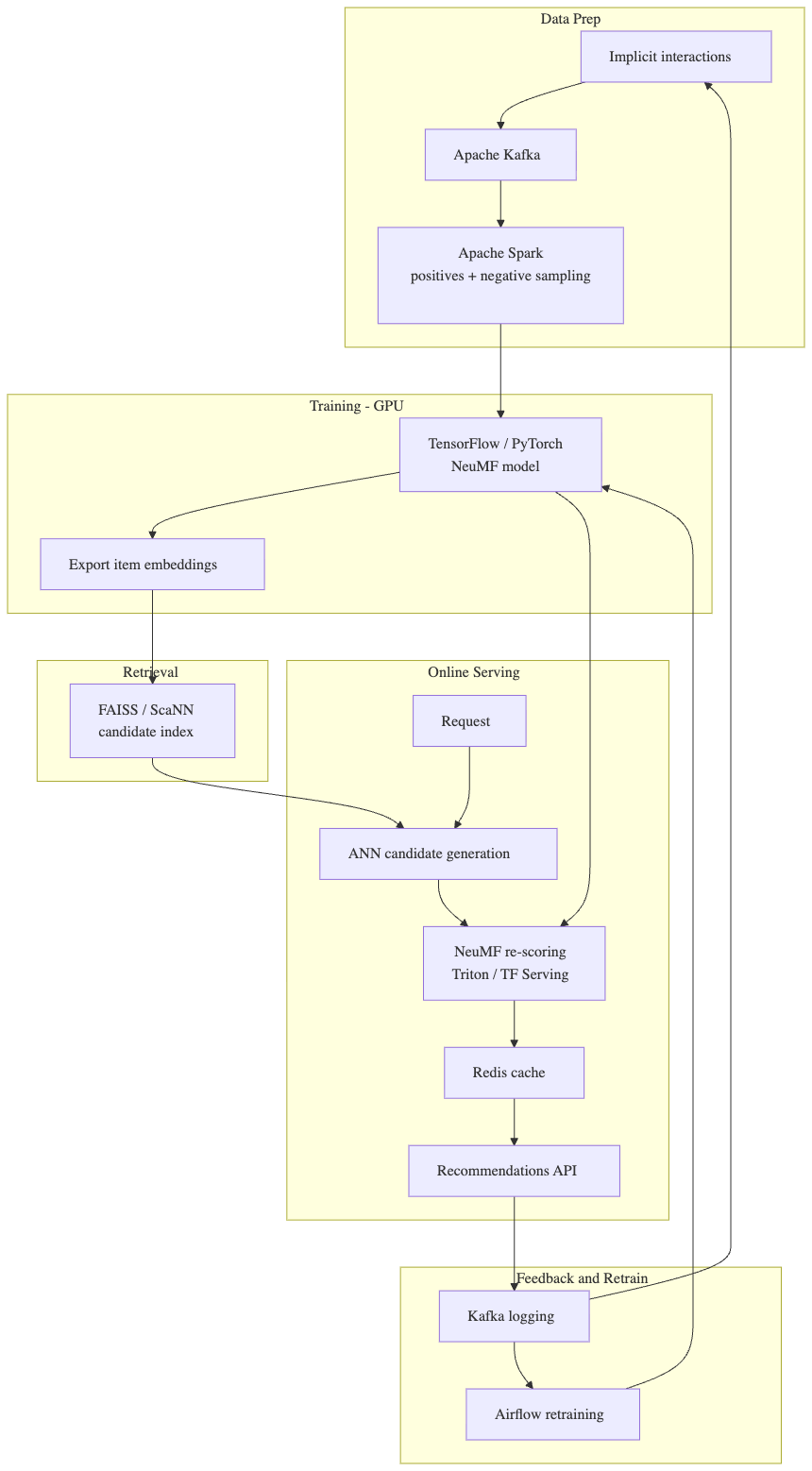
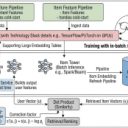
Reference Architecture (with Technology Stack)

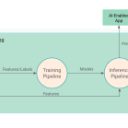
The same flow on concrete tooling — Spark for negative sampling, TensorFlow/PyTorch on GPU for NeuMF, FAISS for candidate generation, and Triton/TF Serving to re-score with the neural network.

Neural Collaborative Filtering (NCF) for Recommendation Service


Signals & Features

The base NCF model uses only user and item IDs (like MF). Its value is the richer interaction function, not richer inputs. In practice the architecture is extended by concatenating side features (user demographics, item metadata, context) into the MLP branch, which also alleviates cold-start — moving NCF toward the feature-rich deep models (Wide & Deep, DeepFM) covered separately.


Training & Serving Considerations

Training is standard mini-batch SGD (Stochastic Gradient Descent) / Adam with negative sampling; the negative ratio is a sensitive knob. The serving wrinkle is that NeuMF’s score is not a dot product, so you cannot run a single MIPS (Maximum Inner Product Search) query over all items. The standard pattern is two-stage: use a dot-product-friendly model (or GMF embeddings) for ANN (Approximate Nearest Neighbor) candidate generation, then apply the full NeuMF network to re-score the few hundred candidates. This makes NCF most natural as a ranking model rather than a billion-item retriever.


Evaluation

NCF is evaluated with top-N ranking metrics — Hit Ratio @ k (HR@k) and NDCG@k (Normalized Discounted Cumulative Gain at k) are the metrics used in the original paper, typically under a leave-one-out protocol with sampled negatives. Use temporal splits and a fixed negative-sampling seed for reproducible comparisons, and beware that sampled-metric evaluation can be biased relative to full-ranking evaluation.


Strengths & Weaknesses

Strengths: learns non-linear user–item interactions that pure MF cannot represent; subsumes MF as a special case; extends cleanly to side features; strong accuracy on implicit-feedback top-N tasks.

Weaknesses: more data- and compute-hungry than MF; the non-dot-product score complicates large-scale retrieval (needs a two-stage setup); still suffers ID cold-start without side features; lower interpretability; later work debated how much the MLP truly beats a well-tuned dot product, so gains are workload-dependent.


When to Use It

NCF is a good fit when you have ample implicit-feedback data and want to rank a candidate set with a learned interaction function, especially when you intend to fold in side features. At web scale it usually lives as the ranking layer behind a cheaper retrieval stage rather than as the retriever itself, and it serves as the conceptual bridge from matrix factorization to the broader deep-learning recommender family.

Tags Candidate Generation Deep Learning Models GMF Implicit Feedback MLP Matrix Factorization Multi-Layer Perceptron NCF Negative Sampling Neural Collaborative Filtering Neural Matrix Factorization NewMF Ranking Models Recommendation Architecture Recommendation Service Recommendation Systems Facebook X
Comments 0
Similar posts
  1. Hybrid Methods for Recommendation Service
    213
  2. Sequence Models (RNN / Transformer) for Recommendation Service widely used at OTT and e-Commerce
    240
  3. Two-Tower Model for Recommendation Service having a Very Large Catalog
    259
  4. Model-Based CF: Matrix Factorization for Recommendation Service
    177
  5. Memory-Based Collaborative Filtering for Recommendation Service
    186
  6. Content-Based Filtering for Recommendation Service (aka User-based Model)
    187
  7. Common Recommendation Service Architecture
    525
  8. Wide & Deep / DeepFM for Recommendation Service (aka Ranking Service)
    247
  9. YouTube's Recommendation System
    259
  10. Reinforcement Learning–Based Methods for CTR Improvement based on Recommendation System
    262
  11. TikTok's Recommendation System - Monolith
    287
  12. How Netflix Runs Recommendations for Hundreds of Millions of Users Using Amazon SageMaker & Metaflow
    171
  13. Building a Video Content Recommendation System with Amazon SageMaker
    521
  14. Netflix's Recommendation System
    412
  15. Beyond SDLC: Why the Entertainment Sector Needs an AI Development Life Cycle Now
    282
  1. Comparison of ChatGPT, Gemini, and Grok
    554
  2. MLOps Explained: Spark, Flink, and Reference Architecture Deep Dive
    237
  3. AI-based Image Creation based on Bing Image Creator
    981
  4. ChatGPT App (flowGPT) to create images with text
    1,030
  5. TikTok's Recommendation System - Monolith
    287
  6. Things to Know for AI-driven, Multimodal Content Personalization.
    196
  7. Deep Dive into Vector Databases: Understanding Collections (Not Tables) and Embeddings
    230
  8. Image Embeddings for Vector Databases
    241
  9. Vector Databases: From Embeddings to Application
    310
  10. Scaling Vector Search: How to Architect FAISS on AWS EKS and ECS
    158
  11. Reinforcement Learning–Based Methods for CTR Improvement based on Recommendation System
    262
  12. YouTube's Recommendation System
    259
  13. Wide & Deep / DeepFM for Recommendation Service (aka Ranking Service)
    247
  14. Two-Tower Model for Recommendation Service having a Very Large Catalog
    259
  15. Sequence Models (RNN / Transformer) for Recommendation Service widely used at OTT and e-Commerce
    240
  16. Common Recommendation Service Architecture
    525
Recently updated
  1. Why 100% SEO Guarantees Better User Engagement and How to Achieve It in Your Service
    27
  2. Why SPF and DKIM Are Essential for Linux Email Servers?
    24
  3. How do I create animated background for Google Meet?
    19,732
  4. MaxMind GeoLite2 vs. DB-IP Lite vs. ip-api.com: Choosing the Right Free IP Geolocation Solution
    217
  5. Meet Valkey: Why Redis Changed Its License, Why Valkey is Better, and How to Use It as a Drop-in Replacement
    86
  6. How Rogue Web Scrapers Are Stealing My Content and Destroying My Server
    153
  7. Array of arguments passed to script in PHP
    85
  8. Invalid Auction Storms in Ad Tech
    93
  9. Building MRC-Compliant Instrumentation in Ad Tech: Implementation Steps and Key Challenges
    198
  10. The Two Clocks of Ad Server Architecture
    63
  11. Frequency Cap Architecture Overview
    509
  12. Collecting Proof-of-Play from 100,000 Screens
    141
  13. Vector Search in Relational Databases (RDBs): Trends & Usage Environments
    280
  14. What is RedisVL?
    105
  15. Designing a Skill Registry Architecture: Minimize Token Usage and Maximize AI Performance
    224
  16. TPU & GPU Cluster Management Tools
    234
  17. The Concept of Scaffolding in AI Agents
    222
  18. Beyond Static Pipelines: Architecting LLM Multi-Agent Systems for Autonomous Workflow Orchestration
    576
  19. AI-DLC vs. AI-SDLC: Model-Centric vs. System-Centric AI Development
    253
  20. Fine-Tuning Open-Weight LLMs: Training, Licensing, and Deploying Custom Models with Ollama
    328
  21. Inside the Next-Generation Streaming Architecture: Ultra-Low Latency, SGAI, and AI Codecs
    197
  22. Machine Learning: Training vs. Ranking
    213
  23. The Continuous Learning Machine: Designing a Loop That Actually Turns
    217
  24. The Next-Gen Low-Latency Standards: LL-HLS & MoQ
    189
  25. Designing a Data Curation System Around a Vector Database
    215
  26. Extracting Context from Live Video: The Architecture Got Simpler When We Stopped Building Features
    229
  27. The New Ad Stack Behind Live Sports Streaming: Inside SGAI, EABN, and the Standards Race to Fix Live Monetization
    649
  28. Designing MLOps Architectures to Handle Seasonal Data Drift in EV Fleet Models
    185
  29. From 15 to 40+ FPS: Accelerating PyTorch Object Detection on Automotive ECUs
    207
  30. Understanding Data Lineage
    252