Wide & Deep / DeepFM for Recommendation Service (aka Ranking Service)

CK CK 3788 
Created at  
253 0 0

Wide & Deep and DeepFM are ranking models built to do two things at once: memorize frequent, specific feature combinations and generalize to combinations never (or rarely) seen in training. They are the canonical “deep ranking” architectures that score a shortlist of candidates with rich features and context.

  • Wide & Deep (Google, 2016) trains a wide linear model (memorization) and a deep neural network (generalization) jointly, summing their outputs.
  • DeepFM (Deep Factorization Machine) (Huawei, 2017) replaces the wide part’s manual cross-features with a Factorization Machine (FM) that learns all pairwise feature interactions automatically, sharing embeddings with the deep part — so no hand-crafted crosses are needed.


How It Works (The Math)

Wide & Deep

The wide component is generalized linear over raw and cross-product features φ(x) (e.g., AND(gender=female, category=cosmetics)):

y_wide = wᵀ [ x ; φ(x) ] + b

The deep component embeds sparse categorical features and passes them through an MLP (Multi-Layer Perceptron):

y_deep = MLP( [ emb(x₁); …; emb(x_n) ] )

They are combined and squashed for CTR (Click-Through Rate) prediction:

ŷ = σ( y_wide + y_deep )

Memorization (wide) captures “users who installed app A also install app B”; generalization (deep) proposes plausible unseen pairs. The catch: the wide part’s crosses are hand-engineered.

DeepFM

DeepFM removes the manual crosses. An FM component models order-1 and order-2 interactions over shared embeddings vᵢ:

y_FM = Σᵢ wᵢ xᵢ + Σ_{i<j} (vᵢ · vⱼ) xᵢ xⱼ

A deep component shares those same embeddings and learns higher-order interactions:

y_deep = MLP( [ v₁; …; v_n ] )

Combined:

ŷ = σ( y_FM + y_deep )

Because the FM and deep parts share embeddings and there is no feature engineering, DeepFM trains end-to-end and is a frequent default for CTR ranking.


Requirements

  • Rich feature data: high-cardinality categoricals (user ID, item ID, geo, app), dense numerics, and context.
  • A feature store + embedding tables for the many sparse categorical fields.
  • For Wide & Deep, domain-driven cross-feature engineering; for DeepFM, this is learned automatically.
  • A GPU training stack and standard CTR-modeling discipline (calibration, class-imbalance handling, regularization).
  • A candidate set to rank — these are second-stage models fed by a retriever (e.g., two-tower), not billion-item retrievers themselves.


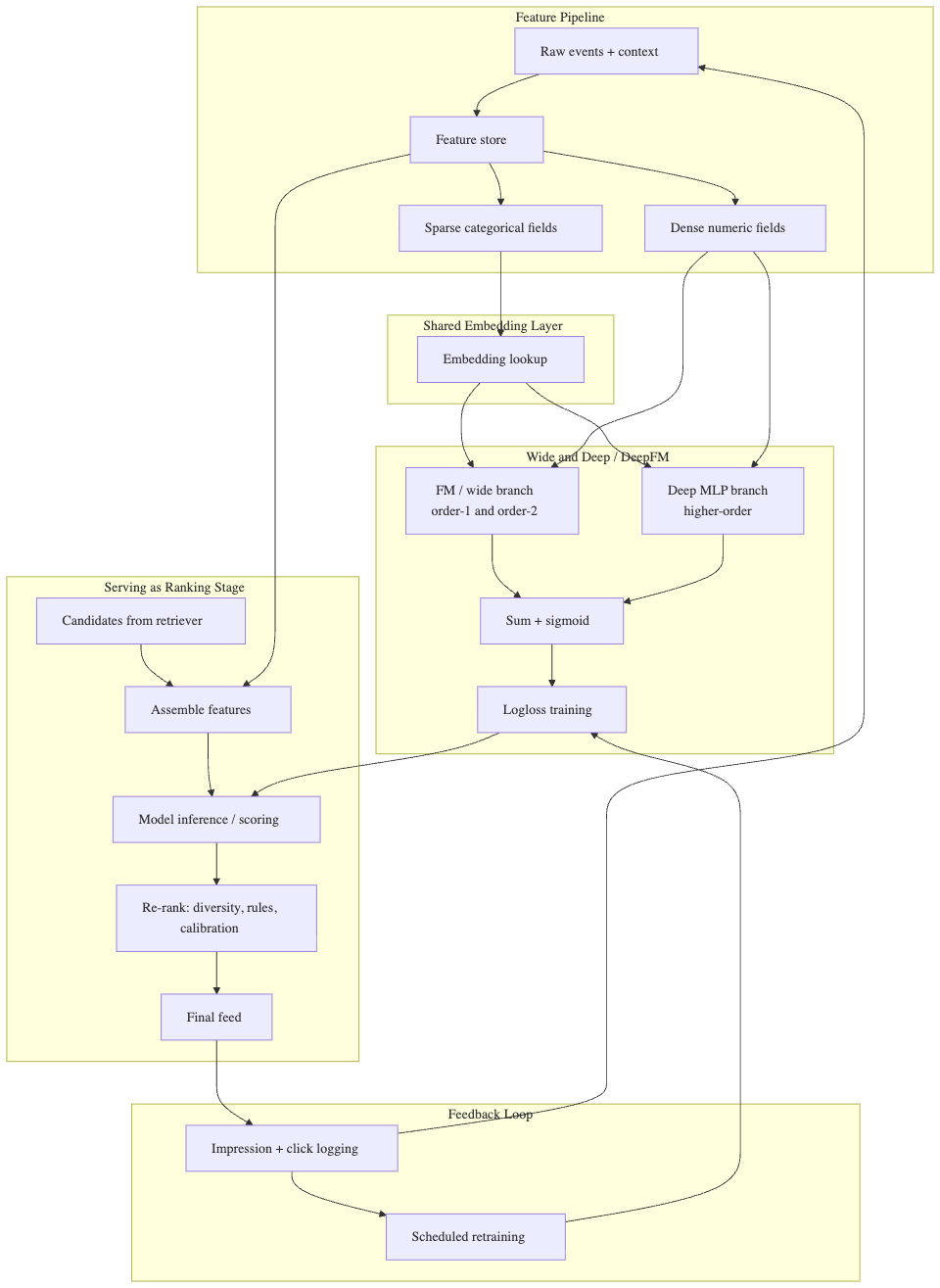
Simplified Architecture

Wide & Deep / DeepFM for Recommendation Service (aka Ranking Service)


Reference Architecture

Wide & Deep / DeepFM for Recommendation Service (aka Ranking Service)


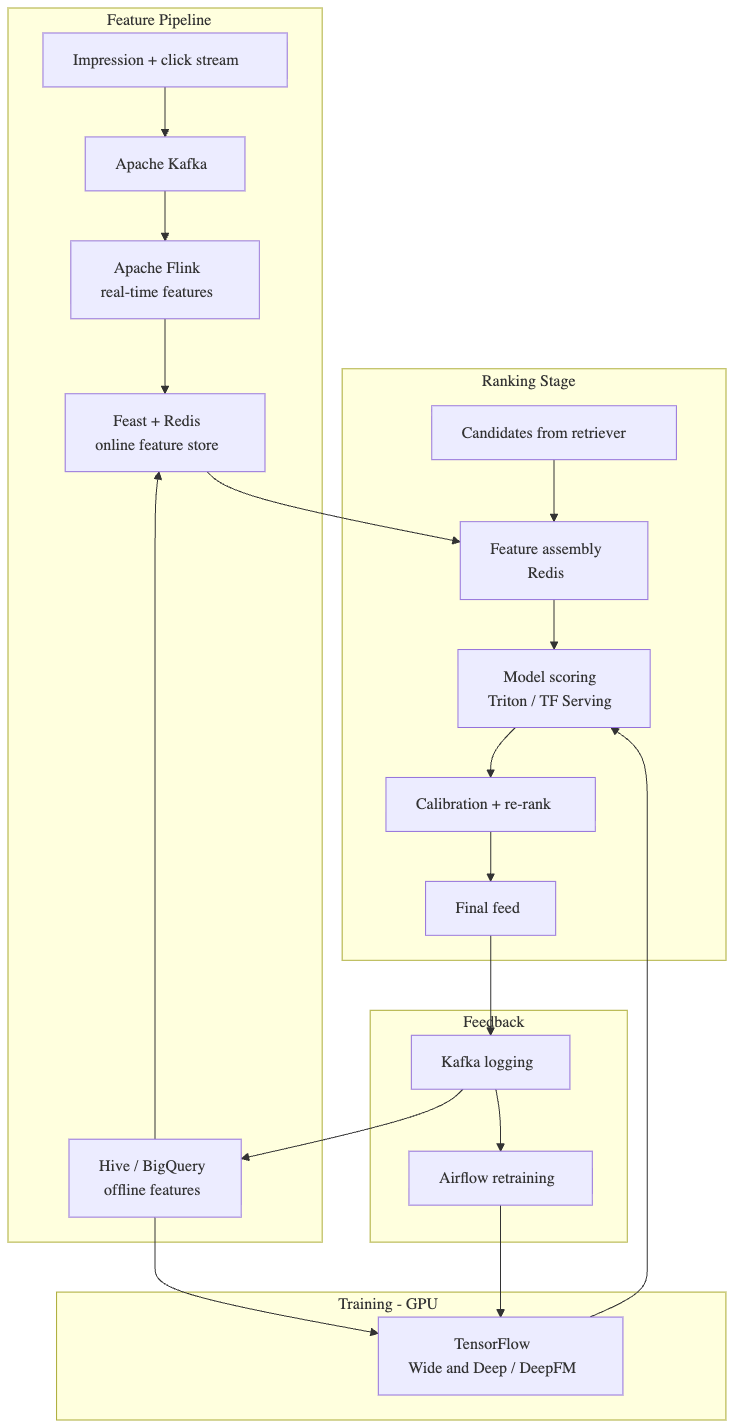
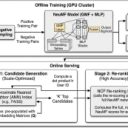
Reference Architecture (with Technology Stack)

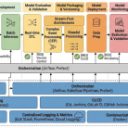
The same flow on concrete tooling — Flink for real-time features, Hive/BigQuery plus Feast/Redis as the feature store, TensorFlow on GPU for training, and Triton/TF Serving as the ranking stage behind a retriever.

Wide & Deep / DeepFM for Recommendation Service (aka Ranking Service)


Signals & Features

These models are feature-omnivores. Typical inputs span user features (ID, demographics, historical engagement), item features (ID, category, creator, price), and context (device, time, query, position). High-cardinality IDs go through embeddings; numerics are bucketized or normalized. The combination of memorization (specific seen patterns) and generalization (plausible unseen patterns) is the whole point — and why context features matter so much for ranking quality.


Training & Serving Considerations

Both are trained with logloss on impression/click data, jointly optimizing wide/FM and deep parts so neither dominates. Class imbalance (clicks are rare) is handled via sampling or loss weighting, and probability calibration matters because downstream auctions/blending consume the predicted CTR as a number, not just a ranking. These are ranking-stage models: they score the hundreds of candidates emerging from retrieval, so per-request latency budgets are tight and feature assembly from the feature store is often the bottleneck.


Evaluation

CTR ranking is evaluated with AUC (Area Under the ROC Curve) and LogLoss (Logarithmic Loss) offline (small AUC gains often translate to meaningful online lift), with calibration checks (predicted vs. observed CTR). Online, A/B test CTR, conversions, and downstream engagement. Watch for position bias in logged data, which inflates offline metrics if not corrected.


Strengths & Weaknesses

Strengths: combine memorization and generalization in one model; DeepFM removes manual feature engineering by learning pairwise interactions; strong, well-understood CTR-prediction performance; production-proven at scale.

Weaknesses: Wide & Deep needs hand-crafted cross-features (expertise and maintenance); both are ranking models requiring an upstream retriever; data- and feature-pipeline-heavy; lower interpretability; sensitive to feature drift and logging bias.


When to Use It

Reach for Wide & Deep or DeepFM as the ranking layer of a two-stage system — after a retriever (two-tower, MF) narrows millions of items to a few hundred, these models score them precisely using full feature interactions and context. DeepFM is a strong default when you want minimal feature engineering; Wide & Deep suits cases where domain experts can craft high-value crosses worth memorizing.

Tags CTR Prediction Deep Learning DeepFM Model Factorization Machine Feature Engineering Machine Learning Model Architecture Ranking Models Recommendation Architecture Recommendation System Wide Deep Model Facebook X
Comments 0
Similar posts
  1. Two-Tower Model for Recommendation Service having a Very Large Catalog
    263
  2. Sequence Models (RNN / Transformer) for Recommendation Service widely used at OTT and e-Commerce
    248
  3. Neural Collaborative Filtering (NCF) for Recommendation Service
    241
  4. Hybrid Methods for Recommendation Service
    217
  5. Model-Based CF: Matrix Factorization for Recommendation Service
    178
  6. Memory-Based Collaborative Filtering for Recommendation Service
    193
  7. Content-Based Filtering for Recommendation Service (aka User-based Model)
    189
  8. Common Recommendation Service Architecture
    532
  9. Harnessing the Power of Random Forest Algorithm in Python
    658
  10. Mastering Model Persistence: Saving and Loading Trained Machine Learning Models in Python
    1,156
  11. YouTube's Recommendation System
    263
  12. Reinforcement Learning–Based Methods for CTR Improvement based on Recommendation System
    265
  13. Understanding and Implementing K-Nearest Neighbors (KNN) Algorithm in Python
    633
  14. Forecasting the Weather with PyTorch: A Beginner's Guide to Temperature Prediction
    1,434
  15. Getting Started with PyTorch: A Beginner's Guide to Building Your First Neural Network
    800
  16. Mastering AI: A Beginner's Guide to Python Programming and Beyond
    1,034
  17. Forecasting with Linear Regression and KNN Regression in Python
    925
  18. Temporal Programming Model - Robust, Long-Running, Fault-Tolerant Applications as WorkFlows
    352
  19. Vector Databases: From Embeddings to Application
    315
  20. Image Embeddings for Vector Databases
    248
  21. Machine Learning Models for Ad Detection from a Video Stream
    188
  22. FAISS Already Does ANN... So Why Do Top Teams Still Pay for SageMaker?
    309
  23. TikTok's Recommendation System - Monolith
    291
  24. Milvus & FAISS: Decoding Their ML Synergy
    278
  25. PyTorch example to Forcast Stock Price based on 10 days Dataset
    651
  26. Predicting Buyer Preferences with PyTorch: A Deep Learning Approach
    1,233
  27. Mastering Ad Budget Throttling: Static, PID, and ML Strategies
    321
  28. Ad Impression Forecasting (aka Ad Inventory Forecasting): Architecting for Scale, Speed, and Accuracy
    330
  29. AI-Powered Ad Fraud Detection: Architectural Strategies
    334
  30. Brand Safety: AI-Driven Content Moderation on AWS
    719
  1. Vulnerabilities of MCP
    588
  2. The Revenge of the Junior Developer
    2,289
  3. A Complete Guide to LLM Dataset Formats: From Pre-Training to DPO in JSONL
    206
  4. Comparison of ChatGPT, Gemini, and Grok
    561
  5. MLOps Explained: Spark, Flink, and Reference Architecture Deep Dive
    242
  6. AI-based Image Creation based on Bing Image Creator
    985
  7. ChatGPT App (flowGPT) to create images with text
    1,035
  8. TikTok's Recommendation System - Monolith
    291
  9. Things to Know for AI-driven, Multimodal Content Personalization.
    200
  10. Deep Dive into Vector Databases: Understanding Collections (Not Tables) and Embeddings
    232
  11. Image Embeddings for Vector Databases
    248
  12. Vector Databases: From Embeddings to Application
    315
  13. Scaling Vector Search: How to Architect FAISS on AWS EKS and ECS
    162
  14. Reinforcement Learning–Based Methods for CTR Improvement based on Recommendation System
    265
  15. YouTube's Recommendation System
    263
  16. Two-Tower Model for Recommendation Service having a Very Large Catalog
    263
  17. Sequence Models (RNN / Transformer) for Recommendation Service widely used at OTT and e-Commerce
    248
  18. Neural Collaborative Filtering (NCF) for Recommendation Service
    241
  19. Common Recommendation Service Architecture
    532
Recently updated
  1. Why 100% SEO Guarantees Better User Engagement and How to Achieve It in Your Service
    40
  2. Why SPF and DKIM Are Essential for Linux Email Servers?
    34
  3. How do I create animated background for Google Meet?
    20,613
  4. MaxMind GeoLite2 vs. DB-IP Lite vs. ip-api.com: Choosing the Right Free IP Geolocation Solution
    244
  5. Meet Valkey: Why Redis Changed Its License, Why Valkey is Better, and How to Use It as a Drop-in Replacement
    94
  6. How Rogue Web Scrapers Are Stealing My Content and Destroying My Server
    157
  7. Array of arguments passed to script in PHP
    90
  8. Invalid Auction Storms in Ad Tech
    98
  9. Building MRC-Compliant Instrumentation in Ad Tech: Implementation Steps and Key Challenges
    202
  10. The Two Clocks of Ad Server Architecture
    70
  11. Frequency Cap Architecture Overview
    514
  12. Collecting Proof-of-Play from 100,000 Screens
    146
  13. Vector Search in Relational Databases (RDBs): Trends & Usage Environments
    287
  14. What is RedisVL?
    109
  15. Designing a Skill Registry Architecture: Minimize Token Usage and Maximize AI Performance
    230
  16. TPU & GPU Cluster Management Tools
    244
  17. The Concept of Scaffolding in AI Agents
    233
  18. Beyond Static Pipelines: Architecting LLM Multi-Agent Systems for Autonomous Workflow Orchestration
    583
  19. AI-DLC vs. AI-SDLC: Model-Centric vs. System-Centric AI Development
    258
  20. Fine-Tuning Open-Weight LLMs: Training, Licensing, and Deploying Custom Models with Ollama
    339
  21. Inside the Next-Generation Streaming Architecture: Ultra-Low Latency, SGAI, and AI Codecs
    202
  22. Machine Learning: Training vs. Ranking
    221
  23. The Continuous Learning Machine: Designing a Loop That Actually Turns
    222
  24. The Next-Gen Low-Latency Standards: LL-HLS & MoQ
    195
  25. Designing a Data Curation System Around a Vector Database
    220
  26. Extracting Context from Live Video: The Architecture Got Simpler When We Stopped Building Features
    256
  27. The New Ad Stack Behind Live Sports Streaming: Inside SGAI, EABN, and the Standards Race to Fix Live Monetization
    656
  28. Designing MLOps Architectures to Handle Seasonal Data Drift in EV Fleet Models
    195
  29. From 15 to 40+ FPS: Accelerating PyTorch Object Detection on Automotive ECUs
    217
  30. Understanding Data Lineage
    260