TikTok's Recommendation System - Monolith

CK CK 3788 
Created at  
287 0 0

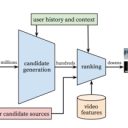
Monolith is ByteDance’s deep-learning recommendation system (described in a 2022 paper) that powers TikTok’s “For You” feed. It is a large-scale, two-stage (retrieval → ranking) deep-learning engine, purpose-built for the dynamic, sparse, and constantly shifting nature of short-video feedback.

Its defining edge is speed of adaptation. Two design choices — collisionless embedding tables and online (real-time) training — let the system reflect a user’s most recent behavior and platform-wide trends within minutes. This near-real-time responsiveness is central to TikTok’s fast, “addictive” feed dynamics.

The summary in one line: Monolith trades a little training stability for a lot of embedding freshness, and that freshness is the product.

TikTok's Recommendation System - Monolith


Why Short-Video Feedback Is Hard

Three properties of the domain shape every design decision:

  • Enormous, ever-growing ID space. New users, videos, and tags appear continuously; the feature ID space is unbounded and sparse.
  • Rapid concept drift. Trends rise and decay within hours. A model trained on yesterday’s data is already stale.
  • Dense, immediate feedback. Watch completion, re-watches, likes, shares, comments, skips, and dwell time arrive in a continuous stream and can sharpen recommendations within a single session.


Key Technical Ideas

Collisionless embedding tables

Standard recommenders hash features into a fixed-size embedding table, so distinct IDs inevitably collide into the same vector — acceptable noise at small scale, harmful when the ID space is huge and growing. Monolith uses a hash-based, expandable embedding structure built on a Cuckoo HashMap so that distinct features never share a vector. The table grows as new IDs appear and uses expiry/eviction to retire stale IDs, keeping memory bounded.

Online / real-time training

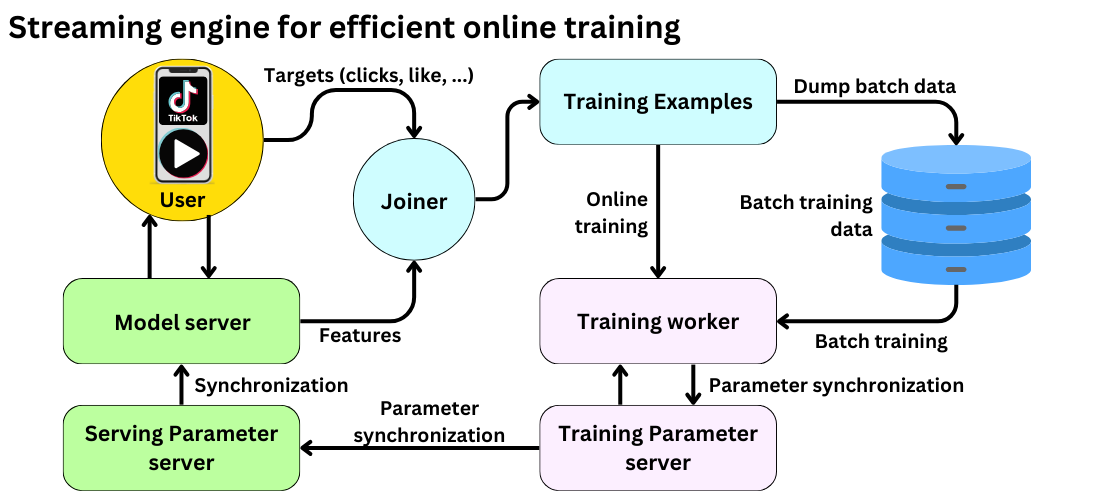
Rather than retraining in fixed daily batches, Monolith continuously trains on streaming user feedback. Fresh interactions update parameters within minutes, so the model adapts to a user’s evolving session intent and to platform-wide trending content almost as it happens.

Real-time feedback loop

Engagement signals — completion rate, re-watches, likes, shares, comments, skips, dwell — are fed back almost immediately, sharpening recommendations during a single session rather than the next day.

Fault tolerance vs. freshness trade-off

Online training risks instability and state loss on failure. Monolith is engineered to balance training stability against embedding freshness, with mechanisms to recover from failures without discarding learned state (e.g., careful checkpointing of the parameter server).

Distinctive cold-start strength

Because the feed weights a video’s own engagement signals over the creator’s social graph, new content from low-follower accounts can spread rapidly if early viewers respond well. This content-centric (not follower-centric) weighting is why unknown creators can go viral.


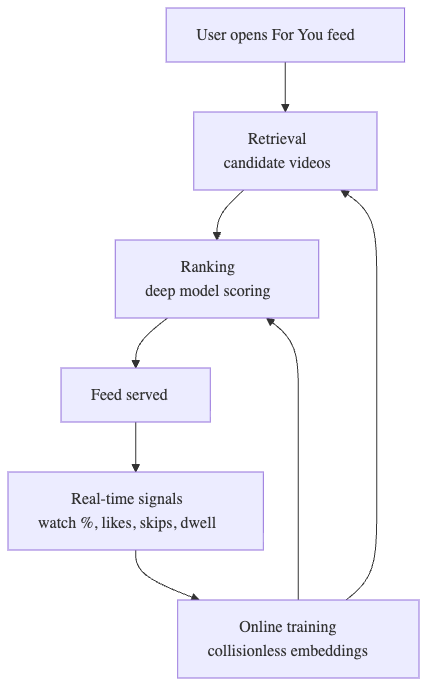
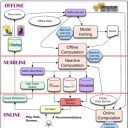
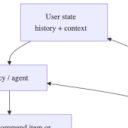
Simplified Architecture

TikTok's Recommendation System - Monolith


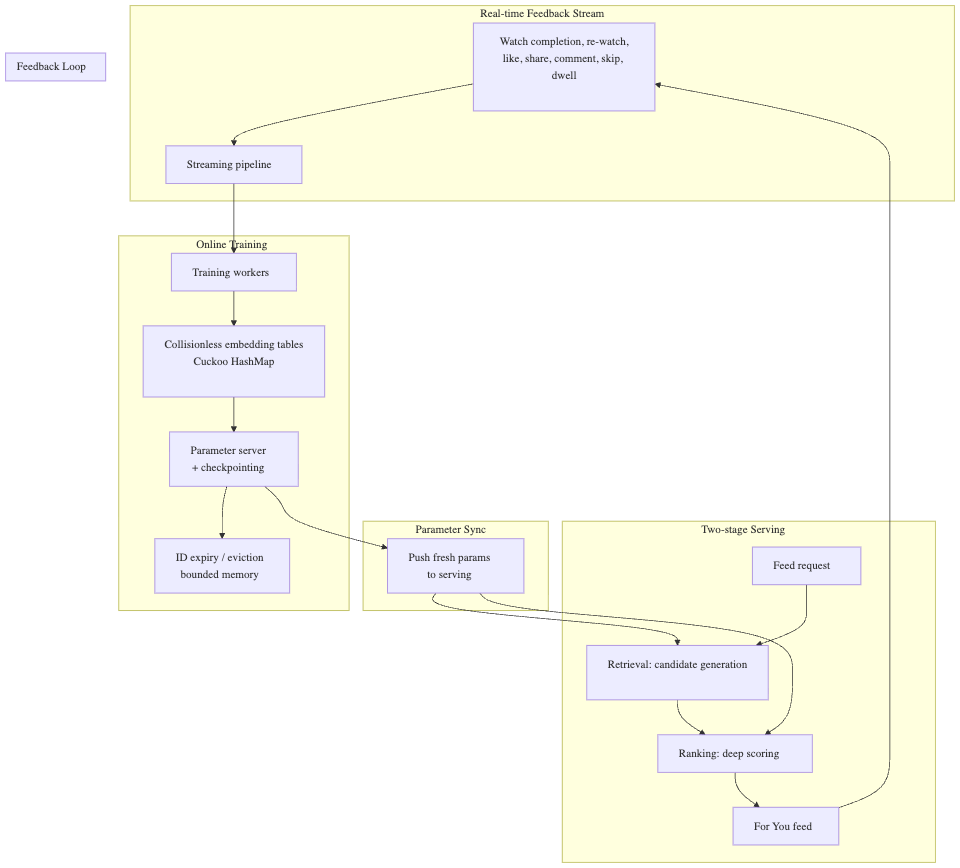
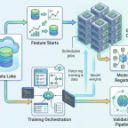
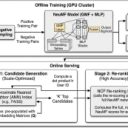
Reference Architecture

TikTok's Recommendation System - Monolith


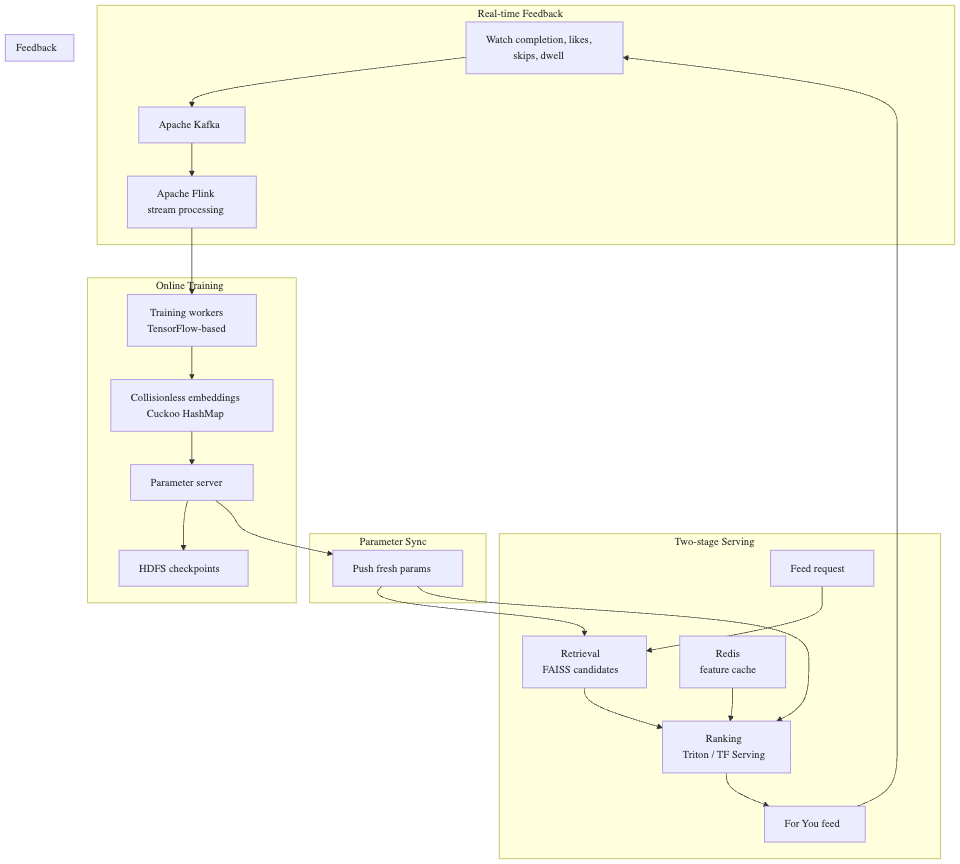
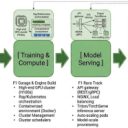
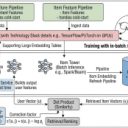
Reference Architecture (with Technology Stack)

The same flow on concrete tooling — Kafka + Flink streaming, online training workers writing to a parameter server with HDFS checkpoints, FAISS for retrieval, Redis for feature caching, and Triton for ranking.

TikTok's Recommendation System - Monolith


Signals & Features

Monolith’s signal set is the rich, immediate engagement stream that short video produces: watch completion rate, re-watches, likes, shares, comments, skips, and dwell time, alongside video metadata, tags, and user/video IDs. The emphasis on completion and re-watch — strong implicit quality signals for short clips — combined with content-centric weighting is what makes the feed feel uncannily responsive.


Training & Serving Considerations

The architecture’s hallmark is the tight coupling of online training and serving via frequent parameter synchronization, so the deployed model is never more than minutes behind reality. The collisionless tables keep representation quality high as the ID space explodes, while expiry/eviction and checkpointing keep memory bounded and recovery possible. The explicit, tunable stability-vs-freshness trade-off is the system’s core engineering theme: push freshness too hard and training destabilizes; too little and the feed loses its responsiveness.


Evaluation

In production, the decisive measures are online: watch time, completion rate, session length, and retention, validated through continuous experimentation. Offline proxies guide model iteration, but the real test is whether faster adaptation improves live engagement — the metric Monolith was built to move.


Strengths & Weaknesses

Strengths: exceptional speed of adaptation (online training + fresh embeddings); collisionless embeddings preserve quality at enormous, growing scale; strong cold-start for new content via content-centric weighting; rich real-time feedback loop.

Weaknesses: significant infrastructure and MLOps (Machine Learning Operations) complexity (streaming training, parameter servers, fault tolerance); online training introduces stability and reproducibility challenges; the same responsiveness that drives engagement raises well-known concerns about filter bubbles and compulsive use.


Takeaway for Engineers

Monolith is a case study in optimizing for freshness: when the domain drifts in hours, the winning architecture is one that learns continuously rather than in daily batches, and that represents an unbounded ID space without collisions. For a job seeker, the transferable lessons are the two-stage retrieval→ranking pattern, the role of embedding tables at scale, and the engineering reality that production recommendation is as much a streaming-systems and MLOps problem as a modeling one.


Note: This describes the architecture as published in 2022. TikTok’s current production system is proprietary and continuously evolving; exact internal details are not fully disclosed.

Tags AI Architecture Deep Learning Embedding Tables MLOps Monolith System OTT Online Training Real-time AI Recommendation Architecture Recommendation System Short Video Short-form TikTok TikTok Algorithm Facebook X
Comments 0
Similar posts
  1. FAISS Already Does ANN... So Why Do Top Teams Still Pay for SageMaker?
    307
  2. PyTorch example to Forcast Stock Price based on 10 days Dataset
    651
  3. Predicting Buyer Preferences with PyTorch: A Deep Learning Approach
    1,231
  4. MLOps Explained: Spark, Flink, and Reference Architecture Deep Dive
    237
  5. Image Embeddings for Vector Databases
    241
  6. How Netflix Runs Recommendations for Hundreds of Millions of Users Using Amazon SageMaker & Metaflow
    171
  7. Your Blueprint for an LLM & Vector DB Insurance Product Q&A
    256
  8. Building my own ChatGPT based on SageMaker and Milvus that is specialized to Shopping Mall
    264
  9. Is PyTorch Dead? Deep Learning's Enduring Role Beyond LLMs & Essential Skills
    691
  10. Netflix's Recommendation System
    412
  11. Cloud-Based AI Architecture Proposals for US Auto Finance Industry
    551
  12. Arm Kernel DNNs: Powering Efficient AI at the Edge
    221
  13. Autonomous Vehicle Machine Learning (AV ML): An Architectural Review
    395
  14. End-to-End Autonomous Vehicle ML Training Pipeline
    306
  15. Bridging the Gap: How Machine Learning Integrates with Infrastructure
    263
  16. When Do You Need Real-Time Model Registry Versioning Powered by Autonomous Agents?
    220
  17. Understanding Data Lineage
    252
  18. Designing a Data Curation System Around a Vector Database
    215
  19. AI-DLC vs. AI-SDLC: Model-Centric vs. System-Centric AI Development
    253
  20. Forecasting the Weather with PyTorch: A Beginner's Guide to Temperature Prediction
    1,430
  21. Reinforcement Learning–Based Methods for CTR Improvement based on Recommendation System
    262
  22. YouTube's Recommendation System
    258
  23. Wide & Deep / DeepFM for Recommendation Service (aka Ranking Service)
    247
  24. Two-Tower Model for Recommendation Service having a Very Large Catalog
    259
  25. Neural Collaborative Filtering (NCF) for Recommendation Service
    235
  26. Hybrid Methods for Recommendation Service
    213
  27. Model-Based CF: Matrix Factorization for Recommendation Service
    177
  28. Memory-Based Collaborative Filtering for Recommendation Service
    186
  29. Content-Based Filtering for Recommendation Service (aka User-based Model)
    187
  30. Common Recommendation Service Architecture
    525
  1. Amazon Q CLI for Debugging - What You Can Do
    436
  2. Vibe coding with Amazon Q in CLI combined with Claud AI Sonet 4
    464
  3. How do you create AI-based commit message with scope and action in Cursor AI?
    794
  4. Learn SLM if you have interent in the next after LLM
    4781
  5. VLM vs. LLM: How Vision-Language Models Are Revolutionizing Real-Time Media Processing
    29
  6. Why Reranking is Crucial for RAG and Agentic AI Systems?
    261
  7. Technical Hierarchy of AI Agents
    808
  8. MCP vs A2A
    592
  9. Vulnerabilities of MCP
    583
  10. The Revenge of the Junior Developer
    2,281
  11. A Complete Guide to LLM Dataset Formats: From Pre-Training to DPO in JSONL
    198
  12. Comparison of ChatGPT, Gemini, and Grok
    554
  13. MLOps Explained: Spark, Flink, and Reference Architecture Deep Dive
    237
  14. AI-based Image Creation based on Bing Image Creator
    981
  15. ChatGPT App (flowGPT) to create images with text
    1,030
  16. Things to Know for AI-driven, Multimodal Content Personalization.
    196
  17. Deep Dive into Vector Databases: Understanding Collections (Not Tables) and Embeddings
    230
  18. Image Embeddings for Vector Databases
    241
  19. Vector Databases: From Embeddings to Application
    310
  20. Scaling Vector Search: How to Architect FAISS on AWS EKS and ECS
    158
  21. Reinforcement Learning–Based Methods for CTR Improvement based on Recommendation System
    262
  22. YouTube's Recommendation System
    258
  23. Wide & Deep / DeepFM for Recommendation Service (aka Ranking Service)
    247
  24. Two-Tower Model for Recommendation Service having a Very Large Catalog
    259
  25. Sequence Models (RNN / Transformer) for Recommendation Service widely used at OTT and e-Commerce
    240
  26. Neural Collaborative Filtering (NCF) for Recommendation Service
    235
  27. Common Recommendation Service Architecture
    525
Recently updated
  1. Why 100% SEO Guarantees Better User Engagement and How to Achieve It in Your Service
    27
  2. Why SPF and DKIM Are Essential for Linux Email Servers?
    24
  3. How do I create animated background for Google Meet?
    19,712
  4. MaxMind GeoLite2 vs. DB-IP Lite vs. ip-api.com: Choosing the Right Free IP Geolocation Solution
    217
  5. Meet Valkey: Why Redis Changed Its License, Why Valkey is Better, and How to Use It as a Drop-in Replacement
    85
  6. How Rogue Web Scrapers Are Stealing My Content and Destroying My Server
    153
  7. Array of arguments passed to script in PHP
    85
  8. Invalid Auction Storms in Ad Tech
    93
  9. Building MRC-Compliant Instrumentation in Ad Tech: Implementation Steps and Key Challenges
    198
  10. The Two Clocks of Ad Server Architecture
    63
  11. Frequency Cap Architecture Overview
    509
  12. Collecting Proof-of-Play from 100,000 Screens
    141
  13. Vector Search in Relational Databases (RDBs): Trends & Usage Environments
    280
  14. What is RedisVL?
    105
  15. Designing a Skill Registry Architecture: Minimize Token Usage and Maximize AI Performance
    224
  16. TPU & GPU Cluster Management Tools
    232
  17. The Concept of Scaffolding in AI Agents
    221
  18. Beyond Static Pipelines: Architecting LLM Multi-Agent Systems for Autonomous Workflow Orchestration
    576
  19. AI-DLC vs. AI-SDLC: Model-Centric vs. System-Centric AI Development
    253
  20. Fine-Tuning Open-Weight LLMs: Training, Licensing, and Deploying Custom Models with Ollama
    327
  21. Inside the Next-Generation Streaming Architecture: Ultra-Low Latency, SGAI, and AI Codecs
    197
  22. Machine Learning: Training vs. Ranking
    213
  23. The Continuous Learning Machine: Designing a Loop That Actually Turns
    217
  24. The Next-Gen Low-Latency Standards: LL-HLS & MoQ
    189
  25. Designing a Data Curation System Around a Vector Database
    215
  26. Extracting Context from Live Video: The Architecture Got Simpler When We Stopped Building Features
    229
  27. The New Ad Stack Behind Live Sports Streaming: Inside SGAI, EABN, and the Standards Race to Fix Live Monetization
    649
  28. Designing MLOps Architectures to Handle Seasonal Data Drift in EV Fleet Models
    185
  29. From 15 to 40+ FPS: Accelerating PyTorch Object Detection on Automotive ECUs
    207
  30. Understanding Data Lineage
    252