YouTube's Recommendation System

CK CK 3788 
Created at  
269 0 0

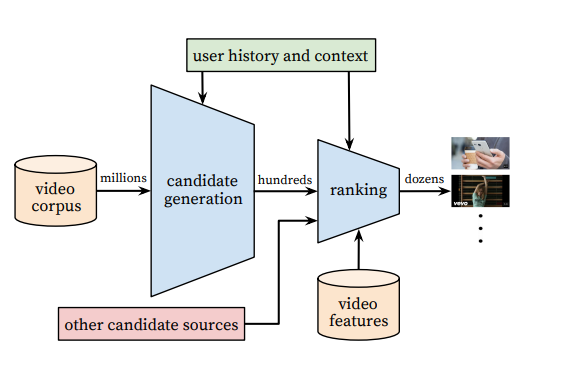
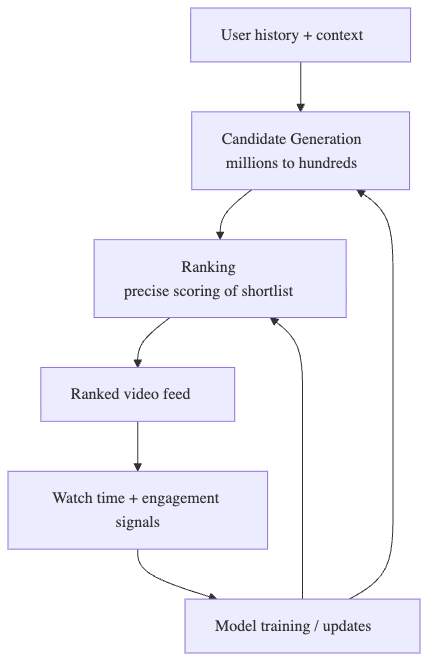
YouTube’s recommendation system is the archetypal two-stage deep-learning recommender. The influential 2016 paper (“Deep Neural Networks for YouTube Recommendations”) split the problem into Candidate Generation (narrow millions of videos down to hundreds) followed by Ranking (precisely score that shortlist). This decomposition — cheap, high-recall retrieval then expensive, high-precision ranking — became the blueprint for nearly every large-scale feed.

The system later evolved with multi-task learning (MMoE) to jointly optimize several objectives and REINFORCE-based reinforcement learning to optimize long-term engagement. Its long-standing primary objective was maximizing watch time (rather than clicks, to discourage clickbait), expanded over time toward multi-objective satisfaction metrics.

YouTube's Recommendation System


How It Works

Stage 1 — Candidate Generation

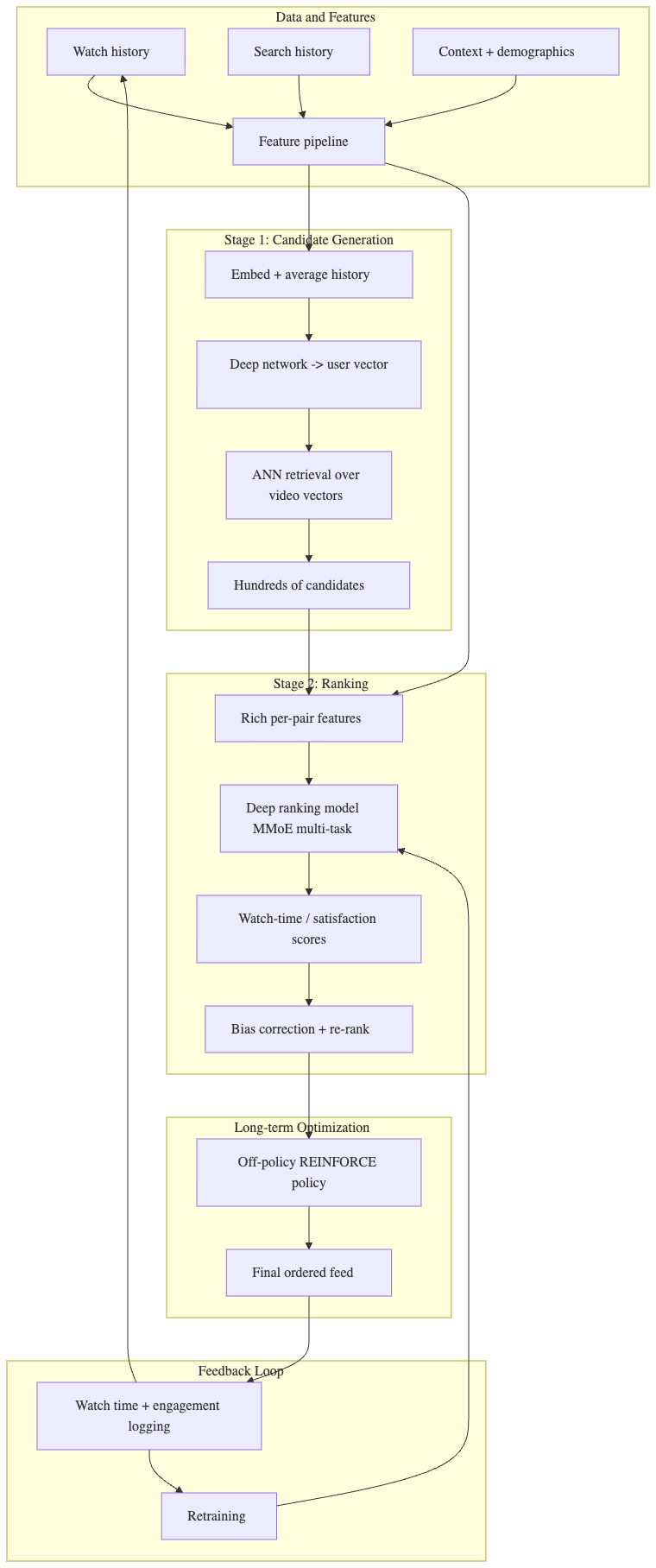
Framed as extreme multiclass classification: predict which video the user watches next out of the entire corpus, given their history. User watch history and search tokens are embedded and averaged into a fixed user vector, concatenated with demographic/context features, and passed through a deep network to produce a user embedding.

P(watch = i | user, context) = softmax( vᵢ · u )

over millions of classes. At serving time, exact softmax is infeasible, so the learned video vectors vᵢ are placed in an index and the user vector u retrieves the top candidates by approximate nearest-neighbor (ANN) search — effectively a learned two-tower-style retrieval. The model also uses signals like “example age” (video freshness) to avoid biasing toward older videos.

Stage 2 — Ranking

A separate, richer deep network scores each of the few hundred candidates using many more features per (user, video) pair: watch history with this channel, time since last watch, previous impressions (to demote repeatedly-ignored videos), language, and more. The original ranking model optimized expected watch time via a weighted logistic formulation rather than click probability — a deliberate choice to align the metric with genuine satisfaction.

Later evolution

  • MMoE (Multi-gate Mixture-of-Experts): the ranking model becomes multi-task, jointly predicting several engagement and satisfaction objectives (clicks, watch time, likes, surveys) with shared expert sub-networks and per-task gating. This handles competing objectives and reduces negative transfer.
  • REINFORCE / RL: a top-K off-policy policy-gradient layer optimizes long-term engagement, correcting for the bias that the training data was collected under previous recommendation policies.
  • Selection-bias correction: a shallow tower models position/selection bias so the main model learns true relevance, not just where an item was shown.


Requirements

  • Massive logged interaction data: watch history, search history, impressions, and engagement.
  • Two distinct models and pipelines — a retrieval network plus an ANN index, and a heavier ranking network.
  • Rich feature engineering for the ranking stage (cross/historical features, freshness/“example age”).
  • Multi-objective training infrastructure (MMoE) and off-policy RL machinery for the long-term objective.
  • Bias-correction mechanisms for position and selection bias inherent in logged feedback.
  • Low-latency serving with ANN retrieval and per-request feature assembly.


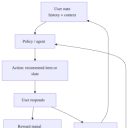
Simplified Architecture

YouTube's Recommendation System


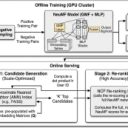
Reference Architecture

YouTube's Recommendation System


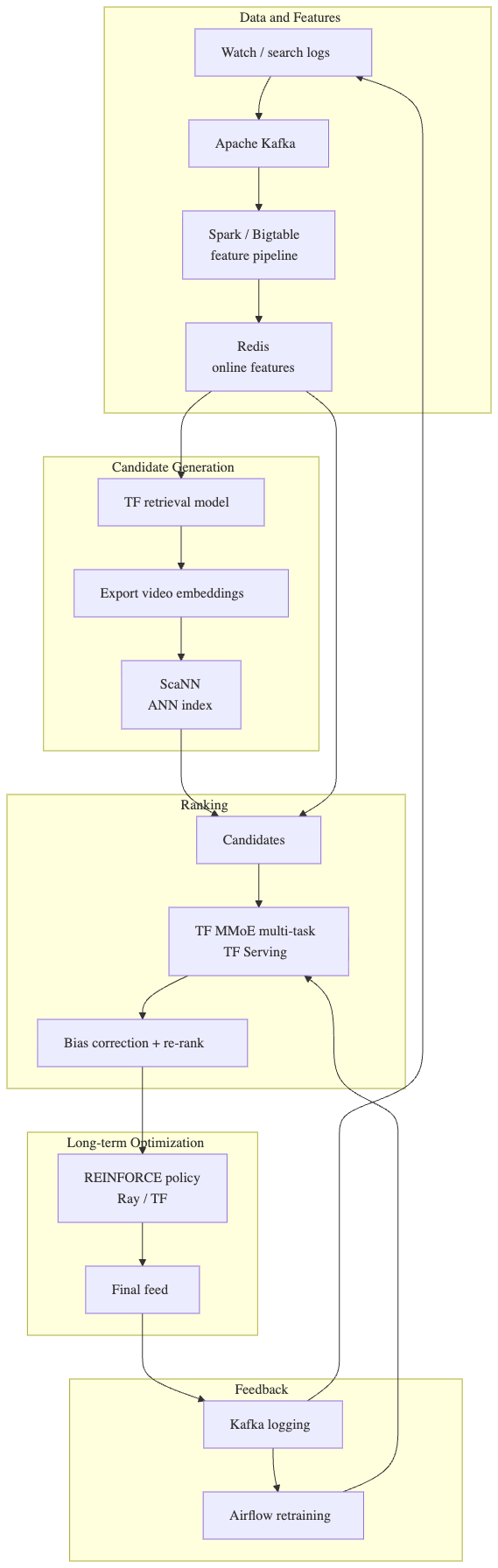
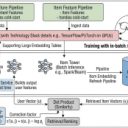
Reference Architecture (with Technology Stack)

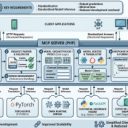
The same flow on concrete tooling — Kafka logs into a Spark/Bigtable feature pipeline, TensorFlow retrieval embeddings indexed in ScaNN, an MMoE ranking model on TF Serving, and a Ray/TF REINFORCE policy for long-term optimization.

YouTube's Recommendation System


Signals & Features

The system consumes watch history, search history, demographic and context features (device, geography, time), video metadata, and a broad set of engagement signals. Distinctive engineered features include example age / freshness (so the model recommends fresh uploads rather than over-weighting older, more-watched videos) and previous-impression counts (to avoid re-showing ignored videos). The decision to optimize watch time over clicks is itself a signal-design choice meant to suppress clickbait.


Training & Serving Considerations

Candidate generation is trained as huge-vocabulary classification and served via ANN over learned video embeddings; ranking is a heavier model run only on the small candidate set, where latency budgets are tight and feature assembly dominates cost. Moving to MMoE let one ranking model serve multiple objectives without separate models per goal, while REINFORCE added long-term optimization. Throughout, logged-feedback bias (position, selection, previous policy) is explicitly corrected — a recurring theme in mature recommendation engineering.


Evaluation

Offline, retrieval is judged on recall@k and ranking on AUC (Area Under the ROC Curve) / logloss (Logarithmic Loss) and watch-time prediction error; multi-task models track per-objective metrics. The authoritative signals are online A/B tests on watch time, satisfaction, and long-term retention. Counterfactual/off-policy estimators support the RL components, and bias-correction is validated by checking that learned relevance generalizes beyond historically-favored positions.


Strengths & Weaknesses

Strengths: the two-stage pattern scales precise ranking to a billion-item corpus; multi-task MMoE balances competing objectives; RL targets long-term engagement; deliberate watch-time and bias-correction design improves genuine satisfaction over naive click optimization.

Weaknesses: large engineering and MLOps (Machine Learning Operations) footprint (two models, ANN index, bias correction, RL); heavy data and compute requirements; lower interpretability; multi-objective and long-term optimization are hard to tune; susceptibility to feedback-loop and filter-bubble effects that require active mitigation.


Takeaway for Engineers

YouTube’s system is the reference implementation of the candidate generation → ranking paradigm that underlies almost every modern feed. The transferable lessons for a job seeker: master the two-stage retrieval/ranking split, understand why teams optimize watch time / satisfaction over raw clicks, and learn how production systems correct logged-data biases and balance multiple objectives with MMoE and RL.


Note: This summarizes commonly published architectures (notably the 2016, 2019 MMoE, and REINFORCE papers). YouTube’s current production system is proprietary and continuously evolving; exact internal details are not fully disclosed.

Tags AI System Candidate Generation Deep Learning Machine Learning Multi Task Learning Ranking Ranking System Recommendation Architecture Recommendation System Reinforcement Learning Scoring Watch Time YouTube Recommendation Facebook X
Comments 0
Similar posts
  1. Mastering Model Persistence: Saving and Loading Trained Machine Learning Models in Python
    1,165
  2. Harnessing the Power of Random Forest Algorithm in Python
    658
  3. Wide & Deep / DeepFM for Recommendation Service (aka Ranking Service)
    265
  4. Two-Tower Model for Recommendation Service having a Very Large Catalog
    270
  5. Sequence Models (RNN / Transformer) for Recommendation Service widely used at OTT and e-Commerce
    253
  6. Neural Collaborative Filtering (NCF) for Recommendation Service
    249
  7. Hybrid Methods for Recommendation Service
    222
  8. Model-Based CF: Matrix Factorization for Recommendation Service
    186
  9. Memory-Based Collaborative Filtering for Recommendation Service
    201
  10. Content-Based Filtering for Recommendation Service (aka User-based Model)
    194
  11. Common Recommendation Service Architecture
    539
  12. Reinforcement Learning–Based Methods for CTR Improvement based on Recommendation System
    273
  13. Forecasting the Weather with PyTorch: A Beginner's Guide to Temperature Prediction
    1,444
  14. Understanding and Implementing K-Nearest Neighbors (KNN) Algorithm in Python
    636
  15. Forecasting with Linear Regression and KNN Regression in Python
    928
  16. Getting Started with PyTorch: A Beginner's Guide to Building Your First Neural Network
    801
  17. Mastering AI: A Beginner's Guide to Python Programming and Beyond
    1,040
  18. Vector Databases: From Embeddings to Application
    322
  19. Image Embeddings for Vector Databases
    254
  20. Machine Learning Models for Ad Detection from a Video Stream
    194
  21. FAISS Already Does ANN... So Why Do Top Teams Still Pay for SageMaker?
    314
  22. TikTok's Recommendation System - Monolith
    300
  23. Milvus & FAISS: Decoding Their ML Synergy
    286
  24. PyTorch example to Forcast Stock Price based on 10 days Dataset
    653
  25. Predicting Buyer Preferences with PyTorch: A Deep Learning Approach
    1,234
  26. Mastering Ad Budget Throttling: Static, PID, and ML Strategies
    325
  27. Ad Impression Forecasting (aka Ad Inventory Forecasting): Architecting for Scale, Speed, and Accuracy
    334
  28. AI-Powered Ad Fraud Detection: Architectural Strategies
    337
  29. Brand Safety: AI-Driven Content Moderation on AWS
    736
  30. Building a MCP server in PHP
    638
  1. Learn SLM if you have interent in the next after LLM
    4921
  2. VLM vs. LLM: How Vision-Language Models Are Revolutionizing Real-Time Media Processing
    50
  3. Why Reranking is Crucial for RAG and Agentic AI Systems?
    274
  4. Technical Hierarchy of AI Agents
    825
  5. MCP vs A2A
    606
  6. Vulnerabilities of MCP
    593
  7. The Revenge of the Junior Developer
    2,311
  8. A Complete Guide to LLM Dataset Formats: From Pre-Training to DPO in JSONL
    223
  9. Comparison of ChatGPT, Gemini, and Grok
    565
  10. MLOps Explained: Spark, Flink, and Reference Architecture Deep Dive
    247
  11. AI-based Image Creation based on Bing Image Creator
    991
  12. ChatGPT App (flowGPT) to create images with text
    1,042
  13. Things to Know for AI-driven, Multimodal Content Personalization.
    206
  14. Deep Dive into Vector Databases: Understanding Collections (Not Tables) and Embeddings
    240
  15. Scaling Vector Search: How to Architect FAISS on AWS EKS and ECS
    196
Recently updated
  1. Google OAuth Token Expiration: Causes and Solutions
    29
  2. Why 100% SEO Guarantees Better User Engagement and How to Achieve It in Your Service
    55
  3. Why SPF and DKIM Are Essential for Linux Email Servers?
    49
  4. How do I create animated background for Google Meet?
    22,830
  5. MaxMind GeoLite2 vs. DB-IP Lite vs. ip-api.com: Choosing the Right Free IP Geolocation Solution
    271
  6. Meet Valkey: Why Redis Changed Its License, Why Valkey is Better, and How to Use It as a Drop-in Replacement
    103
  7. How Rogue Web Scrapers Are Stealing My Content and Destroying My Server
    168
  8. Array of arguments passed to script in PHP
    97
  9. Invalid Auction Storms in Ad Tech
    106
  10. Building MRC-Compliant Instrumentation in Ad Tech: Implementation Steps and Key Challenges
    207
  11. The Two Clocks of Ad Server Architecture
    77
  12. Frequency Cap Architecture Overview
    526
  13. Collecting Proof-of-Play from 100,000 Screens
    152
  14. Vector Search in Relational Databases (RDBs): Trends & Usage Environments
    302
  15. What is RedisVL?
    114
  16. Designing a Skill Registry Architecture: Minimize Token Usage and Maximize AI Performance
    246
  17. TPU & GPU Cluster Management Tools
    257
  18. The Concept of Scaffolding in AI Agents
    244
  19. Beyond Static Pipelines: Architecting LLM Multi-Agent Systems for Autonomous Workflow Orchestration
    596
  20. AI-DLC vs. AI-SDLC: Model-Centric vs. System-Centric AI Development
    267
  21. Fine-Tuning Open-Weight LLMs: Training, Licensing, and Deploying Custom Models with Ollama
    353
  22. Inside the Next-Generation Streaming Architecture: Ultra-Low Latency, SGAI, and AI Codecs
    206
  23. Machine Learning: Training vs. Ranking
    229
  24. The Continuous Learning Machine: Designing a Loop That Actually Turns
    228
  25. The Next-Gen Low-Latency Standards: LL-HLS & MoQ
    202
  26. Designing a Data Curation System Around a Vector Database
    230
  27. Extracting Context from Live Video: The Architecture Got Simpler When We Stopped Building Features
    263
  28. The New Ad Stack Behind Live Sports Streaming: Inside SGAI, EABN, and the Standards Race to Fix Live Monetization
    671
  29. Designing MLOps Architectures to Handle Seasonal Data Drift in EV Fleet Models
    200
  30. From 15 to 40+ FPS: Accelerating PyTorch Object Detection on Automotive ECUs
    232