Netflix's Recommendation System | ||
| ||
| Netflix is the company that arguably made “recommendation system” a household engineering term — first through the Netflix Prize (2006–2009), which popularized matrix factorization, and later through one of the most influential production architectures in the industry. Roughly 80% of what members watch is reported to come from recommendations rather than search, so personalization is core to the business. Netflix does not personalize a single feed. It personalizes an entire two-dimensional homepage: which rows to show (genres, “Trending Now”, “Continue Watching”, Netflix Originals), how to order titles within each row, and even which artwork/thumbnail to display for each title. This is a richer problem than a linear feed, and the architecture reflects it. Two ideas define Netflix’s published architecture: a three-tier computation model (offline / nearline / online) that decides where each computation runs, and a candidate generation → ranking → re-ranking pipeline that decides how titles are selected and ordered. As of 2025, Netflix has been consolidating its many specialized models into a single foundation model for personalization, borrowing directly from large-language-model design.
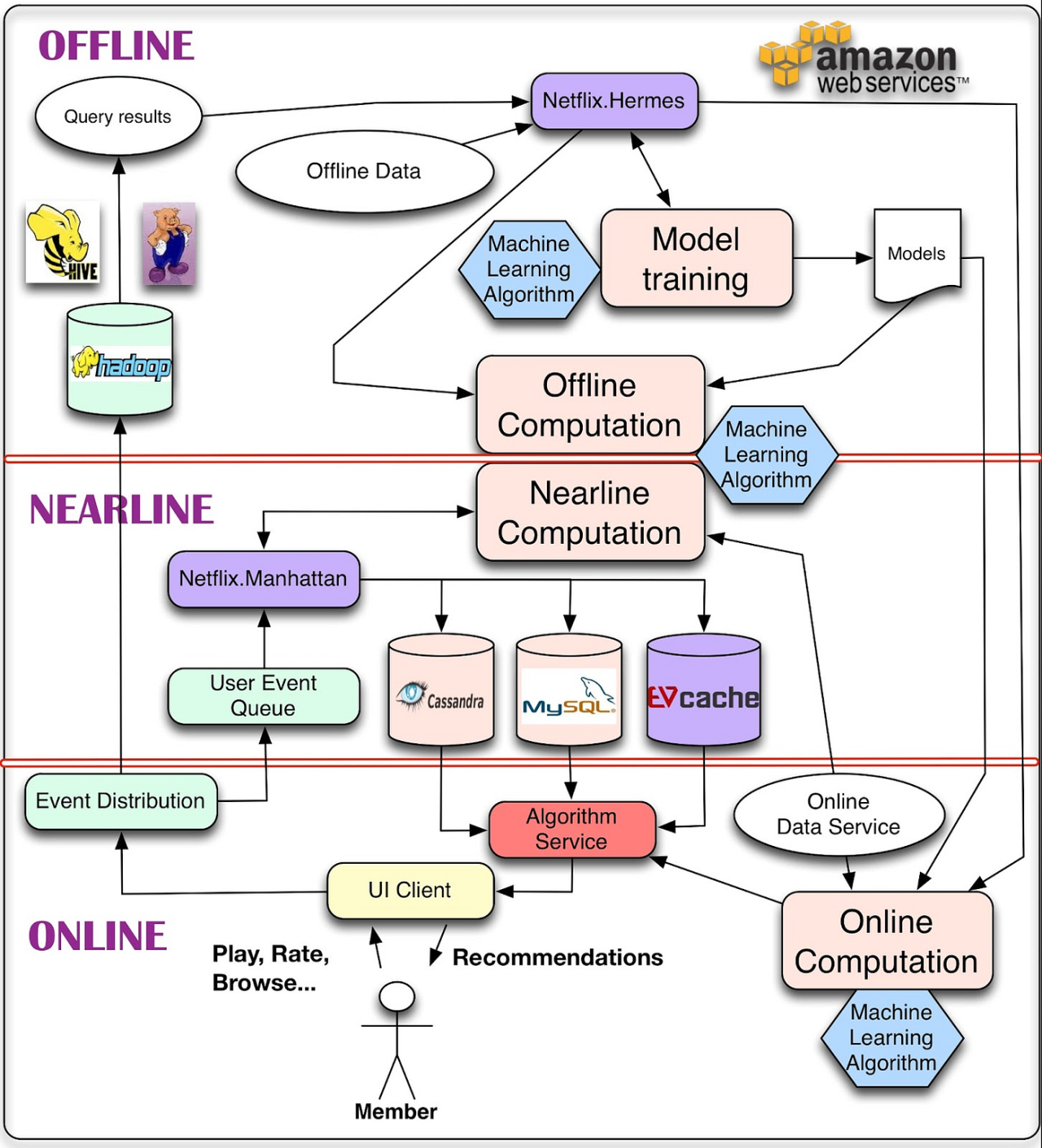
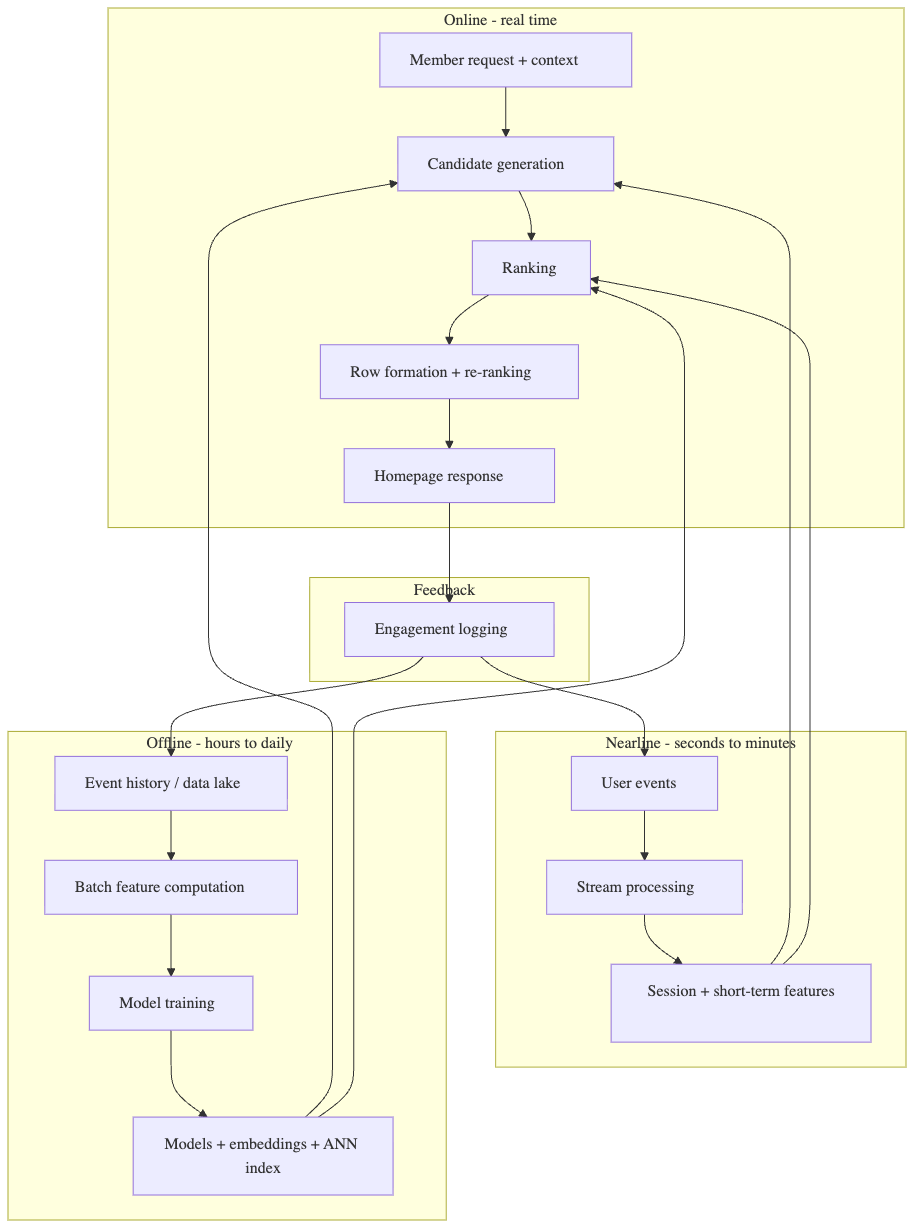
The Three-Tier Computation ModelNetflix’s classic contribution is organizing computation by latency and freshness requirements rather than by algorithm. The same logical recommendation can be split across three tiers:
Most real recommendations are a blend of all three: an offline-trained model, refreshed with nearline features, executed online against live context. Deciding which work lands in which tier is the central design trade-off — it balances responsiveness, cost, and engineering complexity.
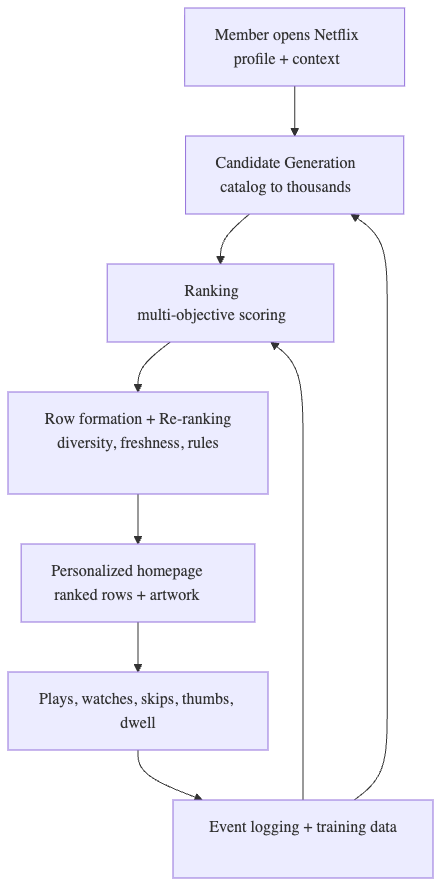
The Recommendation PipelineWithin the online/nearline tiers, Netflix uses the same multi-stage funnel described in the Common Recommendation Service Architecture doc:
A note on the mathNetflix has no single canonical formula, but two recur. The Netflix Prize era established matrix factorization with the regularized squared-error objective
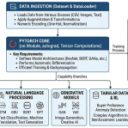
The 2025 Shift: A Foundation Model for Unified PersonalizationOver years, Netflix accumulated dozens of specialized models — one for “Continue Watching”, another for “Today’s Top Picks”, others for search, kids’ homepage, notifications. Each had its own pipeline, feature engineering, and label processing, causing heavy duplication, low cross-model leverage, and slow innovation. In 2025 Netflix published a shift to a single autoregressive transformer foundation model, inspired by large language models, that learns unified user representations from interaction sequences:
The foundation model is consumed three ways: embedded as a subgraph inside downstream models, via shared embeddings pushed to a central store, or through fine-tuning/distillation for a specific application. Downstream models become thin layers, so a single improvement to the foundation model lifts all of them at once.
Requirements
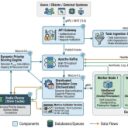
Simplified Architecture
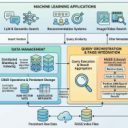
Reference Architecture
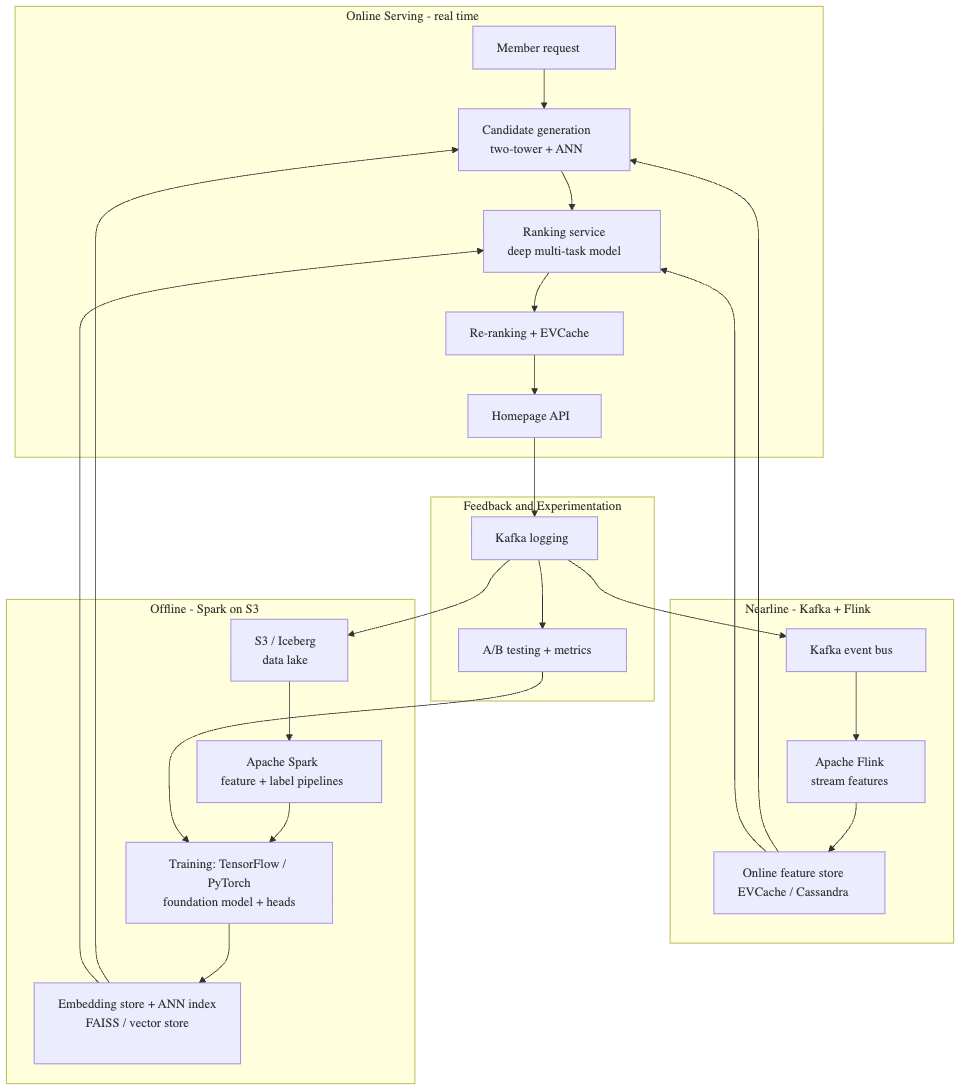
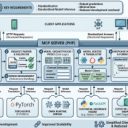
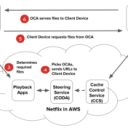
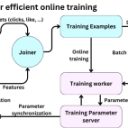
Reference Architecture (with Technology Stack)Mapped onto Netflix’s well-known platform — Kafka for the event bus, Flink for nearline processing, Spark on an S3/Iceberg data lake for offline, EVCache and Cassandra for low-latency stores, and TensorFlow/PyTorch for training the foundation model and its heads.
Signals & FeaturesNetflix draws on viewing history and completion, explicit thumbs ratings, search queries, time of day and day of week, device and network context, in-session behavior, title metadata (genre, cast, theme), and content/artwork embeddings. The foundation model additionally treats the full interaction sequence as its primary signal, encoding the when/where/what of every event. A centralized feature store serves heavy offline aggregates (long-term genre affinity, recency-decayed counts) alongside short-window nearline features (last session, last few minutes).
Training & Serving ConsiderationsTraining spans the three tiers: offline batch (Spark + GPU training of the foundation model and downstream heads), nearline refresh of features and session state, and online assembly under latency limits. Netflix’s notable serving constraint is that the foundation model’s scale is capped by latency, not accuracy — production use leans on distillation and on consuming the model as embeddings or subgraphs rather than always running the full network online. The ANN index for retrieval is rebuilt as embeddings refresh, and EVCache/Cassandra absorb the read load at request time.
EvaluationNetflix is famous for a rigorous A/B testing culture: offline metrics (ranking quality, recall, calibrated engagement predictions) gate candidates, but launch decisions hinge on online experiments measuring member engagement and, ultimately, retention — the metric the business cares about. For the foundation model, wins are reported across many downstream applications and A/B tests, validating that centralized improvements propagate widely. Long-term satisfaction (not just immediate plays) is an explicit target, which is why multi-token prediction and multi-objective heads matter.
Strengths & WeaknessesStrengths: the three-tier model cleanly balances freshness, latency, and cost; whole-page personalization (rows, ordering, and artwork) is uniquely rich; the foundation-model consolidation yields high leverage — one improvement benefits every surface — and faster innovation; deep experimentation discipline keeps decisions honest. Weaknesses: enormous engineering and MLOps (Machine Learning Operations) complexity across three tiers and many surfaces; the foundation model is latency-bound at scale, forcing distillation; cold start for new titles still requires semantic side information; feedback loops and popularity bias require active mitigation; and, as with all production systems, exact current internals are proprietary.
Takeaway for EngineersNetflix is the best case study for two lessons. First, organize computation by latency and freshness (offline/nearline/online), not just by algorithm — this framing transfers to almost any large personalization system. Second, the industry is consolidating many specialized models into unified foundation models; understanding sequence-based, LLM-style user representations and the leverage they create is increasingly valuable. Read this doc alongside the Common Service Architecture (00), Matrix Factorization (03), Two-Tower (07), Wide & Deep / DeepFM (08), and Sequence Models (06) docs — Netflix instantiates all of them.
Note: This summarizes commonly published Netflix architectures — the classic offline/nearline/online tech-blog model and the 2025 foundation-model work. Netflix’s exact, current production system is proprietary and continuously evolving; specific internal details are not fully disclosed. References
| ||
| | ||
| |