Reinforcement Learning–Based Methods for CTR Improvement based on Recommendation System

CK CK 3776 
Created at  
259 0 0

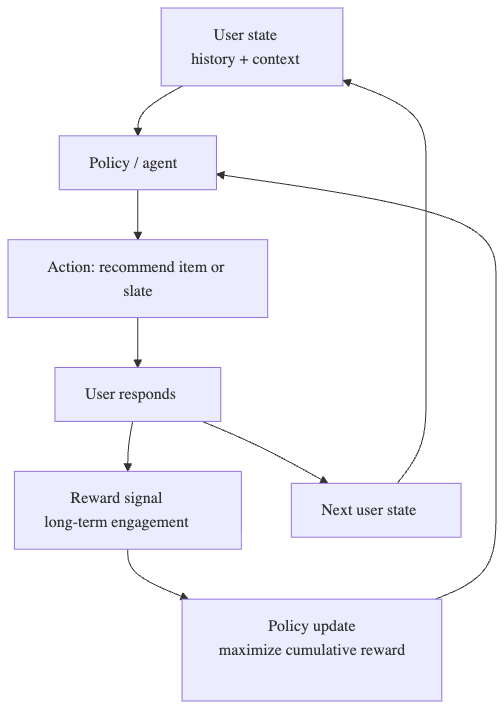
Reinforcement Learning (RL) reframes recommendation as a sequential decision-making problem rather than a one-shot prediction. Instead of asking “what will the user click right now?”, it asks “what sequence of recommendations maximizes long-term reward — sustained engagement, satisfaction, retention?”

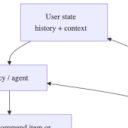
The recommender is an agent that observes the user’s state, takes an action (recommend item(s)), and receives a reward (the user’s response). It learns a policy that optimizes cumulative reward over a horizon, explicitly trading exploration (try new things to learn) against exploitation (serve known-good items). This directly addresses a blind spot of click-optimized models: maximizing immediate clicks can degrade long-term satisfaction (clickbait, filter bubbles).

Reinforcement Learning–Based Methods for CTR Improvement based on Recommendation System


How It Works (The Math)

The problem is modeled as a Markov Decision Process (MDP) (S, A, P, R, γ):

  • State s — user representation: history, context, session features.
  • Action a — the item (or slate of items) recommended.
  • Reward r — engagement signal (watch time, return visit, satisfaction).
  • Transition P(s' | s, a) — how the user state evolves after a recommendation.
  • Discount γ ∈ [0,1) — how much future reward counts versus immediate.

The objective is to maximize expected discounted return:

J(π) = E_π [ Σ_{t=0}^{∞} γᵗ r_t ]

Value-based (Deep Q-Network / DQN style)

Learn an action-value function and act greedily/ε-greedily:

Q*(s, a) = E[ r + γ · max_{a'} Q*(s', a') ]

Policy-gradient (REINFORCE)

Directly optimize a parameterized policy π_θ(a | s):
∇_θ J = E_π [ ∇_θ log π_θ(a | s) · Aᵗ ]

where Aᵗ is the (advantage-corrected) return. YouTube’s top-K off-policy REINFORCE is a landmark production application, learning from logged data with importance-sampling correction because the data was collected under a different (old) policy than the one being learned.

The off-policy challenge

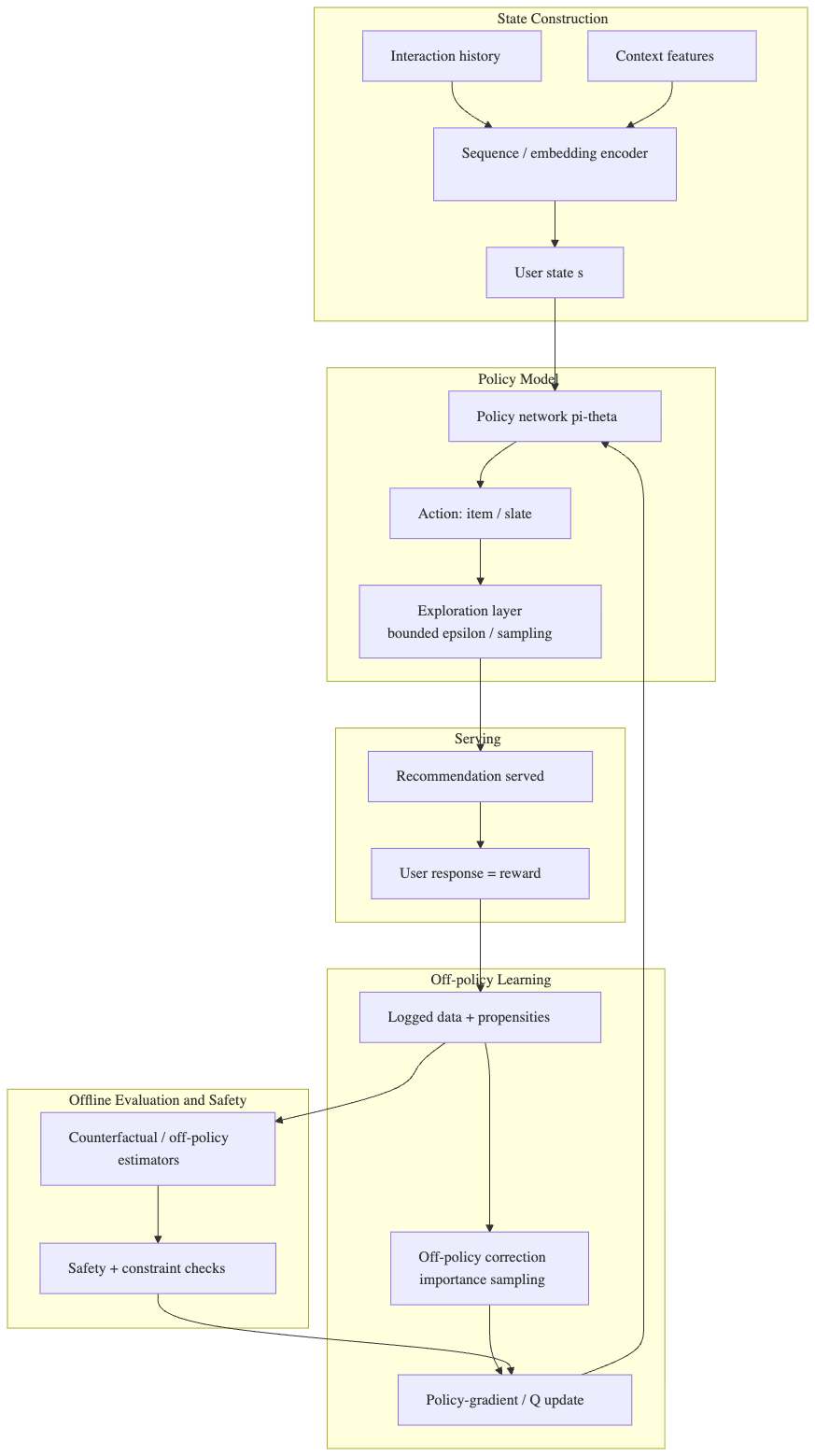
Recommenders cannot freely experiment on live users, so training mostly happens off-policy on logged data. Correcting the mismatch between the logging policy and the target policy (via importance weighting / propensity correction) is the central technical difficulty.


Requirements

  • A reward definition that genuinely encodes long-term value — the hardest and most consequential design choice.
  • A state representation of the user, usually produced by a sequence/embedding model.
  • Logged interaction data with logging propensities for off-policy learning, or a simulator for safe pretraining.
  • Off-policy correction machinery (importance sampling, propensity scores).
  • Guardrails: exploration must be bounded so experimentation does not harm user experience; safety constraints prevent runaway optimization.
  • Robust offline evaluation (off-policy/counterfactual estimators) since live trial-and-error is expensive and risky.


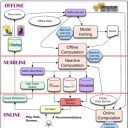
Simplified Architecture

Reinforcement Learning–Based Methods for CTR Improvement based on Recommendation System


Reference Architecture

Reinforcement Learning–Based Methods for CTR Improvement based on Recommendation System


Reference Architecture (with Technology Stack)

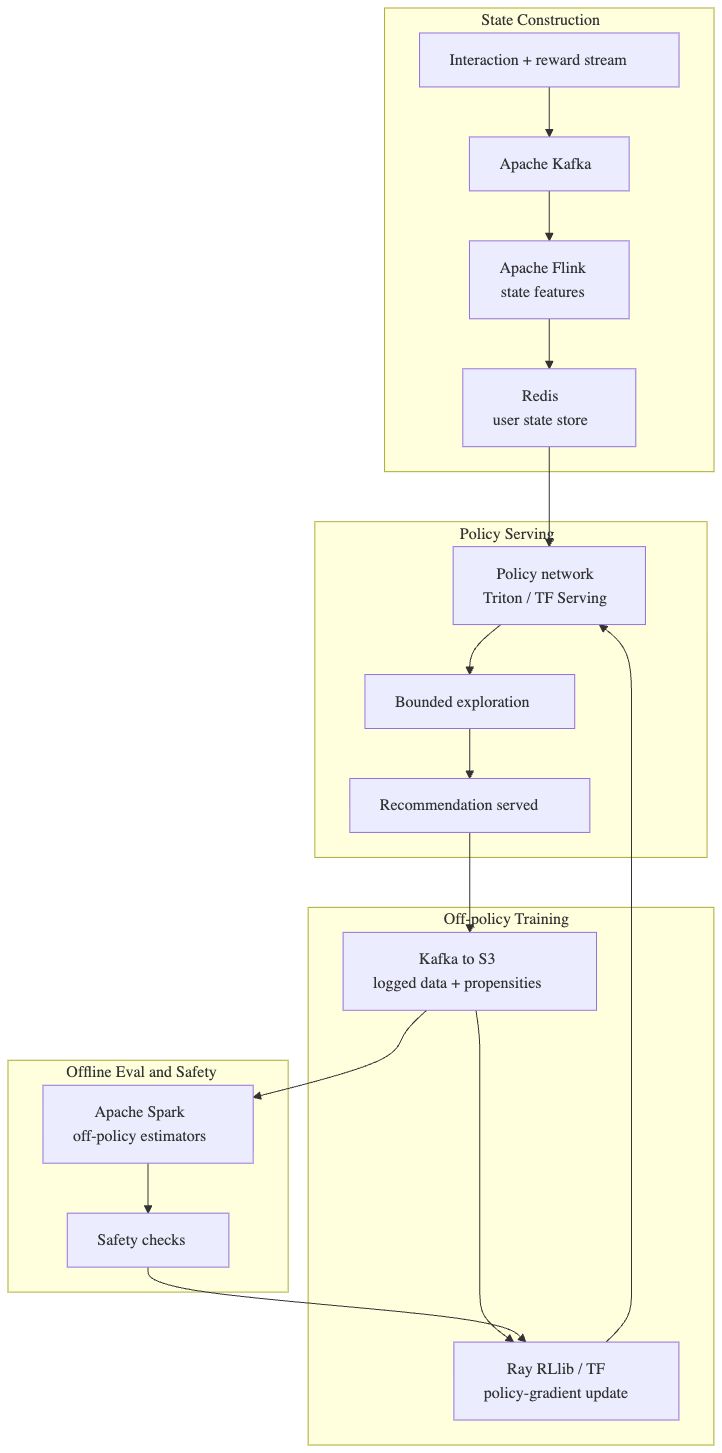
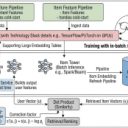
The same flow on concrete tooling — Flink for state features, Redis for the user-state store, Triton for policy serving, Ray RLlib/TF for off-policy training, and Spark for counterfactual evaluation.

Reinforcement Learning–Based Methods for CTR Improvement based on Recommendation System


Signals & Features

The state aggregates the same features used elsewhere (history embeddings, context, session signals). What distinguishes RL is the reward signal: it must capture long-horizon value — return visits, cumulative watch time, satisfaction surveys, retention — not just the immediate click. Poorly chosen rewards (e.g., raw watch time alone) invite reward gaming, so production systems blend multiple reward terms and add penalties for undesirable outcomes.


Training & Serving Considerations

Because online experimentation is costly and risky, training is predominantly off-policy on logged data with importance-sampling correction; simulators sometimes provide safe pretraining. Exploration is deliberately constrained so users are not subjected to too many bad recommendations. RL is frequently layered on top of a strong supervised system — supervised models propose candidates and an RL policy shapes long-term sequencing — rather than replacing it. This staging tames variance and keeps the system stable.


Evaluation

The defining difficulty is that offline accuracy metrics don’t capture long-term reward. Teams rely on off-policy / counterfactual estimators (importance-sampling, doubly-robust) to estimate a new policy’s value from logged data, then confirm with carefully scoped online A/B tests measuring retention and long-term engagement, not just session CTR (Click-Through Rate). Reward-gaming and distribution shift are monitored continuously.


Strengths & Weaknesses

Strengths: optimizes long-horizon objectives (retention, satisfaction) that myopic click models miss; adapts to evolving user state; principled handling of the exploration–exploitation trade-off.

Weaknesses: reward design is hard and mis-specification causes reward gaming / unintended optimization; off-policy training and offline evaluation are difficult; high variance and sample inefficiency; risky to experiment on live users; substantial engineering and theoretical complexity.


When to Use It

RL fits platforms where long-term engagement and retention are the real objective and where short-term-click optimization is known to backfire — large feeds and streaming services (YouTube’s REINFORCE work being the canonical example). It is best adopted after a solid supervised retrieval+ranking stack exists, added as a policy layer to optimize sequencing and long-term value, with strong off-policy evaluation and safety guardrails in place.

Tags AI Recommendations CTR CTR Improvement Deep Learning Exploration Exploitation Long Term Engagement Markov Decision Process Off Policy Learning Recommendation Architecture Recommendation Systems Reinforcement Learning Sequential Decisions User Retention YouTube Facebook X
Comments 0
Similar posts
  1. YouTube's Recommendation System
    257
  2. Wide & Deep / DeepFM for Recommendation Service (aka Ranking Service)
    245
  3. Two-Tower Model for Recommendation Service having a Very Large Catalog
    253
  4. Sequence Models (RNN / Transformer) for Recommendation Service widely used at OTT and e-Commerce
    239
  5. Neural Collaborative Filtering (NCF) for Recommendation Service
    235
  6. Hybrid Methods for Recommendation Service
    211
  7. Model-Based CF: Matrix Factorization for Recommendation Service
    177
  8. Memory-Based Collaborative Filtering for Recommendation Service
    185
  9. Content-Based Filtering for Recommendation Service (aka User-based Model)
    187
  10. Common Recommendation Service Architecture
    523
  11. AWS Architecture for collecting Click-Through Events on Advertisement serving
    10,371
  12. Forecasting the Weather with PyTorch: A Beginner's Guide to Temperature Prediction
    1,427
  13. Getting Started with PyTorch: A Beginner's Guide to Building Your First Neural Network
    797
  14. Mastering AI: A Beginner's Guide to Python Programming and Beyond
    1,031
  15. Image Embeddings for Vector Databases
    239
  16. FAISS Already Does ANN... So Why Do Top Teams Still Pay for SageMaker?
    307
  17. TikTok's Recommendation System - Monolith
    284
  18. PyTorch example to Forcast Stock Price based on 10 days Dataset
    651
  19. Predicting Buyer Preferences with PyTorch: A Deep Learning Approach
    1,228
  20. Navigating the Ad Tech Cold Start: Simple Solutions for a Complex Problem
    330
  21. JavaScript Code to Get Meta Description from HTML
    391
  22. How Netflix Runs Recommendations for Hundreds of Millions of Users Using Amazon SageMaker & Metaflow
    168
  23. Is PyTorch Dead? Deep Learning's Enduring Role Beyond LLMs & Essential Skills
    687
  24. Netflix's Recommendation System
    406
  25. Autonomous Vehicle Machine Learning (AV ML): An Architectural Review
    386
  26. Beyond SDLC: Why the Entertainment Sector Needs an AI Development Life Cycle Now
    277
  27. End-to-End Contextual Video Processing Architecture for AdTech
    202
  28. Samsung Apps hits 5 million Smart TV app downloads
    643
  1. Technical Hierarchy of AI Agents
    806
  2. MCP vs A2A
    589
  3. Vulnerabilities of MCP
    577
  4. The Revenge of the Junior Developer
    2,275
  5. A Complete Guide to LLM Dataset Formats: From Pre-Training to DPO in JSONL
    191
  6. Comparison of ChatGPT, Gemini, and Grok
    549
  7. MLOps Explained: Spark, Flink, and Reference Architecture Deep Dive
    236
  8. AI-based Image Creation based on Bing Image Creator
    978
  9. ChatGPT App (flowGPT) to create images with text
    1,030
  10. TikTok's Recommendation System - Monolith
    284
  11. Things to Know for AI-driven, Multimodal Content Personalization.
    194
  12. Deep Dive into Vector Databases: Understanding Collections (Not Tables) and Embeddings
    226
  13. Image Embeddings for Vector Databases
    239
  14. Vector Databases: From Embeddings to Application
    309
  15. Scaling Vector Search: How to Architect FAISS on AWS EKS and ECS
    155
  16. YouTube's Recommendation System
    257
  17. Wide & Deep / DeepFM for Recommendation Service (aka Ranking Service)
    245
  18. Two-Tower Model for Recommendation Service having a Very Large Catalog
    253
  19. Sequence Models (RNN / Transformer) for Recommendation Service widely used at OTT and e-Commerce
    239
  20. Neural Collaborative Filtering (NCF) for Recommendation Service
    235
  21. Common Recommendation Service Architecture
    523
Recently updated
  1. How do I create animated background for Google Meet?
    19,000
  2. MaxMind GeoLite2 vs. DB-IP Lite vs. ip-api.com: Choosing the Right Free IP Geolocation Solution
    192
  3. Meet Valkey: Why Redis Changed Its License, Why Valkey is Better, and How to Use It as a Drop-in Replacement
    75
  4. How Rogue Web Scrapers Are Stealing My Content and Destroying My Server
    151
  5. Array of arguments passed to script in PHP
    83
  6. Invalid Auction Storms in Ad Tech
    91
  7. Building MRC-Compliant Instrumentation in Ad Tech: Implementation Steps and Key Challenges
    194
  8. The Two Clocks of Ad Server Architecture
    61
  9. Frequency Cap Architecture Overview
    505
  10. Collecting Proof-of-Play from 100,000 Screens
    139
  11. Vector Search in Relational Databases (RDBs): Trends & Usage Environments
    276
  12. What is RedisVL?
    102
  13. Designing a Skill Registry Architecture: Minimize Token Usage and Maximize AI Performance
    218
  14. TPU & GPU Cluster Management Tools
    229
  15. The Concept of Scaffolding in AI Agents
    217
  16. Beyond Static Pipelines: Architecting LLM Multi-Agent Systems for Autonomous Workflow Orchestration
    568
  17. AI-DLC vs. AI-SDLC: Model-Centric vs. System-Centric AI Development
    246
  18. Fine-Tuning Open-Weight LLMs: Training, Licensing, and Deploying Custom Models with Ollama
    321
  19. Inside the Next-Generation Streaming Architecture: Ultra-Low Latency, SGAI, and AI Codecs
    196
  20. Machine Learning: Training vs. Ranking
    200
  21. The Continuous Learning Machine: Designing a Loop That Actually Turns
    212
  22. The Next-Gen Low-Latency Standards: LL-HLS & MoQ
    188
  23. Designing a Data Curation System Around a Vector Database
    212
  24. Extracting Context from Live Video: The Architecture Got Simpler When We Stopped Building Features
    228
  25. The New Ad Stack Behind Live Sports Streaming: Inside SGAI, EABN, and the Standards Race to Fix Live Monetization
    646
  26. Designing MLOps Architectures to Handle Seasonal Data Drift in EV Fleet Models
    180
  27. From 15 to 40+ FPS: Accelerating PyTorch Object Detection on Automotive ECUs
    203
  28. Understanding Data Lineage
    251
  29. System Requirements and Architecture: Intelligent Priority-Based Scheduler
    159
  30. GPU & LLM Cluster Infrastructure & Task Scheduling Architecture
    229