| Many people ask me what a vector database means. Vector databases, a concept researched for far longer than often realized, trace their mathematical and theoretical origins to the 1970s with early work on vector space models and high-dimensional data processing. The algorithmic foundations were further solidified from the late 1990s to early 2000s through advancements in Approximate Nearest Neighbor (ANN) search techniques. Commercialization and the establishment of a distinct product category began around 2019 with the emergence of specialized vector database products, but it was the generative AI and RAG (Retrieval Augmented Generation) craze, spearheaded by ChatGPT in late 2022, that brought this technology an explosive wave of mainstream attention. 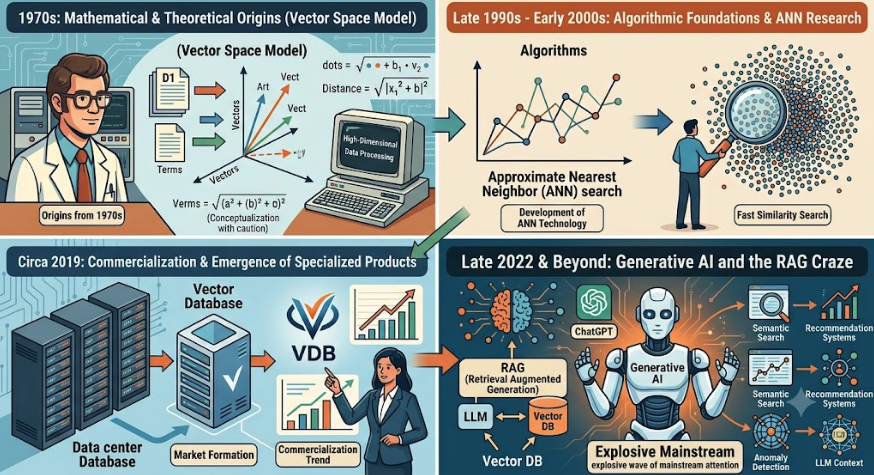
A vector database is a specialized database designed to store, manage, and query high-dimensional vectors, also known as embeddings. These embeddings are numerical representations of various forms of data (text, images, audio, video, etc.) that capture their semantic meaning or characteristics in a multi-dimensional space. 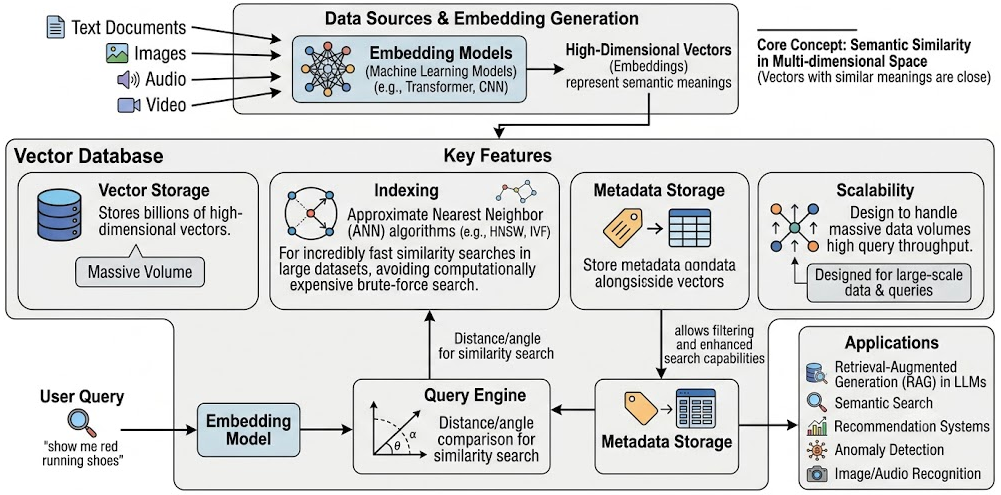
- Purpose: Its primary purpose is to enable efficient similarity search. By comparing the distance or angle between vectors, a vector database can quickly find data points that are semantically "similar" to a given query, even if their exact string or pixel values are different.
- Core Concept: It operates on the principle that data points with similar meanings or attributes will have their vector representations located close to each other in the vector space.
- Key Features:
- Vector Storage: Stores billions of high-dimensional vectors.
- Indexing: Utilizes Approximate Nearest Neighbor (ANN) algorithms (e.g., HNSW, IVF) to perform incredibly fast similarity searches in large datasets, avoiding the computationally expensive brute-force nearest neighbor search.
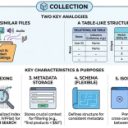
- Metadata Storage: Often stores metadata alongside vectors, allowing for filtering and enhanced search capabilities.
- Scalability: Designed to handle massive volumes of data and high query throughput.
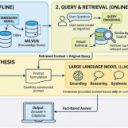
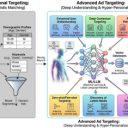
- Applications: Crucial for applications like Retrieval-Augmented Generation (RAG) in Large Language Models (LLMs), semantic search, recommendation systems, anomaly detection, image and audio recognition, and more.
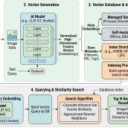
How do we build the Vector Database?Building a vector database, whether from scratch or understanding its core components, involves several key elements: 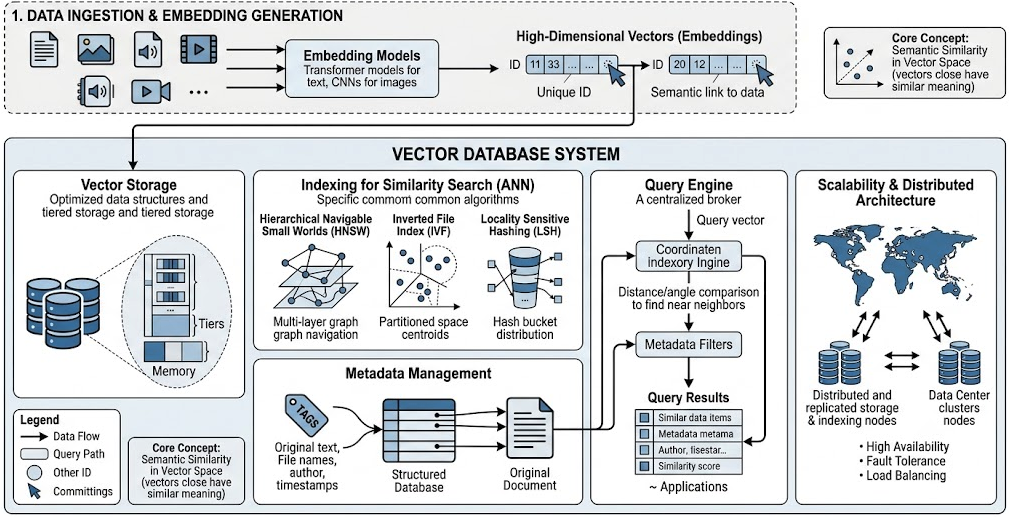
- Data Embedding:
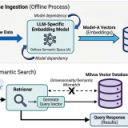
- The first step is to convert raw data (text documents, images, audio files) into high-dimensional numerical vectors (embeddings). This process is typically done using specialized machine learning models (e.g., Transformer models for text, CNNs for images).
- Each piece of data is associated with a unique vector that represents its semantic meaning.
- Vector Storage:
- Once generated, these vectors need to be stored efficiently. This often involves specialized data structures optimized for high-dimensional numerical data.
- Indexing for Similarity Search:
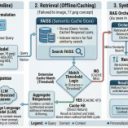
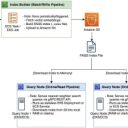
- This is the most critical component. To perform fast similarity searches across millions or billions of vectors, vector databases employ Approximate Nearest Neighbor (ANN) algorithms.
- Instead of checking every single vector (which is computationally prohibitive for large datasets), ANN algorithms create an index that allows for a fast, but potentially not perfectly exact, lookup of the nearest neighbors. Common ANN algorithms include:
- Hierarchical Navigable Small Worlds (HNSW): Builds a multi-layer graph where searches navigate from coarser to finer layers.
- Inverted File Index (IVF): Partitions the vector space into clusters, searching only relevant clusters.
- Locality Sensitive Hashing (LSH): Hashing vectors such that similar vectors have a higher probability of being hashed to the same bucket.
- These indexes need to be updated as new vectors are added or existing ones are modified.
- Metadata Management:
- Alongside the vectors, the database often stores associated metadata (e.g., original text, file names, author, timestamps). This metadata is crucial for filtering search results and retrieving the original context of the similar vectors found.
- Query Engine:
- A robust query engine is needed to accept incoming query vectors, utilize the ANN index to find similar vectors, apply any specified metadata filters, and return the results.
- Scalability and Distributed Architecture:
- For production-grade vector databases, a distributed architecture is essential to handle large datasets, high query loads, and ensure high availability and fault tolerance.
What is the most popular method to get embeddings?The most popular and effective method to obtain embeddings, especially for textual data, involves using pre-trained Transformer models. 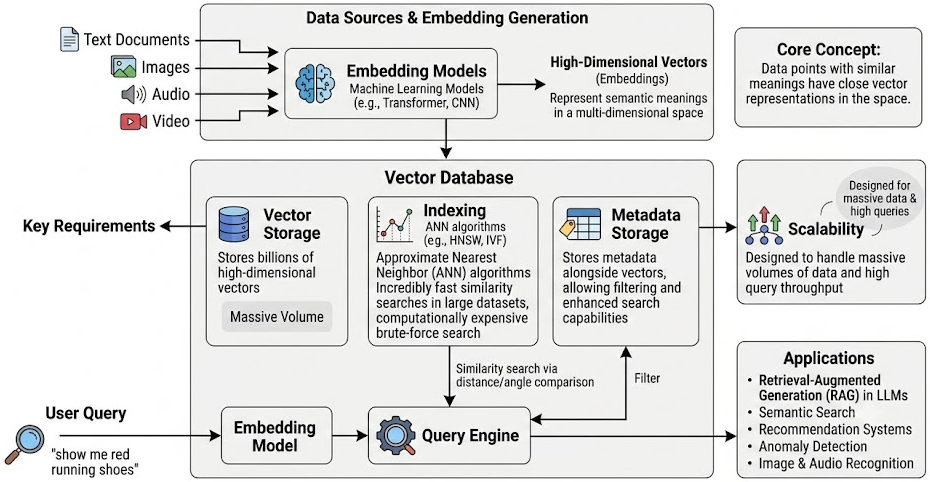
- Transformer Architecture: Models like BERT, RoBERTa, GPT, T5, and their variants are built upon the Transformer architecture, which excels at understanding context and relationships in sequential data.
- Mechanism:
- Tokenization: Input text is first broken down into smaller units called tokens.
- Contextual Understanding: The Transformer model processes these tokens through multiple layers, learning rich contextual representations for each token within the sentence.
- Embedding Extraction: A fixed-size vector (embedding) is then extracted from a specific layer of the model. For sentence embeddings, this often involves pooling the embeddings of all tokens in the sentence (e.g., averaging or using a special
[CLS] token's embedding).
- Why they are popular:
- High Quality: These models are trained on vast amounts of text data, allowing them to capture nuanced semantic relationships and produce highly discriminative embeddings.
- Contextualization: Unlike older methods like Word2Vec or GloVe, Transformer-based embeddings are contextual, meaning the embedding for a word like "bank" will differ depending on whether it refers to a financial institution or a riverbank.
- Readily Available: Many powerful pre-trained models are available either as open-source libraries (e.g., Sentence-BERT, Hugging Face Transformers) or as managed API services (e.g., OpenAI's
text-embedding-ada-002, Cohere Embed, Google's Vertex AI embeddings). - Generalizability: They perform well across a wide range of tasks and domains without requiring extensive fine-tuning for embedding generation.
While other methods exist (e.g., CNNs for images, specialized models for audio, or older NLP techniques like Word2Vec), Transformer models are the dominant standard for generating high-quality, general-purpose semantic embeddings, particularly for natural language. How do we use/access the Vector Database?Accessing and using a vector database typically follows a structured workflow, primarily focused on similarity search and data management. 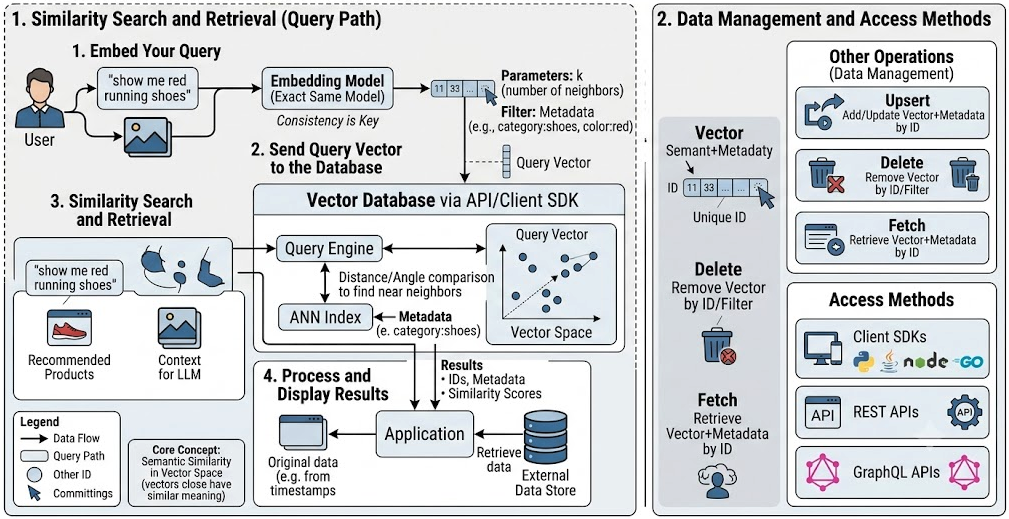
- 1. Embed Your Query:
- When a user submits a query (e.g., "show me red running shoes," or an image), the very first step is to convert that query into a high-dimensional vector.
- Crucially, this must be done using the exact same embedding model that was used to generate the embeddings stored in the vector database. Consistency is key for accurate similarity matching.
- 2. Send Query Vector to the Database:
- The generated query vector is then sent to the vector database via its API or client SDK.
- Along with the query vector, you often specify parameters like:
k: The number of nearest neighbors (most similar results) to retrieve.filter: Metadata filters to apply (e.g., "only return items where category is 'shoes' and color is 'red'"). This allows for hybrid search combining semantic and keyword/attribute filtering.
- 3. Similarity Search and Retrieval:
- The vector database receives the query vector.
- It uses its internal Approximate Nearest Neighbor (ANN) index to quickly find the
k vectors closest to the query vector in the multi-dimensional space. - Based on these similar vectors, it retrieves their associated metadata or pointers to the original data.
- 4. Process and Display Results:
- The application receives the results from the vector database, which typically include the IDs of the similar items, their associated metadata, and sometimes their similarity scores.
- The application then uses this information to retrieve the full original data (e.g., product descriptions, image files) from a separate data store if not stored directly in the metadata.
- Finally, the results are presented to the user (e.g., a list of recommended products, search results for documents, or context for an LLM).
- Other Operations (Data Management):
- Upsert: To add new vectors to the database, or update existing ones. You provide an ID, the vector, and any associated metadata.
- Delete: To remove vectors from the database based on their ID or specific metadata filters.
- Fetch: To retrieve specific vectors and their metadata by ID without performing a similarity search.
- Access Methods:
- Client SDKs: Most vector database providers offer client libraries in popular programming languages (Python, Java, Node.js, Go) to interact with the database.
- REST APIs: A common way to interact programmatically, allowing integration from any language or platform.
- GraphQL APIs: Some advanced vector databases might offer GraphQL interfaces for more flexible querying.
|