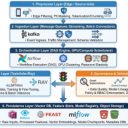
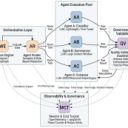
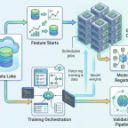
| Five cloud-based AI architectures are proposed to transform the US Auto Finance Industry, focusing on enhancing operational efficiency and customer engagement. These include an AI Underwriting system leveraging machine learning for rapid credit assessment, especially for thin-file customers, using diverse data sources and managed ML platforms. Another architecture offers AI-powered Vehicle Condition Assessment, utilizing computer vision for objective damage evaluation at lease return to reduce disputes. A third focuses on Lease Expiration Prediction and Personalized Marketing, employing predictive analytics and recommendation engines to deliver customized offers and improve retention. Furthermore, an AI Chatbot and Personalized Deal Matching system provides an intelligent conversational interface that matches customer preferences with optimal lease deals in real-time. Finally, a unique Consumer-Side AI for Reverse Negotiation empowers customers with an AI agent that directly negotiates with lease companies for better pricing. Each architecture comprehensively integrates cloud services for data management, advanced AI/ML processing, secure deployment, and continuous monitoring to drive innovation across critical financial operations. 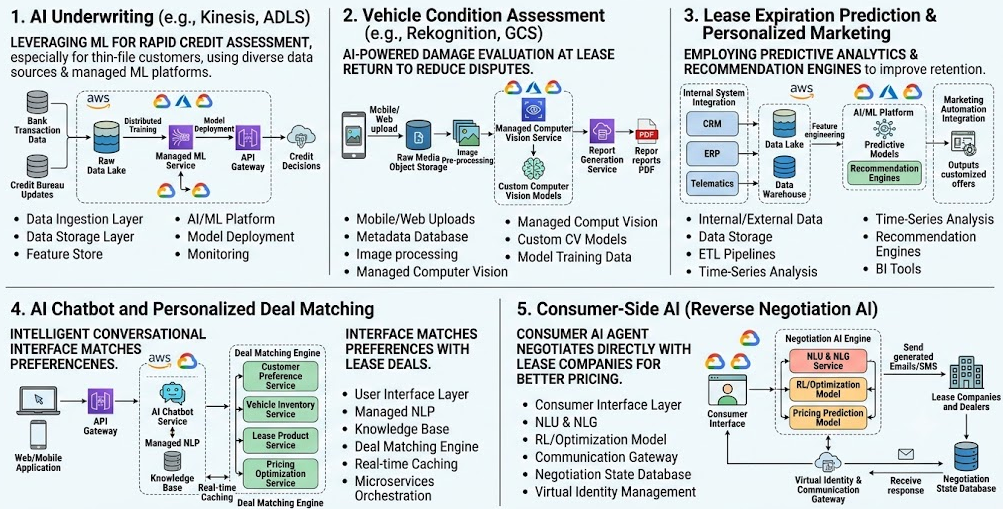
1. Credit Underwriting and Risk Management (AI Underwriting)This architecture focuses on leveraging machine learning to process diverse data sources for rapid and accurate credit assessment, particularly for thin-file customers. 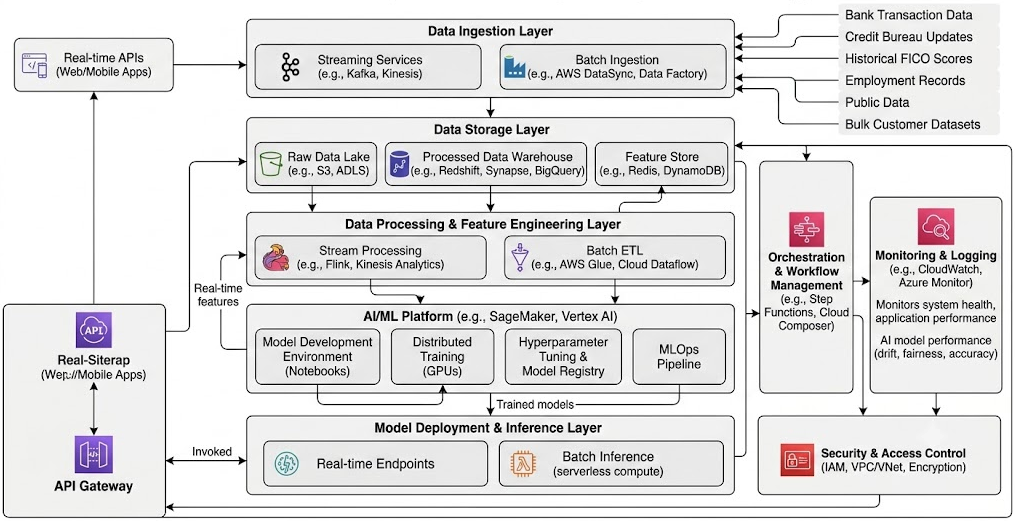
Key Components & Architecture: - Data Ingestion Layer:
- Real-time APIs: For direct submission of applicant data from web/mobile applications.
- Streaming Services: (e.g., Apache Kafka equivalent on cloud, Amazon Kinesis, Azure Event Hubs, Google Pub/Sub) for ingesting bank transaction data, credit bureau updates, and other alternative data feeds in real-time.
- Batch Ingestion: (e.g., AWS DataSync, Azure Data Factory, GCP Data Transfer Service) for historical FICO scores, employment records, public data, and bulk customer datasets into a Data Lake.
- Data Storage Layer:
- Raw Data Lake: (e.g., Amazon S3, Azure Data Lake Storage, Google Cloud Storage) to store all raw, immutable data from various sources.
- Processed Data Warehouse: (e.g., Amazon Redshift, Azure Synapse Analytics, Google BigQuery) for structured and transformed data, used for aggregate analysis and reporting.
- Feature Store: (e.g., managed Redis, DynamoDB, or specialized feature store services) to store pre-computed and real-time features, ensuring consistency between training and inference.
- Data Processing & Feature Engineering Layer:
- Batch ETL: (e.g., AWS Glue, Azure Data Factory with Databricks, Google Cloud Dataflow) for cleansing, transforming, and feature engineering historical data for model training.
- Stream Processing: (e.g., Apache Flink equivalent on cloud, Kinesis Data Analytics, Spark Streaming) for real-time feature generation and enrichment of incoming application data to ensure low-latency inference.
- AI/ML Platform:
- Managed ML Service: (e.g., Amazon SageMaker, Azure Machine Learning, Google Vertex AI) for model development, training, tuning, and MLOps. This includes:
- Model Development Environment: Notebooks for experimentation.
- Distributed Training: Utilizing GPU instances for complex ML models (e.g., XGBoost, LightGBM, deep learning for tabular data).
- Hyperparameter Tuning & Model Registry: For managing model versions and performance.
- MLOps Pipeline: Automation for retraining, monitoring, and deployment.
- Model Deployment & Inference Layer:
- Real-time Endpoints: (e.g., SageMaker Endpoints, Azure ML Endpoints, Vertex AI Endpoints) for low-latency predictions invoked via API Gateway during the application process.
- Batch Inference: Serverless compute (e.g., AWS Lambda, Azure Functions, Google Cloud Functions) or batch processing services for periodic risk re-evaluation of existing portfolios.
- Orchestration & Workflow Management:
- Workflow Services: (e.g., AWS Step Functions, Azure Logic Apps, Google Cloud Composer) to manage complex data pipelines, model training schedules, and inference jobs.
- Monitoring & Logging:
- Cloud Monitoring Services: (e.g., Amazon CloudWatch, Azure Monitor, Google Cloud Logging/Monitoring) for tracking system health, application performance, and AI model performance (drift detection, fairness metrics, prediction accuracy).
- Security & Access Control:
- IAM & VPC/VNet: For granular access control, network isolation, and data encryption (at rest and in transit).
- API Gateway:
- Exposing a secure, scalable API endpoint for internal and external systems to submit applications and receive credit decisions.
2. Vehicle Condition Assessment (AI-Powered Depreciation Evaluation)This architecture uses computer vision AI to objectively assess vehicle damage at lease return, reducing disputes and ensuring transparent depreciation costs. 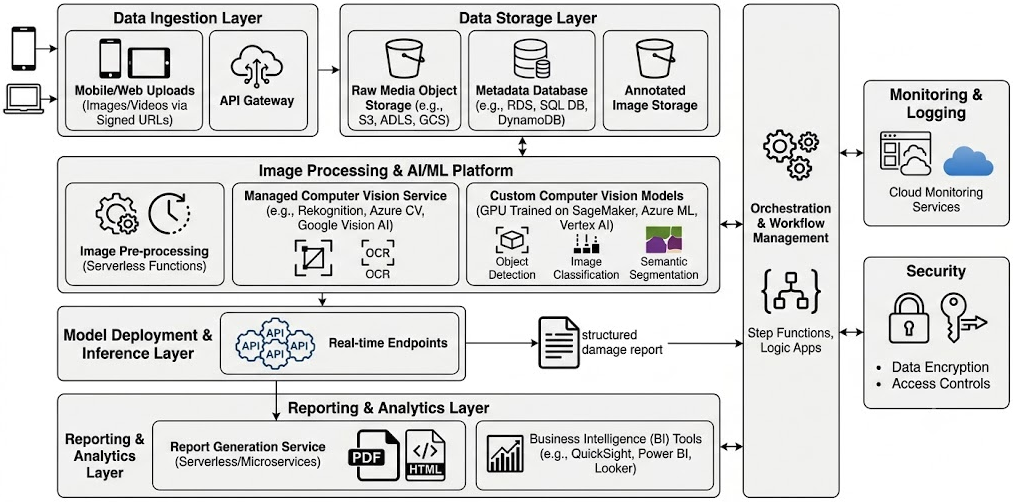
Key Components & Architecture: - Data Ingestion Layer:
- Mobile/Web Uploads: Direct secure uploads of images/videos from customer smartphones or dealer inspection tools to Object Storage via signed URLs.
- API Gateway: Serves as the entry point for image/video submissions from client applications.
- Data Storage Layer:
- Raw Media Object Storage: (e.g., Amazon S3, Azure Data Lake Storage, Google Cloud Storage) for storing original, high-resolution images and videos.
- Metadata Database: (e.g., Amazon RDS, Azure SQL Database, Google Cloud SQL, or a NoSQL database like DynamoDB) to store inspection details, vehicle VINs, customer information, timestamps, and model predictions.
- Annotated Image Storage: Object Storage for images with AI-detected damage overlays and bounding boxes.
- Image Processing & AI/ML Platform:
- Image Pre-processing: Serverless functions (e.g., AWS Lambda, Azure Functions, Google Cloud Functions) triggered by new uploads for resizing, format conversion, basic quality checks, and metadata extraction.
- Managed Computer Vision Service: (e.g., Amazon Rekognition, Azure Computer Vision, Google Vision AI) for initial object detection (e.g., identifying car parts, tires) and OCR if needed.
- Custom Computer Vision Models: (Trained on SageMaker, Azure ML, Vertex AI using GPU instances) for:
- Object Detection: Precisely identifying damages like scratches, dents, chips, and tire wear.
- Image Classification: Categorizing damage types and severity.
- Semantic Segmentation: To accurately outline damaged areas for quantitative measurement.
- Model Training Data: Millions of annotated damage images for robust model training.
- Model Deployment & Inference Layer:
- Real-time Endpoints: Managed API Endpoints (e.g., SageMaker Endpoints, Azure ML Endpoints, Vertex AI Endpoints) for immediate damage detection upon image upload, returning structured damage reports.
- Reporting & Analytics Layer:
- Report Generation Service: Serverless functions or microservices to compile AI findings, vehicle metadata, and generate objective inspection reports (PDF, HTML) automatically.
- Business Intelligence (BI) Tools: (e.g., Amazon QuickSight, Power BI, Looker) for analyzing damage trends, model accuracy, and cost savings from reduced disputes.
- Orchestration & Workflow Management:
- Workflow Services: (e.g., AWS Step Functions, Azure Logic Apps, Google Cloud Composer) to manage the sequence of image ingestion, pre-processing, AI inference, and report generation.
- Monitoring & Logging:
- Cloud Monitoring Services: For tracking API usage, model latency, accuracy, and overall system health. Includes model drift detection.
- Security:
- Data Encryption: For all media and metadata (at rest and in transit).
- Access Controls: Granular permissions for user uploads and system access.
3. Lease Expiration Prediction and Personalized MarketingThis architecture utilizes predictive analytics and recommendation engines to forecast customer behavior and deliver timely, customized lease offers, improving retention and sales. 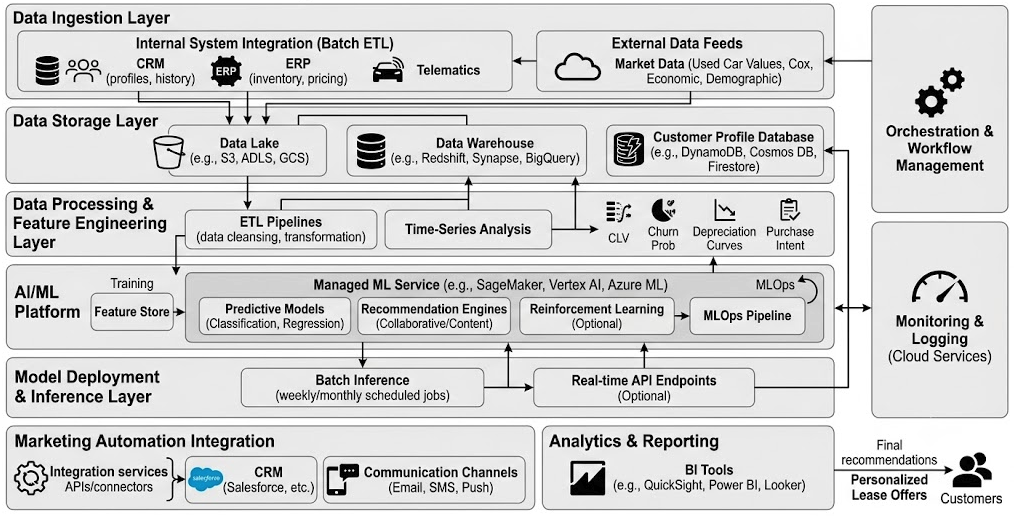
Key Components & Architecture: - Data Ingestion Layer:
- Internal System Integration: Batch ETL jobs (e.g., AWS Glue, Azure Data Factory, Google Cloud Dataflow) to extract data from CRM (customer profiles, lease history), ERP (vehicle inventory, pricing), and telematics systems.
- External Data Feeds: APIs or batch imports for market data (e.g., used car values like Cox Automotive's data, economic indicators, demographic data).
- Data Storage Layer:
- Data Lake: (e.g., Amazon S3, Azure Data Lake Storage, Google Cloud Storage) for storing all raw and semi-structured internal/external data.
- Data Warehouse: (e.g., Amazon Redshift, Azure Synapse Analytics, Google BigQuery) for structured, transformed, and aggregated data suitable for analytical queries and model training.
- Customer Profile Database: (e.g., NoSQL database like DynamoDB, Azure Cosmos DB, Google Cloud Firestore) for storing real-time customer preferences, behavioral data, and personalized recommendations.
- Data Processing & Feature Engineering Layer:
- ETL Pipelines: (e.g., AWS Glue, Azure Data Factory, Google Cloud Dataflow) for data cleansing, transformation, and creation of features crucial for prediction and recommendations (e.g., customer lifetime value, churn probability, vehicle depreciation curves, purchase intent scores).
- Time-Series Analysis: For forecasting vehicle residual values, market demand, and predicting customer lease-end behavior.
- AI/ML Platform:
- Managed ML Service: (e.g., Amazon SageMaker, Azure Machine Learning, Google Vertex AI) for developing and deploying:
- Predictive Models: Classification models for renewal likelihood, next vehicle type prediction, and regression models for optimal price points.
- Recommendation Engines: Collaborative filtering or content-based systems to suggest personalized vehicle models, lease terms, and accessories based on customer profile, history, and market trends.
- Reinforcement Learning (Optional): To dynamically optimize marketing campaign strategies based on real-time customer responses.
- MLOps: Automated pipelines for continuous retraining, model versioning, and deployment.
- Model Deployment & Inference Layer:
- Batch Inference: Scheduled jobs to generate predictions and recommendations for the entire customer base periodically (e.g., weekly or monthly), updating the Customer Profile Database.
- Real-time API Endpoints (Optional): For dynamic recommendation generation if integrated with a real-time marketing or customer service platform.
- Marketing Automation Integration:
- Integration Services: APIs or connectors to seamlessly integrate AI-generated insights and recommendations with existing CRM (e.g., Salesforce), marketing automation platforms, and communication channels (email, SMS, push notifications).
- Analytics & Reporting:
- BI Tools: (e.g., Amazon QuickSight, Power BI, Looker) for tracking campaign performance, conversion rates, customer engagement, and overall ROI of personalized marketing efforts.
- Orchestration & Workflow Management:
- Workflow Services: To manage data ingestion, ETL, model training, inference, and integration with marketing platforms.
- Monitoring & Logging:
- Cloud Monitoring Services: For system health, application performance, and AI model performance (prediction accuracy, recommendation relevance, data drift).
4. AI Chatbot and Personalized Deal MatchingThis architecture provides an intelligent conversational interface for customers, matching their preferences with optimal lease deals from various providers in real-time. 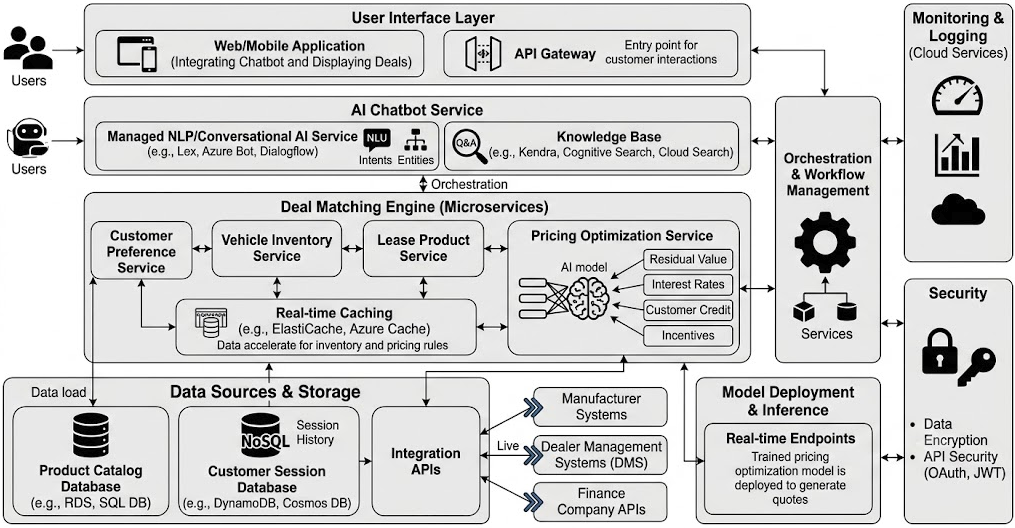
Key Components & Architecture: - User Interface Layer:
- Web/Mobile Application: Customer-facing interface integrating the chatbot and displaying matched lease deals.
- API Gateway:
- Entry point for customer interactions from the web/mobile app, directing requests to the appropriate backend services.
- AI Chatbot Service:
- Managed NLP/Conversational AI Service: (e.g., Amazon Lex, Azure Bot Service with QnA Maker, Google Dialogflow) for natural language understanding (NLU), intent recognition, entity extraction, and dialogue management.
- Knowledge Base: (e.g., managed search service like Amazon Kendra, Azure Cognitive Search, Google Cloud Search) for providing answers to common questions about leasing terms, vehicle features, etc.
- Deal Matching Engine (Microservices):
- Customer Preference Service: Stores and analyzes customer inputs (budget, vehicle type, driving habits).
- Vehicle Inventory Service: Aggregates real-time inventory from manufacturers and dealers via APIs.
- Lease Product Service: Catalogs lease terms, rates, and eligibility criteria from various finance companies.
- Pricing Optimization Service: An AI model (trained on SageMaker, Azure ML, Vertex AI) that considers multiple factors (residual value, interest rates, customer credit, incentives) to generate optimized lease quotes.
- Real-time Caching: (e.g., Amazon ElastiCache for Redis, Azure Cache for Redis, Google Cloud Memorystore) for frequently accessed data like inventory, pricing rules, and popular lease deals to ensure low-latency responses.
- Data Sources & Storage:
- Product Catalog Database: (e.g., relational database like Amazon RDS, Azure SQL Database, Google Cloud SQL) for structured vehicle and lease product information.
- Customer Session Database: (e.g., NoSQL database like DynamoDB, Cosmos DB, Cloud Firestore) for storing chatbot conversation history and user preferences during a session.
- Integration APIs: Real-time connections to manufacturer systems, dealer management systems (DMS), and finance company APIs for live data.
- Model Deployment & Inference:
- Real-time Endpoints: The pricing optimization model is deployed as a real-time API endpoint to provide immediate lease quote calculations.
- Orchestration & Workflow Management:
- Microservices Orchestration: Using container orchestration (e.g., Kubernetes on EKS, AKS, GKE) or serverless functions (e.g., Lambda, Azure Functions, Cloud Functions) to coordinate calls between various services (chatbot, inventory, pricing, finance APIs).
- Monitoring & Logging:
- Cloud Monitoring Services: For chatbot analytics (user engagement, intent accuracy), API performance, system health, and model performance.
- Security:
- Data Encryption: For sensitive customer and financial data.
- API Security: OAuth, JWT for secure API access.
5. Consumer-Side AI (Reverse Negotiation AI)This unique architecture empowers consumers by deploying an AI agent that directly negotiates with lease companies and dealers to secure better lease prices. 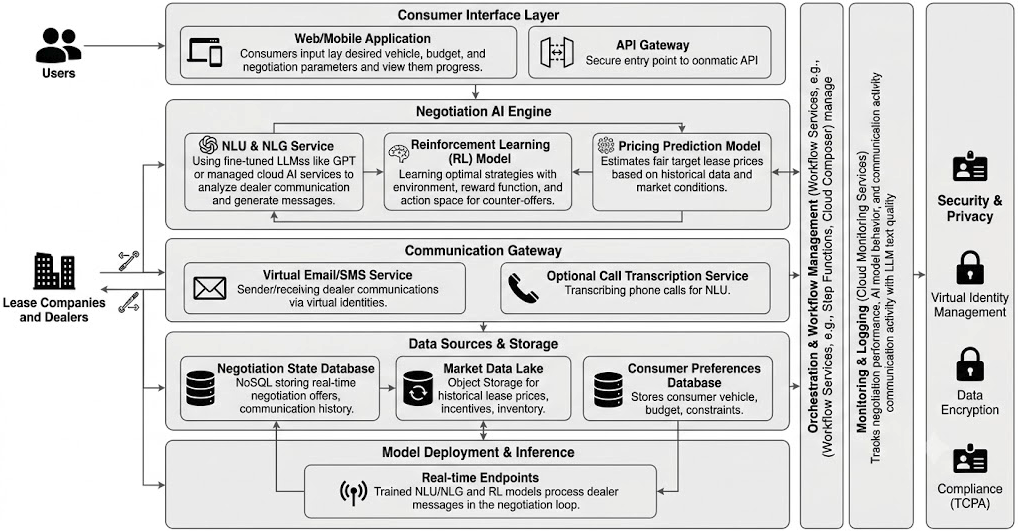
Key Components & Architecture: - Consumer Interface Layer:
- Web/Mobile Application: Where consumers input their desired vehicle, budget, and desired negotiation parameters. Displays negotiation progress and final offers.
- API Gateway:
- Secure entry point for consumer requests and communication from the negotiation AI.
- Negotiation AI Engine:
- Natural Language Understanding (NLU) & Generation (NLG) Service: (e.g., fine-tuned large language models like GPT-series, or managed services like Amazon Comprehend/Lex, Azure Language Service, Google Cloud AI Platform) to analyze incoming dealer communications and generate persuasive, context-aware negotiation messages (emails/SMS).
- Reinforcement Learning (RL) / Optimization Model: (e.g., trained using SageMaker, Azure ML, Vertex AI, or specialized RL platforms) that learns optimal negotiation strategies based on:
- Environment: Simulating or interacting with real dealer responses.
- Reward Function: Maximizing price reduction for the consumer while ensuring a deal is reached.
- Action Space: Generating counter-offers, asking questions, requesting incentives, etc.
- Pricing Prediction Model: An ML model (trained on historical lease data, dealer incentives, market conditions) to estimate a fair target lease price for a given vehicle, guiding the negotiation.
- Communication Gateway:
- Virtual Email/SMS Service: (e.g., Amazon SES, Twilio, SendGrid) to send and receive communications with dealers using generated virtual email addresses and phone numbers.
- Call Transcription Service (Optional): If the AI is designed to handle phone calls, a speech-to-text service would transcribe conversations for NLU.
- Data Sources & Storage:
- Negotiation State Database: (e.g., NoSQL database like DynamoDB, Cosmos DB, Cloud Firestore) to store the real-time state of each negotiation, including offers, counter-offers, communication history, and internal AI decision logs.
- Market Data Lake: (e.g., Object Storage) for historical lease prices, dealer incentive programs, competitor data, and publicly available inventory.
- Consumer Preferences Database: Stores desired vehicle, budget, and other negotiation constraints.
- Model Deployment & Inference:
- Real-time Endpoints: For the NLU/NLG and RL models to process incoming dealer messages and generate immediate responses in the negotiation loop.
- Orchestration & Workflow Management:
- Workflow Services: (e.g., AWS Step Functions, Azure Logic Apps, Google Cloud Composer) to manage the entire negotiation lifecycle, from initial consumer request to final deal closure, coordinating AI actions and communication.
- Monitoring & Logging:
- Cloud Monitoring Services: For tracking negotiation performance (savings achieved, negotiation duration, success rate), AI model behavior, and communication gateway activity. Includes LLM monitoring for generated text quality.
- Security & Privacy:
- Virtual Identity Management: Secure generation and management of virtual email/phone numbers to protect consumer identity.
- Data Encryption: For all communication logs and sensitive consumer data.
- Compliance: Ensuring compliance with communication regulations (e.g., TCPA).
|