AI-based workflow innovation - it's not just an optimizing cost/process but also a matter of survival!

CK CK 3788 
Created at
Updated at  
391 0 0

Many companies are aggressively innovating workflows with AI nowadays primarily to unlock unprecedented levels of efficiency, automate repetitive tasks, and drastically reduce operational costs. It's not just an optimizing cost/process but also a matter of survival for them.

This drive is fueled by the desire to gain a significant competitive edge, enabling faster decision-making through sophisticated data analysis, and creating more personalized customer experiences.

Furthermore, the rapid advancements and accessibility of AI technologies make it a strategic imperative for businesses to adapt and transform, ensuring they remain agile, scalable, and relevant in a dynamic global market.


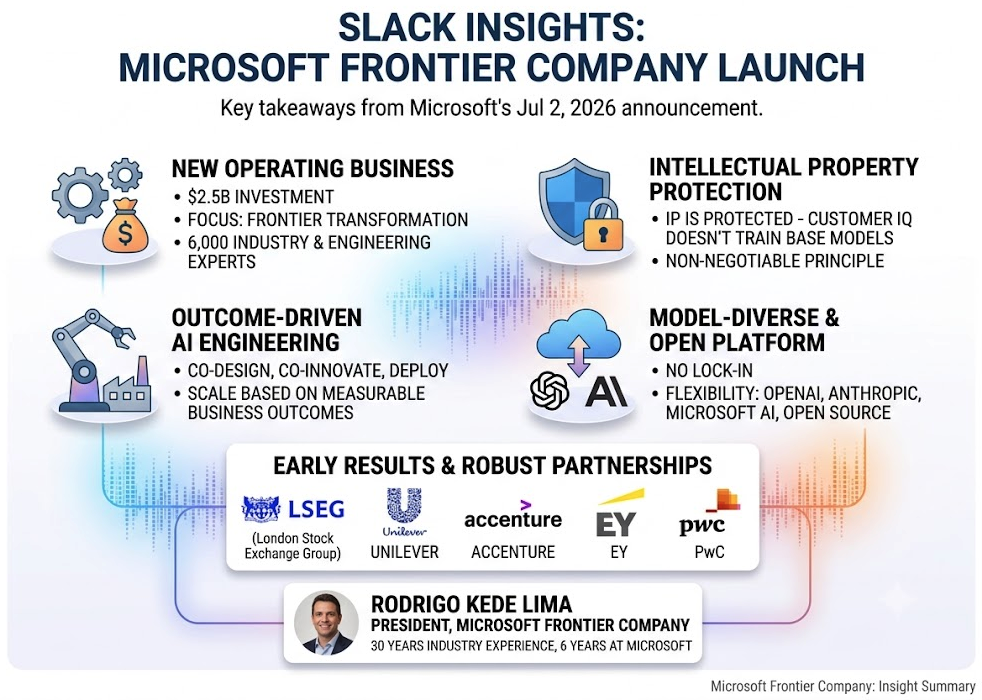
Microsoft Frontier Company: AI engineering that amplifies and protects your intelligence (7/2/2026)

AI-based workflow innovation - it's not just an optimizing cost/process but also a matter of survival!

Microsoft is shifting heavily from mere AI experimentation to delivering measurable business outcomes and enterprise-grade AI engineering. They are embedding 6,000 industry experts directly into client teams to co-design and scale AI systems.

AI-based workflow innovation - it's not just an optimizing cost/process but also a matter of survival!

Many companies are aggressively driving Digital Transformation (DX) and AI-powered Workflow Innovation to unlock unprecedented levels of efficiency and slash operational costs.


Digtal Transformation Trend for Workflow Improvement

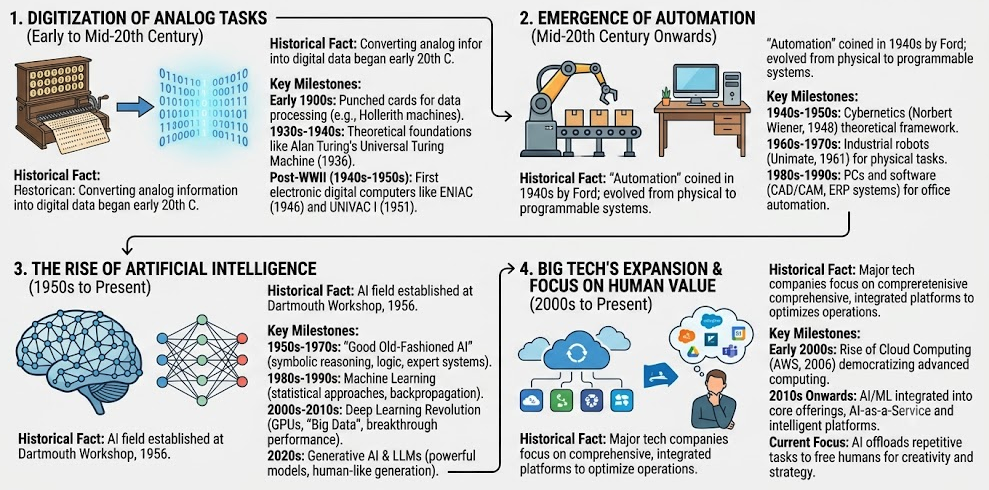
While workflow innovation itself traces back over a century to the digitization of analog tasks and the emergence of mechanical and programmable automation, AI-based workflow innovation, as we understand it today, represents a sophisticated new phase rather than an entirely new concept. 
AI-based workflow innovation - it's not just an optimizing cost/process but also a matter of survival!

Early efforts converted physical data to digital and automated repetitive processes, but the formal advent of Artificial Intelligence in the 1950s, evolving from symbolic reasoning through machine learning and deep learning to current generative AI, has dramatically transformed these capabilities. Today, integrated AI within platforms primarily aims to offload complex cognitive, data-intensive, or low-value tasks from humans, empowering them to focus on uniquely valuable contributions like creativity, critical thinking, and strategic planning, marking a significant evolution in human-machine collaboration.


Workflow Innovation Area

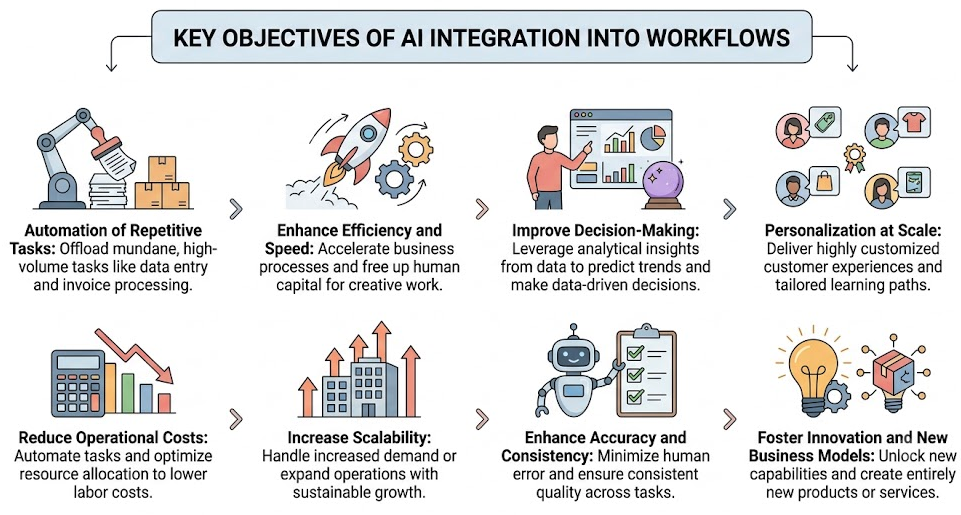
Many companies are actively pursuing AI integration into workflows with several key objectives:

AI-based workflow innovation - it's not just an optimizing cost/process but also a matter of survival!

  • Automation of Repetitive Tasks: To offload mundane, high-volume, and rule-based tasks from human employees, such as data entry, invoice processing, customer service FAQs, and report generation.
  • Enhance Efficiency and Speed: To accelerate business processes, reduce turnaround times, and free up human capital for more complex, creative, and strategic work.
  • Improve Decision-Making: To leverage AI's analytical capabilities to extract insights from vast datasets, predict trends, and provide data-driven recommendations, leading to more informed and accurate business decisions.
  • Personalization at Scale: To deliver highly customized experiences for customers and employees, whether through personalized product recommendations, tailored learning paths, or individualized support.
  • Reduce Operational Costs: By automating tasks and optimizing resource allocation, companies aim to lower labor costs, minimize errors, and improve overall resource utilization.
  • Increase Scalability: To enable organizations to handle increased demand or expand operations without a proportional increase in human resources, making growth more sustainable.
  • Enhance Accuracy and Consistency: To minimize human error and ensure a consistent level of quality in output across various tasks and processes.
  • Foster Innovation and New Business Models: To unlock new capabilities and create opportunities for entirely new products, services, or operational models that were previously impossible.


Pain Points to Solve for Innovating Workflow with AI

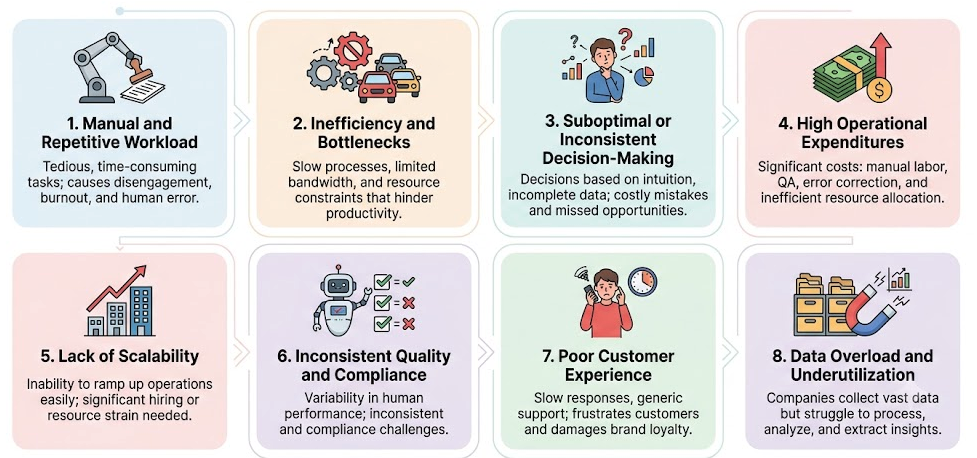
The adoption of AI in workflows is fundamentally driven by a comprehensive need to alleviate organizational pain points such as the burden of manual and repetitive tasks that lead to employee disengagement, burnout, and human error, simultaneously tackling inefficiencies and bottlenecks that impede productivity. AI further addresses the challenge of suboptimal or inconsistent decision-making often based on limited data, helping to reduce high operational expenditures and overcome a lack of scalability when facing fluctuating demands. Moreover, organizations leverage AI to ensure consistent quality and compliance, to transform poor customer experiences into personalized and responsive interactions, and to effectively process and utilize vast amounts of data that would otherwise remain underutilized, thus enabling better insights and strategic outcomes.
AI-based workflow innovation - it's not just an optimizing cost/process but also a matter of survival!


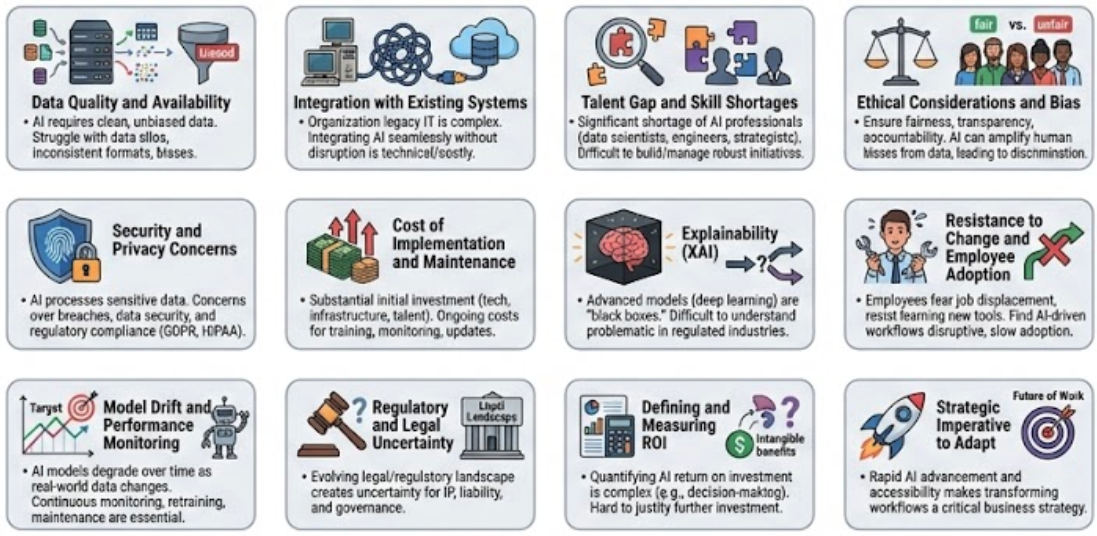
Challenges in AI-based Workflow Innovation

Integrating AI into workflows presents significant challenges, beginning with data quality and availability issues like silos, biases, and privacy concerns, compounded by the complexity and cost of integrating with existing legacy systems. A severe talent gap, ethical considerations surrounding bias amplification, and critical security and privacy concerns further complicate adoption. Additional hurdles include the substantial costs of implementation and ongoing maintenance, the 'black box' nature of many AI models hindering explainability, and employee resistance to new AI-driven processes. Organizations must also navigate model drift requiring continuous monitoring, an uncertain and evolving regulatory landscape, and the inherent difficulty in defining and measuring the return on investment for AI projects.

AI-based workflow innovation - it's not just an optimizing cost/process but also a matter of survival!

Tags AI Implementation AI Strategy AI Transformation AI Workflow Business AI Corporate AI Digital Transformation Future Of Work Productivity AI Workflow Innovation Facebook X
Comments 0
Similar posts
  1. Why AI-DLC is the New Paradigm for Development?
    331
  1. What ML Labeling Actually Is - And How to Design a Pipeline for It
    335
  2. Bridging the Gap: How Machine Learning Integrates with Infrastructure
    277
  3. Designing an Enterprise ML Experiment Tracking and Reproducibility Platform: System Requirements and Architecture
    310
  4. End-to-End AI/Machine Learning Architecture: AI/ML 6 Layers
    244
  5. Architecting an LLM-Powered Multi-Agent Orchestration System: Design and Requirements
    246
  6. End-to-End Autonomous Vehicle ML Training Pipeline
    330
  7. Building GPU Clusters on GCP, Azure, and AWS: A Practical Guide and Head-to-Head Comparison
    352
  8. Embeddings on the Lakehouse: What Snowflake and Databricks Actually Do (and Don't)
    291
  9. Vector Database Integration on Fully Managed Multi-Agent Environment
    306
  10. AWS Multi-Agent Collaboration Approach: Fully Managed vs. Code-based Implementation
    278
  11. Semantic Kernel: Microsoft's GenAI Orchestration SDK
    401
  12. LLM Application Development with LangGraph: Features and Architectures for Stateful Multi-Actor LLM Applications
    353
  13. Microsoft AutoGen: Next-Generation Multi-Agent Framework
    306
  14. Beyond SDLC: Why the Entertainment Sector Needs an AI Development Life Cycle Now
    286
  15. Autonomous Vehicle Machine Learning (AV ML): An Architectural Review
    408
  16. Cloud-Based AI Architecture Proposals for US Auto Finance Industry
    568
  17. Netflix's Recommendation System
    419
  18. Is PyTorch Dead? Deep Learning's Enduring Role Beyond LLMs & Essential Skills
    695
  19. Coding Revolution with Claude Code & MoAI ADK(Agent Development Kit)
    734
  20. Curiousity if OpenAI Engineers use Cursor.ai
    6691
  21. Building my own ChatGPT based on SageMaker and Milvus that is specialized to Shopping Mall
    271
  22. Your Blueprint for an LLM & Vector DB Insurance Product Q&A
    263
  23. The Core of Vector Databases: Embeddings and LLM Dependency
    260
  24. Original Purpose of Markdown File - why Engineers love it?
    767
  25. Switch to using Claude Sonnet 4 (Claude-4-sonnet) in the Amazon Q Developer CLI
    642
  26. Amazon Q CLI for Debugging - What You Can Do
    442
  27. Vibe coding with Amazon Q in CLI combined with Claud AI Sonet 4
    471
  28. How do you create AI-based commit message with scope and action in Cursor AI?
    804
  29. Learn SLM if you have interent in the next after LLM
    4861
  30. VLM vs. LLM: How Vision-Language Models Are Revolutionizing Real-Time Media Processing
    39
Recently updated
  1. Why 100% SEO Guarantees Better User Engagement and How to Achieve It in Your Service
    42
  2. Why SPF and DKIM Are Essential for Linux Email Servers?
    36
  3. How do I create animated background for Google Meet?
    21,044
  4. MaxMind GeoLite2 vs. DB-IP Lite vs. ip-api.com: Choosing the Right Free IP Geolocation Solution
    252
  5. Meet Valkey: Why Redis Changed Its License, Why Valkey is Better, and How to Use It as a Drop-in Replacement
    94
  6. How Rogue Web Scrapers Are Stealing My Content and Destroying My Server
    157
  7. Array of arguments passed to script in PHP
    90
  8. Invalid Auction Storms in Ad Tech
    98
  9. Building MRC-Compliant Instrumentation in Ad Tech: Implementation Steps and Key Challenges
    202
  10. The Two Clocks of Ad Server Architecture
    70
  11. Frequency Cap Architecture Overview
    515
  12. Collecting Proof-of-Play from 100,000 Screens
    146
  13. Vector Search in Relational Databases (RDBs): Trends & Usage Environments
    288
  14. What is RedisVL?
    109
  15. Designing a Skill Registry Architecture: Minimize Token Usage and Maximize AI Performance
    232
  16. TPU & GPU Cluster Management Tools
    245
  17. The Concept of Scaffolding in AI Agents
    234
  18. Beyond Static Pipelines: Architecting LLM Multi-Agent Systems for Autonomous Workflow Orchestration
    583
  19. AI-DLC vs. AI-SDLC: Model-Centric vs. System-Centric AI Development
    259
  20. Fine-Tuning Open-Weight LLMs: Training, Licensing, and Deploying Custom Models with Ollama
    339
  21. Inside the Next-Generation Streaming Architecture: Ultra-Low Latency, SGAI, and AI Codecs
    202
  22. Machine Learning: Training vs. Ranking
    222
  23. The Continuous Learning Machine: Designing a Loop That Actually Turns
    222
  24. The Next-Gen Low-Latency Standards: LL-HLS & MoQ
    195
  25. Designing a Data Curation System Around a Vector Database
    221
  26. Extracting Context from Live Video: The Architecture Got Simpler When We Stopped Building Features
    256
  27. The New Ad Stack Behind Live Sports Streaming: Inside SGAI, EABN, and the Standards Race to Fix Live Monetization
    656
  28. Designing MLOps Architectures to Handle Seasonal Data Drift in EV Fleet Models
    196
  29. From 15 to 40+ FPS: Accelerating PyTorch Object Detection on Automotive ECUs
    219
  30. Understanding Data Lineage
    263