MLOps Explained: Spark, Flink, and Reference Architecture Deep Dive

CK CK 3788 
Created at  
243 0 0

MLOps (Machine Learning Operations)

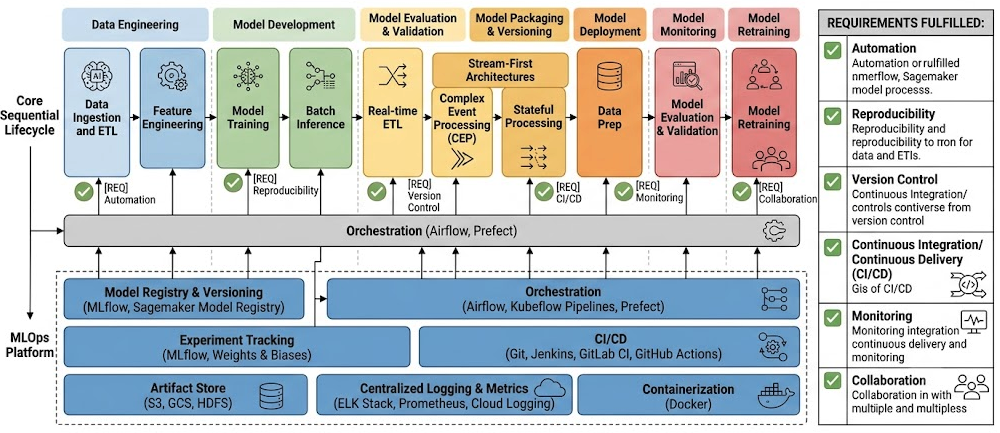
MLOps is a set of practices that aims to deploy and maintain machine learning models in production reliably and efficiently. It bridges the gap between machine learning development (ML Dev) and operations (Ops), similar to how DevOps streamlines software development and operations.


Key objectives of MLOps include:

  • Automation: Automating the entire ML lifecycle, from data collection and model training to deployment and monitoring.
  • Reproducibility: Ensuring that models can be retrained and reproduced with consistent results.
  • Version Control: Tracking data, code, models, and environments.
  • Continuous Integration/Continuous Delivery (CI/CD): Applying CI/CD principles to ML systems for faster and more reliable updates.
  • Monitoring: Continuously observing model performance, data quality, and system health in production.
  • Collaboration: Fostering collaboration between data scientists, ML engineers, and operations teams.

MLOps Explained: Spark, Flink, and Reference Architecture Deep Dive

The core phases of an MLOps lifecycle typically involve:

  1. Data Engineering: Data ingestion, cleaning, transformation, and feature engineering.
  2. Model Development: Experimentation, model training, hyperparameter tuning.
  3. Model Evaluation & Validation: Assessing model performance against metrics and business goals.
  4. Model Packaging & Versioning: Creating reproducible model artifacts and tracking versions.
  5. Model Deployment: Serving models as APIs or integrated services.
  6. Model Monitoring: Tracking predictions, actuals, data drift, and model drift.
  7. Model Retraining: Triggering retraining based on performance degradation or new data.


Role of Apache Spark and Apache Flink in MLOps

Apache Spark and Apache Flink are powerful open-source distributed processing frameworks highly relevant in MLOps, particularly in the data engineering and model training phases. They excel at processing large volumes of data (batch and streaming) with high throughput and low latency.

MLOps Explained: Spark, Flink, and Reference Architecture Deep Dive


Apache Spark

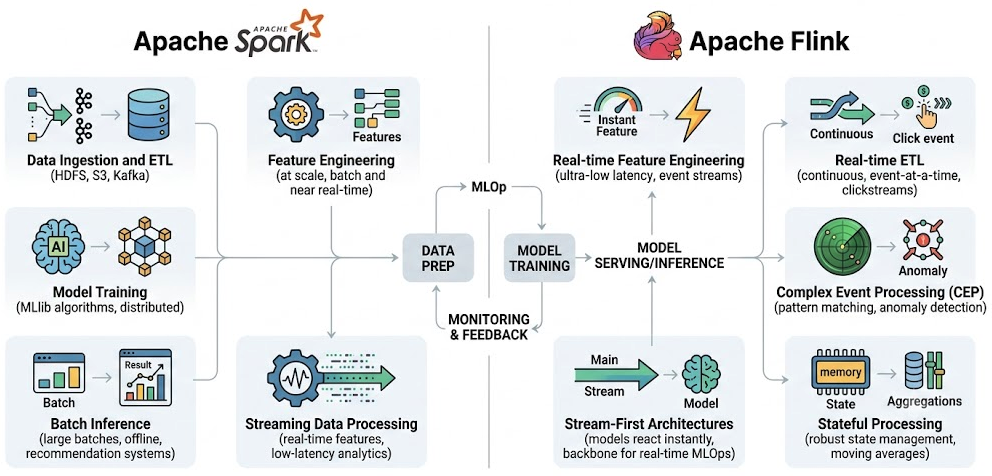
  • Data Ingestion and ETL: Spark's capabilities (Spark SQL, DataFrames) allow for efficient ingestion, cleaning, transformation, and aggregation of large datasets from various sources (HDFS, S3, Kafka, databases).
  • Feature Engineering: It's widely used to generate and transform features at scale, both for batch and near real-time scenarios. Spark's distributed nature allows for parallel processing of complex feature extraction logic.
  • Model Training: Spark MLlib provides a rich set of machine learning algorithms and utilities (e.g., classification, regression, clustering, collaborative filtering) that can be trained on large datasets in a distributed manner. It supports pipelines for orchestrating multiple ML transformations and estimators.
  • Batch Inference: Spark can be used for making predictions on large batches of data, which is common for use cases like recommendation systems or risk scoring that don't require real-time responses.
  • Streaming Data Processing: Spark Streaming (or Structured Streaming) can process live data streams for real-time feature generation, low-latency analytics, and even continuous model updates or online learning.


Apache Flink

  • Real-time Feature Engineering: Flink's primary strength is its true stream processing capabilities, offering very low latency and high throughput for real-time data pipelines. This is critical for generating fresh features from event streams for models requiring up-to-the-minute information.
  • Real-time ETL: Similar to Spark, Flink can perform ETL operations, but with a strong emphasis on continuous, event-at-a-time processing. This is ideal for transforming raw sensor data, clickstreams, or transactional data into features almost instantly.
  • Complex Event Processing (CEP): Flink is excellent for identifying patterns in data streams, which can be crucial for anomaly detection or trigger-based systems that inform ML models.
  • Stream-First Architectures: For use cases where models need to react immediately to new data, Flink can provide the backbone for a stream-first MLOps pipeline, feeding models with real-time processed data for online inference or retraining.
  • Stateful Processing: Flink's robust state management allows for processing long-running computations and maintaining state across events, which is essential for complex real-time feature aggregations (e.g., calculating moving averages over a specific time window).


Both Spark and Flink are instrumental in building scalable, resilient, and performant data pipelines that feed and interact with ML models in production MLOps environments.


MLOps Reference Architecture

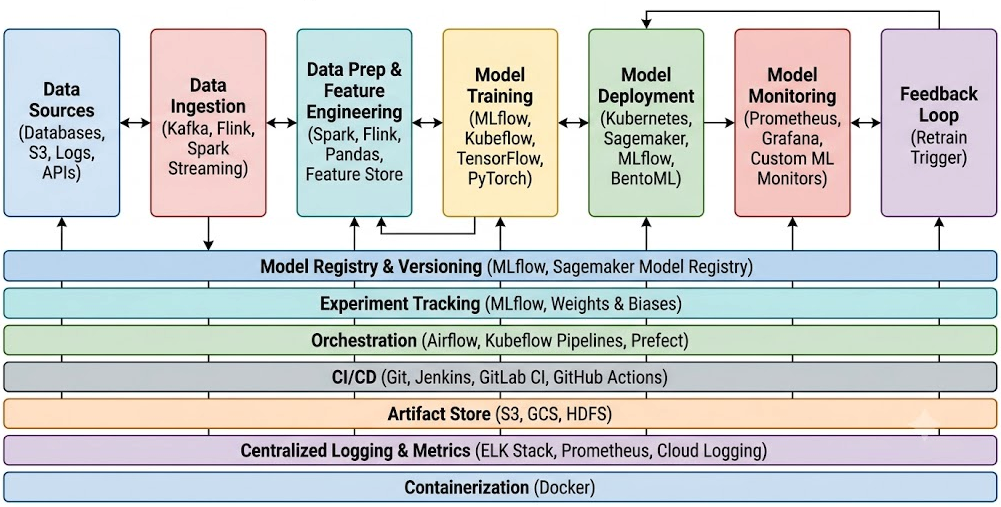
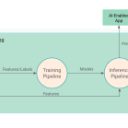
A typical MLOps reference architecture aims to provide a robust, scalable, and automated pipeline for the entire machine learning lifecycle. It integrates various tools and components across different stages.

MLOps Explained: Spark, Flink, and Reference Architecture Deep Dive


Components and Stages Explained:

1. Data Sources:

  • Origin of raw data: Databases (SQL, NoSQL), data lakes (S3, GCS, ADLS), streaming platforms (Kafka, Kinesis), external APIs, log files, data warehouses (Snowflake, BigQuery).

2. Data Ingestion:

  • Purpose: Collect data from various sources.
  • Technologies:
    • Batch: Apache Spark (for batch ETL), Apache NiFi, custom scripts.
    • Streaming: Apache Kafka, Apache Kinesis (message brokers), Apache Flink (real-time processing of streams), Apache Spark Streaming/Structured Streaming.
  • Output: Raw data stored in a data lake or stream processed for immediate use.

3. Data Preparation & Feature Engineering:

  • Purpose: Cleanse, transform, aggregate, and create features from raw data. This is where the bulk of data processing for ML occurs.
  • Technologies:
    • Batch/Streaming: Apache Spark (DataFrames, Spark SQL, MLlib for feature transformers), Apache Flink (for real-time feature computation and aggregation).
    • Local/Interactive: Pandas, NumPy, Scikit-learn (for prototyping and smaller datasets).
    • Feature Store: A centralized repository for managing, serving, and versioning features (e.g., Feast, Tecton). This ensures consistency between training and serving.
  • Output: Prepared datasets with engineered features, often stored in a data lake or fed directly to model training.

4. Model Training & Experimentation:

  • Purpose: Develop, train, and evaluate ML models.
  • Technologies:
    • ML Frameworks: TensorFlow, PyTorch, Scikit-learn, XGBoost, LightGBM.
    • Distributed Training: Distributed TensorFlow/PyTorch, Spark MLlib.
    • Experiment Tracking: MLflow Tracking, Weights & Biases, Comet ML (to log parameters, metrics, code, and models).
    • Hyperparameter Tuning: Optuna, Ray Tune, Hyperopt, cloud-native services.
    • Compute: Kubernetes clusters, managed ML services (AWS Sagemaker, GCP AI Platform, Azure ML).
  • Output: Trained model artifacts, evaluation metrics, and metadata.

5. Model Evaluation & Validation:

  • Purpose: Rigorously test the trained model against held-out data and define criteria for deployment (e.g., performance thresholds, fairness metrics).
  • Technologies: Python scripts, custom validation frameworks, MLflow for metric comparison.
  • Output: Evaluation reports, decision to promote or reject the model version.

6. Model Registry & Versioning:

  • Purpose: Store, version, and manage trained models as production-ready artifacts.
  • Technologies: MLflow Model Registry, AWS Sagemaker Model Registry, Google Cloud AI Platform Model Registry.
  • Output: Versioned models ready for deployment, tracked with their metadata.

7. Model Deployment:

  • Purpose: Make the model available for inference (predictions).
  • Technologies:
    • Serving Frameworks: TensorFlow Serving, TorchServe, BentoML, FastAPI.
    • Containerization: Docker (package models and their dependencies).
    • Orchestration: Kubernetes (deploy and scale containers).
    • Serverless: AWS Lambda, Azure Functions, Google Cloud Functions (for low-volume, event-driven inference).
    • Managed Services: AWS Sagemaker Endpoints, GCP AI Platform Prediction, Azure ML Endpoints.
  • Output: An API endpoint or a batch processing job that provides predictions.

8. Model Monitoring:

  • Purpose: Continuously observe the deployed model's performance, data quality, and system health in production.
  • Technologies:
    • Metrics Collection: Prometheus, Grafana, custom logging.
    • Data Drift: Evident AI, WhyLabs, custom scripts comparing input data distributions over time (using Spark/Flink for analysis).
    • Model Drift/Performance Degradation: Comparing actual outcomes to predicted outcomes, analyzing prediction distributions.
    • Alerting: PagerDuty, Slack integrations based on monitored thresholds.
  • Output: Alerts on issues, dashboards for performance visualization.

9. ML Pipelines & Orchestration:

  • Purpose: Automate and manage the entire sequence of steps in the MLOps workflow.
  • Technologies: Apache Airflow, Kubeflow Pipelines, Prefect, Dagster, Azure Data Factory.
  • Output: Automated, repeatable, and traceable ML workflows.

10. CI/CD (Continuous Integration/Continuous Delivery):

  • Purpose: Automate the build, test, and deployment process for ML code, data pipelines, and models.
  • Technologies: Git (version control), Jenkins, GitLab CI/CD, GitHub Actions, AWS CodePipeline, Azure DevOps.
  • Output: Rapid and reliable deployment of changes.

11. Artifact Store:

  • Purpose: Centralized storage for all artifacts (datasets, models, logs, metrics).
  • Technologies: Amazon S3, Google Cloud Storage, Azure Blob Storage, HDFS.

This architecture emphasizes automation, reproducibility, and continuous feedback loops, ensuring that ML models remain effective and up-to-date in dynamic production environments. Apache Spark and Flink play a crucial role in the data-intensive parts of this pipeline, enabling the scalable processing required for large-scale MLOps.


Tags Airflow Apache Flink Apache Spark Data Pipelines Flink MLOps ML Workflow MLOps MLOps Architecture Machine Learning Operations Perfect Reference Architecture Spark MLOps Facebook X
Comments 0
Similar posts
  1. Your Comprehensive Guide to Flink & Kafka for Real-time Stream Processing
    413
  2. TikTok's Recommendation System - Monolith
    292
  3. The Ultimate Data Engineering Roadmap
    1,072
  4. How Netflix Runs Recommendations for Hundreds of Millions of Users Using Amazon SageMaker & Metaflow
    175
  5. Is PyTorch Dead? Deep Learning's Enduring Role Beyond LLMs & Essential Skills
    695
  6. ETL vs ELT what makes the differeence? Why MLOps leverage ELT?
    196
  7. End-to-End Autonomous Vehicle ML Training Pipeline
    327
  8. Bridging the Gap: How Machine Learning Integrates with Infrastructure
    272
  9. When Do You Need Real-Time Model Registry Versioning Powered by Autonomous Agents?
    227
  10. Understanding Data Lineage
    260
  11. Designing MLOps Architectures to Handle Seasonal Data Drift in EV Fleet Models
    195
  12. Designing a Data Curation System Around a Vector Database
    220
  13. AI-DLC vs. AI-SDLC: Model-Centric vs. System-Centric AI Development
    259
  14. Collecting Proof-of-Play from 100,000 Screens
    146
  15. Common Recommendation Service Architecture
    532
  1. The Core of Vector Databases: Embeddings and LLM Dependency
    258
  2. Original Purpose of Markdown File - why Engineers love it?
    765
  3. Switch to using Claude Sonnet 4 (Claude-4-sonnet) in the Amazon Q Developer CLI
    642
  4. Amazon Q CLI for Debugging - What You Can Do
    440
  5. Vibe coding with Amazon Q in CLI combined with Claud AI Sonet 4
    469
  6. How do you create AI-based commit message with scope and action in Cursor AI?
    803
  7. Learn SLM if you have interent in the next after LLM
    4851
  8. VLM vs. LLM: How Vision-Language Models Are Revolutionizing Real-Time Media Processing
    35
  9. Why Reranking is Crucial for RAG and Agentic AI Systems?
    269
  10. Technical Hierarchy of AI Agents
    817
  11. MCP vs A2A
    600
  12. Vulnerabilities of MCP
    588
  13. The Revenge of the Junior Developer
    2,289
  14. A Complete Guide to LLM Dataset Formats: From Pre-Training to DPO in JSONL
    206
  15. Comparison of ChatGPT, Gemini, and Grok
    561
  16. AI-based Image Creation based on Bing Image Creator
    985
  17. ChatGPT App (flowGPT) to create images with text
    1,035
  18. TikTok's Recommendation System - Monolith
    292
  19. Things to Know for AI-driven, Multimodal Content Personalization.
    200
  20. Deep Dive into Vector Databases: Understanding Collections (Not Tables) and Embeddings
    232
  21. Image Embeddings for Vector Databases
    248
  22. Vector Databases: From Embeddings to Application
    315
  23. Scaling Vector Search: How to Architect FAISS on AWS EKS and ECS
    162
  24. Reinforcement Learning–Based Methods for CTR Improvement based on Recommendation System
    265
  25. YouTube's Recommendation System
    263
  26. Wide & Deep / DeepFM for Recommendation Service (aka Ranking Service)
    253
  27. Two-Tower Model for Recommendation Service having a Very Large Catalog
    263
  28. Sequence Models (RNN / Transformer) for Recommendation Service widely used at OTT and e-Commerce
    248
  29. Neural Collaborative Filtering (NCF) for Recommendation Service
    241
  30. Common Recommendation Service Architecture
    532
Recently updated
  1. Why 100% SEO Guarantees Better User Engagement and How to Achieve It in Your Service
    40
  2. Why SPF and DKIM Are Essential for Linux Email Servers?
    34
  3. How do I create animated background for Google Meet?
    20,613
  4. MaxMind GeoLite2 vs. DB-IP Lite vs. ip-api.com: Choosing the Right Free IP Geolocation Solution
    245
  5. Meet Valkey: Why Redis Changed Its License, Why Valkey is Better, and How to Use It as a Drop-in Replacement
    94
  6. How Rogue Web Scrapers Are Stealing My Content and Destroying My Server
    157
  7. Array of arguments passed to script in PHP
    90
  8. Invalid Auction Storms in Ad Tech
    98
  9. Building MRC-Compliant Instrumentation in Ad Tech: Implementation Steps and Key Challenges
    202
  10. The Two Clocks of Ad Server Architecture
    70
  11. Frequency Cap Architecture Overview
    515
  12. Collecting Proof-of-Play from 100,000 Screens
    146
  13. Vector Search in Relational Databases (RDBs): Trends & Usage Environments
    287
  14. What is RedisVL?
    109
  15. Designing a Skill Registry Architecture: Minimize Token Usage and Maximize AI Performance
    230
  16. TPU & GPU Cluster Management Tools
    244
  17. The Concept of Scaffolding in AI Agents
    233
  18. Beyond Static Pipelines: Architecting LLM Multi-Agent Systems for Autonomous Workflow Orchestration
    583
  19. AI-DLC vs. AI-SDLC: Model-Centric vs. System-Centric AI Development
    259
  20. Fine-Tuning Open-Weight LLMs: Training, Licensing, and Deploying Custom Models with Ollama
    339
  21. Inside the Next-Generation Streaming Architecture: Ultra-Low Latency, SGAI, and AI Codecs
    202
  22. Machine Learning: Training vs. Ranking
    221
  23. The Continuous Learning Machine: Designing a Loop That Actually Turns
    222
  24. The Next-Gen Low-Latency Standards: LL-HLS & MoQ
    195
  25. Designing a Data Curation System Around a Vector Database
    220
  26. Extracting Context from Live Video: The Architecture Got Simpler When We Stopped Building Features
    256
  27. The New Ad Stack Behind Live Sports Streaming: Inside SGAI, EABN, and the Standards Race to Fix Live Monetization
    656
  28. Designing MLOps Architectures to Handle Seasonal Data Drift in EV Fleet Models
    195
  29. From 15 to 40+ FPS: Accelerating PyTorch Object Detection on Automotive ECUs
    217
  30. Understanding Data Lineage
    260