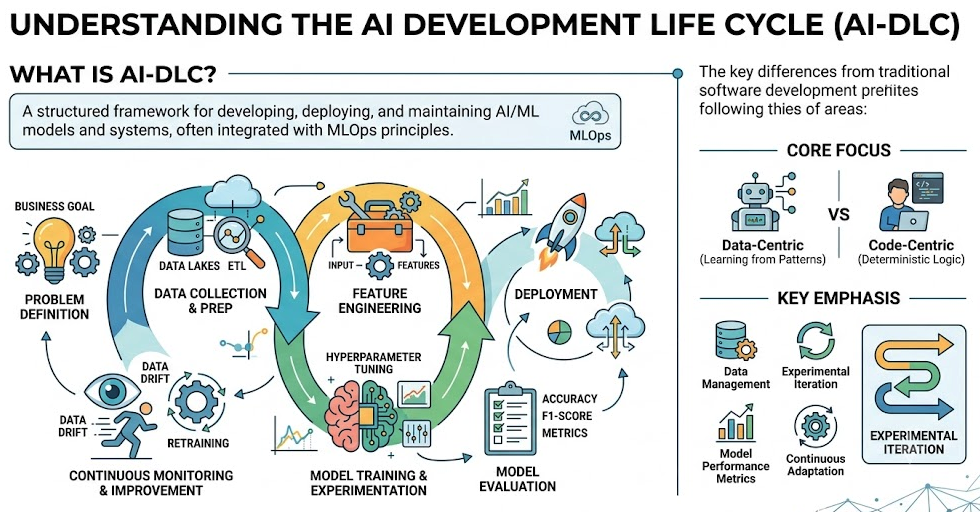
The AI Development Life Cycle (AI-DLC), often integrated with MLOps (Machine Learning Operations) principles, is a structured framework for developing, deploying, and maintaining Artificial Intelligence and Machine Learning models and systems. It encompasses all stages from problem definition and data collection to model training, evaluation, deployment, and continuous monitoring and improvement. Unlike traditional software development, AI-DLC places significant emphasis on data management, experimental iteration, model performance metrics, and the continuous adaptation of models in production environments.
Organizations building and managing knowledge bases essential for AI operations should indeed adopt an AI-DLC framework, as this clearly represents a new paradigm.
Differences from Traditional SDLC
Feature
Traditional SDLC (Software Development Life Cycle)
AI-DLC (AI Development Life Cycle)
Core Focus
Code-centric; developing logical instructions to perform specific tasks.
Data-centric; developing models that learn patterns from data to make predictions or decisions.
Primary Artifact
Source code, compiled binaries, executables.
Trained models, datasets, features, code (for data pipelines, training, inference).
Problem framing, data collection/preparation, feature engineering, model selection/training, evaluation, deployment, continuous monitoring, retraining.
Iteration
Can be iterative (Agile), but often more sequential for major releases.
Inherently highly iterative due, to hyperparameter tuning, model experimentation, and data changes.
Testing
Functional testing, unit testing, integration testing, system testing, UI testing.
Model performance testing (accuracy, precision, recall, F1, RMSE), robustness, fairness, bias testing, interpretability, in addition to functional testing of the code infrastructure.
Maintenance
Bug fixes, feature enhancements, system upgrades.
Continuous monitoring for data drift, concept drift, model decay, performance degradation, and regular retraining/redeployment.
Dependencies
Primarily code quality, architectural design.
Primarily data quality, data volume, data relevance, feature engineering, and model architecture.
Uncertainty
Logic is deterministic; bugs are due to coding errors.
Model behavior can be probabilistic; performance is influenced by data, making outcomes less deterministic.
Teams Involved
Software engineers, QA engineers, project managers, business analysts.
Data scientists, ML engineers, data engineers, MLOps specialists, domain experts, software engineers.
Advantages and Disadvantages of AI-DLC
Advantages:
Structured Approach: Provides a clear, systematic methodology for managing the complexity of AI projects, reducing ad-hoc development.
Risk Mitigation: Helps identify and address critical issues like data quality problems, model bias, and performance bottlenecks early in the cycle.
Improved Model Quality & Performance: Leads to more robust, accurate, fair, and reliable AI systems through rigorous data management, experimentation, and evaluation.
Enhanced Scalability: Facilitates the deployment and management of multiple AI models in production environments efficiently.
Increased Efficiency: Automates repetitive tasks (e.g., model training, deployment, monitoring) through MLOps, freeing up data scientists and engineers.
Better Collaboration: Defines clear roles and responsibilities, fostering better communication and collaboration between data science, engineering, and operations teams.
Continuous Improvement: Supports continuous learning and adaptation of models to new data and changing real-world conditions.
Disadvantages:
Increased Complexity: Inherently more complex than traditional SDLC due to the intertwining of data, models, and code, along with continuous monitoring needs.
Resource Intensive: Requires significant investment in specialized talent (data scientists, ML engineers), computational resources (GPUs, cloud infrastructure), and robust data infrastructure.
Data Dependency: Success is heavily reliant on the availability of high-quality, relevant, and sufficiently large datasets, which can be challenging to acquire, clean, and label.
Evaluation Challenges: Quantifying and evaluating AI model performance, especially regarding fairness, interpretability, and long-term impact, can be more nuanced and difficult than traditional software testing.
Ethical Considerations: Requires constant vigilance and dedicated processes for addressing potential issues like bias, privacy violations, and lack of transparency in AI models.
Tooling Fragmentation: The MLOps ecosystem is still evolving, leading to a wide array of tools that may not always integrate seamlessly.
Prerequisites and Requirements for a Successful AI DLC
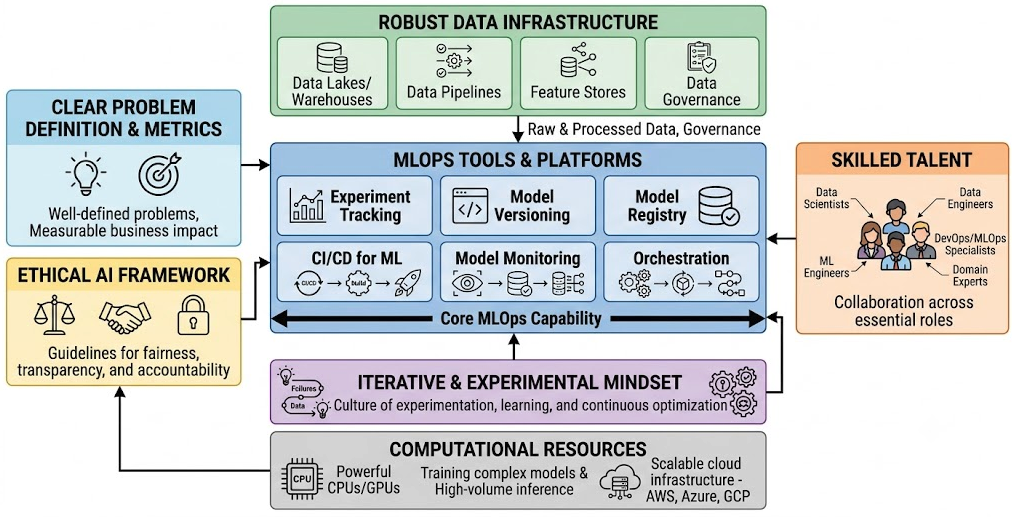
For a successful AI-DLC implementation, several key elements are crucial:
Robust Data Infrastructure:
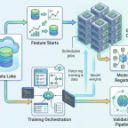
Data Lakes/Warehouses: Centralized storage for raw and processed data.
Data Pipelines: Automated systems for data ingestion, transformation, and loading (ETL/ELT).
Feature Stores: Centralized repositories for sharing and reusing engineered features across models, ensuring consistency and preventing recalculations.
Data Governance: Policies and tools for data quality, security, privacy, and compliance.
Computational Resources:
Access to powerful CPUs and GPUs for training complex models and performing high-volume inference.
Experiment Tracking: Tools to log model metrics, hyperparameters, and datasets for reproducibility.
Model Versioning: Systems to track different versions of models, code, and data.
Model Registry: A centralized hub to store, manage, and discover trained models.
CI/CD for ML: Automated pipelines for continuous integration, continuous delivery, and continuous deployment of models.
Model Monitoring: Tools to track model performance, data drift, concept drift, and resource utilization in production.
Orchestration: Tools to automate and manage complex ML workflows.
Skilled Talent:
Data Scientists: For model development, experimentation, and analysis.
Machine Learning Engineers: For building scalable ML systems, MLOps, and model deployment.
Data Engineers: For building and maintaining data pipelines and infrastructure.
DevOps/MLOps Specialists: For automating the entire ML lifecycle.
Domain Experts: To provide business context and validate model outputs.
Clear Problem Definition & Metrics:
Well-defined business problems suitable for AI solutions.
Clear, measurable success metrics for model performance and business impact.
Iterative & Experimental Mindset:
A culture that embraces experimentation, failure as a learning opportunity, and continuous improvement.
Ethical AI Framework:
Guidelines and processes to ensure fairness, transparency, accountability, and privacy in AI systems.
Strong Collaboration:
Effective communication channels and collaboration tools between data science, engineering, and business teams.
Success Stories
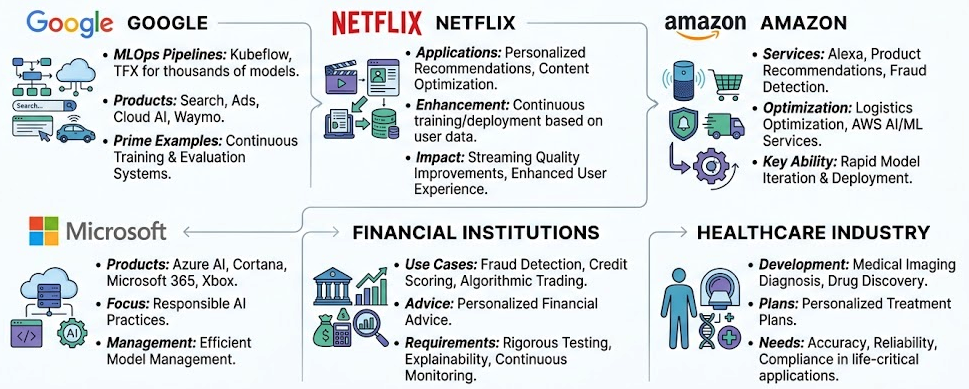
Many leading technology companies and organizations have successfully implemented mature AI-DLC practices, often under the umbrella of MLOps, to deliver and maintain their AI-powered products and services.
Google: Leverages sophisticated MLOps pipelines (e.g., using Kubeflow, TensorFlow Extended - TFX) to manage thousands of AI models across its products like Search, Ads, Google Cloud AI services, and autonomous driving (Waymo). Their continuous training and evaluation systems are prime examples.
Netflix: Utilizes advanced AI-DLC for its personalized recommendation engines, content optimization, and streaming quality improvements. They continuously train and deploy models based on vast amounts of user behavior data to enhance user experience.
Amazon: Employs robust AI-DLC for services like Alexa, product recommendations, fraud detection, logistics optimization, and AWS AI/ML services. Their ability to rapidly iterate and deploy models is central to their innovation.
Microsoft: Implements comprehensive AI-DLC for products such as Azure AI services, Cortana, Microsoft 365 AI features, and Xbox. They focus on responsible AI practices alongside efficient model management.
Financial Institutions: Banks and fintech companies use AI-DLC extensively for fraud detection, credit scoring, algorithmic trading, and personalized financial advice. The regulatory environment demands rigorous testing, explainability, and continuous monitoring of these critical models.
Healthcare Industry: Companies developing AI for medical imaging diagnosis, drug discovery, and personalized treatment plans rely on structured AI-DLC to ensure accuracy, reliability, and compliance in life-critical applications.