Beyond SDLC: Why the Entertainment Sector Needs an AI Development Life Cycle Now
CK 3788 Created at Updated at
29900
One might easily think that media & entertainment companies just need to make good movies. However, if you look deeper, there are many things to meticulously consider and think about, beyond just casting actors for high fees.
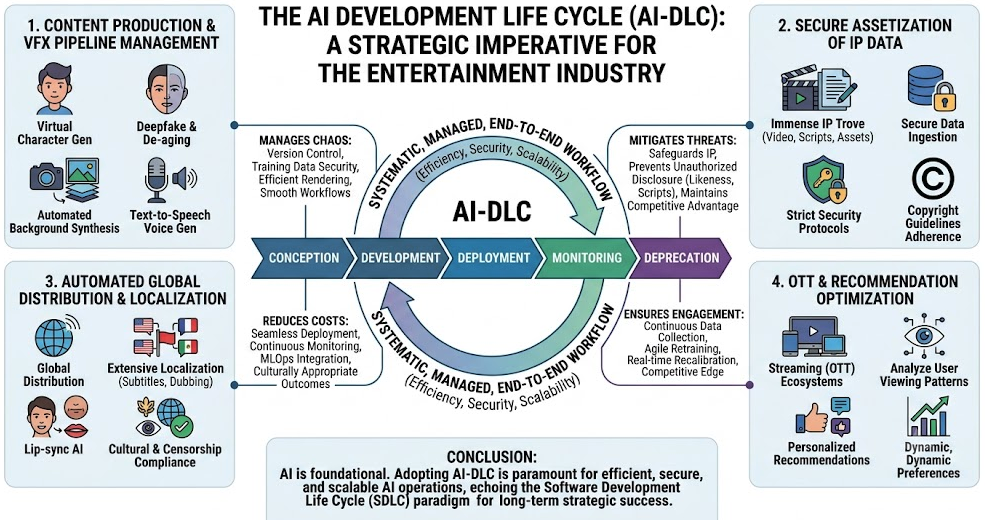
The media and entertainment industry is rapidly transforming from traditional content creation into an IT and AI technology sector. For large global entertainment enterprises, embracing an AI Development Life Cycle (AI-DLC) is not merely an option but a strategic imperative. This structured approach to managing AI from conception to deprecation is crucial for efficiency, security, and scalability across various operations.
The Necessity of an AI-DLC Approach
1. Content Production and Visual Effects (VFX) AI Pipeline Management
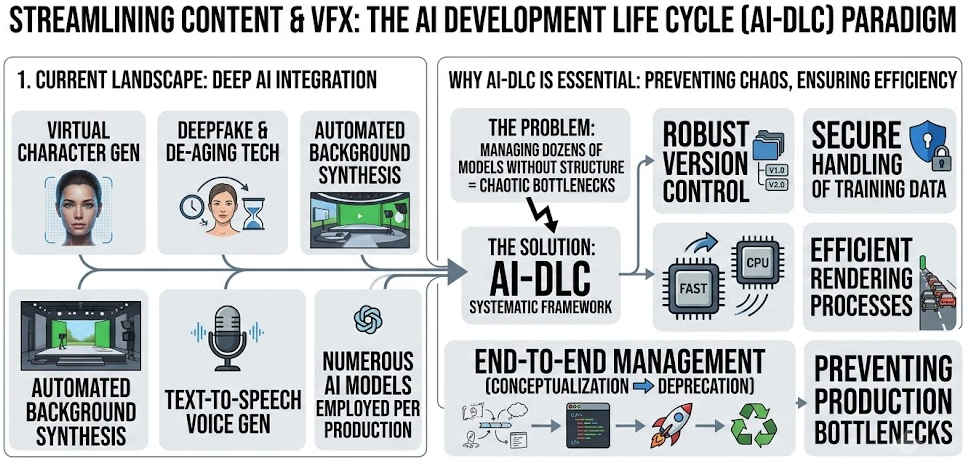
Artificial intelligence is now deeply integrated into the content creation landscape. Modern productions heavily leverage AI for tasks such as virtual character generation, deepfake and de-aging technologies, automated background synthesis, and text-to-speech voice generation. Numerous AI models are employed in a single production.
Why AI-DLC is Essential: Without a systematic framework like AI-DLC, managing dozens of AI models across a single project becomes chaotic. AI-DLC ensures robust version control, secure handling of training data, and efficient rendering processes. It provides end-to-end management for each AI model, from its initial conceptualization and development through deployment and eventual deprecation, preventing production bottlenecks and ensuring smooth workflows.
2. Secure Assetization of Vast Intellectual Property (IP) Data
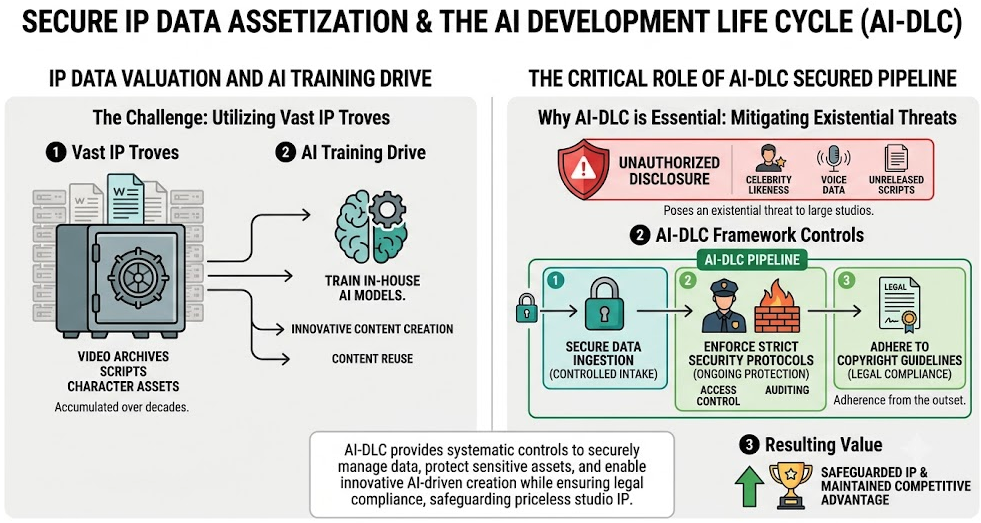
Major entertainment studios possess an immense trove of IP data accumulated over decades, including video archives, scripts, and character assets. There's a significant drive to leverage this proprietary data to train in-house AI models for innovative content creation and reuse.
Why AI-DLC is Essential: For large studios, the unauthorized disclosure of sensitive data, such as celebrity likenesses, voice data, or unreleased project scripts, poses an existential threat. An AI-DLC framework provides the necessary controls to manage data ingestion securely, enforce strict security protocols, and adhere to copyright guidelines from the very outset. This systematic approach safeguards invaluable IP and maintains competitive advantage.
3. Automated Global Distribution and Localization
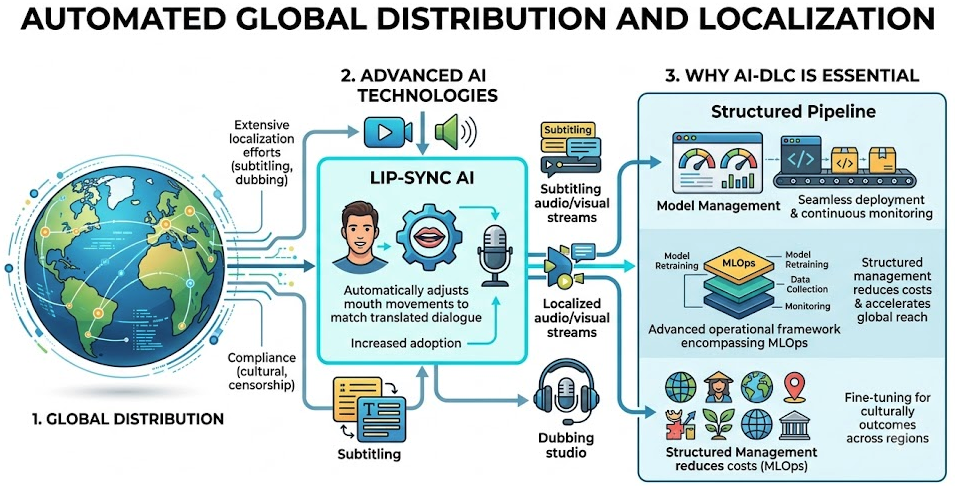
Distributing content globally requires extensive localization efforts, including subtitling and dubbing into dozens of languages, as well as editing content to comply with cultural sensitivities and censorship guidelines in various countries. Advanced AI technologies, such as lip-sync AI, which automatically adjusts actors' mouth movements to match translated dialogue, are increasingly being adopted.
Why AI-DLC is Essential: To efficiently manage global distribution schedules, AI models must be deployed seamlessly and monitored continuously. An advanced operational framework, encompassing MLOps principles within an AI-DLC, is vital for fine-tuning models to ensure culturally appropriate outcomes across different regions. This structured management significantly reduces costs and accelerates the global reach of content.
4. Streaming (OTT) and User Recommendation Algorithm Optimization
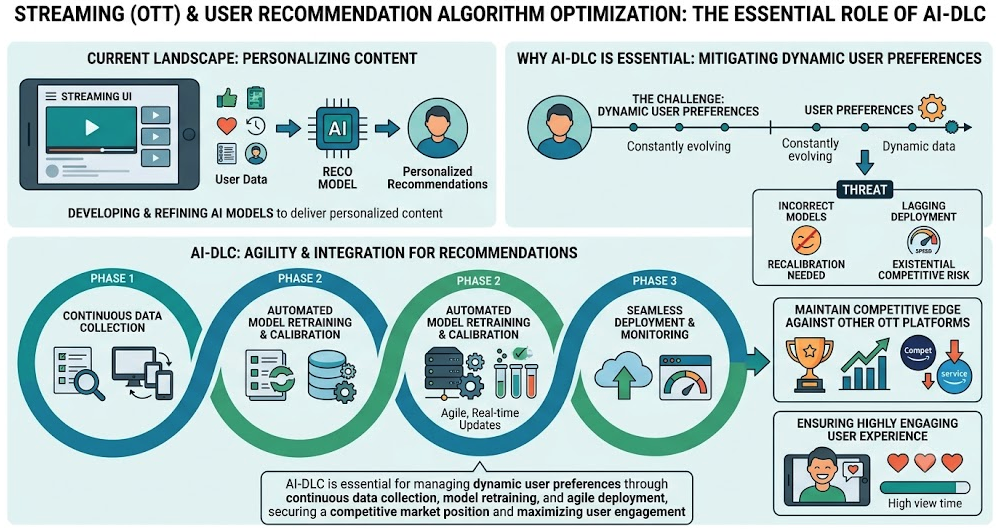
Companies operating entertainment ecosystems, including streaming services, are constantly developing and refining AI models to analyze user viewing patterns and deliver personalized content recommendations.
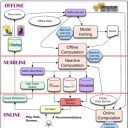
Why AI-DLC is Essential: User preferences are dynamic and constantly evolving, necessitating real-time updates and recalibration of recommendation models. A robust AI-DLC pipeline facilitates continuous data collection, model retraining, and deployment. This agile and integrated approach is crucial for maintaining a competitive edge against other OTT platforms and ensuring a highly engaging user experience.
Checklist: AI-Driven Dynamic Content & Personalization (AI-DLC) Maturity Checklist for Media & Entertainment
What score would our company get?
Instructions: For each item, score your current implementation level based on the following scale. Add comments to provide context and evidence.
0 - Not Started / Planned: No active work or formal plans yet.
1 - Experimenting / PoC (Proof of Concept): Small-scale experiments, prototypes, or isolated PoCs.
2 - Partially Implemented / Pilot Phase: Deployed in limited areas, specific projects, or pilot programs.
3 - Fully Implemented / Operational: Widely adopted in relevant areas, part of core workflows.
4 - Optimized / Innovating / Strategic: Continuously refined, driving significant business impact, leading innovation in this area.
Section 1: Foundational Elements & Data Infrastructure
Item
Score (0-4)
Comments / Evidence
1.1 Data Collection & Storage Strategy
Centralized storage for user data, content metadata, engagement metrics, and operational data.
1.2 Data Quality & Governance
Processes for ensuring data accuracy, consistency, completeness, and adherence to privacy regulations (e.g., GDPR, CCPA).
1.3 AI Infrastructure (Compute & Storage)
Access to scalable cloud or on-premise compute resources (GPUs, TPUs) and storage for AI model training and inference.
1.4 Data Integration & APIs
Seamless integration between various data sources (CRM, CMS, analytics platforms) via APIs for AI consumption.
1.5 M&E Specific Metadata
Rich, standardized, and machine-readable metadata for all content assets (genres, themes, actors, emotions, scenes, topics).
Section 2: AI-Driven Content Creation & Production
AI models predicting user churn, engagement levels, or future content consumption patterns.
4.2 Sentiment Analysis & Feedback Interpretation
AI analyzing user comments, reviews, and social media sentiment to gauge audience reaction to content.
4.3 Audience Segmentation & Targeting
AI dynamically segmenting audiences based on behavior, preferences, and demographics for tailored campaigns.
4.4 A/B Testing & Optimization (AI-assisted)
AI guiding and optimizing A/B tests for content elements, marketing messages, and platform features.
4.5 Content Performance Insights
AI providing deeper insights into why certain content performs well or poorly, beyond basic metrics.
4.6 AI-Powered Customer Support / Chatbots
AI-driven chatbots handling FAQs, content recommendations, or basic troubleshooting for users.
Section 5: Operational Efficiency & Business Impact
Item
Score (0-4)
Comments / Evidence
5.1 Workflow Automation (Non-Creative Tasks)
AI automating repetitive tasks in content ingest, asset management, scheduling, and distribution.
5.2 Resource Allocation Optimization
AI assisting in optimizing allocation of production resources, talent, or marketing budgets.
5.3 Cost Reduction through AI
Tangible evidence of cost savings achieved through AI-driven automation or efficiency improvements.
5.4 New Revenue Streams / Business Models
AI enabling new monetization opportunities, e.g., hyper-personalized content subscriptions, AI-generated IP licensing.
5.5 Strategic Decision Making (AI-informed)
AI insights consistently influencing strategic decisions regarding content greenlighting, acquisition, or platform development.
Section 6: Governance, Ethics & Future Readiness
Item
Score (0-4)
Comments / Evidence
6.1 Ethical AI Guidelines & Policies
Established company-wide policies for ethical AI development and deployment, including fairness and transparency.
6.2 Bias Detection & Mitigation
Active measures to detect and reduce algorithmic bias in AI models, especially in recommendations or content moderation.
6.3 AI Model Explainability & Transparency
Ability to understand how AI models make decisions and communicate this effectively when necessary.
6.4 AI Security & Robustness
Measures to protect AI systems from adversarial attacks, data poisoning, and ensure model integrity.
6.5 AI Talent & Skills Development
Ongoing investment in training and hiring AI specialists, data scientists, and MLOps engineers.
6.6 Continuous AI Innovation & Research
Dedicated efforts for R&D in new AI techniques and applications relevant to the M&E landscape.
This checklist should provide a robust framework for evaluating your company's AI-DLC maturity and help identify strategic areas for future investment and development. Good luck with your assessment!
Conclusion
In the modern entertainment industry, AI is no longer a peripheral tool but a foundational component of a company's core infrastructure. For large enterprises to deploy AI efficiently, securely, and scalably, adopting a dedicated AI Development Life Cycle is paramount. Just as the Software Development Life Cycle (SDLC) provides a structured approach for software creation, AI-DLC establishes the essential paradigm for managing the entire lifecycle of AI systems, ensuring their strategic value and long-term success.