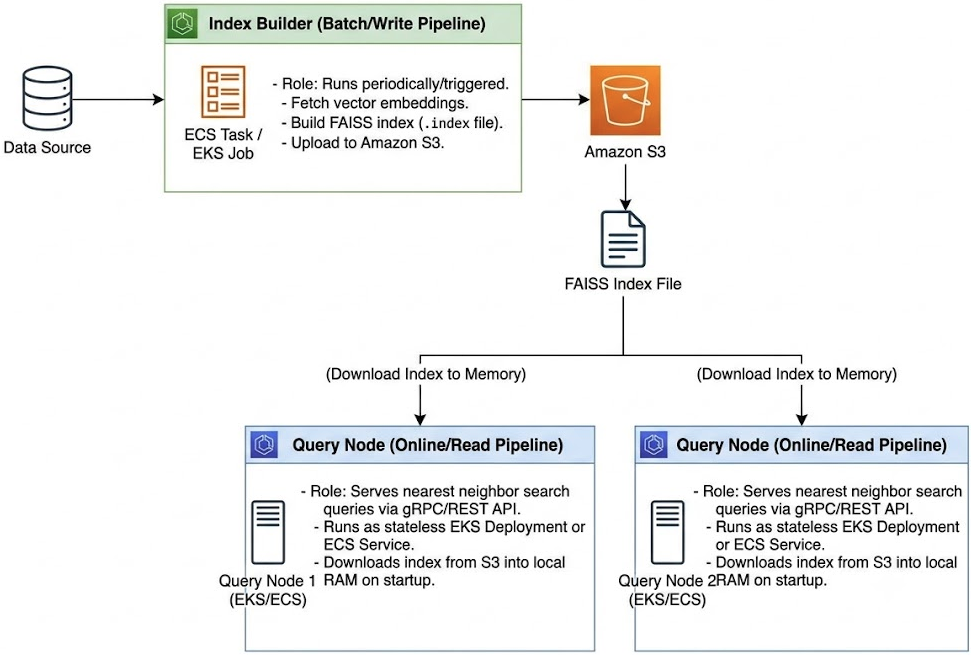
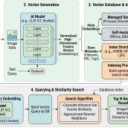
Because FAISS is an in-memory library rather than a distributed database, scaling it requires decoupling the Index Generation (Write/Batch) from the Index Search (Read/Query).
Index Builder (Batch/Write Pipeline)
Role: Runs periodically (daily/hourly) or is triggered by data changes. It fetches vector embeddings, builds the FAISS index (.index file), and uploads it to Amazon S3.
Compute: Runs as an EKS Job or ECS Task (non-persistent). It requires high-CPU/GPU and high-RAM instances (e.g., AWS r6i or g5 families) depending on the dataset size and quantization parameters.
Query Engine (Online/Read Pipeline)
Role: Exposes a gRPC or REST API (using FastAPI, Go, or C++) to serve nearest neighbor search queries.
Compute: Runs as a stateless EKS Deployment or ECS Service. Upon startup, it downloads the FAISS index file from S3 into local RAM and serves queries.
2. Index Lifecycle and Storage Management
Managing how index files are loaded and updated without downtime is the main challenge of scaling FAISS.
Bootstrapping and Local Storage
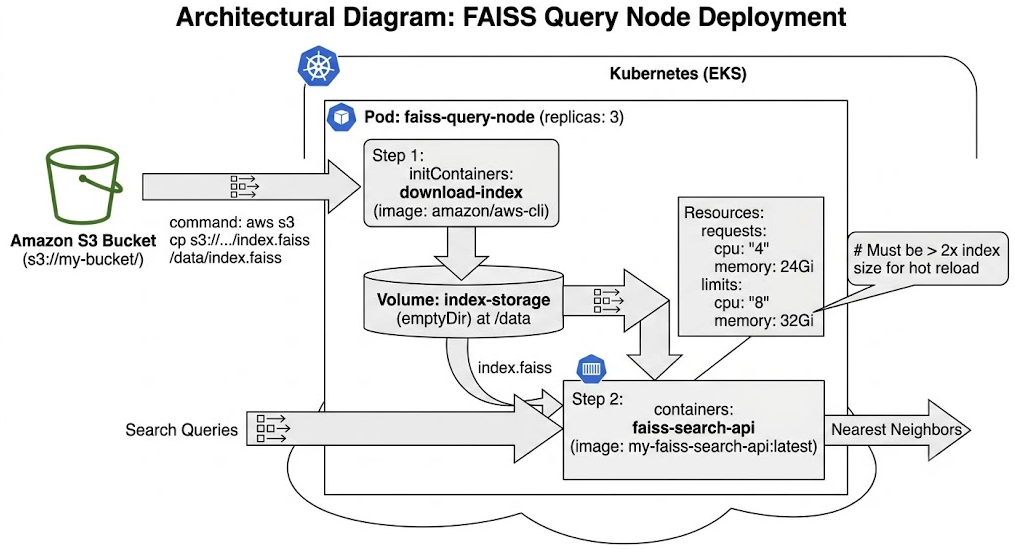
EKS: Use an initContainer in the Pod spec to download the latest index from S3 to an emptyDir volume (configured to use medium: Memory or high-speed NVMe instance storage) before the main container starts.
ECS: Use container entrypoint scripts to pull the index from S3 to the local ephemeral storage container path before starting the query application.
Hot Reloading (Zero-Downtime Updates)
To update the index without restarting the containers:
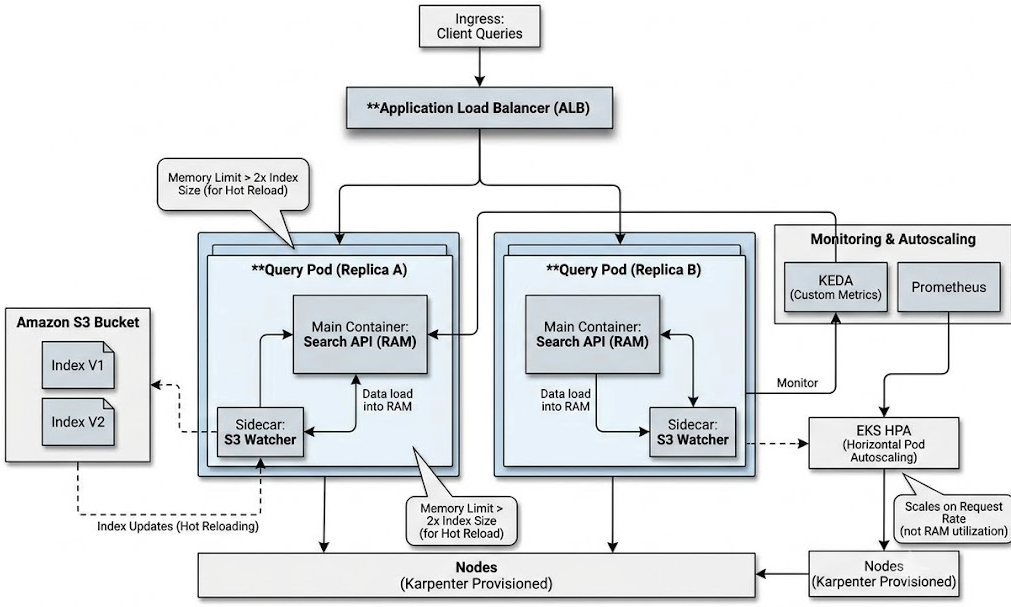
Double Buffering Pattern: The Query Engine application runs a background thread that periodically checks S3 for a new index version.
Upon detecting a new version, it downloads the new index into a secondary memory buffer, swaps the pointer of the active search index to the new one, and releases the old memory buffer.
Ensure the container's memory limit is configured to handle at least 2x the index size to prevent Out-Of-Memory (OOM) kills during this swap process.
Standard Scaling Metric: Do not use Memory utilization for scaling. FAISS loads the index into RAM once, keeping memory usage flat (e.g., always at 80%).
Custom Metrics: Use KEDA (Kubernetes Event-driven Autoscaling) to scale based on:
Incoming request rate (throughput via Prometheus metrics).
ALB Target Group Active Connections.
Compute Provisioning: Use Karpenter instead of Cluster Autoscaler. Karpenter can rapidly spin up specific node groups (e.g., memory-optimized r6id nodes with local NVMe) when HPA triggers scaling.
Pod Configuration Example (EKS)
4. Scaling FAISS on Amazon ECS
ECS is ideal for simpler operations with less management overhead.
Task Launch Type Selection
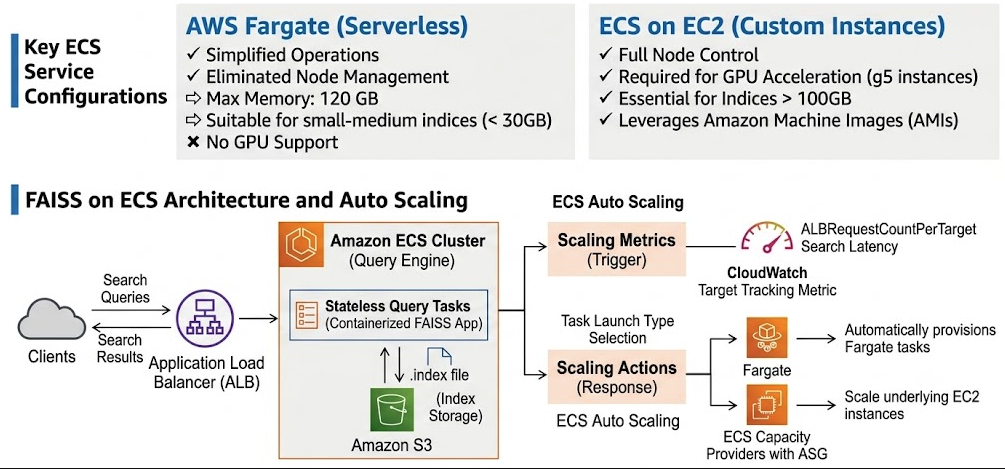
AWS Fargate: Best for small to medium indices (index size < 30GB). Max memory available is 120 GB per task. Fargate eliminates node management but does not support GPUs.
ECS on EC2: Required if the index is larger than 100GB, or if GPU acceleration (e.g., g5 instances) is needed.
ECS Auto Scaling
Target Tracking Policy: Scale based on ALBRequestCountPerTarget or a custom CloudWatch metric representing Search Latency.
Capacity Providers: Configure ECS Capacity Providers with ASG (Auto Scaling Groups) to automatically scale the underlying EC2 instances when new FAISS tasks are pending.
5. Performance Optimization & Production Best Practices
Index Partitioning (Sharding) for Massive Datasets
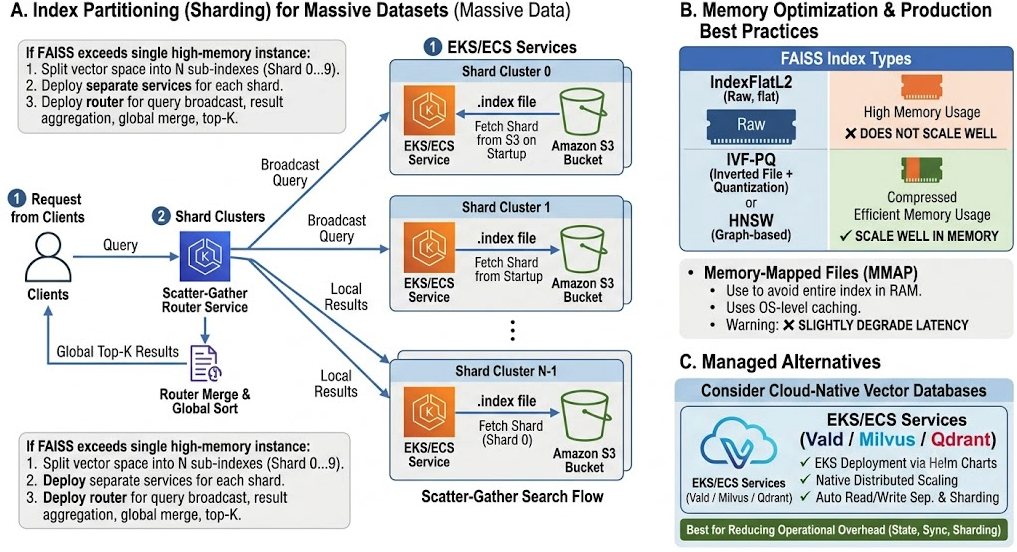
If the FAISS index exceeds the memory capacity of a single high-memory instance: 1. Shard the Index: Split the vector space into $N$ separate sub-indexes (e.g., Shard 0 to Shard 9). 2. Deploy Shard Clusters: Deploy separate EKS/ECS services for each shard. 3. Scatter-Gather Router: Deploy a lightweight router service in front of the shards. The router broadcasts the query to all shards, aggregates the results, performs a global merge, and returns the top-K results.
Memory Optimization
Use IVF-PQ (Inverted File with Product Quantization) or HNSW compression within FAISS. Raw flat indexes (IndexFlatL2) do not scale well in memory.
Utilize Memory-Mapped Files (MMAP) if you want to avoid loading the entire index into RAM, allowing OS-level caching, though this may slightly degrade search latency.
Managed Alternatives
If managing raw FAISS on EKS/ECS introduces too much operational overhead (handling state, synchronization, sharding), consider deploying cloud-native vector databases that use FAISS under the hood but handle scaling natively:
Vald: A highly distributed vector search engine built specifically for Kubernetes.
Milvus / Qdrant: Supports native distributed deployments on EKS via Helm charts, managing read/write separation and sharding automatically.