Microsoft AutoGen: Next-Generation Multi-Agent Framework
CK 3788 Created at Updated at
30000
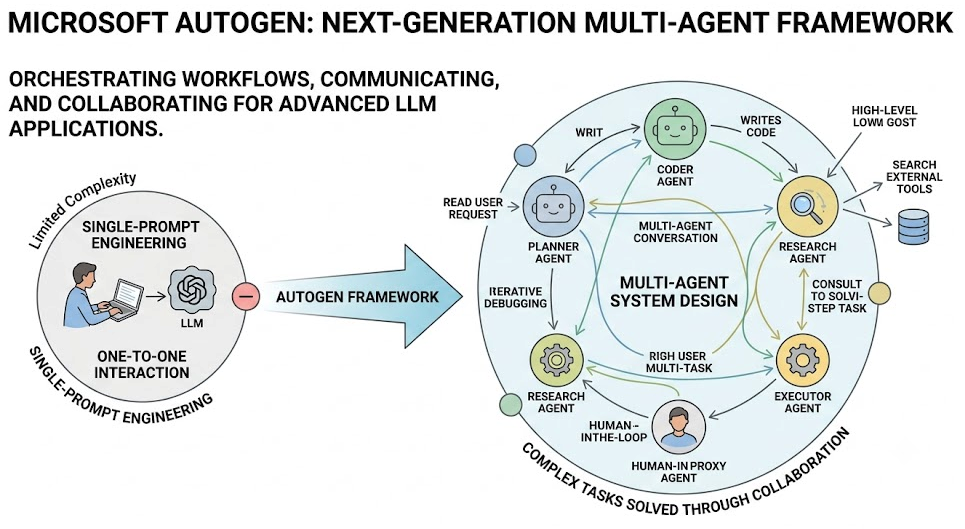
Microsoft AutoGen is an open-source framework designed to simplify the development of advanced Large Language Model (LLM) applications. Its core paradigm relies on multi-agent conversation, where multiple specialized agents communicate, collaborate, and orchestrate workflows to solve complex tasks.
By enabling agents to interact with each other, with humans, and with external tools, AutoGen shifts the paradigm of AI development from single-prompt engineering to multi-agent system design.
1. Core Features of AutoGen
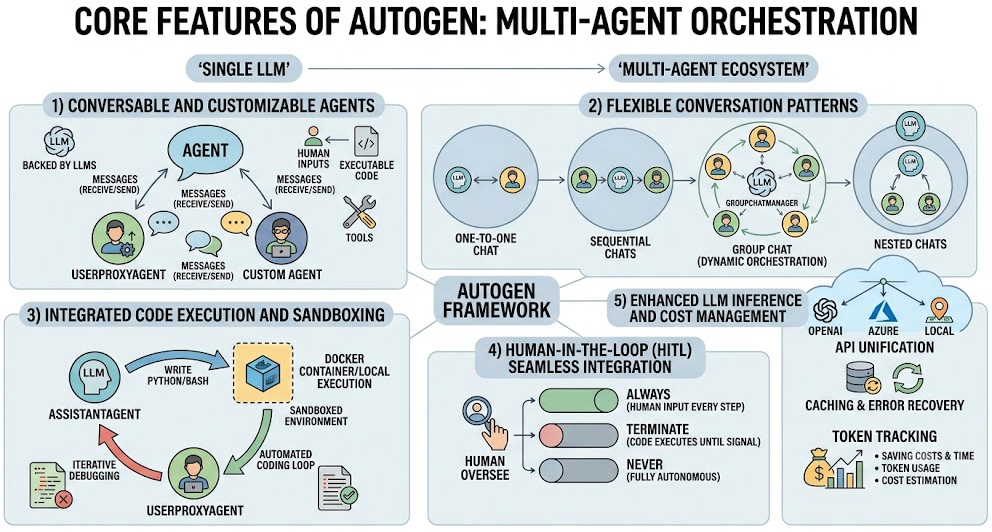
1) Conversable and Customizable Agents
AutoGen agents are designed as "conversable" entities, meaning they can send and receive messages to and from other agents to initiate or continue a conversation.
Agent Customization: Agents can be backed by LLMs, human inputs, executable code, tools, or a combination of these.
Built-in Agent Types:
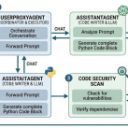
AssistantAgent: Acts as an AI assistant. By default, it leverages LLMs to generate text, write code, or propose solutions.
UserProxyAgent: Acts as a proxy for the human user. It can automatically execute code generated by other agents and trigger human intervention when necessary.
Custom Agents: Developers can inherit from base classes to build highly specialized agents with custom system prompts, memory structures, and toolsets.
2) Flexible Conversation Patterns
Unlike rigid sequential pipelines, AutoGen supports diverse and dynamic conversation topologies:
One-to-One Chat: Direct conversation between two agents (e.g., an assistant and a user proxy).
Sequential Chats: A chain of chats where the output of one conversation acts as the context or input for the next.
Group Chat (Dynamic Orchestration): A multi-agent environment managed by a GroupChatManager. The manager uses an LLM to dynamically select the next speaker based on the conversation history and context, allowing for organic brainstorming and collaborative problem-solving.
Nested Chats: Agents can spawn internal, sub-conversations with other agents to solve sub-tasks before replying to the main conversation thread.
3) Integrated Code Execution and Sandboxing
One of AutoGen's most powerful features is its ability to execute code natively:
Automated Coding Loop: An AssistantAgent can write Python or Bash code, and the UserProxyAgent can automatically execute it.
Sandboxed Environments: Code execution can be isolated using Docker containers or local execution environments, ensuring security and preventing malicious code from affecting the host system.
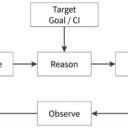
Iterative Debugging: If the code execution fails, the error output is sent back to the coding agent, which analyzes the stack trace and writes corrected code.
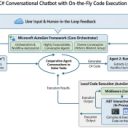
4) Human-in-the-Loop (HITL) Seamless Integration
AutoGen natively supports varying degrees of human oversight:
ALWAYS Mode: The user proxy asks for human input at every step.
TERMINATE Mode: The proxy executes code automatically until a specific stopping condition (like a "TERMINATE" signal) is met, at which point it prompts the user.
NEVER Mode: Fully autonomous execution where the proxy runs all code and logic without human confirmation.
5) Enhanced LLM Inference and Cost Management
API Unification: AutoGen provides a unified interface for various LLM providers (OpenAI, Azure OpenAI, local models via LiteLLM, Ollama, etc.).
Caching & Error Recovery: It includes built-in disk caching to prevent duplicate API calls (saving costs and time) and features auto-retry mechanisms for rate limits or API failures.
Token Tracking: Detailed tracking of token usage and financial cost estimation per agent session.
2. Proposed Application Integration Architectures
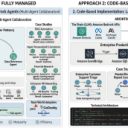
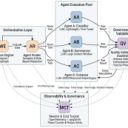
Integrating AutoGen into enterprise software requires robust architectural patterns. Below are the key integration architectures proposed for deploying AutoGen in production environments, leveraging both classic (v0.2/v0.3) and the modern event-driven/actor-based (v0.4+) paradigms.
1) The Distributed Actor-Model Architecture (Modern AutoGen v0.4+)
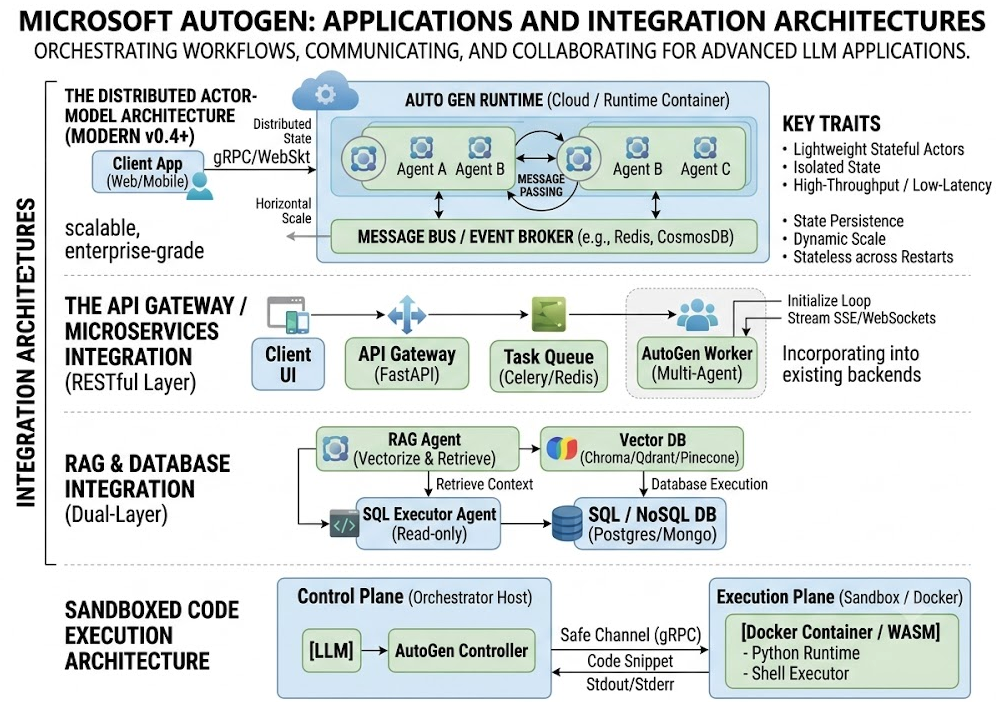
For scalable, enterprise-grade applications, AutoGen utilizes an event-driven actor model (similar to Orleans or Akka frameworks).
How it works: Agents are modeled as isolated, lightweight stateful actors that communicate purely via asynchronous message passing.
Network Protocol: Communication between the frontend, hosting runtime, and agents is handled via gRPC or WebSockets for high-throughput, low-latency communication.
State Management: Agent states and conversation histories are persisted in external distributed databases (e.g., Redis, CosmosDB), allowing agents to be stateless across restarts and dynamically scale horizontally.
2) The API Gateway / Microservices Integration (RESTful Layer)
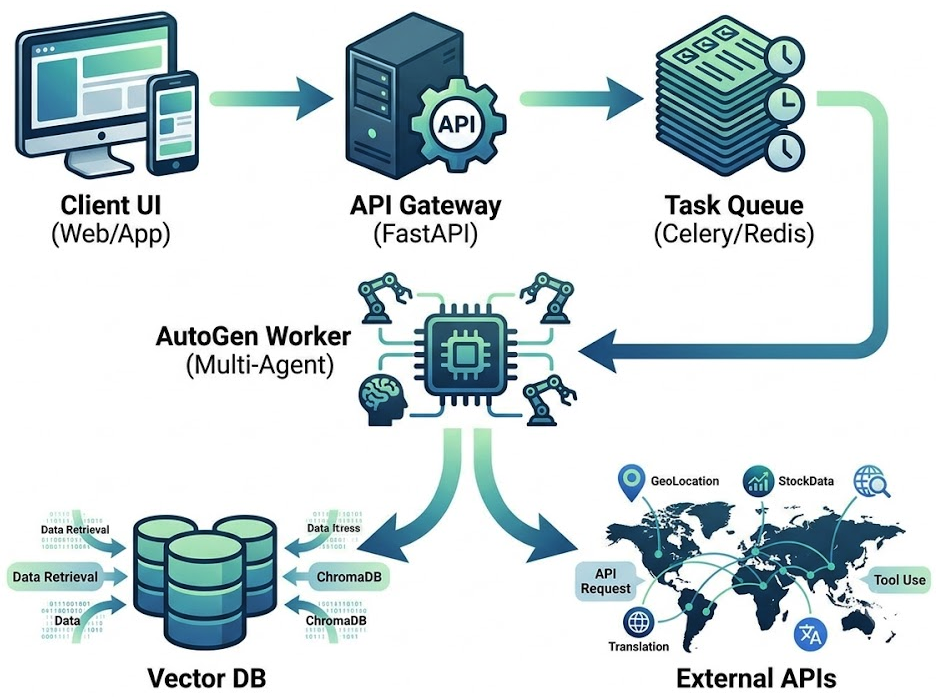
This architecture is ideal for incorporating AutoGen as a background worker process within an existing microservices backend.
Ingress Layer: A web framework like FastAPI or Express acts as the entry point, exposing REST endpoints to trigger agent workflows (e.g., /api/v1/generate-report).
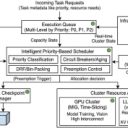
Asynchronous Queue: Since multi-agent conversations can take seconds or minutes to complete, tasks are pushed to a message broker (e.g., RabbitMQ, Celery, Redis).
Execution Worker: The AutoGen execution runtime runs as a background worker. It pulls the task, initializes the agent conversation, runs the loop, and updates the state.
Webhooks/Server-Sent Events (SSE): The worker streams agent messages and final outputs back to the client UI using WebSockets or SSE for real-time visualization.
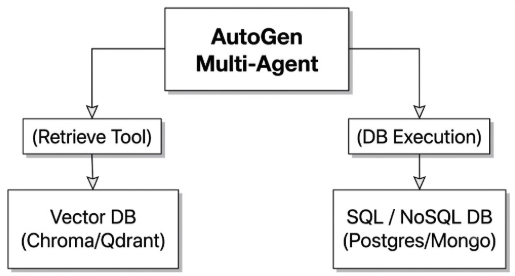
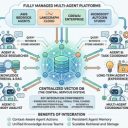
When agents need access to secure enterprise databases, local files, or real-time vector embeddings, a dual-layer data integration architecture is used.
RetrieveUserProxyAgent (RAG): AutoGen provides a dedicated RAG agent that automatically vectorizes incoming queries, queries vector databases (like ChromaDB, Qdrant, or Pinecone), and injects the retrieved context directly into the conversation history.
Database Agents: A designated SQL Executor Agent is equipped with read-only database connections. It translates natural language to SQL, executes the queries, and returns raw data to an Analyst Agent for interpretation, shielding the LLM from direct, unrestricted system write access.
4) Sandboxed Code Execution Architecture
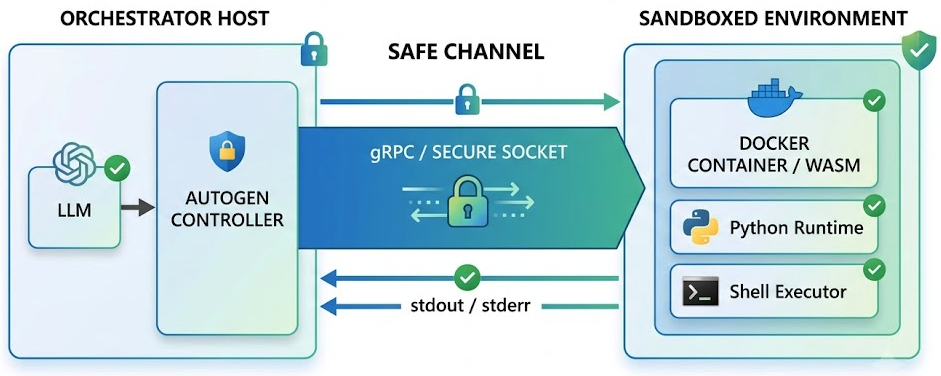
In scenarios where agents write and run code to solve problems, security is paramount. The architecture segregates the Orchestrator from the Executor.
Control Plane (Orchestrator): Runs the core AutoGen library, handles state transitions, LLM calls, and parses structured agent instructions.
Execution Plane (Sandbox): A completely isolated Docker container, VM, or WebAssembly (WASM) sandbox. It receives code snippets via a secure gRPC link, executes them in a clean-room environment with limited filesystem access, and returns only standard output (stdout) and error logs (stderr).