Semantic Kernel: Microsoft's GenAI Orchestration SDK

CK CK 3788 
Created at  
390 0 0

Here is an in-depth investigation into Semantic Kernel (SK), its key features, proposed integration architectures, and a detailed comparison with Microsoft AutoGen.
 

1. What is Semantic Kernel?

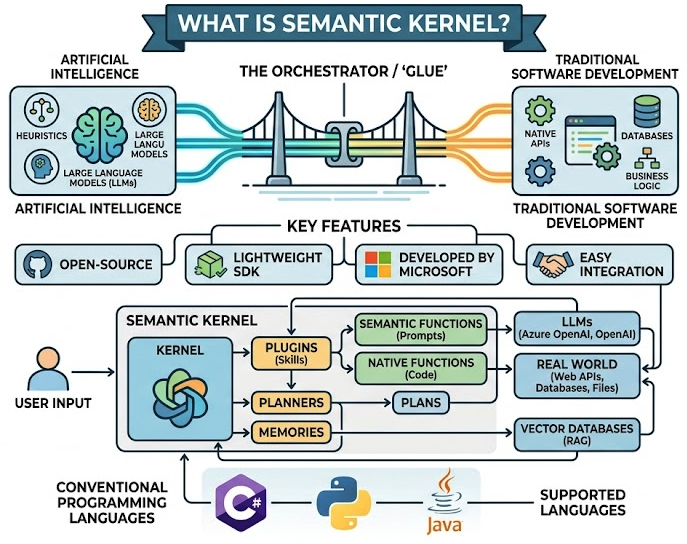
Semantic Kernel (SK) is an open-source, lightweight SDK developed by Microsoft that allows developers to easily integrate Large Language Models (LLMs) with conventional programming languages like C#, Python, and Java.

It serves as an enterprise-grade AI orchestrator. Its primary philosophy is to act as the "glue" between artificial intelligence (heuristics, LLMs) and traditional software development (native APIs, databases, business logic).

Semantic Kernel: Microsoft's GenAI Orchestration SDK


2. Key Features of Semantic Kernel

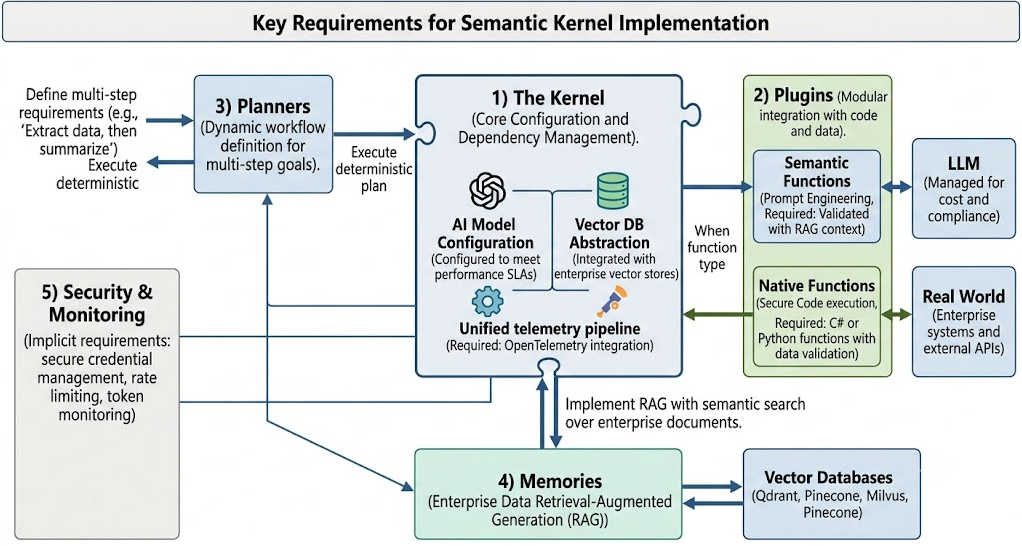
Semantic Kernel is structured around a few core building blocks designed to make AI integration modular and testable:


1) The Kernel

The Kernel is the central object of the SDK. It manages the configuration, registers services (like AI models and vector databases), and orchestrates the execution of plugins and pipelines.


2) Plugins (formerly "Skills")

Plugins are the "hands and eyes" of the LLM. They allow the model to interact with the real world. A plugin is a collection of functions that can be of two types:

  • Semantic Functions: Prompts written in natural language (using templating formats) that direct the LLM.
  • Native Functions: Traditional code (C#, Python) that performs tasks like querying a database, calling an API, or reading a file.


3) Planners

Planners are out-of-the-box AI algorithms that take a user's goal (e.g., "Draft an email to the team summarizing last week's sales") and dynamically generate a plan to achieve it. The planner decides which plugins to call, in what order, and passes the output of one plugin as the input to the next.


4) Memories (Vector Database Integration)

To solve the LLM "hallucination" and lack of context issues, Semantic Kernel integrates with Vector Databases (like Qdrant, Pinecone, Milvus, or Azure AI Search). It abstracts these databases into Memories, allowing developers to easily implement RAG (Retrieval-Augmented Generation) by performing semantic searches on enterprise data.


5) Out-of-the-Box Connectors

SK provides native connectors to various LLM providers (Azure OpenAI, OpenAI, Hugging Face, Ollama) and telemetry tools (OpenTelemetry) to monitor token usage, latency, and execution paths.


Semantic Kernel: Microsoft's GenAI Orchestration SDK


3. Proposed Application Integration Architectures

Microsoft proposes several architectural patterns for integrating Semantic Kernel into enterprise systems. Below are the two most common architectures:


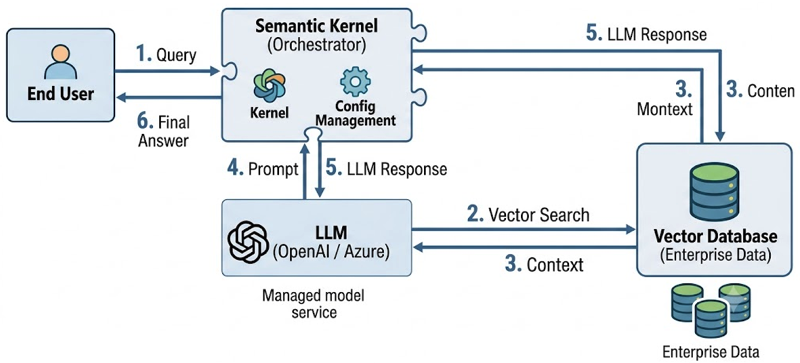
Architecture A: The Standard RAG (Retrieval-Augmented Generation) Pattern

This is used for "Chat with your Data" applications (like custom enterprise Copilots).

Semantic Kernel: Microsoft's GenAI Orchestration SDK

  1. User Input: The user asks a question.
  2. Context Retrieval: Semantic Kernel uses a Memory Connector to convert the question into an embedding, search a Vector DB, and retrieve relevant enterprise documents.
  3. Prompt Construction: SK injects the retrieved context and user query into a semantic template.
  4. Inference: The compiled prompt is sent to the LLM.
  5. Output Delivery: The LLM generates a grounded response, which is sent back to the user.


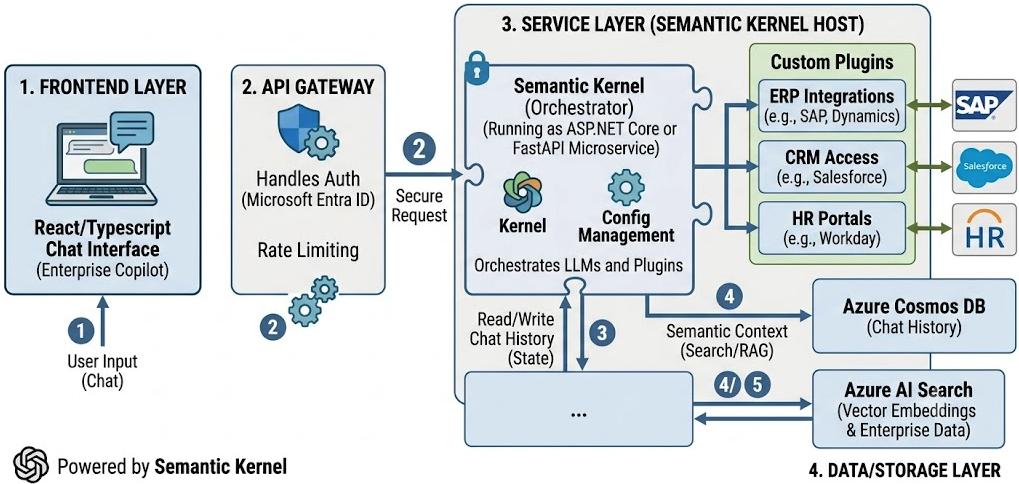
Architecture B: Microservices-based Copilot Architecture (Enterprise)

For large enterprises, Microsoft proposes deploying Semantic Kernel within a Web API layer, separated from the frontend and database layers.

  • Frontend Layer: A React/Typescript chat interface.
  • API Gateway: Manages authentication (Microsoft Entra ID) and rate limiting.
  • Service Layer (Semantic Kernel Host): An ASP.NET Core or FastAPI microservice running Semantic Kernel. This layer contains the Custom Plugins (ERP integrations, CRM access, HR portals).
  • Data/Storage Layer: Azure Cosmos DB for storing Chat History (state) and Azure AI Search for vector embeddings.

Semantic Kernel: Microsoft's GenAI Orchestration SDK


4. Semantic Kernel vs. Microsoft AutoGen

While both are Microsoft-backed frameworks for GenAI, they serve radically different paradigms. Semantic Kernel is a single-agent orchestrator, whereas AutoGen is a multi-agent conversation framework.


Conceptual Comparison

FeatureSemantic KernelMicrosoft AutoGen
Core ConceptApplication Orchestrator & SDK. Bridges LLMs with traditional code.Multi-Agent Conversation. Solves tasks via collaborative agents.
Primary ParadigmSingle-agent / Linear or Planned workflows.Agent-to-Agent interaction / Event-driven conversations.
Primary LanguagesC# (First-class), Python, Java.Python (First-class), .NET (in preview).
Autonomy LevelControlled / Semi-autonomous (driven by Planners & rigid code).High Autonomy (Agents talk to each other to solve problems autonomously).
Human-in-the-LoopManaged manually via application logic.Built-in native support for human feedback during agent loops.
Ideal ForIntegrating AI into existing corporate C#/.NET applications, APIs, and Copilots.Complex problem solving, code generation/execution, simulations, and R&D.


Key Differences Explained

1) Architecture of execution:

  • Semantic Kernel: Works like a traditional pipeline. It takes a user input, compiles a prompt, calls an API via a plugin, gets data, and gives an answer. It behaves like a highly capable AI-assisted assistant/function.
  • AutoGen: Works like a team in a Slack channel. You define an "Admin Agent," a "Coder Agent," and a "Tester Agent." They pass messages back and forth. The Coder writes code, the Tester runs it in a safe docker container, reports errors, and the Coder fixes it—all without human intervention.

2) Target Developer:

  • Semantic Kernel is built for Enterprise Software Engineers. It fits perfectly into standard ASP.NET architectures, respects enterprise design patterns, and focuses on security, predictability, and API integration.
  • AutoGen is built for AI Researchers and Advanced AI Engineers experimenting with swarm intelligence, multi-agent collaboration, and high-autonomy workflows.

3) Execution Predictability:

  • Semantic Kernel is highly predictable. Even when using Planners, the developer has tight control over what APIs can be called.
  • AutoGen is non-deterministic and can be expensive. Since agents talk to each other recursively until a task is solved, it can lead to long loops of LLM calls (consuming many tokens) if not constrained properly.


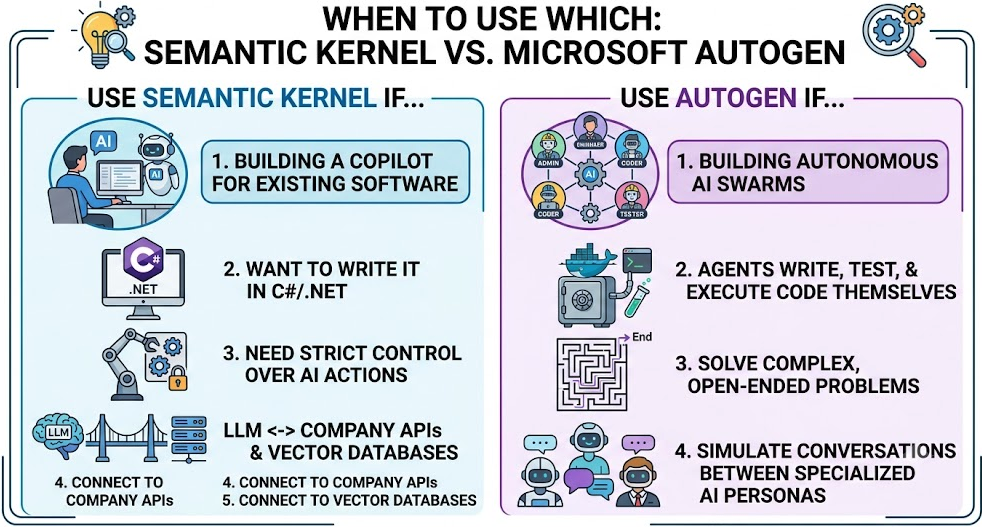
Summary: When to use which?

  • Use Semantic Kernel if you want to build a Copilot for your existing software, want to write it in C#/.NET, need strict control over what the AI does, and need to connect LLMs to your company's APIs and Vector Databases.
  • Use AutoGen if you want to build Autonomous AI Swarms that can write, test, and execute code themselves, solve complex open-ended problems, or simulate conversations between different specialized AI personas.

 

Semantic Kernel: Microsoft's GenAI Orchestration SDK

Tags AI App Development AI Integration Architectures Agentic AI AutoGen AutoGen Comparison LLM Application LLM Orchestration Microsoft AI SDK Microsoft AutoGen Microsoft GenAI Orchestration SDK Semantic Kernel Facebook X
Comments 0
Similar posts
  1. LLM Application Development with LangGraph: Features and Architectures for Stateful Multi-Actor LLM Applications
    344
  2. Microsoft AutoGen: Next-Generation Multi-Agent Framework
    300
  3. How to Build a Python Chatbot That Writes and Runs Code Using Microsoft AutoGen (With Sample Code)
    236
  4. Conversation Multi-Agent Chatbot with On-the-Fly Code Execition via Microsoft AutoGen
    293
  5. AWS Multi-Agent Collaboration Approach: Fully Managed vs. Code-based Implementation

    270
  6. Architecting an LLM-Powered Multi-Agent Orchestration System: Design and Requirements

    238
  7. When Do You Need Real-Time Model Registry Versioning Powered by Autonomous Agents?
    220
  8. Beyond Static Pipelines: Architecting LLM Multi-Agent Systems for Autonomous Workflow Orchestration
    576
  9. Why Reranking is Crucial for RAG and Agentic AI Systems?
    262
  10. Technical Hierarchy of AI Agents
    808
  1. Designing MLOps Architectures to Handle Seasonal Data Drift in EV Fleet Models
    185
  2. From 15 to 40+ FPS: Accelerating PyTorch Object Detection on Automotive ECUs
    207
  3. Understanding Data Lineage
    252
  4. GPU & LLM Cluster Infrastructure & Task Scheduling Architecture
    231
  5. When Do You Need Real-Time Model Registry Versioning Powered by Autonomous Agents?
    220
  6. What ML Labeling Actually Is - And How to Design a Pipeline for It
    328
  7. Bridging the Gap: How Machine Learning Integrates with Infrastructure
    263
  8. Designing an Enterprise ML Experiment Tracking and Reproducibility Platform: System Requirements and Architecture
    303
  9. End-to-End AI/Machine Learning Architecture: AI/ML 6 Layers
    231
  10. Architecting an LLM-Powered Multi-Agent Orchestration System: Design and Requirements
    238
  11. End-to-End Autonomous Vehicle ML Training Pipeline
    306
  12. Building GPU Clusters on GCP, Azure, and AWS: A Practical Guide and Head-to-Head Comparison
    335
  13. Embeddings on the Lakehouse: What Snowflake and Databricks Actually Do (and Don't)
    280
  14. Vector Database Integration on Fully Managed Multi-Agent Environment
    293
  15. AWS Multi-Agent Collaboration Approach: Fully Managed vs. Code-based Implementation
    270
  16. LLM Application Development with LangGraph: Features and Architectures for Stateful Multi-Actor LLM Applications
    344
  17. Microsoft AutoGen: Next-Generation Multi-Agent Framework
    300
  18. Beyond SDLC: Why the Entertainment Sector Needs an AI Development Life Cycle Now
    282
  19. Why AI-DLC is the New Paradigm for Development?
    326
  20. Autonomous Vehicle Machine Learning (AV ML): An Architectural Review
    395
  21. AI-based workflow innovation - it's not just an optimizing cost/process but also a matter of survival!
    381
  22. Cloud-Based AI Architecture Proposals for US Auto Finance Industry
    551
  23. Netflix's Recommendation System
    412
  24. Is PyTorch Dead? Deep Learning's Enduring Role Beyond LLMs & Essential Skills
    691
  25. Coding Revolution with Claude Code & MoAI ADK(Agent Development Kit)
    726
  26. Curiousity if OpenAI Engineers use Cursor.ai
    6611
  27. Building my own ChatGPT based on SageMaker and Milvus that is specialized to Shopping Mall
    264
  28. Your Blueprint for an LLM & Vector DB Insurance Product Q&A
    256
  29. The Core of Vector Databases: Embeddings and LLM Dependency
    253
  30. Original Purpose of Markdown File - why Engineers love it?
    758
Recently updated
  1. Why 100% SEO Guarantees Better User Engagement and How to Achieve It in Your Service
    27
  2. Why SPF and DKIM Are Essential for Linux Email Servers?
    24
  3. How do I create animated background for Google Meet?
    19,736
  4. MaxMind GeoLite2 vs. DB-IP Lite vs. ip-api.com: Choosing the Right Free IP Geolocation Solution
    218
  5. Meet Valkey: Why Redis Changed Its License, Why Valkey is Better, and How to Use It as a Drop-in Replacement
    86
  6. How Rogue Web Scrapers Are Stealing My Content and Destroying My Server
    153
  7. Array of arguments passed to script in PHP
    85
  8. Invalid Auction Storms in Ad Tech
    93
  9. Building MRC-Compliant Instrumentation in Ad Tech: Implementation Steps and Key Challenges
    198
  10. The Two Clocks of Ad Server Architecture
    63
  11. Frequency Cap Architecture Overview
    509
  12. Collecting Proof-of-Play from 100,000 Screens
    141
  13. Vector Search in Relational Databases (RDBs): Trends & Usage Environments
    280
  14. What is RedisVL?
    105
  15. Designing a Skill Registry Architecture: Minimize Token Usage and Maximize AI Performance
    224
  16. TPU & GPU Cluster Management Tools
    234
  17. The Concept of Scaffolding in AI Agents
    222
  18. Beyond Static Pipelines: Architecting LLM Multi-Agent Systems for Autonomous Workflow Orchestration
    576
  19. AI-DLC vs. AI-SDLC: Model-Centric vs. System-Centric AI Development
    253
  20. Fine-Tuning Open-Weight LLMs: Training, Licensing, and Deploying Custom Models with Ollama
    328
  21. Inside the Next-Generation Streaming Architecture: Ultra-Low Latency, SGAI, and AI Codecs
    198
  22. Machine Learning: Training vs. Ranking
    213
  23. The Continuous Learning Machine: Designing a Loop That Actually Turns
    217
  24. The Next-Gen Low-Latency Standards: LL-HLS & MoQ
    189
  25. Designing a Data Curation System Around a Vector Database
    215
  26. Extracting Context from Live Video: The Architecture Got Simpler When We Stopped Building Features
    229
  27. The New Ad Stack Behind Live Sports Streaming: Inside SGAI, EABN, and the Standards Race to Fix Live Monetization
    649
  28. Designing MLOps Architectures to Handle Seasonal Data Drift in EV Fleet Models
    185
  29. From 15 to 40+ FPS: Accelerating PyTorch Object Detection on Automotive ECUs
    207
  30. Understanding Data Lineage
    252