AWS Multi-Agent Collaboration Approach: Fully Managed vs. Code-based Implementation
CK 3788 Created at Updated at
27000
Just like Microsoft’s AutoGen or CrewAI, Amazon Web Services (AWS) provides powerful multi-agent frameworks and fully managed features that enable multiple AI agents to collaborate and solve complex tasks.
Broadly, AWS offers two main paths for implementing multi-agent systems: 1) A Fully Managed AWS Native Service and 2) A Code-Based Approach combining open-source frameworks with AWS infrastructure.
As part of Amazon Bedrock (AWS’s flagship generative AI service), Amazon Bedrock Agents includes a built-in Multi-Agent Collaboration capability.
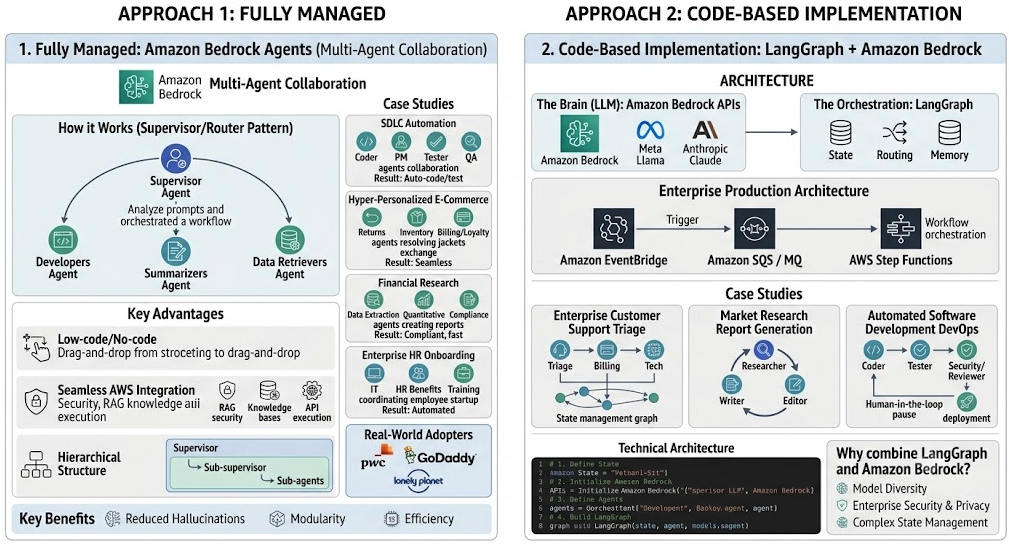
How it Works (Supervisor/Router Pattern):
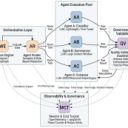
Similar to AutoGen’s GroupChatManager or CrewAI’s Manager, Bedrock employs a "Supervisor Agent." When a user submits a complex request, the Supervisor Agent analyzes the prompt, orchestrates the workflow, routes sub-tasks to specialized sub-agents (e.g., developers, summarizers, or data retrievers), and aggregates the final results.
Key Advantages:
Low-code/No-code: You can build and configure agent teams directly via the AWS Console or through prompt instructions, minimizing the need for complex coding.
Seamless AWS Integration: Out-of-the-box integration with AWS security (IAM), enterprise data sources (RAG via Knowledge Bases for Amazon Bedrock), and external API executions (via Action Groups).
Key Feature:
It supports hierarchical structures, allowing you to build agent teams with up to 3 nested layers (Supervisor → Sub-supervisor → Sub-agents).
Case 1) Software Development Life Cycle (SDLC) Automation
This is one of the most common technical use cases, where different agents act as different roles in a software team.
The Scenario: A user wants to add a new feature to an application.
The Collaborating Agents:
Supervisor Agent: Receives the user request, breaks it down into tasks, and routes them to specialized agents.
Product Manager (PM) Agent: Analyzes the request, checks existing documentation, and writes user stories/requirements.
Developer Agent: Writes the actual code based on the PM Agent's requirements.
QA/Tester Agent: Writes unit tests, runs them against the developer's code, and sends feedback if tests fail.
Result: The system can automatically generate, test, and refine code before human review.
Case 2) Hyper-Personalized E-Commerce & Customer Support
In retail, customer inquiries often require accessing multiple distinct backend systems (inventory, billing, shipping).
The Scenario: A customer contacts support saying: "I bought a red jacket, but it’s too small. I want to return it and get a blue one in medium, and I want to use my loyalty points for any price difference."
The Collaborating Agents:
Supervisor Agent: Understands the complex, multi-part request.
Returns/Refund Agent: Initiates the return process for the red jacket and checks the refund eligibility.
Inventory Agent: Checks if the blue jacket in size medium is in stock.
Loyalty & Billing Agent: Accesses the customer's loyalty point balance and calculates the final transaction.
Result: The customer gets a seamless, immediate resolution without being transferred to different human departments or navigating a frustrating phone menu.
Case 3) Financial Research, Analysis, and Compliance
In investment banking and wealth management, pulling data and ensuring regulatory compliance are highly complex tasks.
The Scenario: A financial analyst wants to generate a quarterly investment recommendation report for a specific stock portfolio.
The Collaborating Agents:
Data Extraction Agent: Uses RAG (Retrieval-Augmented Generation) to pull the latest SEC filings, earnings call transcripts, and market news.
Compliance & Legal Agent: Checks the generated recommendations against SEC regulations and internal company compliance guidelines to ensure no rules are violated.
Result: A fully compliant, data-driven financial report generated in minutes instead of days.
Case 4) Enterprise HR and Employee Onboarding
Onboarding a new employee requires coordination across IT, HR, Legal, and Facilities.
The Scenario: A hiring manager triggers the onboarding workflow for a new software engineer.
The Collaborating Agents:
IT Provisioning Agent: Creates the new employee's AWS account, email, and requests a laptop shipment.
HR Benefits Agent: Generates enrollment forms for health insurance and pension plans.
Training & Compliance Agent: Assigns mandatory security training courses in the company's LMS (Learning Management System).
Result: The entire onboarding checklist is executed automatically, ensuring no steps are missed.
Real-World Industry Adopters of Amazon Bedrock Agents
While specific proprietary multi-agent codebases are kept private, major enterprises utilize Bedrock's agentic workflows:
PwC: Uses Bedrock Agents to help audit and tax professionals quickly analyze regulatory documents and automate compliance checks.
GoDaddy: Uses Bedrock-powered agents to guide small business owners through setting up their websites, domain registration, and marketing campaigns by coordinating different sub-tasks.
Lonely Planet: Developed AI travel itineraries where different agentic functions (booking, local attractions, budgeting) collaborate to create personalized travel plans.
Key Benefits of Multi-Agent Collaboration in Bedrock:
Reduced Hallucinations: By limiting the scope of each agent (e.g., the "Billing Agent" only has access to billing tools), the LLM is less likely to get confused.
Modularity: You can update the "Inventory Agent" without breaking the "Loyalty Agent."
Efficiency: Bedrock automatically handles the routing, memory sharing, and session state between the supervisor and sub-agents.
If you prefer to write Python code for granular control over agent state transitions, conversation flows, and memory (similar to AutoGen), AWS officially promotes and supports integrating LangGraph (the industry-standard graph-based agent framework) with Amazon Bedrock.
Architecture:
The Brain (LLM): Amazon Bedrock APIs provide access to industry-leading foundation models (such as Anthropic Claude, Meta Llama, etc.).
The Orchestration: LangGraph manages the state, routing, and conversation loops between the agents.
Enterprise Production Architecture:
To scale this approach for production, AWS guides developers on how to combine LangGraph with traditional AWS messaging and workflow orchestration services. This ensures reliable message delivery and state persistence across agent interactions using:
Yes, the combination of LangGraph (as the orchestration framework) and Amazon Bedrock (providing secure, enterprise-grade Foundation Models like Anthropic Claude 3/3.5) is a highly popular and powerful architecture for building production-ready Multi-Agent Systems.
In enterprise environments, companies use LangGraph to manage complex, cyclical agent workflows (state management, human-in-the-loop, error recovery) while utilizing Amazon Bedrock to run models securely within their AWS VPC, ensuring data privacy.
Below are key use cases and architectural patterns where LangGraph + Amazon Bedrock is successfully implemented.
Case 1) Enterprise Customer Support & Triage System (Multi-Agent)
In this scenario, a single general chatbot is not enough. Instead, a team of specialized agents handles different aspects of customer service.
How it works with LangGraph + Bedrock:
Triage Agent (Router): Driven by Claude 3 Haiku (fast and cost-effective) on Bedrock. It analyzes the incoming customer query.
Billing Agent: Driven by Claude 3.5 Sonnet. It has access to database tools to check invoices and process refunds.
Technical Support Agent: Connected to internal product documentation (via Amazon Bedrock Knowledge Bases / RAG).
State Management (LangGraph): LangGraph routes the conversation state from the Triage Agent to the Specialist Agents. If the Billing Agent needs technical info, it can pass the state to the Tech Agent and back.
AWS Benefit: Securely accesses customer databases and internal documents within the AWS environment.
Case 2) Market Research & Automated Report Generation (Researcher + Writer + Editor)
This is a classic cyclical multi-agent pattern where agents must collaborate and critique each other's work before delivering a final report.
How it works with LangGraph + Bedrock:
Researcher Agent: Uses search tools (e.g., Tavily, Bing) to gather data on a topic. It summarizes findings using Claude 3.5 Sonnet on Bedrock.
Writer Agent: Takes the research notes and drafts a structured PDF report.
Editor/Critic Agent: Reviews the draft against a quality checklist.
The LangGraph Cycle: If the Editor finds missing information, LangGraph routes the state back to the Researcher with specific feedback. This loop continues until the Editor approves.
AWS Benefit: The final reports and intermediate data are saved securely in Amazon S3, and Bedrock ensures the proprietary market data used for synthesis does not leave the AWS boundary.
Case 3) Automated Software Development & Code Review (Coder + Tester + Deployer)
In DevOps, this combination is used to automate code generation, testing, and deployment safely.
How it works with LangGraph + Bedrock:
Coder Agent: Receives a feature request, writes the code (Python/JS), and creates a pull request.
Tester Agent (Validation): Runs unit tests in a secure sandbox (like AWS CodeBuild). If tests fail, it sends the error logs back to the Coder Agent.
Security/Reviewer Agent: Uses Claude 3.5 Sonnet to inspect the code for security vulnerabilities (e.g., hardcoded secrets, SQL injection).
Human-in-the-Loop (LangGraph feature): LangGraph pauses the graph execution and waits for a human developer to click "Approve" in Slack or an internal portal before deploying the code to AWS Lambda or ECS.
Technical Architecture: How They Integrate
In Python, you integrate them by using langchain_aws (to call Bedrock) and langgraph (to build the state graph).
from langchain_aws import ChatBedrock
from langgraph.graph import StateGraph, END
from typing import TypedDict, Annotated, Sequence
import operator

# 1. Define the State
class AgentState(TypedDict):
    messages: Annotated[Sequence[dict], operator.add]
    next_step: str

# 2. Initialize Amazon Bedrock (using Claude 3.5 Sonnet)
llm = ChatBedrock(
    model_id="anthropic.claude-3-5-sonnet-20240620-v1:0",
    model_kwargs={"temperature": 0.5},
    region_name="us-east-1" # Or your preferred AWS region
)

# 3. Define Agents
def triage_agent(state: AgentState):
    # LLM logic to decide the next agent
    response = llm.invoke(state["messages"])
    return {"messages": [response], "next_step": "billing_agent"}

def billing_agent(state: AgentState):
    # LLM logic to handle billing
    response = llm.invoke(state["messages"])
    return {"messages": [response], "next_step": END}

# 4. Build the LangGraph
workflow = StateGraph(AgentState)
workflow.add_node("triage", triage_agent)
workflow.add_node("billing", billing_agent)

workflow.set_entry_point("triage")
workflow.add_conditional_edges(
    "triage",
    lambda state: state["next_step"],
    {
        "billing_agent": "billing",
        "end": END
    }
)
workflow.add_edge("billing", END)

app = workflow.compile()
Why combine LangGraph and Amazon Bedrock?
Model Diversity (Bedrock): You can use different models for different agents. Use Claude 3.5 Sonnet for the "Master Coordinator/Editor" agent that requires high reasoning, and Claude 3 Haiku or Llama 3 for "Sub-agents" performing simple tasks to minimize latency and cost.
Enterprise Security & Privacy: Bedrock guarantees that your prompt data is not used to train the base models. This is crucial when multi-agents are processing sensitive customer data.
Complex State Management (LangGraph): Standard chain-of-thought LLMs struggle with multi-step processes. LangGraph allows agents to loop, pause for human approval, and maintain memory across complex conversations.
💡 Summary & Recommendation
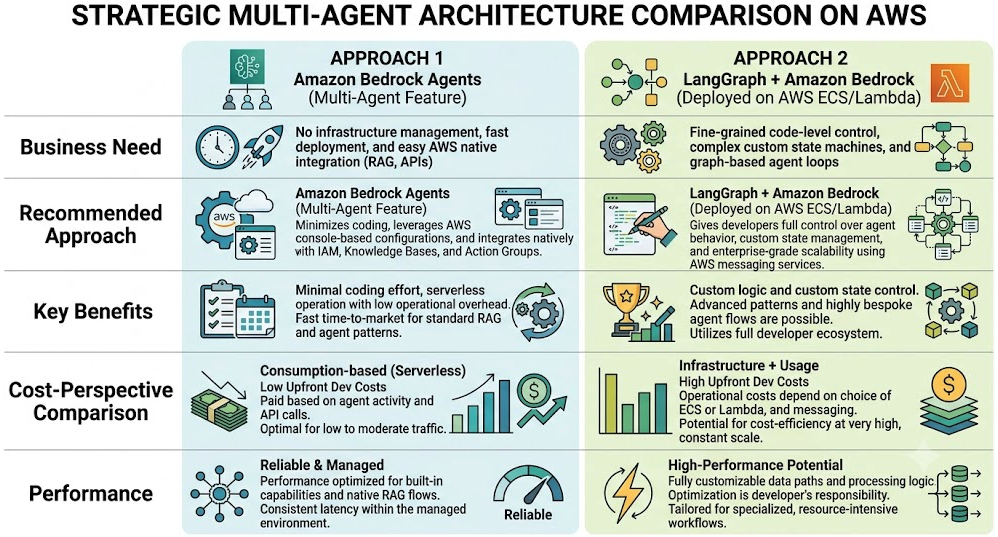
Business Need
Recommended Approach
Key Benefits
No infrastructure management, fast deployment, and easy AWS native integration (RAG, APIs)
Amazon Bedrock Agents (Multi-Agent Feature)
Minimizes coding, leverages AWS console-based configurations, and integrates natively with IAM, Knowledge Bases, and Action Groups.
Fine-grained code-level control, complex custom state machines, and graph-based agent loops
LangGraph + Amazon Bedrock (Deployed on AWS ECS/Lambda)
Gives developers full control over agent behavior, custom state management, and enterprise-grade scalability using AWS messaging services.