Bridging the Gap: How Machine Learning Integrates with Infrastructure

CK CK 3788 
Created at  
271 0 0

Bridging the gap between Machine Learning (ML) theory and infrastructure often comes down to shift in perspective: ML is the intelligence (the brain), and Infrastructure is the system that keeps it alive, fed, and useful to the world (the body and environment).

Here is a structured, intuitive framework to understand and explain how ML connects with infrastructure.
 

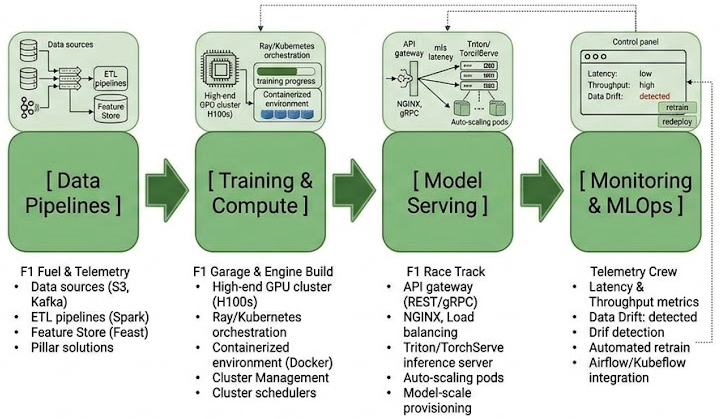
1. The Core Analogy: The Formula 1 Racing Team

To explain ML and infrastructure simply, use the Formula 1 (F1) analogy:

  • The ML Model = The Driver & Car Design: The algorithms, math, and weights. It defines how fast you can go.
  • Infrastructure = The Factory, Pit Crew, & Track:
    • Data Infra: The fuel supply chain and telemetry sensors.
    • Compute Infra: The high-end garage where the engine is built and tested.
    • Serving Infra: The race track where the car actually runs under real-world pressures.
    • Monitoring Infra: The telemetry crew analyzing performance in real time to prevent crashes.

The Elevator Pitch: A brilliant ML model in a Jupyter Notebook is like a Formula 1 car stuck in a garage. Infrastructure is everything required to get that car onto the track, running safely at top speeds for millions of users.


2. The 4 Pillars of ML Infrastructure (The Lifecycle View)

ML infrastructure can be grouped into four main stages corresponding to the life cycle of a model:

Bridging the Gap: How Machine Learning Integrates with Infrastructure

Pillar 1: Data Infrastructure (Feeding the Model)

  • The Problem: Models need massive amounts of clean data, fast.
  • The Infra Solution:
    • Storage: Data Lakes / Object Storage (e.g., AWS S3, Google Cloud Storage) to hold raw unstructured data (images, text, logs).
    • Processing Pipelines: Distributed processing engines (e.g., Apache Spark) to clean, transform, and extract features.
    • Feature Stores: Centralized repositories (e.g., Feast, Hopsworks) that cache features so both training and real-time inference use identical data definitions.


Pillar 2: Compute & Training Infrastructure (Building the Model)

  • The Problem: Training deep learning models requires massive parallel processing (GPUs/TPUs) and takes hours or days.
  • The Infra Solution:
    • Hardware Orchestration: Provisioning GPU clusters (e.g., NVIDIA A100/H100) efficiently.
    • Containerization: Using Docker to package code, dependencies, and CUDA libraries so the training runs identically anywhere.
    • Cluster Management: Kubernetes (K8s) or specialized schedulers (e.g., Ray, Slurm) to distribute training jobs across hundreds of GPUs without manual management.


Pillar 3: Serving & Deployment Infrastructure (Delivering Predictions)

  • The Problem: Converting a saved model file (.pt, .onnx, .pb) into an API that responds to user requests in milliseconds.
  • The Infra Solution:
    • Model Servers: Dedicated engines like Triton Inference Server, TorchServe, or vLLM optimized for low latency and high throughput.
    • API Gateways & Load Balancers: Routing traffic (via REST or gRPC) from thousands of concurrent users to the available instances.
    • Auto-scaling: Automatically increasing server instances (via Kubernetes HPA) when traffic spikes and scaling down to save costs when idle.


Pillar 4: Monitoring & MLOps (Maintaining Quality)

  • The Problem: Unlike traditional software, ML models degrade over time because real-world data changes (Data Drift).
  • The Infra Solution:
    • Observability Tools: Capturing incoming request data and prediction logs (e.g., Prometheus, Grafana, Evidently AI).
    • Automated CI/CD Pipelines: Triggers (e.g., Airflow, Kubeflow) that automatically retrain and redeploy the model when accuracy drops below a threshold.


3. Practical Cheat Sheet: ML Need vs. Infrastructure Component

When explaining to engineers or managers, map ML problems directly to Infra solutions:

ML ChallengeInfrastructure SolutionExample Tools
"My data doesn't fit in RAM."Distributed Storage & Streaming PipelinesAWS S3, Apache Kafka, Spark
"Training takes 3 weeks on my laptop."Distributed GPU Orchestration & Auto-scalingDocker, Kubernetes, Ray, AWS SageMaker
"Environment settings break on other machines."Containerization & Immutable EnvironmentsDocker, NVIDIA Container Toolkit
"The API crashes when 10,000 users visit."Load Balancing, Model Servers, Auto-scalingTriton Inference Server, NGINX, KServe
"The model predictions got worse over time."Drift Detection & Automated Retraining PipelinesApache Airflow, MLflow, Evidently AI


4. A Simple 3-Step Framework for Answering Interview Questions

When asked: "How do you integrate ML with Infrastructure?", structure your answer in three logical steps:

  • Inbound (Data & Prep): "First, infrastructure automates data flow—moving data from databases into object storage, running ETL jobs, and storing features so models can train on reliable data."
  • Execution (Training & Hosting): "Second, infrastructure provides scalable compute—containerizing model code with Docker, managing GPU clusters with Kubernetes, and exposing models as lightweight microservices via specialized inference engines."
  • Outbound (Monitoring & Continuous Integration): “Third, infrastructure ensures reliability—monitoring latency, GPU usage, and data drift, while running CI/CD pipelines to automatically retrain models without downtime.”
Tags AI Integration Cloud Infrastructure Data Infrastructure ML Engineering MLOps Machine Learning Infrastructure Model Deployment Production Machine Learning Scalable Machine Learning System Architecture Facebook X
Comments 0
Similar posts
  1. End-to-End Autonomous Vehicle ML Training Pipeline
    325
  2. Building GPU Clusters on GCP, Azure, and AWS: A Practical Guide and Head-to-Head Comparison
    345
  3. When Do You Need Real-Time Model Registry Versioning Powered by Autonomous Agents?
    225
  4. System Requirements and Architecture: Intelligent Priority-Based Scheduler
    165
  5. Understanding Data Lineage
    259
  6. Designing a Data Curation System Around a Vector Database
    220
  7. The Blueprint of Success: Why System Design and Architecture Matter?
    399
  8. AI-DLC vs. AI-SDLC: Model-Centric vs. System-Centric AI Development
    258
  9. Beyond Static Pipelines: Architecting LLM Multi-Agent Systems for Autonomous Workflow Orchestration
    582
  10. Arm Kernel DNNs: Powering Efficient AI at the Edge
    224
  11. Designing a Skill Registry Architecture: Minimize Token Usage and Maximize AI Performance
    229
  12. The Two Clocks of Ad Server Architecture
    69
  13. Is PyTorch Dead? Deep Learning's Enduring Role Beyond LLMs & Essential Skills
    693
  14. Milvus and LLM Integration - Very Smart Approach!
    296
  15. How Netflix Runs Recommendations for Hundreds of Millions of Users Using Amazon SageMaker & Metaflow
    174
  16. MLOps Explained: Spark, Flink, and Reference Architecture Deep Dive
    242
  17. TikTok's Recommendation System - Monolith
    291
  18. Common Recommendation Service Architecture
    531
  19. Stateful Databases: A Deep Dive with Cassandra & TiDB
    187
  20. Designing Resilient Infrastructure to Prevent Order Data Loss During Kafka Failures
    154
  21. Enterprise-Scale 100k+ TPS Order Processing System Architecture
    175
  22. Architecting Dynamic Scale-Out and Scale-In with Docker Containers
    133
  23. How to Design Redis Caching in Infrastructure Architecture
    156
  24. Architecture Design - Database Partitioning vs. Sharding
    152
  1. Designing a Skill Registry Architecture: Minimize Token Usage and Maximize AI Performance
    229
  2. TPU & GPU Cluster Management Tools
    243
  3. The Concept of Scaffolding in AI Agents
    232
  4. Beyond Static Pipelines: Architecting LLM Multi-Agent Systems for Autonomous Workflow Orchestration
    582
  5. AI-DLC vs. AI-SDLC: Model-Centric vs. System-Centric AI Development
    258
  6. Fine-Tuning Open-Weight LLMs: Training, Licensing, and Deploying Custom Models with Ollama
    337
  7. Machine Learning: Training vs. Ranking
    221
  8. The Continuous Learning Machine: Designing a Loop That Actually Turns
    222
  9. Designing a Data Curation System Around a Vector Database
    220
  10. Designing MLOps Architectures to Handle Seasonal Data Drift in EV Fleet Models
    194
  11. From 15 to 40+ FPS: Accelerating PyTorch Object Detection on Automotive ECUs
    215
  12. Understanding Data Lineage
    259
  13. GPU & LLM Cluster Infrastructure & Task Scheduling Architecture
    244
  14. When Do You Need Real-Time Model Registry Versioning Powered by Autonomous Agents?
    225
  15. What ML Labeling Actually Is - And How to Design a Pipeline for It
    333
  16. Designing an Enterprise ML Experiment Tracking and Reproducibility Platform: System Requirements and Architecture
    309
  17. End-to-End AI/Machine Learning Architecture: AI/ML 6 Layers
    239
  18. Architecting an LLM-Powered Multi-Agent Orchestration System: Design and Requirements
    243
  19. End-to-End Autonomous Vehicle ML Training Pipeline
    325
  20. Building GPU Clusters on GCP, Azure, and AWS: A Practical Guide and Head-to-Head Comparison
    345
  21. Embeddings on the Lakehouse: What Snowflake and Databricks Actually Do (and Don't)
    286
  22. Vector Database Integration on Fully Managed Multi-Agent Environment
    301
  23. AWS Multi-Agent Collaboration Approach: Fully Managed vs. Code-based Implementation
    274
  24. Semantic Kernel: Microsoft's GenAI Orchestration SDK
    397
  25. LLM Application Development with LangGraph: Features and Architectures for Stateful Multi-Actor LLM Applications
    350
  26. Microsoft AutoGen: Next-Generation Multi-Agent Framework
    305
  27. Beyond SDLC: Why the Entertainment Sector Needs an AI Development Life Cycle Now
    284
  28. Why AI-DLC is the New Paradigm for Development?
    328
  29. Autonomous Vehicle Machine Learning (AV ML): An Architectural Review
    403
  30. AI-based workflow innovation - it's not just an optimizing cost/process but also a matter of survival!
    386
Recently updated
  1. Why 100% SEO Guarantees Better User Engagement and How to Achieve It in Your Service
    39
  2. Why SPF and DKIM Are Essential for Linux Email Servers?
    34
  3. How do I create animated background for Google Meet?
    20,611
  4. MaxMind GeoLite2 vs. DB-IP Lite vs. ip-api.com: Choosing the Right Free IP Geolocation Solution
    244
  5. Meet Valkey: Why Redis Changed Its License, Why Valkey is Better, and How to Use It as a Drop-in Replacement
    93
  6. How Rogue Web Scrapers Are Stealing My Content and Destroying My Server
    156
  7. Array of arguments passed to script in PHP
    89
  8. Invalid Auction Storms in Ad Tech
    98
  9. Building MRC-Compliant Instrumentation in Ad Tech: Implementation Steps and Key Challenges
    202
  10. The Two Clocks of Ad Server Architecture
    69
  11. Frequency Cap Architecture Overview
    513
  12. Collecting Proof-of-Play from 100,000 Screens
    145
  13. Vector Search in Relational Databases (RDBs): Trends & Usage Environments
    286
  14. What is RedisVL?
    108
  15. Designing a Skill Registry Architecture: Minimize Token Usage and Maximize AI Performance
    229
  16. TPU & GPU Cluster Management Tools
    243
  17. The Concept of Scaffolding in AI Agents
    232
  18. Beyond Static Pipelines: Architecting LLM Multi-Agent Systems for Autonomous Workflow Orchestration
    582
  19. AI-DLC vs. AI-SDLC: Model-Centric vs. System-Centric AI Development
    258
  20. Fine-Tuning Open-Weight LLMs: Training, Licensing, and Deploying Custom Models with Ollama
    337
  21. Inside the Next-Generation Streaming Architecture: Ultra-Low Latency, SGAI, and AI Codecs
    201
  22. Machine Learning: Training vs. Ranking
    221
  23. The Continuous Learning Machine: Designing a Loop That Actually Turns
    222
  24. The Next-Gen Low-Latency Standards: LL-HLS & MoQ
    194
  25. Designing a Data Curation System Around a Vector Database
    220
  26. Extracting Context from Live Video: The Architecture Got Simpler When We Stopped Building Features
    256
  27. The New Ad Stack Behind Live Sports Streaming: Inside SGAI, EABN, and the Standards Race to Fix Live Monetization
    655
  28. Designing MLOps Architectures to Handle Seasonal Data Drift in EV Fleet Models
    194
  29. From 15 to 40+ FPS: Accelerating PyTorch Object Detection on Automotive ECUs
    215
  30. Understanding Data Lineage
    259