When Do You Need Real-Time Model Registry Versioning Powered by Autonomous Agents?

CK CK 3788 
Created at  
226 0 0

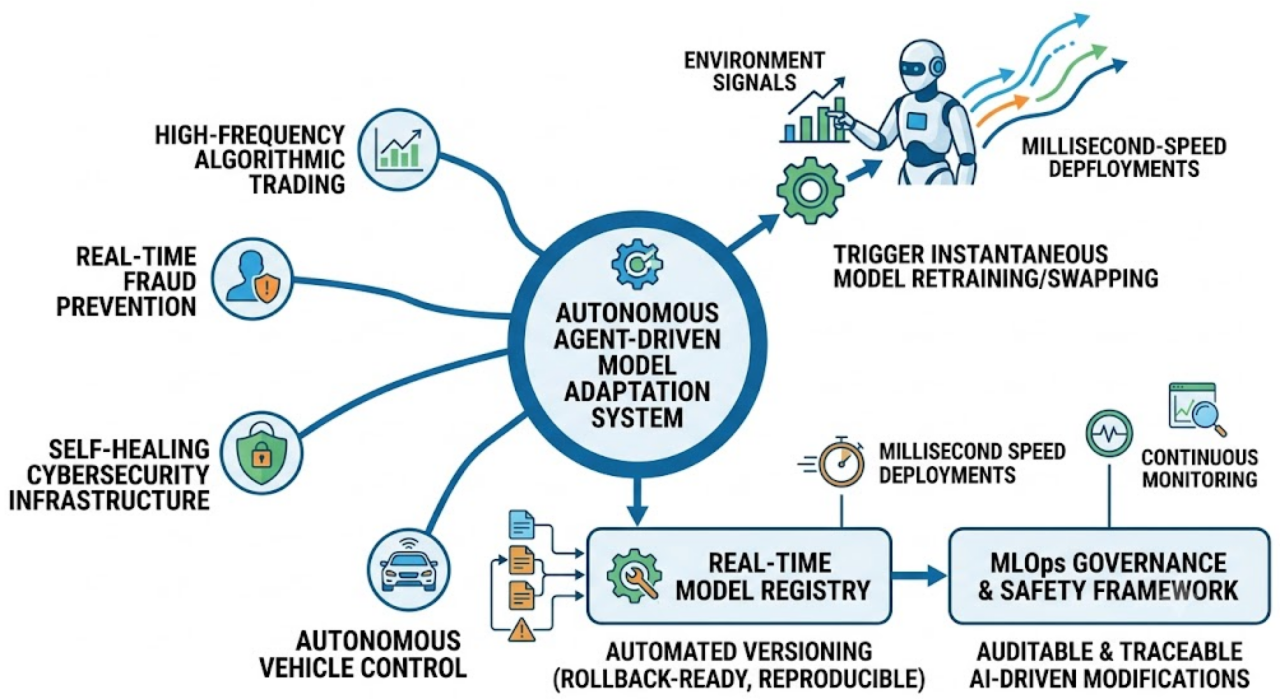
Real-time model registry versioning and dynamic model adaptation driven by autonomous agents become essential in highly dynamic, mission-critical environments where data distributions shift rapidly and manual human intervention creates costly operational delays.

In applications such as high-frequency algorithmic trading, real-time fraud prevention, self-healing cybersecurity infrastructure, and autonomous vehicle control, intelligent agents must continuously monitor environment signals, trigger instantaneous model retraining or swapping, and deploy optimal machine learning checkpoints in milliseconds.

Implementing real-time versioning alongside these autonomous updates ensures that every dynamic shift is fully auditable, reproducible, and rollback-ready, thereby providing the necessary governance, safety, and operational traceability required when allowing AI systems to modify their own core decision-making models on the fly.

When Do You Need Real-Time Model Registry Versioning Powered by Autonomous Agents?


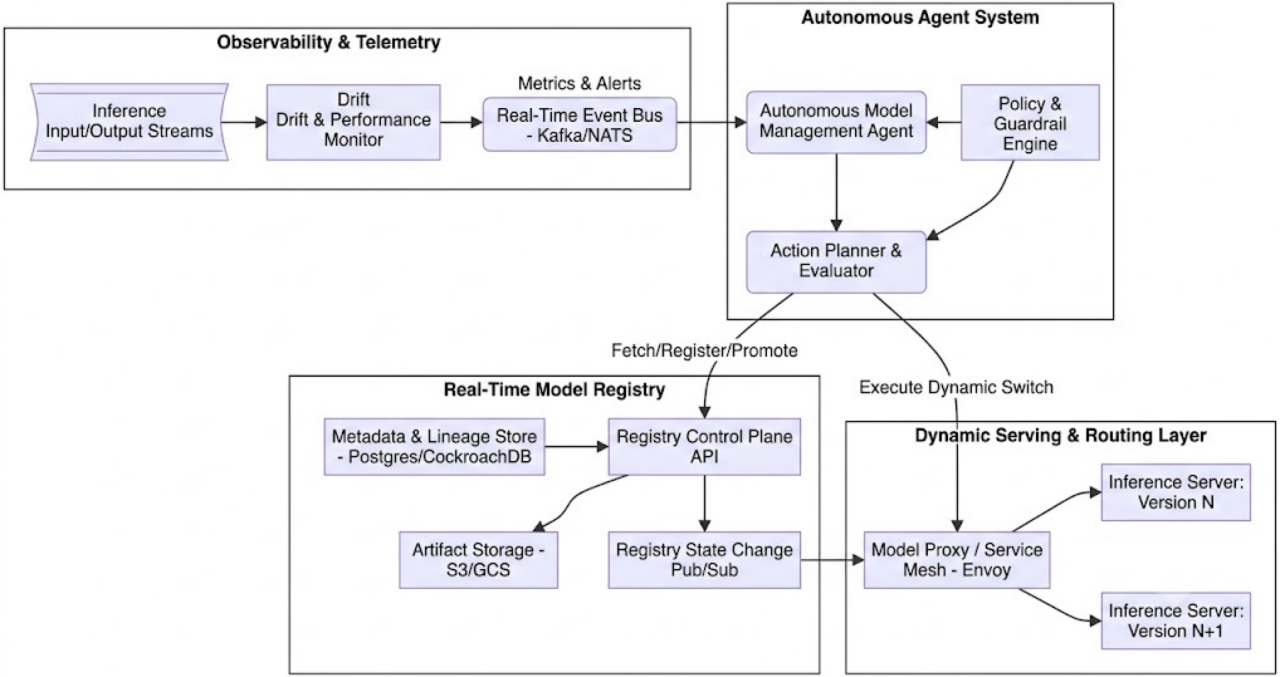
System Architecture Blueprint

When Do You Need Real-Time Model Registry Versioning Powered by Autonomous Agents?


Core Architectural Components


1) Autonomous Model Management Agent (AMMA)

The central intelligence engine responsible for monitoring model health, deciding when model updates or fallbacks are required, and executing zero-downtime dynamic model swaps.

  • Sense Engine: Continuously ingests streaming metrics from the observability pipeline (e.g., Population Stability Index (PSI), Kolmogorov-Smirnov (KS) tests for drift, latency p99, precision/recall degradation, error rates).
  • Reasoning & Policy Engine: Operates on pre-defined constraint boundaries and reinforcement/rule-based decision logic. It evaluates whether a model issue requires:
    • Adjusting inference parameters (e.g., temperature, confidence thresholds).
    • Routing traffic to a lightweight/quantized fallback version.
    • Promoting a freshly trained model version from staging to production.
    • Rolling back to an immutable "Golden Model" baseline.
  • Execution Engine: Issues signed atomic directives to the model registry and inference proxies to orchestrate target dynamic swaps.


2) Real-Time Model Registry

A low-latency, event-driven registry designed for high-throughput reads, instant dynamic tagging, and distributed synchronization.

  • Metadata Store: High-availability distributed database (e.g., CockroachDB, PostgreSQL) storing model schemas, hyperparameter configurations, metrics history, dataset lineage, dependency trees, and access policies.
  • Artifact Store: Object storage (e.g., AWS S3, Ceph) storing serialized model weights (TensorRT, ONNX, TorchScript, GGML), container images, and code artifacts.
  • State Pub/Sub Engine: Event distribution backbone (e.g., NATS JetStream, Apache Kafka) that broadcasts real-time version status changes to inference nodes instantly upon state updates.


3) Dynamic Model Serving & Routing Infrastructure

A decoupled serving architecture enabling hot-swapping and variable traffic allocation without dropping inflight client requests.

  • Dynamic Proxy / Mesh: Envoy-based API gateway or custom HTTP/gRPC proxy capable of dynamic route modification via Control Plane APIs (xDS).
  • Dynamic Inference Servers: Scalable runtime clusters (e.g., Triton Inference Server, Ray Serve, vLLM) capable of loading and unloading model instances in-memory via dynamic C++ API calls without restarting underlying container instances.


4) Telemetry & Observability Pipeline

A continuous monitoring pipeline calculating both statistical data drift and business metric shifts in near real-time.

  • Collector: Micro-batch collector capturing inputs, predictions, ground-truth labels (when available asynchronously), and runtime metrics.
  • Stream Analytics Engine: Stream processor (e.g., Apache Flink) executing statistical algorithms against rolling baseline distributions to detect covariate shift, concept drift, and performance anomalies.


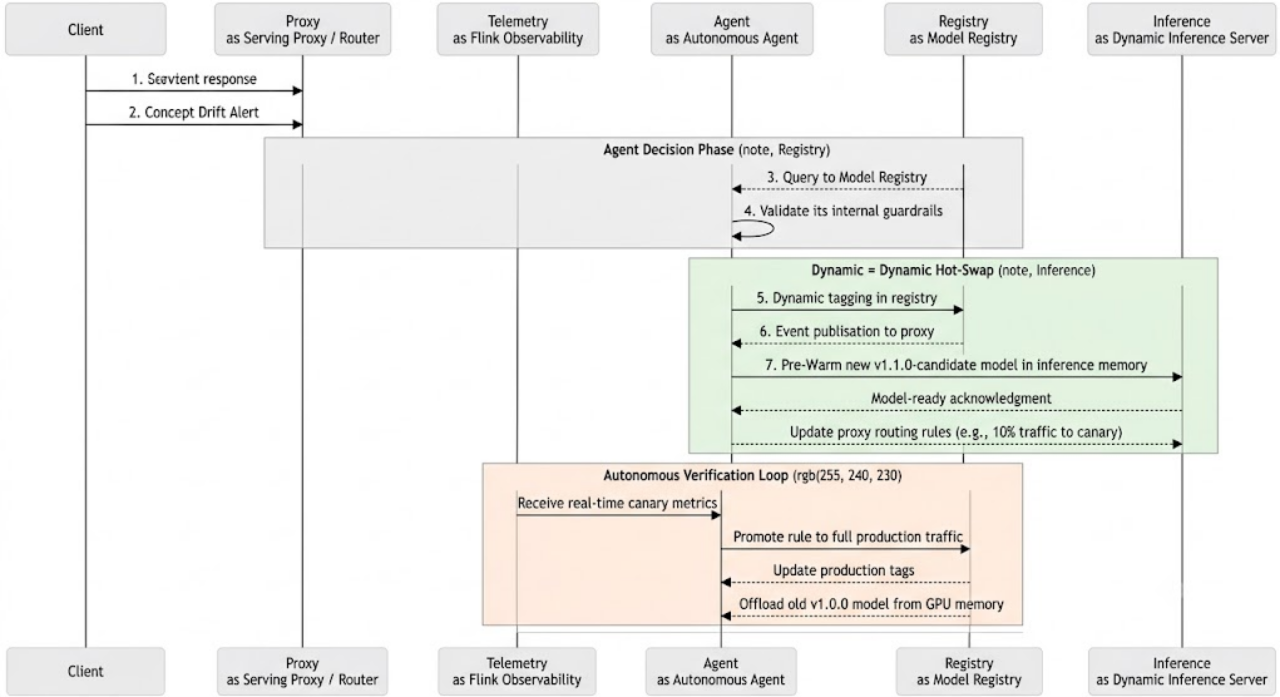
Data Flow & Execution Sequence

When Do You Need Real-Time Model Registry Versioning Powered by Autonomous Agents?


Model Registry Schema & Dynamic Metadata


Registry Data Schema

{
  "model_id": "model_nlp_intent_classifier",
  "version": "2.4.1-patch.18",
  "semantic_tag": "production-active",
  "lineage": {
    "commit_hash": "a1b2c3d4e5f67890",
    "dataset_version": "ds_intent_v2026.03.29",
    "base_model": "transformer-base-uncased-v1"
  },
  "artifacts": {
    "format": "onnx",
    "uri": "s3://ml-artifacts-bucket/models/intent/2.4.1-patch.18/model.onnx",
    "checksum_sha256": "e3b0c44298fc1c149afbf4c8996fb92427ae41e4649b934ca495991b7852b855",
    "size_bytes": 438102940
  },
  "runtime_specs": {
    "framework": "onnxruntime-gpu",
    "cuda_version": "12.2",
    "min_vram_mb": 2048,
    "batch_size_optimal": 32,
    "expected_p99_latency_ms": 18.5
  },
  "eval_metrics": {
    "f1_score": 0.942,
    "accuracy": 0.951,
    "latency_p99_ms": 16.2,
    "validated_at": "2026-03-30T04:12:00Z"
  },
  "governance": {
    "signed_by": "agent-id-auto-deployer-01",
    "cryptographic_signature": "MEUCIQD...==",
    "status": "APPROVED_FOR_AUTO_PROMOTION"
  }
}


Tag Mutation Protocol

  • Tags are volatile metadata pointers pointing to specific immutable model versions (version_id).
  • Pointer changes (e.g., reassignment of production-active from v2.4.0 to v2.4.1) trigger immediate, atomic events via the system event bus.


Autonomous Agent Logic Engine

Decision Matrix Framework

Trigger ConditionsEvaluated System ContextAgent Decision PathTarget Action
Data Drift (PSI > 0.25) & Accuracy Decline (< 5%)High-performance candidate model exists in Registry (Status: Validated).Canary DeploymentLoad candidate model; route 5% traffic; evaluate metrics for 10 minutes.
Data Drift (PSI > 0.25) & No Candidate Model AvailableRe-training pipeline triggers in background.Graceful FallbackRe-route traffic to rule-based system or lightweight robust baseline model.
Latency Spike (P99 > SLA Threshold)Inference cluster experiencing high VRAM/CPU saturation.Dynamic Model DownscalingDynamic swap from FP32 model to FP16/INT8 quantized version.
Inference Error Spike (> 2%)Newly promoted version active < 1 hour.Emergency RollbackInstantaneous zero-downtime rollback to target immutable "Golden Version".


Guardrails & Dampening Loop Logic

class AgentGuardrailEngine:
    def __init__(self, cooldown_seconds: int = 300, max_swaps_per_hour: int = 3):
        self.cooldown_seconds = cooldown_seconds
        self.max_swaps_per_hour = max_swaps_per_hour
        self.swap_history = []

    def evaluate_swap_safety(self, model_id: str, target_version: str) -> bool:
        current_time = time.time()
        
        # Guardrail 1: Cooldown period check to prevent oscillation (flapping)
        if self.swap_history:
            last_swap_time = self.swap_history[-1]['timestamp']
            if current_time - last_swap_time < self.cooldown_seconds:
                raise GuardrailViolation("Cooldown active. Action suppressed.")

        # Guardrail 2: Rate limiting swaps per unit time
        one_hour_ago = current_time - 3600
        recent_swaps = [s for s in self.swap_history if s['timestamp'] > one_hour_ago]
        if len(recent_swaps) >= self.max_swaps_per_hour:
            raise GuardrailViolation("Maximum hourly swap limit reached. Escalating to human operator.")

        # Guardrail 3: Dynamic SLA check
        return True


Zero-Downtime Hot-Swapping Infrastructure


In-Memory Model Swapping Engine

To switch models in real-time without restarting inference processes:

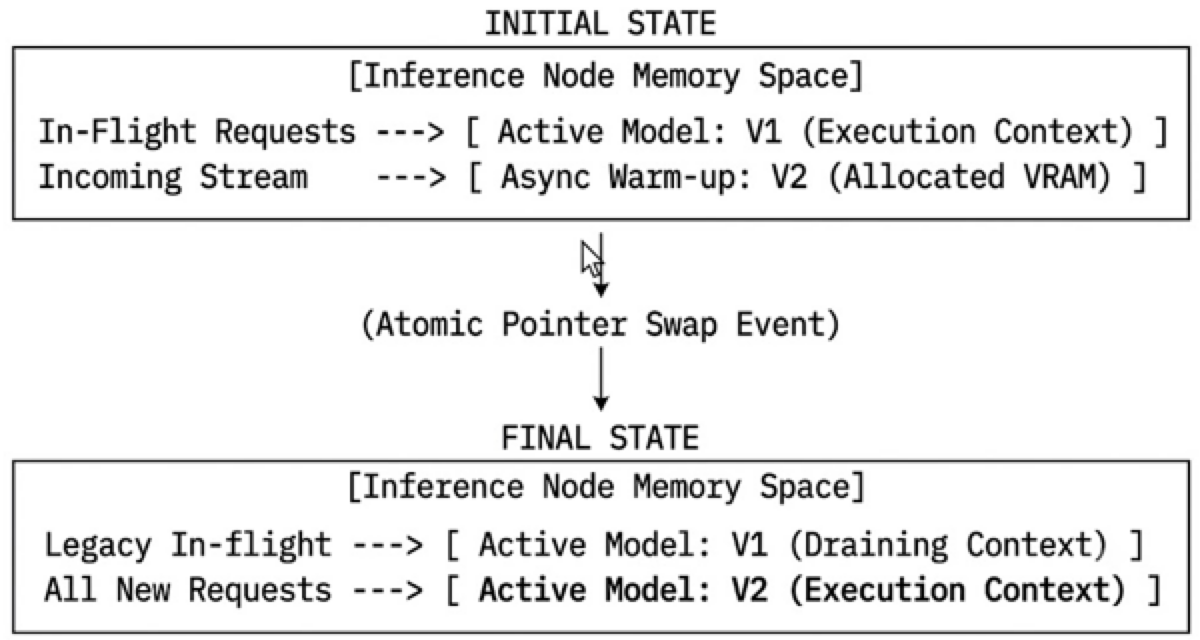
  • Shared Memory Allocate: The host process allocates host/device pinned memory (VRAM) for the incoming version artifacts (Model_V2).
  • Async Weight Ingestion: Weights for Model_V2 are read from local block store/SSD and streamed asynchronously to GPU memory using non-blocking memory copies (cudaMemcpyAsync).
  • Warm-Up Execution: The serving runtime executes dynamic dummy forward passes (synthetic data) against Model_V2 to trigger runtime graph compilation, kernel execution optimizations, and cache population.
  • Pointer Swap Execution: The routing atomic switch changes the internal memory execution graph reference from Model_V1 to Model_V2 via an atomic pointer swap operation.
  • In-Flight Request Drain: Existing requests queued under Model_V1 finish execution using legacy memory references.
  • Resource Deallocation: Memory mapped to Model_V1 is safely reclaimed after all associated request context handles are disposed.


When Do You Need Real-Time Model Registry Versioning Powered by Autonomous Agents?


Reliability, Safety & Governance Protocols

1. Audit Logging & Immutable Lineage


Every single action triggered by the Autonomous Agent is cryptographically signed and stored in an append-only audit ledger:

  • Traceability Matrix: Logs the exact Telemetry State -> Reasoning Payload -> Decision Output -> Model Hash Executed -> Metric Outcome sequence.
  • Version Control Integration: Registry mutations commit exact Git SHA references corresponding to model code, hyperparameter specs, and data pipeline commits.

2. Emergency Manual Override & Safe Mode

  • Circuit Breakers: Human operators can issue an override command via CLI/UI to strip write access from the Autonomous Agent, pinning the system to a fixed baseline model indefinitely.
  • Golden Model Anchor: The system maintains a verified, static fallback version (e.g., highly compressed, deterministic model) guaranteed to operate within strict error bounds. If the agent encounters unknown telemetry states or ambiguous failure modes, the system defaults to this anchor version automatically.

3. Security Framework

  • Cryptographic Artifact Signing: Model artifacts are signed using asymmetric keys (e.g., Cosign/Sigstore) upon passing automated evaluation pipelines. The Dynamic Serving layer rejects models with missing or invalid signatures.
  • Role-Based Access Control (RBAC): The Autonomous Agent operates under strict service account roles, limiting its write capabilities to tagging, route configuration, and warm-loading models within scoped namespace parameters.
Tags AI Governance Adaptive AI Agentic AI Automated MLOps Autonomous Agents Dynamic Model Switching MLOps Model Registry Model Versioning Real Time AI Facebook X
Comments 0
Similar posts
  1. Understanding Data Lineage
    259
  2. Bridging the Gap: How Machine Learning Integrates with Infrastructure
    271
  3. End-to-End AI/Machine Learning Architecture: AI/ML 6 Layers
    240
  4. Architecting an LLM-Powered Multi-Agent Orchestration System: Design and Requirements
    243
  5. End-to-End Autonomous Vehicle ML Training Pipeline
    325
  6. Designing a Data Curation System Around a Vector Database
    220
  7. AI-DLC vs. AI-SDLC: Model-Centric vs. System-Centric AI Development
    258
  8. Beyond Static Pipelines: Architecting LLM Multi-Agent Systems for Autonomous Workflow Orchestration
    582
  9. AWS Multi-Agent Collaboration Approach: Fully Managed vs. Code-based Implementation
    275
  10. Conversation Multi-Agent Chatbot with On-the-Fly Code Execition via Microsoft AutoGen
    295
  11. The Concept of Scaffolding in AI Agents
    232
  12. Semantic Kernel: Microsoft's GenAI Orchestration SDK
    398
  13. Is PyTorch Dead? Deep Learning's Enduring Role Beyond LLMs & Essential Skills
    693
  14. How Netflix Runs Recommendations for Hundreds of Millions of Users Using Amazon SageMaker & Metaflow
    174
  15. Why Reranking is Crucial for RAG and Agentic AI Systems?
    268
  16. MLOps Explained: Spark, Flink, and Reference Architecture Deep Dive
    242
  17. TikTok's Recommendation System - Monolith
    291
  18. Common Recommendation Service Architecture
    532
  1. Vector Search in Relational Databases (RDBs): Trends & Usage Environments
    287
  2. Designing a Skill Registry Architecture: Minimize Token Usage and Maximize AI Performance
    230
  3. TPU & GPU Cluster Management Tools
    243
  4. The Concept of Scaffolding in AI Agents
    232
  5. Beyond Static Pipelines: Architecting LLM Multi-Agent Systems for Autonomous Workflow Orchestration
    582
  6. AI-DLC vs. AI-SDLC: Model-Centric vs. System-Centric AI Development
    258
  7. Fine-Tuning Open-Weight LLMs: Training, Licensing, and Deploying Custom Models with Ollama
    338
  8. Machine Learning: Training vs. Ranking
    221
  9. The Continuous Learning Machine: Designing a Loop That Actually Turns
    222
  10. Designing a Data Curation System Around a Vector Database
    220
  11. Designing MLOps Architectures to Handle Seasonal Data Drift in EV Fleet Models
    195
  12. From 15 to 40+ FPS: Accelerating PyTorch Object Detection on Automotive ECUs
    216
  13. Understanding Data Lineage
    259
  14. GPU & LLM Cluster Infrastructure & Task Scheduling Architecture
    244
  15. What ML Labeling Actually Is - And How to Design a Pipeline for It
    333
  16. Bridging the Gap: How Machine Learning Integrates with Infrastructure
    271
  17. Designing an Enterprise ML Experiment Tracking and Reproducibility Platform: System Requirements and Architecture
    309
  18. End-to-End AI/Machine Learning Architecture: AI/ML 6 Layers
    240
  19. Architecting an LLM-Powered Multi-Agent Orchestration System: Design and Requirements
    243
  20. End-to-End Autonomous Vehicle ML Training Pipeline
    325
  21. Building GPU Clusters on GCP, Azure, and AWS: A Practical Guide and Head-to-Head Comparison
    346
  22. Embeddings on the Lakehouse: What Snowflake and Databricks Actually Do (and Don't)
    287
  23. Vector Database Integration on Fully Managed Multi-Agent Environment
    301
  24. AWS Multi-Agent Collaboration Approach: Fully Managed vs. Code-based Implementation
    275
  25. Semantic Kernel: Microsoft's GenAI Orchestration SDK
    398
  26. LLM Application Development with LangGraph: Features and Architectures for Stateful Multi-Actor LLM Applications
    350
  27. Microsoft AutoGen: Next-Generation Multi-Agent Framework
    305
  28. Beyond SDLC: Why the Entertainment Sector Needs an AI Development Life Cycle Now
    284
  29. Why AI-DLC is the New Paradigm for Development?
    328
Recently updated
  1. Why 100% SEO Guarantees Better User Engagement and How to Achieve It in Your Service
    39
  2. Why SPF and DKIM Are Essential for Linux Email Servers?
    34
  3. How do I create animated background for Google Meet?
    20,611
  4. MaxMind GeoLite2 vs. DB-IP Lite vs. ip-api.com: Choosing the Right Free IP Geolocation Solution
    244
  5. Meet Valkey: Why Redis Changed Its License, Why Valkey is Better, and How to Use It as a Drop-in Replacement
    94
  6. How Rogue Web Scrapers Are Stealing My Content and Destroying My Server
    156
  7. Array of arguments passed to script in PHP
    90
  8. Invalid Auction Storms in Ad Tech
    98
  9. Building MRC-Compliant Instrumentation in Ad Tech: Implementation Steps and Key Challenges
    202
  10. The Two Clocks of Ad Server Architecture
    69
  11. Frequency Cap Architecture Overview
    514
  12. Collecting Proof-of-Play from 100,000 Screens
    146
  13. Vector Search in Relational Databases (RDBs): Trends & Usage Environments
    287
  14. What is RedisVL?
    108
  15. Designing a Skill Registry Architecture: Minimize Token Usage and Maximize AI Performance
    230
  16. TPU & GPU Cluster Management Tools
    243
  17. The Concept of Scaffolding in AI Agents
    232
  18. Beyond Static Pipelines: Architecting LLM Multi-Agent Systems for Autonomous Workflow Orchestration
    582
  19. AI-DLC vs. AI-SDLC: Model-Centric vs. System-Centric AI Development
    258
  20. Fine-Tuning Open-Weight LLMs: Training, Licensing, and Deploying Custom Models with Ollama
    338
  21. Inside the Next-Generation Streaming Architecture: Ultra-Low Latency, SGAI, and AI Codecs
    202
  22. Machine Learning: Training vs. Ranking
    221
  23. The Continuous Learning Machine: Designing a Loop That Actually Turns
    222
  24. The Next-Gen Low-Latency Standards: LL-HLS & MoQ
    195
  25. Designing a Data Curation System Around a Vector Database
    220
  26. Extracting Context from Live Video: The Architecture Got Simpler When We Stopped Building Features
    256
  27. The New Ad Stack Behind Live Sports Streaming: Inside SGAI, EABN, and the Standards Race to Fix Live Monetization
    655
  28. Designing MLOps Architectures to Handle Seasonal Data Drift in EV Fleet Models
    195
  29. From 15 to 40+ FPS: Accelerating PyTorch Object Detection on Automotive ECUs
    216
  30. Understanding Data Lineage
    259