GPU & LLM Cluster Infrastructure & Task Scheduling Architecture

CK CK 3788 
Created at
Updated at  
231 0 0

Designing a robust system infrastructure for allocating GPU and LLM clusters requires an optimized task management approach to address severe resource limitations.

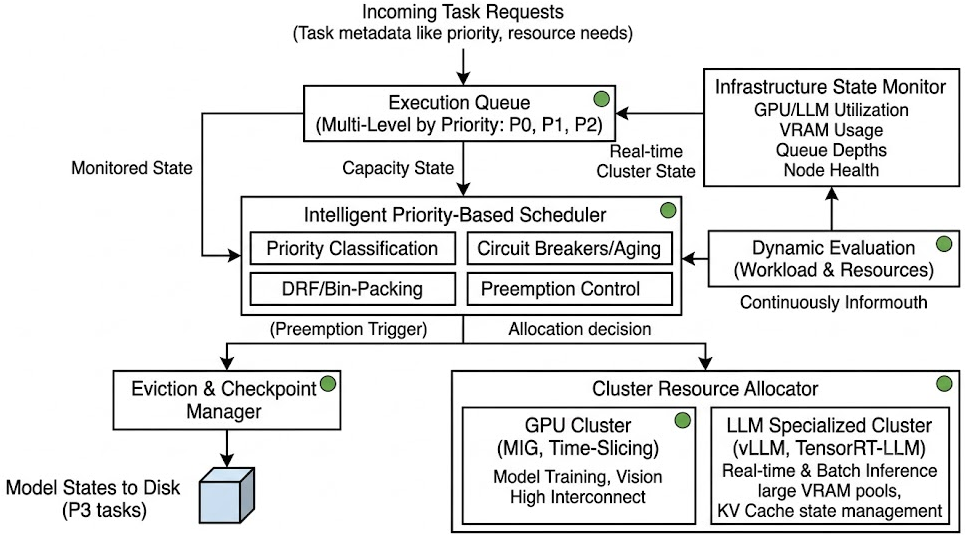
Because these computational clusters operate under strict hardware constraints, the infrastructure must incorporate an intelligent, priority-based scheduling algorithm to efficiently queue, assign, and manage execution requests.

By dynamically evaluating workload priorities, resource availability, and job requirements, the system ensures that critical high-priority tasks receive immediate access to compute resources while maximizing overall cluster utilization and minimizing operational latency.

GPU & LLM Cluster Infrastructure & Task Scheduling Architecture


1. Core Infrastructure Architecture

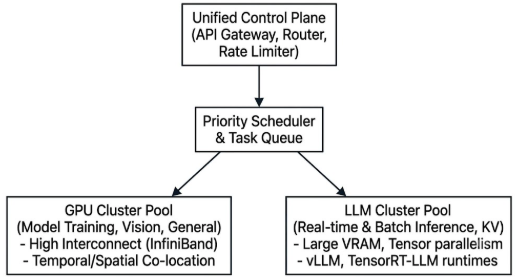
To efficiently allocate compute power across scarce hardware, the infrastructure decouples job requests from raw physical compute via a unified control plane.

GPU & LLM Cluster Infrastructure & Task Scheduling Architecture


Infrastructure Segmentation

  • GPU Compute Cluster (General/Training):
    • Focus: Deep learning model training, fine-tuning, computer vision, and batch processing.
    • Hardware Setup: High-density nodes (e.g., 8x A100/H100) connected via NVLink/InfiniBand for high inter-node communication bandwidth.
    • Workload Pattern: Long-running, non-interactive, compute-bound jobs.
  • LLM Specialized Cluster (Inference & Serving):
    • Focus: Real-time generation, embeddings, long-context text processing, and agentic loops.
    • Hardware Setup: Optimized for high Memory Bandwidth and large VRAM pools to handle Key-Value (KV) cache state management.
    • Workload Pattern: Bursty, latency-sensitive, memory-bound jobs requiring continuous batching capabilities.


2. Task Classification & Priority Framework

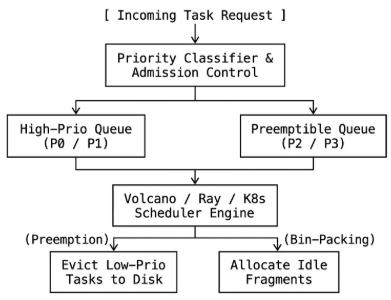
Due to limited physical compute, workloads are assigned to strict operational tiers based on Service Level Agreements (SLAs).

Priority TierTarget SLA / LatencyWorkload TypePreemptible?Example Tasks
P0: CriticalReal-time (<500ms)Live Production API RequestsNoUser-facing LLM Chat, Real-time Fraud Inference
P1: HighInteractive (<5s)Internal Tools, Active DebuggingNoDeveloper Sandbox, Interactive Notebooks
P2: MediumScheduled / HoursFine-tuning & EvaluationYes (Soft)Automated Regression Tests, Weekly Model Fine-tuning
P3: LowBest-Effort / DaysBulk Data Generation, ResearchYes (Hard)Synthetic Dataset Generation, Hyperparameter Tuning


3. Optimized Scheduling & Queue Management

To maximize utilization without starving critical tasks, the scheduling engine implements multi-level queueing and optimization algorithms.

GPU & LLM Cluster Infrastructure & Task Scheduling Architecture

Key Scheduling Strategies

  • Gang Scheduling: Ensures all required multi-node GPU slots are available simultaneously before starting distributed training jobs, preventing deadlocks where single GPUs sit idle waiting for peers.
  • Preemption and Checkpointing: When a P0/P1 task arrives and no free capacity exists, active P3 jobs are evicted. Standardized checkpointing (e.g., saving model state to shared storage) allows P3 tasks to resume seamlessly later.
  • Dominant Resource Fairness (DRF): Allocates tasks fairly based on multi-resource constraints (GPU VRAM, System RAM, CPU cores, PCIe bandwidth) rather than simply counting raw GPU instances.


4. Resource Optimization Strategies

Given the scarcity of high-end accelerators, the system applies hardware- and software-level optimizations to compress task footprints.


Hardware & Virtualization Level

  • Multi-Instance GPU (MIG): Dynamically partitions physical GPUs (e.g., H100s) into smaller hardware-isolated slices for low-tier tasks or light inference models, preventing a 70B model setup from running on an 8GB job constraint.
  • GPU Time-Slicing: Over-subscribes GPU access for non-realtime, intermittent tasks by rapidly switching execution context.

Runtime & Software Level

  • PagedAttention & KV Cache Sharing: For LLM inference clusters, algorithms like vLLM manage memory dynamically, allocating KV cache dynamically to prevent VRAM fragmentation and allow higher throughput batching.
  • Dynamic Continuous Batching: Groups incoming asynchronous inference requests into single execution iterations dynamically, keeping GPU Compute Units saturated.
  • Model Quantization Fallbacks: When peak system load exceeds safety thresholds, the infrastructure routes specific inference queries to lower-precision quantized variations (e.g., FP16 → INT8/INT4) to free up VRAM.


5. Circuit Breakers, Anti-Starvation & Governance

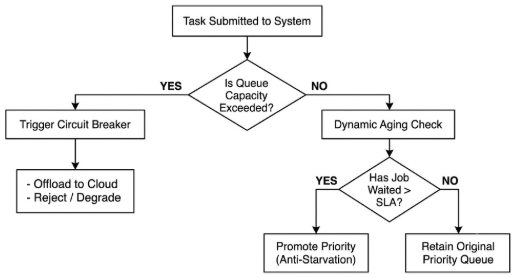
System safeguards ensure lower-priority tasks eventually execute and costs remain governed under peak capacity constraints.

GPU & LLM Cluster Infrastructure & Task Scheduling Architecture


Operational Safeguards

  • Aging Mechanisms (Anti-Starvation): P2/P3 tasks accumulating long wait times in queues automatically receive incremental priority bumps over time, guaranteeing eventual execution during lower-traffic windows.
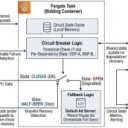
  • Hybrid Cloud Bursting (Circuit Breaker): When local hardware utilization hits critical thresholds (>95% VRAM and compute), the infrastructure dynamically bursts P1/P0 workloads to external public cloud providers (e.g., AWS, GCP, Azure).
  • Quotas & Token Buckets: Departments and users are bounded by strictly enforced GPU-hour and API-token rate limits, preventing single teams from consuming total system capacity.
Tags AI Infrastructure Aging Circuit Breakers Cluster Optimization DRF GPU GPU Cluster Management GPU Clusters GPU Scheduling LLM LLM Cluster Management LLM Clusters LLM Infrastructure MIG Priority Task Scheduling Resource Allocation Resource Management Task Priority Optimization TensorRT TensorRT-LLM VRAM vLLM Facebook X
Comments 0
Similar posts
  1. From 15 to 40+ FPS: Accelerating PyTorch Object Detection on Automotive ECUs

    207
  2. Extracting Context from Live Video: The Architecture Got Simpler When We Stopped Building Features
    229
  3. TPU & GPU Cluster Management Tools
    234
  4. Designing an Enterprise ML Experiment Tracking and Reproducibility Platform: System Requirements and Architecture
    303
  5. End-to-End AI/Machine Learning Architecture: AI/ML 6 Layers
    231
  6. What “GPU Clustering” Really Means (And How to Code for It)
    201
  7. Building GPU Clusters on GCP, Azure, and AWS: A Practical Guide and Head-to-Head Comparison
    335
  8. How to Build a Python Chatbot That Writes and Runs Code Using Microsoft AutoGen (With Sample Code)
    236
  9. LLM Application Development with LangGraph: Features and Architectures for Stateful Multi-Actor LLM Applications
    344
  10. Microsoft AutoGen: Next-Generation Multi-Agent Framework
    300
  11. Is a Used M1 or M2 MacBook Pro a Smart Buy Over M4?
    286
  12. Beyond Prompt Engineering: Why Loop Engineering is the Future of Autonomous AI
    300
  13. Is PyTorch Dead? Deep Learning's Enduring Role Beyond LLMs & Essential Skills
    691
  14. TensorRT for LLMs: Speed, Scale, and Why Startups Choose It Over TensorFlow
    459
  15. Milvus and LLM Integration - Very Smart Approach!
    294
  16. Learn SLM if you have interent in the next after LLM
    4781
  17. VLM vs. LLM: How Vision-Language Models Are Revolutionizing Real-Time Media Processing
    29
  18. Technical Hierarchy of AI Agents
    808
  19. Automated API documentation for a Django REST Framework (DRF) project using drf-yasg (Yet Another Swagger Generator)
    1,026
  20. Rust-GPU-tools for interacting with various GPU APIs
    753
  21. Difference between CPU and GPU - Why GPU is faster than CPU?
    802
  22. Ad Tech Circuit Breakers: Architectures for Resilient Bidding Engines - Circuit Breaker
    350
  23. Getting Started with FAISS: A CentOS 7 Installation Guide
    279
  24. NVIDIA CUDA library which can be integrated with C/C++
    375
  1. Vector Search in Relational Databases (RDBs): Trends & Usage Environments
    280
  2. Designing a Skill Registry Architecture: Minimize Token Usage and Maximize AI Performance
    224
  3. TPU & GPU Cluster Management Tools
    234
  4. The Concept of Scaffolding in AI Agents
    222
  5. Beyond Static Pipelines: Architecting LLM Multi-Agent Systems for Autonomous Workflow Orchestration
    576
  6. AI-DLC vs. AI-SDLC: Model-Centric vs. System-Centric AI Development
    253
  7. Fine-Tuning Open-Weight LLMs: Training, Licensing, and Deploying Custom Models with Ollama
    328
  8. Machine Learning: Training vs. Ranking
    213
  9. The Continuous Learning Machine: Designing a Loop That Actually Turns
    217
  10. Designing a Data Curation System Around a Vector Database
    215
  11. Designing MLOps Architectures to Handle Seasonal Data Drift in EV Fleet Models
    185
  12. From 15 to 40+ FPS: Accelerating PyTorch Object Detection on Automotive ECUs
    207
  13. Understanding Data Lineage
    252
  14. When Do You Need Real-Time Model Registry Versioning Powered by Autonomous Agents?
    220
  15. What ML Labeling Actually Is - And How to Design a Pipeline for It
    328
  16. Bridging the Gap: How Machine Learning Integrates with Infrastructure
    263
  17. Designing an Enterprise ML Experiment Tracking and Reproducibility Platform: System Requirements and Architecture
    303
  18. End-to-End AI/Machine Learning Architecture: AI/ML 6 Layers
    231
  19. Architecting an LLM-Powered Multi-Agent Orchestration System: Design and Requirements
    238
  20. End-to-End Autonomous Vehicle ML Training Pipeline
    306
  21. Building GPU Clusters on GCP, Azure, and AWS: A Practical Guide and Head-to-Head Comparison
    335
  22. Embeddings on the Lakehouse: What Snowflake and Databricks Actually Do (and Don't)
    280
  23. Vector Database Integration on Fully Managed Multi-Agent Environment
    293
  24. AWS Multi-Agent Collaboration Approach: Fully Managed vs. Code-based Implementation
    270
  25. Semantic Kernel: Microsoft's GenAI Orchestration SDK
    389
  26. LLM Application Development with LangGraph: Features and Architectures for Stateful Multi-Actor LLM Applications
    344
  27. Microsoft AutoGen: Next-Generation Multi-Agent Framework
    300
  28. Beyond SDLC: Why the Entertainment Sector Needs an AI Development Life Cycle Now
    282
Recently updated
  1. Why 100% SEO Guarantees Better User Engagement and How to Achieve It in Your Service
    27
  2. Why SPF and DKIM Are Essential for Linux Email Servers?
    24
  3. How do I create animated background for Google Meet?
    19,731
  4. MaxMind GeoLite2 vs. DB-IP Lite vs. ip-api.com: Choosing the Right Free IP Geolocation Solution
    217
  5. Meet Valkey: Why Redis Changed Its License, Why Valkey is Better, and How to Use It as a Drop-in Replacement
    86
  6. How Rogue Web Scrapers Are Stealing My Content and Destroying My Server
    153
  7. Array of arguments passed to script in PHP
    85
  8. Invalid Auction Storms in Ad Tech
    93
  9. Building MRC-Compliant Instrumentation in Ad Tech: Implementation Steps and Key Challenges
    198
  10. The Two Clocks of Ad Server Architecture
    63
  11. Frequency Cap Architecture Overview
    509
  12. Collecting Proof-of-Play from 100,000 Screens
    141
  13. Vector Search in Relational Databases (RDBs): Trends & Usage Environments
    280
  14. What is RedisVL?
    105
  15. Designing a Skill Registry Architecture: Minimize Token Usage and Maximize AI Performance
    224
  16. TPU & GPU Cluster Management Tools
    234
  17. The Concept of Scaffolding in AI Agents
    222
  18. Beyond Static Pipelines: Architecting LLM Multi-Agent Systems for Autonomous Workflow Orchestration
    576
  19. AI-DLC vs. AI-SDLC: Model-Centric vs. System-Centric AI Development
    253
  20. Fine-Tuning Open-Weight LLMs: Training, Licensing, and Deploying Custom Models with Ollama
    328
  21. Inside the Next-Generation Streaming Architecture: Ultra-Low Latency, SGAI, and AI Codecs
    197
  22. Machine Learning: Training vs. Ranking
    213
  23. The Continuous Learning Machine: Designing a Loop That Actually Turns
    217
  24. The Next-Gen Low-Latency Standards: LL-HLS & MoQ
    189
  25. Designing a Data Curation System Around a Vector Database
    215
  26. Extracting Context from Live Video: The Architecture Got Simpler When We Stopped Building Features
    229
  27. The New Ad Stack Behind Live Sports Streaming: Inside SGAI, EABN, and the Standards Race to Fix Live Monetization
    649
  28. Designing MLOps Architectures to Handle Seasonal Data Drift in EV Fleet Models
    185
  29. From 15 to 40+ FPS: Accelerating PyTorch Object Detection on Automotive ECUs
    207
  30. Understanding Data Lineage
    252