Understanding Data Lineage

CK CK 3788 
Created at
Updated at  
272 0 0

Definition and Core Concepts

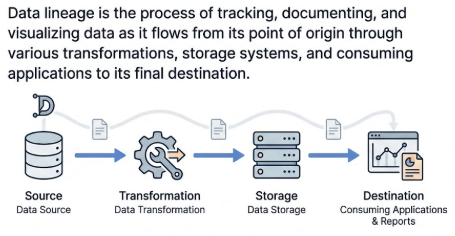
Data lineage is the process of tracking, documenting, and visualizing data as it flows from its point of origin through various transformations, storage systems, and consuming applications to its final destination. It provides a historical record of the data's lifecycle, answering key questions such as:

  • Where did the data originate?
  • How has it been transformed, cleaned, or aggregated over time?
  • Who accessed or modified it?
  • Where is it currently used (e.g., dashboards, reports, operational systems)?

Understanding Data Lineage

At its core, data lineage acts as a detailed map or graph (often represented as a Directed Acyclic Graph, or DAG) that establishes transparency and trust in data assets across an enterprise.


Key Components of Data Lineage

  • Data Sources: Origin systems such as transactional databases, APIs, IoT devices, or third-party feeds.
  • Transformations: Operations applied to data, including filtering, joining, aggregating, or applying business logic via ETL/ELT pipelines.
  • Data Destinations: Storage locations and analytical environments like data warehouses, data lakes, or BI dashboards.
  • Metadata Layer: Information about the data structure, schemas, execution logs, system dependencies, and business definitions.


Primary Use Cases and Benefits

  • Regulatory Compliance: Essential for adhering to regulations like GDPR, CCPA, and BCBS 239 by identifying where sensitive data (PII) resides and how it moves.
  • Impact Analysis: Allows data engineers to evaluate the downstream consequences of modifying a database schema or pipeline before making changes.
  • Root Cause Analysis: Accelerates troubleshooting when a report or dashboard displays incorrect numbers by allowing engineers to trace errors back through the transformation pipeline.
  • Data Quality and Trust: Helps consumers evaluate the reliability of data assets based on their source systems and processing paths.


How ML Lineage Differs from Traditional Lineage

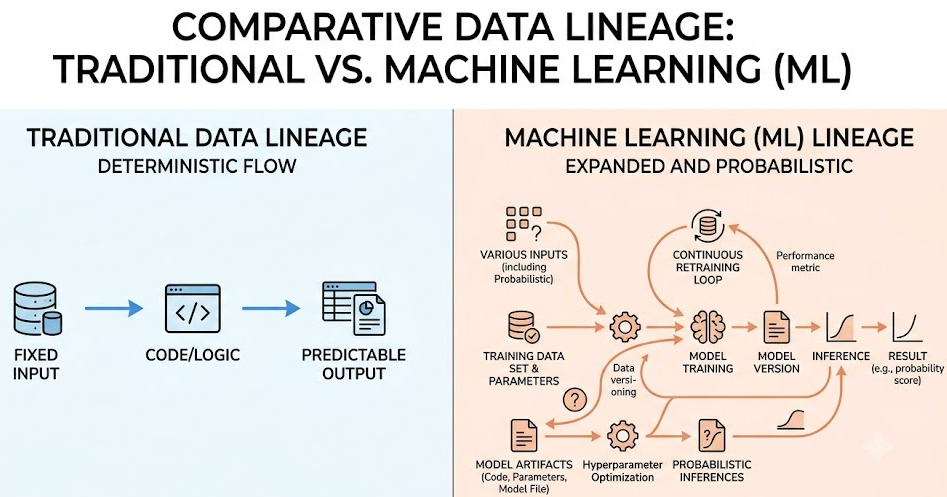
In traditional software and data engineering, data lineage is primarily deterministic: input data goes through fixed code logic to produce a predictable output table or report.


In Machine Learning (ML), lineage expands significantly to account for probabilistic behavior, non-linear dependencies, continuous retraining loops, and tightly coupled artifacts (data, code, parameters, and models).

ML Lineage extends basic data movement to trace how data impacts model behavior and business predictions.

AspectTraditional Data LineageML Data Lineage
Primary FocusTables, schemas, and ETL pipeline flowsDatasets, feature stores, code, model versions, and predictions
LogicDeterministic business rulesStatistical/Probabilistic modeling
VersioningSchema and code versioningData versioning, feature versioning, hyperparameter versioning, and model artifact versioning
Key OutputReports, dashboards, operational tablesDeployed model files, inferences/predictions


Understanding Data Lineage


Core Dimensions of ML Lineage

In machine learning context, lineage is often divided into three interrelated dimensions:


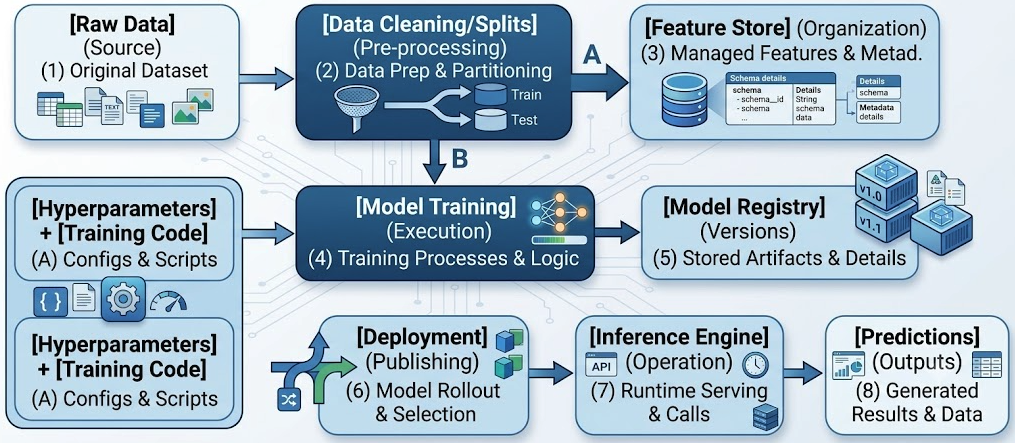
1. Data-to-Feature Lineage

Tracks the transformation of raw, unstructured, or semi-structured data into structured features used for training.

  • Tracking: Raw logs → Preprocessing code → Feature Store → Feature sets (e.g., customer churn risk features at timestamp T).


2. Feature-to-Model Lineage

Connects the exact slice of data used to train, validate, and test a specific version of an ML model.

  • Tracking: Feature sets + Hyperparameters + Training code + Environment specs → Serialized Model Artifact (e.g., .pkl, .onnx file).


3. Model-to-Prediction Lineage

Monitors deployed models in production, linking real-world input requests to generated outputs and downstream operational decisions.

  • Tracking: Production input payload → Model version ID → Prediction output → Downstream user action/feedback.


The Full Lifecycle of ML Lineage

Understanding Data Lineage

To maintain complete ML lineage, systems capture metadata at each step:

  1. Dataset Provenance: Tracking the specific snapshot of data used (e.g., using tools like DVC or LakeFS).
  2. Experiment Tracking: Logging hyperparameter combinations, random seeds, and performance metrics (e.g., using MLflow or Weights & Biases).
  3. Model Provenance: Storing trained weights, dependencies, binary files, and parent training runs in a Model Registry.
  4. Inference Audit Trail: Logging production inputs alongside the specific model version that generated the output for explainability.


Why ML Lineage Matters


1. Reproducibility

ML models can produce different outcomes if the training data, features, code, or environment change even slightly. ML lineage ensures that an engineer can recreate the exact training environment and dataset used to generate any historically produced model.


2. Debugging Data Drift and Model Degradation

When a deployed model's accuracy drops in production, ML lineage allows teams to determine whether the failure was caused by shifts in incoming feature distributions (data drift), changes in the source data pipeline, or outdated training snapshots.


3. AI Governance, Ethics, and Auditing

Emerging legal frameworks (such as the EU AI Act) require organizations to justify automated decisions and prove that models do not rely on biased or forbidden data features. ML lineage provides an immutable audit trail detailing how a model was built and what data shaped its decisions.


4. Regulatory Retraining and Deletion Requirements

Under privacy laws like GDPR's "Right to be Forgotten," if a user requests data deletion, organizations must identify not only where the user's data is stored, but also which ML models were trained on that specific user's data, potentially triggering selective model retraining.


Tags Data Governance Data Lineage Data Pipeline Tracking Data Provenance Data Traceability Lineage ML Data Lineage ML Lineage MLOps Machine Learning Lineage Metadata Management Model Lineage Facebook X
Comments 0
Similar posts
  1. Designing a Data Curation System Around a Vector Database
    230
  2. When Do You Need Real-Time Model Registry Versioning Powered by Autonomous Agents?
    242
  3. AI-DLC vs. AI-SDLC: Model-Centric vs. System-Centric AI Development
    267
  4. Bridging the Gap: How Machine Learning Integrates with Infrastructure
    292
  5. Designing an Enterprise ML Experiment Tracking and Reproducibility Platform: System Requirements and Architecture
    318
  6. End-to-End Autonomous Vehicle ML Training Pipeline
    341
  7. Is PyTorch Dead? Deep Learning's Enduring Role Beyond LLMs & Essential Skills
    699
  8. How Netflix Runs Recommendations for Hundreds of Millions of Users Using Amazon SageMaker & Metaflow
    182
  9. MLOps Explained: Spark, Flink, and Reference Architecture Deep Dive
    247
  10. TikTok's Recommendation System - Monolith
    300
  11. Common Recommendation Service Architecture
    539
  1. Vector Search in Relational Databases (RDBs): Trends & Usage Environments
    302
  2. Designing a Skill Registry Architecture: Minimize Token Usage and Maximize AI Performance
    246
  3. TPU & GPU Cluster Management Tools
    257
  4. The Concept of Scaffolding in AI Agents
    244
  5. Beyond Static Pipelines: Architecting LLM Multi-Agent Systems for Autonomous Workflow Orchestration
    596
  6. Fine-Tuning Open-Weight LLMs: Training, Licensing, and Deploying Custom Models with Ollama
    353
  7. Machine Learning: Training vs. Ranking
    229
  8. The Continuous Learning Machine: Designing a Loop That Actually Turns
    228
  9. Designing MLOps Architectures to Handle Seasonal Data Drift in EV Fleet Models
    200
  10. From 15 to 40+ FPS: Accelerating PyTorch Object Detection on Automotive ECUs
    232
  11. GPU & LLM Cluster Infrastructure & Task Scheduling Architecture
    255
  12. What ML Labeling Actually Is - And How to Design a Pipeline for It
    352
  13. End-to-End AI/Machine Learning Architecture: AI/ML 6 Layers
    255
  14. Architecting an LLM-Powered Multi-Agent Orchestration System: Design and Requirements
    260
  15. Building GPU Clusters on GCP, Azure, and AWS: A Practical Guide and Head-to-Head Comparison
    387
  16. Embeddings on the Lakehouse: What Snowflake and Databricks Actually Do (and Don't)
    303
  17. Vector Database Integration on Fully Managed Multi-Agent Environment
    319
  18. AWS Multi-Agent Collaboration Approach: Fully Managed vs. Code-based Implementation
    292
  19. Semantic Kernel: Microsoft's GenAI Orchestration SDK
    416
  20. LLM Application Development with LangGraph: Features and Architectures for Stateful Multi-Actor LLM Applications
    363
  21. Microsoft AutoGen: Next-Generation Multi-Agent Framework
    318
  22. Beyond SDLC: Why the Entertainment Sector Needs an AI Development Life Cycle Now
    299
  23. Why AI-DLC is the New Paradigm for Development?
    343
  24. Autonomous Vehicle Machine Learning (AV ML): An Architectural Review
    421
  25. AI-based workflow innovation - it's not just an optimizing cost/process but also a matter of survival!
    394
Recently updated
  1. Google OAuth Token Expiration: Causes and Solutions
    29
  2. Why 100% SEO Guarantees Better User Engagement and How to Achieve It in Your Service
    55
  3. Why SPF and DKIM Are Essential for Linux Email Servers?
    49
  4. How do I create animated background for Google Meet?
    22,910
  5. MaxMind GeoLite2 vs. DB-IP Lite vs. ip-api.com: Choosing the Right Free IP Geolocation Solution
    271
  6. Meet Valkey: Why Redis Changed Its License, Why Valkey is Better, and How to Use It as a Drop-in Replacement
    103
  7. How Rogue Web Scrapers Are Stealing My Content and Destroying My Server
    168
  8. Array of arguments passed to script in PHP
    97
  9. Invalid Auction Storms in Ad Tech
    106
  10. Building MRC-Compliant Instrumentation in Ad Tech: Implementation Steps and Key Challenges
    207
  11. The Two Clocks of Ad Server Architecture
    77
  12. Frequency Cap Architecture Overview
    526
  13. Collecting Proof-of-Play from 100,000 Screens
    152
  14. What is RedisVL?
    114
  15. Inside the Next-Generation Streaming Architecture: Ultra-Low Latency, SGAI, and AI Codecs
    206
  16. The Next-Gen Low-Latency Standards: LL-HLS & MoQ
    202
  17. Extracting Context from Live Video: The Architecture Got Simpler When We Stopped Building Features
    263
  18. The New Ad Stack Behind Live Sports Streaming: Inside SGAI, EABN, and the Standards Race to Fix Live Monetization
    672
  19. System Requirements and Architecture: Intelligent Priority-Based Scheduler
    175
  20. Java Variant Type
    210
  21. From SDI to MXL: Inside the Cloud-Native Infrastructure Powering Next-Gen Live Broadcast
    580
  22. IAS IP Blocklist: Causes, Resolution, and Detection Strategies
    196
  23. What Is UniversalAdId? The Complete Guide to VAST Video Ad Tracking
    205
  24. End-to-End Contextual Video Processing Architecture for AdTech
    216
  25. What “GPU Clustering” Really Means (And How to Code for It)
    214
  26. Ad Tech Idempotency: Engineering for Reliability and Scale
    368
  27. Conversation Multi-Agent Chatbot with On-the-Fly Code Execition via Microsoft AutoGen
    305
  28. Contributing to the Ethereum Foundation
    3,602
  29. How to Build a Python Chatbot That Writes and Runs Code Using Microsoft AutoGen (With Sample Code)
    244
  30. Messaging Platform with Limited TPS based on the vendor
    202