From 15 to 40+ FPS: Accelerating PyTorch Object Detection on Automotive ECUs

CK CK 3788 
Created at
Updated at  
217 0 0

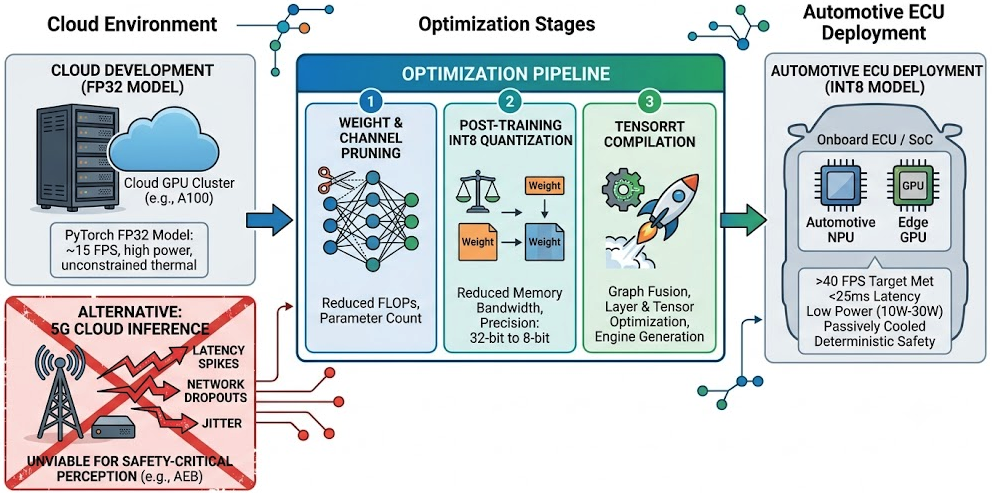
To transition a PyTorch deep learning object detection model from a cloud GPU running at 15 FPS to a vehicle's onboard automotive ECU requiring over 40 FPS within a limited thermal and power budget, the most effective optimization strategy involves applying post-training INT8 quantization, pruning non-critical weights, and compiling the model via TensorRT. Alternative approaches like offloading inference to an external server over 5G introduce unpredictable network latency and connection dropouts that are unacceptable for safety-critical vehicle perception. Instead, post-training INT8 quantization combined with weight pruning and TensorRT compilation drastically reduces memory bandwidth requirements and accelerates hardware compute operations on automotive NPUs and edge GPUs while preserving necessary model accuracy.

From 15 to 40+ FPS: Accelerating PyTorch Object Detection on Automotive ECUs


Problem Statement & Edge Constraints

Deploying deep learning models to automotive embedded environments requires transitioning from high-throughput, unconstrained cloud compute to tightly bounded edge hardware.

  • Target Throughput: Increase execution speed from 15 FPS to >40 FPS (frame latency <25 ms).
  • Hardware Profile: Onboard Automotive Electronic Control Unit (ECU) / System-on-Chip (SoC) equipped with an integrated GPU or Neural Processing Unit (NPU).
  • Thermal & Power Budget: Restricted power envelopes (typically 10W - 30W) without active liquid cooling, requiring high performance per watt.
  • Safety & Reliability: Adherence to functional safety standards (e.g., ISO 26262), requiring deterministic execution local to the vehicle without external network dependencies.


Recommended Optimization Pipeline

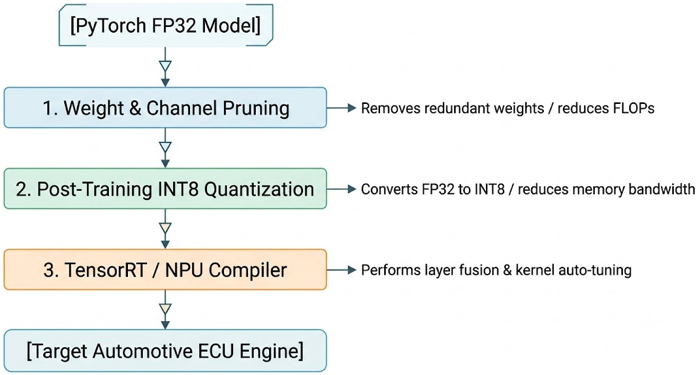
The standard and most effective path to achieve target performance without sacrificing architectural design relies on a three-stage compression and acceleration pipeline: Pruning → Quantization → Graph Compilation.

From 15 to 40+ FPS: Accelerating PyTorch Object Detection on Automotive ECUs

Stage 1: Weight and Channel Pruning

  • Mechanism: Identifies and removes non-critical parameters (structured channel pruning or unstructured weight pruning). Structured channel pruning physically removes redundant convolutional filters, directly reducing matrix dimensions and Compute Floating Point Operations (FLOPs).
  • Impact: Decreases overall parameter count and compute complexity while preserving the model's receptive field and mean Average Precision (mAP).


Stage 2: Post-Training Quantization (PTQ) to INT8

  • Mechanism: Maps 32-bit floating-point (FP32) weights and activation tensors down to 8-bit integers (INT8).
  • Calibration: Uses a small, representative dataset (KL-divergence or MSE minimization) to determine activation scaling factors without full retraining.
  • Impact:
    • Reduces memory footprint and memory bandwidth usage by up to 75\%.
    • Enables utilization of dedicated low-precision integer math hardware (e.g., NVIDIA Tensor Cores, ARM Ethos NPUs), doubling or quadrupling throughput per watt.


Stage 3: Hardware-Specific Graph Compilation (TensorRT / Engine Generation)

  • Layer and Tensor Fusion: Combines adjacent layers (e.g., Convolution + BatchNorm + ReLU) into single execution kernels, eliminating intermediate memory write/read operations back to DRAM.
  • Kernel Auto-Tuning: Selects optimized execution algorithms specific to the target ECU architecture and memory hierarchy.
  • Static Memory Management: Pre-allocates fixed execution memory buffers at load time to prevent dynamic memory allocation overhead during real-time inference.


Technical Evaluation of Alternative Approaches

OptionMethod DescriptionViabilityFailure Reason
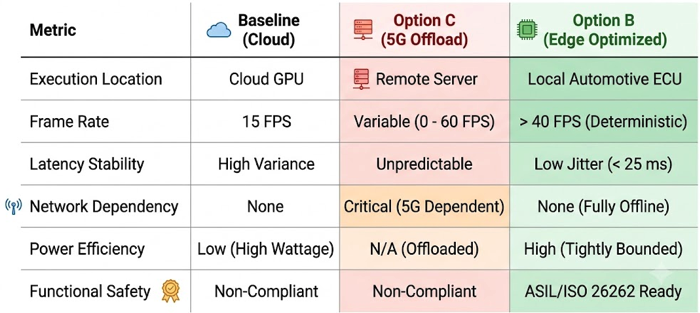
AIncrease batch size & run on CPUUnviableBatch size scaling increases individual frame latency (unsuited for real-time processing). Embedded CPUs lack the parallel execution units needed for deep vision tasks.
BPrune + INT8 Quantize + TensorRTOptimalMaximizes hardware utilization, minimizes memory bandwidth requirements, and achieves deterministic local execution within thermal limits.
CL1 Regularization & 5G REST ServerUnviableNetwork jitter, latency spikes, packet loss, and offline dead-zones break real-time safety guarantees (e.g., Automatic Emergency Braking).
DReplace ConvNet with larger ViTUnviableVision Transformers have O(N^2) computational complexity in self-attention mechanisms, significantly increasing power draw and frame processing time.


Performance Profile Comparison

From 15 to 40+ FPS: Accelerating PyTorch Object Detection on Automotive ECUs

Tags Automotive ECU Autonomous Driving AI ECU Edge AI Inference Electronic Control Unit Embedded Machine Learning FLOPs FP32 INT8 Qualtization INT8 Quantization INT8mFPS Model Pruning NPU Neural Processing Unit Object Detection PyTorch Acceleration Real Time Perception SoC TensorRT TensorRT Optimization mAP Facebook X
Comments 0
Similar posts
  1. GPU & LLM Cluster Infrastructure & Task Scheduling Architecture
    244
  2. TensorRT for LLMs: Speed, Scale, and Why Startups Choose It Over TensorFlow
    460
  3. Java Maps: HashMap vs. LinkedHashMap vs. TreeMap Explained


    226
  1. Vector Search in Relational Databases (RDBs): Trends & Usage Environments
    287
  2. Designing a Skill Registry Architecture: Minimize Token Usage and Maximize AI Performance
    229
  3. TPU & GPU Cluster Management Tools
    243
  4. The Concept of Scaffolding in AI Agents
    232
  5. Beyond Static Pipelines: Architecting LLM Multi-Agent Systems for Autonomous Workflow Orchestration
    582
  6. AI-DLC vs. AI-SDLC: Model-Centric vs. System-Centric AI Development
    258
  7. Fine-Tuning Open-Weight LLMs: Training, Licensing, and Deploying Custom Models with Ollama
    337
  8. Machine Learning: Training vs. Ranking
    221
  9. The Continuous Learning Machine: Designing a Loop That Actually Turns
    222
  10. Designing a Data Curation System Around a Vector Database
    220
  11. Designing MLOps Architectures to Handle Seasonal Data Drift in EV Fleet Models
    194
  12. Understanding Data Lineage
    259
  13. GPU & LLM Cluster Infrastructure & Task Scheduling Architecture
    244
  14. When Do You Need Real-Time Model Registry Versioning Powered by Autonomous Agents?
    225
  15. What ML Labeling Actually Is - And How to Design a Pipeline for It
    333
  16. Bridging the Gap: How Machine Learning Integrates with Infrastructure
    271
  17. Designing an Enterprise ML Experiment Tracking and Reproducibility Platform: System Requirements and Architecture
    309
  18. End-to-End AI/Machine Learning Architecture: AI/ML 6 Layers
    240
  19. Architecting an LLM-Powered Multi-Agent Orchestration System: Design and Requirements
    243
  20. End-to-End Autonomous Vehicle ML Training Pipeline
    325
  21. Building GPU Clusters on GCP, Azure, and AWS: A Practical Guide and Head-to-Head Comparison
    346
  22. Embeddings on the Lakehouse: What Snowflake and Databricks Actually Do (and Don't)
    286
  23. Vector Database Integration on Fully Managed Multi-Agent Environment
    301
  24. AWS Multi-Agent Collaboration Approach: Fully Managed vs. Code-based Implementation
    274
  25. Semantic Kernel: Microsoft's GenAI Orchestration SDK
    398
  26. LLM Application Development with LangGraph: Features and Architectures for Stateful Multi-Actor LLM Applications
    350
Recently updated
  1. Why 100% SEO Guarantees Better User Engagement and How to Achieve It in Your Service
    39
  2. Why SPF and DKIM Are Essential for Linux Email Servers?
    34
  3. How do I create animated background for Google Meet?
    20,611
  4. MaxMind GeoLite2 vs. DB-IP Lite vs. ip-api.com: Choosing the Right Free IP Geolocation Solution
    244
  5. Meet Valkey: Why Redis Changed Its License, Why Valkey is Better, and How to Use It as a Drop-in Replacement
    94
  6. How Rogue Web Scrapers Are Stealing My Content and Destroying My Server
    156
  7. Array of arguments passed to script in PHP
    90
  8. Invalid Auction Storms in Ad Tech
    98
  9. Building MRC-Compliant Instrumentation in Ad Tech: Implementation Steps and Key Challenges
    202
  10. The Two Clocks of Ad Server Architecture
    69
  11. Frequency Cap Architecture Overview
    513
  12. Collecting Proof-of-Play from 100,000 Screens
    145
  13. Vector Search in Relational Databases (RDBs): Trends & Usage Environments
    287
  14. What is RedisVL?
    108
  15. Designing a Skill Registry Architecture: Minimize Token Usage and Maximize AI Performance
    229
  16. TPU & GPU Cluster Management Tools
    243
  17. The Concept of Scaffolding in AI Agents
    232
  18. Beyond Static Pipelines: Architecting LLM Multi-Agent Systems for Autonomous Workflow Orchestration
    582
  19. AI-DLC vs. AI-SDLC: Model-Centric vs. System-Centric AI Development
    258
  20. Fine-Tuning Open-Weight LLMs: Training, Licensing, and Deploying Custom Models with Ollama
    337
  21. Inside the Next-Generation Streaming Architecture: Ultra-Low Latency, SGAI, and AI Codecs
    201
  22. Machine Learning: Training vs. Ranking
    221
  23. The Continuous Learning Machine: Designing a Loop That Actually Turns
    222
  24. The Next-Gen Low-Latency Standards: LL-HLS & MoQ
    195
  25. Designing a Data Curation System Around a Vector Database
    220
  26. Extracting Context from Live Video: The Architecture Got Simpler When We Stopped Building Features
    256
  27. The New Ad Stack Behind Live Sports Streaming: Inside SGAI, EABN, and the Standards Race to Fix Live Monetization
    655
  28. Designing MLOps Architectures to Handle Seasonal Data Drift in EV Fleet Models
    194
  29. Understanding Data Lineage
    259
  30. System Requirements and Architecture: Intelligent Priority-Based Scheduler
    165