Designing MLOps Architectures to Handle Seasonal Data Drift in EV Fleet Models
CK 3788 Created at Updated at
20100
Scenario Overview & Physical Context
In Electric Vehicle (EV) fleet operations, battery degradation modeling is highly sensitive to environmental dynamics. A model trained primarily on warm-weather data suffers severe performance degradation (drop in recall) during winter in northern regions due to fundamental changes in battery electrochemistry and operating environments.
Core Causes of Performance Degradation
Data Drift (P(X) Shift): The marginal distribution of input features shifts significantly. Ambient temperatures, initial internal resistance, charge/discharge rates, and heating loads move into unobserved feature spaces.
Concept Drift (P(Y|X) Shift): The structural relationship between input features (X) and the degradation target (Y) changes. At sub-zero temperatures, lithium plating, electrolyte viscosity increases, and capacity fade mechanisms accelerate non-linearly compared to nominal operating conditions.
Architectural Solution Overview
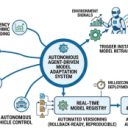
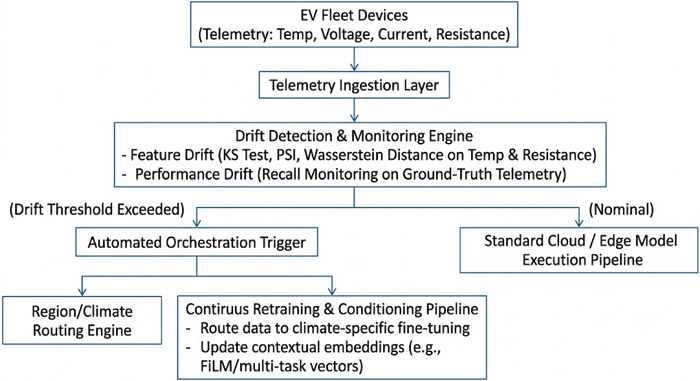
The optimal architectural approach combines automated statistical drift detection with adaptive model orchestration (Option B). Rather than applying static post-processing adjustments, the system dynamically senses distributional shifts and adapts the model contextually.
Technical Deep Dive: Component Design
1. Drift Detection & Monitoring Engine
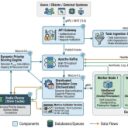
The telemetry ingestion layer continuously routes feature windows to a dedicated statistical monitoring service.
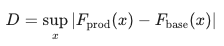
Kolmogorov-Smirnov (KS) Test: Applied to continuous variables such as ambient temperature, battery pack temperature, and internal resistance. Evaluates whether the empirical cumulative distribution function (eCDF) of current production data F_{prod}(x) deviates significantly from the baseline distribution F_{base}(x):
A breach occurs when the calculated p-value < \alpha (e.g., \alpha = 0.01).
Population Stability Index (PSI): Used for binned continuous and categorical features to quantify magnitude of shift:
← with Actual% stacked over Expected% on a fraction bar
Instead of deploying isolated models, the core architecture leverages contextual parameter conditioning (e.g., Feature-wise Linear Modulation - FiLM) or multi-task learning:
Inputs: Raw telemetry features X concatenated with environmental/spatial-temporal embeddings E_{env} (e.g., climate zone, historical rolling temperature averages).
Mechanism: The internal layers of the network scale and shift their feature maps based on E_{env}, allowing a unified model to adapt its degradation boundaries smoothly across wide temperature ranges.
When drift is isolated to specific operating environments:
Data Segmentation: Telemetry is auto-tagged using geospatial and environmental metadata (e.g., region=arctic_north, temp_bucket=<0C).
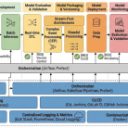
Automated Pipeline Execution: Drift triggers a Continuous Training (CT) job using a specialized dataset weighted for low-temperature operating points.
Shadow Deployment & Champion/Challenger Validation: The updated regional model runs in shadow mode against edge telemetry. Upon passing safety bounds and recall thresholds, it is deployed via dynamic routing based on the vehicle's location and ambient context.
Evaluation of Alternative Options
Option
Approach
Technical Feasibility
Scalability & Safety Risks
A
Increase decision threshold in prediction layer
Low
Inadequate. Raising thresholds changes the precision/recall trade-off curve but does not resolve feature distribution shifts. If cold-weather physical characteristics are missing from the model's representations, threshold manipulation yields unpredictable false-positive/false-negative rates.
B
Automated Data Drift Monitoring + Retraining/Conditioning (Correct)
High
Optimal. Directly addresses the root cause (P(X) and P(Y\
C
Switch to Unsupervised K-Means Clustering
Low
Invalid. K-Means is an unsupervised clustering algorithm. It cannot perform continuous quantitative degradation predictions or target-based recall optimization needed for safety-critical battery health management.
D
Apply a fixed linear multiplier manually
Low
Dangerous. Battery degradation kinetics in extreme cold are highly non-linear (e.g.,Arrhenius temperature dependence). Fixed scalar multipliers fail across varied state-of-charge (SoC) profiles and risk severe over/under-estimation of battery life.
Edge vs. Cloud Architecture Considerations
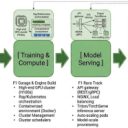
In fleet MLOps, deployment target constraints dictate where components execute:

 ← with Actual% stacked over Expected% on a fraction bar