Designing a Data Curation System Around a Vector Database

CK CK 3776 
Created at  
213 0 0

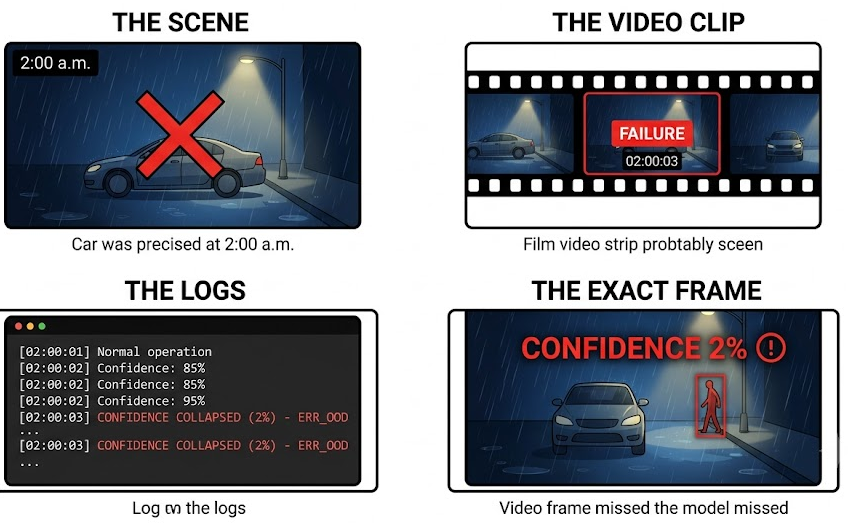
Your model fails at 2 a.m. on a rainy street. You have the clip. You have the logs. You even have the exact frame where confidence collapsed.

Now what?

For most teams, the answer is a week of Slack threads, a half-remembered S3 prefix, and someone scrubbing through video files by hand. The training infrastructure is fine — you can kick off a job in minutes. The bottleneck is upstream: out of the petabytes you've collected, which three thousand samples actually matter for this failure?

That question is what a data curation system exists to answer. This post walks through a design for one: first the user flow, then the architecture that makes it executable, then the six things that will bite you if you skip them.

The setup assumed throughout is unstructured data — images, video, sensor streams, text — collected continuously from production, embedded into a vector space, and queried by similarity when something goes wrong. The skeleton is identical for autonomous driving, visual inspection, speech, and LLM fine-tuning. Only the encoder and the trigger definitions change.

Designing a Data Curation System Around a Vector Database


The shape of the problem

Two things happen on very different timescales, and conflating them is the most common design mistake.

Continuous, unattended: data arrives, gets embedded, gets indexed. No human is involved. This runs forever and has to be cheap.

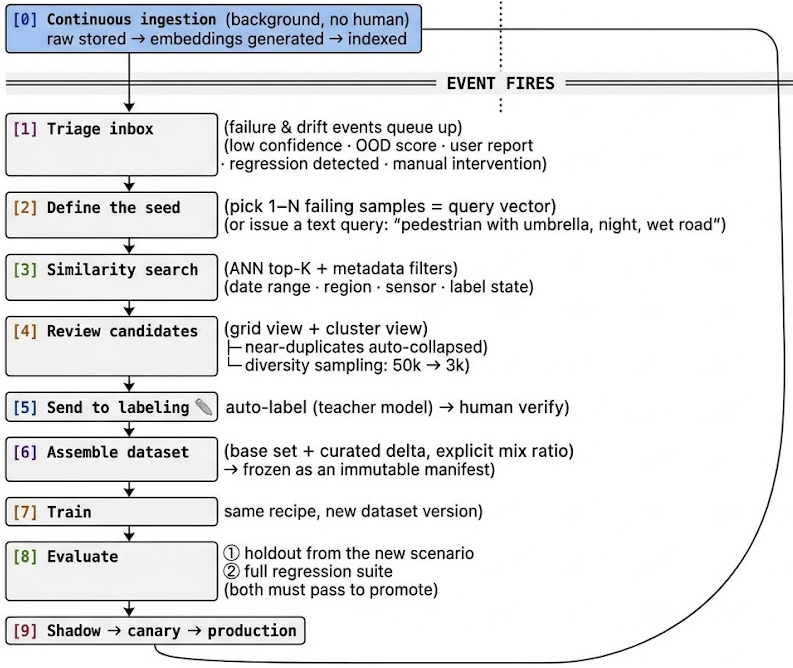
Episodic, interactive: an event fires, an engineer sits down, and within one working session they need to go from "here's the failure" to "here's a training job running on a versioned dataset." This is rare, bursty, and has to be fast — not in throughput, but in iteration latency.

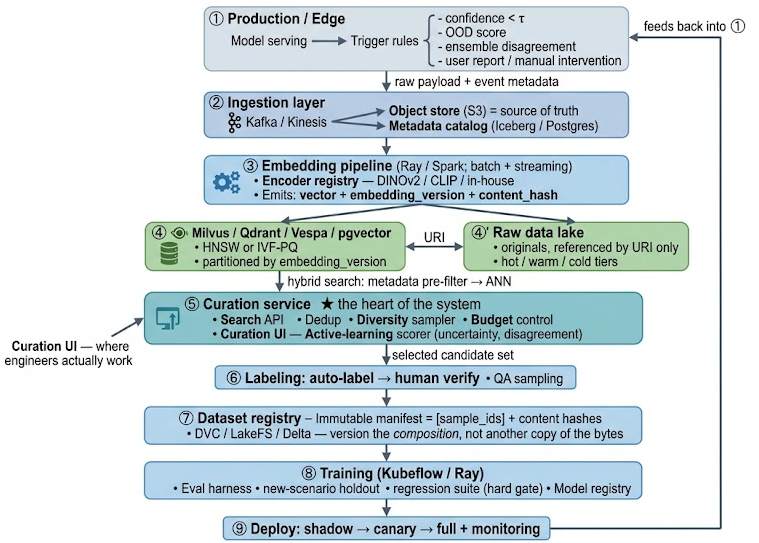
The system is really two systems glued together at the vector index. Design them with different priorities.


Part 1 — The user flow

The primary user is an ML engineer. The design goal is that steps 2 through 4 can be repeated ten times in twenty minutes, because that's what curation actually looks like.

Designing a Data Curation System Around a Vector Database

Two details in this flow carry more weight than they look like they do.

Step 2 should accept both modalities. Query-by-example handles "find me more of this." Text query — via a CLIP-style joint embedding space — handles "find me the thing I suspect exists but haven't seen yet." Teams that build only the former end up unable to probe for gaps proactively.

Step 4 should record rejections. When an engineer reviews 500 candidates and picks 80, the 420 they passed over are a labeled signal about what "relevant" means. Log them. Later, that log is what lets you train the curation policy itself instead of hand-tuning heuristics forever.


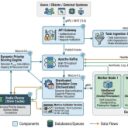
Part 2 — The system architecture

Designing a Data Curation System Around a Vector Database


The record schema

Getting this right is roughly half the battle, and it's very hard to change later.

{
  "id": "clip_9f3a#frame_1204",
  "embedding": [/* 768 dims */],
  "embedding_version": "dinov2-vitl14@v3",   // ← partition key
  "raw_uri": "s3://raw/2026/08/10/clip_9f3a.mp4#f=1204",
  "captured_at": "2026-08-10T21:14:02Z",
  "source": { "device": "unit-7731", "sensor": "cam-front" },
  "content_hash": "phash:a91c...",            // near-duplicate detection
  "label_state": "unlabeled | auto | human_verified",


  "model_signals": { "conf": 0.31, "entropy": 2.7, "disagree": 0.44 },
  "retention": { "policy": "P2Y", "consent_id": "..." }
}

Never put raw data in the vector database. Store vectors, metadata, and a pointer. Keep originals in object storage. Teams that blur this line discover it when they need to rebuild the index and find that "rebuild" now means moving petabytes.


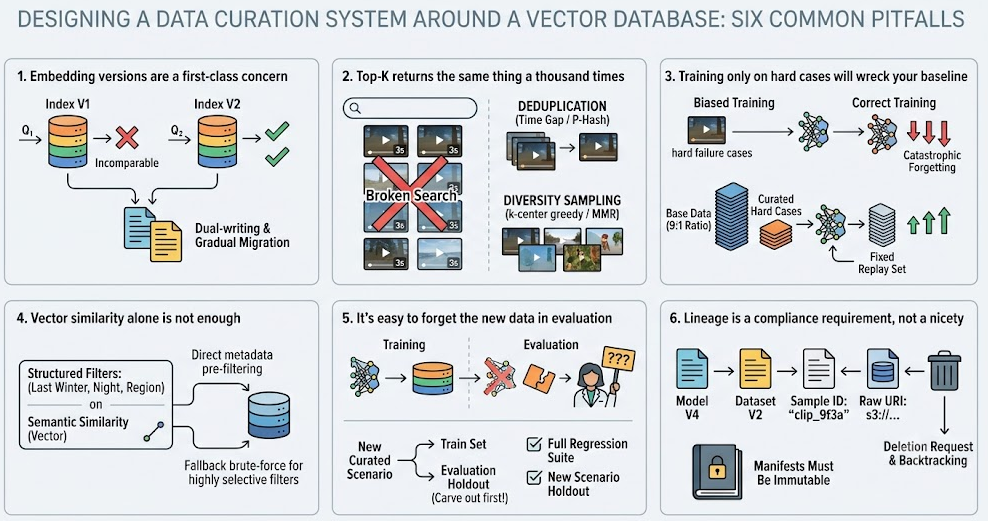
Six things that will bite you

1. Embedding versions are a first-class concern

The moment you swap encoders, every vector in your index becomes meaningless — not wrong, just incomparable. Queries silently return garbage.

Make embedding_version a partition key from day one. Roll out new encoders by dual-writing to a separate index and migrating readers gradually. Retrofitting this later means taking the system down, and re-embedding a billion samples is not a weekend project.


2. Top-K returns the same thing a thousand times

Similarity search over video is brutal about this. Your top 1,000 results are frequently one three-second clip. The engineer scrolls, sees the same intersection over and over, and concludes the search is broken.

Two mandatory post-processing stages:

  • Deduplication — enforce a minimum time gap within a source clip; use perceptual hashing to collapse near-identical frames.
  • Diversity sampling — from K retrieved, select M that actually differ. k-center greedy or MMR both work well and are cheap.

Without these, retrieval quality looks terrible even when the index is perfect.


3. Training only on hard cases will wreck your baseline

Curated data is biased by construction — that's the point. But feed a model nothing but its own failures and you get catastrophic forgetting, dressed up as a mysterious regression on cases that used to work.

Make the mix ratio an explicit, tracked parameter (base : curated = 9 : 1 is a reasonable starting point) and keep a fixed replay set in every run. This is the default failure mode of the whole pipeline; treat it as a known hazard rather than a surprise.


4. Vector similarity alone is not enough

"Last winter, at night, in this specific region" is not something embeddings encode reliably. Real curation queries are almost always hybrid: structured filters and semantic similarity.

Design for metadata pre-filtering ahead of the ANN search, and include a brute-force fallback path for when the filter is selective enough that approximate search stops making sense. Check that your chosen vector database does filtered search well — implementations vary a lot, and some degrade badly at high filter selectivity.


5. It's easy to forget the new data in evaluation

The curated slice goes into training. Everyone remembers that part. What gets skipped is holding a portion out for evaluation.

Skip it and you permanently lose the ability to answer "did we actually fix it?" — you're left judging by vibes and spot checks. Always carve a holdout from the newly curated scenario, and always run the full regression suite alongside it. Both are hard gates for promotion.


6. Lineage is a compliance requirement, not a nicety

You need to trace model_version → dataset_version → sample_id → raw_uri in both directions. When a deletion request arrives, you walk that chain backward — and it has to reach all the way into the vector index, not just the data lake.

Manifests must be immutable. A dataset version that can change out from under you isn't a version.


Designing a Data Curation System Around a Vector Database


What to build first

Don't build all nine layers before shipping anything. This order produces something useful at every step:

  1. Ingestion + metadata catalog. Not losing data is the only thing that's irreversible. Start here.
  2. Offline batch embedding + vector DB + a search API. Even as a CLI, "find me things like this" changes how the team works.
  3. The curation UI. This is what determines whether anyone actually adopts the system. Under-invest here and the rest becomes shelfware.
  4. Dataset registry wired into training. This is the moment the loop closes and the flywheel starts turning.
  5. Automated triggers + active-learning scoring. Now the system proposes what to look at instead of waiting for a human to notice.

Steps 1 and 2 are infrastructure. Step 3 is product. Step 4 is where the compounding starts. Step 5 is the part everyone wants to build first and should build last.


The point of all this

The value isn't the vector database. It's the loop.

A model that fails, gets fixed, and ships in a week is on a fundamentally different trajectory from one that fails and waits a quarter for the next data collection campaign. Every rotation of the loop makes the next failure easier to find, because the index is denser and the triggers are better calibrated.

Build the loop first, even if every component in it is embarrassingly simple. A crude flywheel that turns beats a sophisticated one that doesn't.

Tags AI Data Pipeline Active Learning Continuous Learning Machine Data Curation Data Curation System Dataset Lineage Embedding Models MLOps Machine Learning Infrastructure Milvus OOD Score Qdrant Similarity Search Unstructured Data Vector Database Vespa pgvector Facebook X
Comments 0
Similar posts
  1. The Continuous Learning Machine: Designing a Loop That Actually Turns
    212
  2. Understanding Data Lineage
    251
  3. When Do You Need Real-Time Model Registry Versioning Powered by Autonomous Agents?
    220
  4. AI-DLC vs. AI-SDLC: Model-Centric vs. System-Centric AI Development
    246
  5. What ML Labeling Actually Is - And How to Design a Pipeline for It
    320
  6. Bridging the Gap: How Machine Learning Integrates with Infrastructure
    251
  7. End-to-End Autonomous Vehicle ML Training Pipeline
    298
  8. Building GPU Clusters on GCP, Azure, and AWS: A Practical Guide and Head-to-Head Comparison
    328
  9. What is RedisVL?
    102
  10. Embeddings on the Lakehouse: What Snowflake and Databricks Actually Do (and Don't)
    275
  11. Vector Database Integration on Fully Managed Multi-Agent Environment
    285
  12. Is PyTorch Dead? Deep Learning's Enduring Role Beyond LLMs & Essential Skills
    687
  13. Demystifying FAISS: Your Guide to ANN(Approximate Nearest Neighbor) Search
    313
  14. Building my own ChatGPT based on SageMaker and Milvus that is specialized to Shopping Mall
    256
  15. Your Blueprint for an LLM & Vector DB Insurance Product Q&A
    250
  16. The Core of Vector Databases: Embeddings and LLM Dependency
    251
  17. Architecting ML/LLM Ad Targeting with Kafka, Flink, FAISS, and Milvus
    279
  18. How to overcome the prompt size limit when you use Claude via Bedrock - Chunking / Splitting the Input
    491
  19. Integrating VectorDB stored in S3 with Amazon Bedrock
    421
  20. Milvus and LLM Integration - Very Smart Approach!
    292
  21. How Netflix Runs Recommendations for Hundreds of Millions of Users Using Amazon SageMaker & Metaflow
    168
  22. Understanding Elasticsearch from Installation to Trouble Shooting
    908
  23. MLOps Explained: Spark, Flink, and Reference Architecture Deep Dive
    236
  24. Getting Started with FAISS: A CentOS 7 Installation Guide
    277
  25. Milvus & FAISS: Decoding Their ML Synergy
    275
  26. TikTok's Recommendation System - Monolith
    284
  27. Recommended Vector DB Structure for Amazon Bedrock Integration
    388
  28. Deep Dive into Vector Databases: Understanding Collections (Not Tables) and Embeddings
    226
  29. Image Embeddings for Vector Databases
    239
  30. Vector Databases: From Embeddings to Application
    309
  1. Vector Search in Relational Databases (RDBs): Trends & Usage Environments
    276
  2. Designing a Skill Registry Architecture: Minimize Token Usage and Maximize AI Performance
    219
  3. TPU & GPU Cluster Management Tools
    229
  4. The Concept of Scaffolding in AI Agents
    217
  5. Beyond Static Pipelines: Architecting LLM Multi-Agent Systems for Autonomous Workflow Orchestration
    568
  6. AI-DLC vs. AI-SDLC: Model-Centric vs. System-Centric AI Development
    246
  7. Fine-Tuning Open-Weight LLMs: Training, Licensing, and Deploying Custom Models with Ollama
    321
  8. Machine Learning: Training vs. Ranking
    200
  9. The Continuous Learning Machine: Designing a Loop That Actually Turns
    212
  10. Designing MLOps Architectures to Handle Seasonal Data Drift in EV Fleet Models
    181
  11. From 15 to 40+ FPS: Accelerating PyTorch Object Detection on Automotive ECUs
    203
  12. Understanding Data Lineage
    251
  13. GPU & LLM Cluster Infrastructure & Task Scheduling Architecture
    229
  14. When Do You Need Real-Time Model Registry Versioning Powered by Autonomous Agents?
    220
  15. What ML Labeling Actually Is - And How to Design a Pipeline for It
    320
  16. Bridging the Gap: How Machine Learning Integrates with Infrastructure
    251
  17. Designing an Enterprise ML Experiment Tracking and Reproducibility Platform: System Requirements and Architecture
    299
  18. End-to-End AI/Machine Learning Architecture: AI/ML 6 Layers
    228
  19. Architecting an LLM-Powered Multi-Agent Orchestration System: Design and Requirements
    232
  20. End-to-End Autonomous Vehicle ML Training Pipeline
    298
  21. Building GPU Clusters on GCP, Azure, and AWS: A Practical Guide and Head-to-Head Comparison
    328
  22. Embeddings on the Lakehouse: What Snowflake and Databricks Actually Do (and Don't)
    275
  23. Vector Database Integration on Fully Managed Multi-Agent Environment
    285
  24. AWS Multi-Agent Collaboration Approach: Fully Managed vs. Code-based Implementation
    267
Recently updated
  1. Why SPF and DKIM Are Essential for Linux Email Servers?
    5
  2. How do I create animated background for Google Meet?
    19,014
  3. MaxMind GeoLite2 vs. DB-IP Lite vs. ip-api.com: Choosing the Right Free IP Geolocation Solution
    193
  4. Meet Valkey: Why Redis Changed Its License, Why Valkey is Better, and How to Use It as a Drop-in Replacement
    75
  5. How Rogue Web Scrapers Are Stealing My Content and Destroying My Server
    151
  6. Array of arguments passed to script in PHP
    83
  7. Invalid Auction Storms in Ad Tech
    91
  8. Building MRC-Compliant Instrumentation in Ad Tech: Implementation Steps and Key Challenges
    194
  9. The Two Clocks of Ad Server Architecture
    61
  10. Frequency Cap Architecture Overview
    505
  11. Collecting Proof-of-Play from 100,000 Screens
    139
  12. Vector Search in Relational Databases (RDBs): Trends & Usage Environments
    276
  13. What is RedisVL?
    102
  14. Designing a Skill Registry Architecture: Minimize Token Usage and Maximize AI Performance
    219
  15. TPU & GPU Cluster Management Tools
    229
  16. The Concept of Scaffolding in AI Agents
    217
  17. Beyond Static Pipelines: Architecting LLM Multi-Agent Systems for Autonomous Workflow Orchestration
    568
  18. AI-DLC vs. AI-SDLC: Model-Centric vs. System-Centric AI Development
    246
  19. Fine-Tuning Open-Weight LLMs: Training, Licensing, and Deploying Custom Models with Ollama
    321
  20. Inside the Next-Generation Streaming Architecture: Ultra-Low Latency, SGAI, and AI Codecs
    196
  21. Machine Learning: Training vs. Ranking
    200
  22. The Continuous Learning Machine: Designing a Loop That Actually Turns
    212
  23. The Next-Gen Low-Latency Standards: LL-HLS & MoQ
    188
  24. Extracting Context from Live Video: The Architecture Got Simpler When We Stopped Building Features
    228
  25. The New Ad Stack Behind Live Sports Streaming: Inside SGAI, EABN, and the Standards Race to Fix Live Monetization
    646
  26. Designing MLOps Architectures to Handle Seasonal Data Drift in EV Fleet Models
    181
  27. From 15 to 40+ FPS: Accelerating PyTorch Object Detection on Automotive ECUs
    203
  28. Understanding Data Lineage
    251
  29. System Requirements and Architecture: Intelligent Priority-Based Scheduler
    159
  30. GPU & LLM Cluster Infrastructure & Task Scheduling Architecture
    229