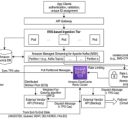
The Continuous Learning Machine: Designing a Loop That Actually Turns | ||||||||||||
| ||||||||||||
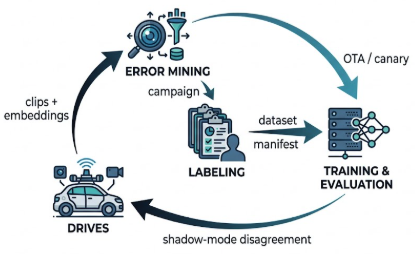
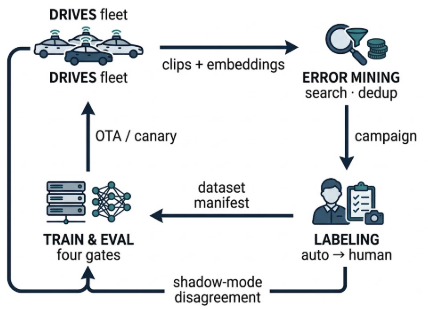
| A fleet of a million vehicles drives a million hours today. Tomorrow it does it again. Somewhere in there are the forty seconds that would fix your model. The hard part was never the training job. It's that 99.999% of what the fleet sees is a car following a car on a dry highway, and your model already handles that perfectly. The value is concentrated in a vanishingly thin slice, the slice you can't afford to store, can't afford to label, and — worst of all — can't reliably recognize when you see it. A Continuous Learning Machine is the system that solves this. Four stages, closed into a loop:
Drives → Error Mining → Labeling → Training & Evaluation → back to the road
Most designs of this system get drawn correctly and built wrong. The boxes are easy. What separates a working data engine from an expensive pile of infrastructure is a single question: how long does one rotation take, and what is the bottleneck? This post walks the loop, stage by stage, with that question in front.
First, the number that decides the architectureBefore any boxes, do the bandwidth math. It dictates everything downstream. Two orders of magnitude of infeasibility, closed by a single decision: the logic that decides what is worth keeping runs on the vehicle, not in the cloud. Every subsequent design choice is downstream of this. You cannot mine data you never uploaded, you cannot upload data you never triggered on, and you cannot trigger on something you haven't taught the vehicle to notice. The loop's intelligence starts at the edge or it doesn't start at all.
And one thing "continuous" does not meanIt does not mean online learning. No safety-critical system updates its policy in the field without passing a validation gate, and no amount of clever infrastructure changes that. What runs continuously is the loop, not the model. The model changes in discrete, audited, reversible steps. Say this out loud early — in a design doc or in an interview — because the name invites the wrong assumption.
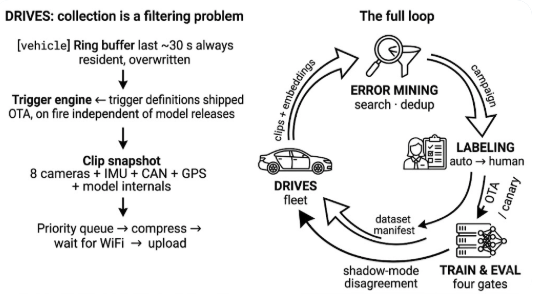
Stage 1 — Drives: collection is a filtering problem
The single most important property here: a trigger is configuration, not code. If adding "pedestrian emerging from behind a stopped truck, at night, in rain" requires a firmware release, your loop's period is the firmware release cycle. That's a quarter. It needs to be a day. Triggers come in layers, and it's worth naming them separately because they have very different precision and volume:
That last one looks like a waste of bandwidth. It is the most important line in the list. Every other trigger fires on something the current model knows it is struggling with. The dangerous failures are the ones the model gets wrong confidently — no low confidence, no disagreement, no intervention, nothing to trigger on. If your entire intake is trigger-driven, those cases are structurally invisible, forever. Reserve 5–10% of upload budget for an unbiased random baseline. It is the only ground truth you have about what your triggers are missing. One bandwidth trick worth building early: upload the embedding before the clip. A few kilobytes of vector plus metadata lets the cloud decide whether the full clip is worth pulling. The vehicle holds the clip; the cloud requests it on demand. This cuts upstream traffic by roughly an order of magnitude and turns the fleet into a queryable index rather than a firehose. Privacy is a hard constraint, not a footnote: face and plate blurring happens on-vehicle, before upload, and deletion requests must propagate from raw clip through embedding index to dataset manifest.
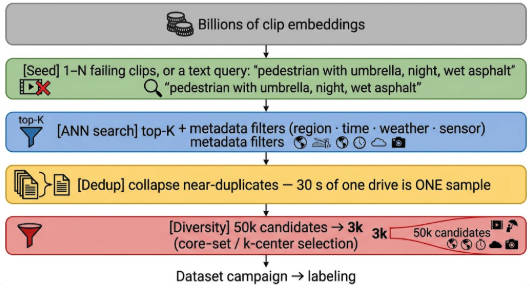
Stage 2 — Error Mining: one failure becomes three thousandThis is the stage that earns the word machine. Without it, you have a bug tracker with video attachments.
Three things here carry more weight than they appear to. Text query, not just query-by-example. Query-by-example only expands failures you've already observed. A joint image-text embedding space lets an engineer probe for the scenario they suspect exists but hasn't been reported yet. Reactive versus proactive curation — teams that build only the former end up permanently one incident behind. Deduplication matters more than retrieval precision. If 2,700 of your 3,000 retrieved samples are consecutive frames from the same drive, you have 300 samples' worth of learning signal and 3,000 samples' worth of labeling cost. This is the single most common way a labeling budget evaporates, and it is invisible unless you measure it explicitly. Offline can see the future. The vehicle at time t knows only up to t. Mining at t+5s knows what actually happened. "This vehicle merged three seconds later and the model never predicted it" is a label that could not exist online. That asymmetry is not a curiosity — it's the foundation of the next stage.
Stage 3 — Labeling: the actual bottleneckMost designs skate past this with "send it to the labeling team." In practice this is where cycle time goes to die, and it's where the highest-leverage engineering investment lives. Structure it as three tiers:
The obvious objection: if a model can label the data, why do you need to train a model? Because the offline labeler operates under none of the vehicle's constraints. On the road, the model is real-time, single-pass, and running on a fixed power budget. Offline, none of that applies. You can run a model ten times larger. You can look forward in time. You can fuse a hundred separate drives through the same intersection into one reconstructed 3D scene and project the answer back onto every frame. The offline system produces ground truth the online model could not have produced under any circumstances. That gap is precisely what makes the loop generative rather than circular. It is also the reason that when the labeling budget gets cut, the correct response is to invest more in L1 coverage, not to label less. Quality control, briefly: a frozen gold set for continuous annotator scoring, multi-annotator consensus reserved for safety-critical attributes only, and periodic sampled audits to re-measure auto-label reliability as the fleet distribution drifts. And datasets must be immutable manifests. A dataset version that can change underneath you is not a version. Freeze the triple — dataset version, code commit, training config — or you will not be able to explain a regression six months from now. Lineage is not bureaucracy; it's the only thing that makes the loop debuggable.
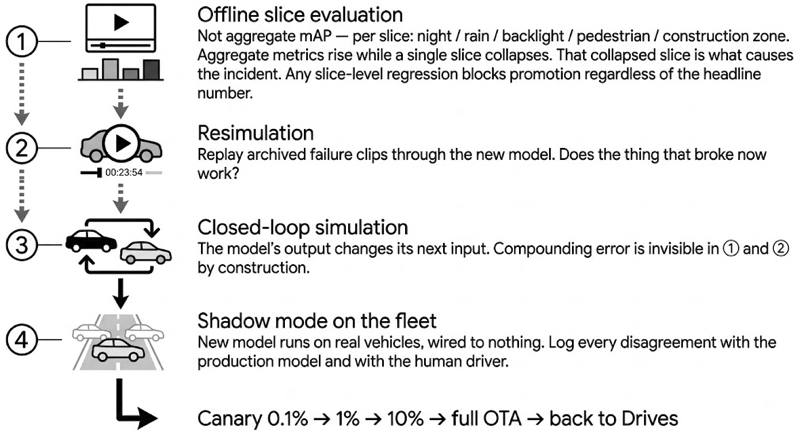
Stage 4 — Training and Evaluation: gates, stackedTwo things about training deserve explicit design attention. Mix ratio is a hyperparameter. Dropping 3,000 freshly mined samples into 10 million existing ones produces no measurable change. Oversampling them fixes the long tail and quietly breaks the common case. The ratio between base set and curated delta needs to be declared, tuned, and recorded in the manifest. Regression suites are frozen, permanently. The failure mode of continuous learning is continuous forgetting, and the only defense is an evaluation set that never gets "improved." Evaluation itself is four gates in series:
Where the loop actually closesLook at gate ④ again. Shadow mode is a validation mechanism. But its output — every disagreement between the candidate model and reality — is exactly the input format Stage 1 produces. The validation stage feeds the collection stage. That's the closure. Not the arrow drawn from the last box back to the first one, but the fact that the act of validating version n generates the training data for version n+1. A loop where each rotation makes the next rotation cheaper is a flywheel. A loop where each rotation costs the same is a treadmill with extra steps.
The five things that will break itEverything above is the happy path. These are the failure modes worth designing against from day one, because each one is silent. Feedback bias. The loop collects what the model knows it finds hard, trains on it, and gets better at exactly that. The blind spots stay blind and the metrics look great. Defense: the uniform random baseline from Stage 1, plus per-slice monitoring that can detect a slice you weren't tracking. Train/eval leakage. Splitting at the clip level is not enough — two clips from the same drive are near-identical. Split by time and geography, so an entire drive lands wholly on one side. Duplicate inflation. Covered above, and worth repeating because it looks like progress. Sample count going up while effective diversity stays flat is the most flattering possible metric. Unversioned datasets. The regression you cannot reproduce is the regression you cannot fix. Optimizing throughput instead of latency. A pipeline that labels a million frames a month but takes six weeks to turn one failure into a deployed fix is losing to a pipeline that does a tenth of the volume in one week.
The only metric that mattersThere are a dozen things to measure in this system — mining precision, label cost per frame, auto-label agreement rate, slice-level AP. All of them are proxies. The real metric is cycle time: from a failure occurring on the road to a validated fix running in the fleet. A team that closes that loop in a week and a team that closes it in a quarter are not on the same curve. They are on different curves entirely, because the first team's twelfth iteration lands before the second team's first, and every rotation makes the index denser, the triggers better calibrated, and the next failure cheaper to find. Which means the right way to build this is not to perfect each stage before connecting it to the next. Build the crudest possible version of all four stages and close the loop. A rough flywheel that turns beats a beautifully engineered one that doesn't. | ||||||||||||
| | ||||||||||||
| |