Machine Learning: Training vs. Ranking

CK CK 3788 
Created at
Updated at  
231 0 0

When discussing ML, some people get confused between Ranking and Training. Similar, yet somehow different... Let me break it down for you.


1. Conceptual Overview: The Core Difference

The primary reason for confusion between Training and Ranking is that they represent two entirely different dimensions of Machine Learning (ML):

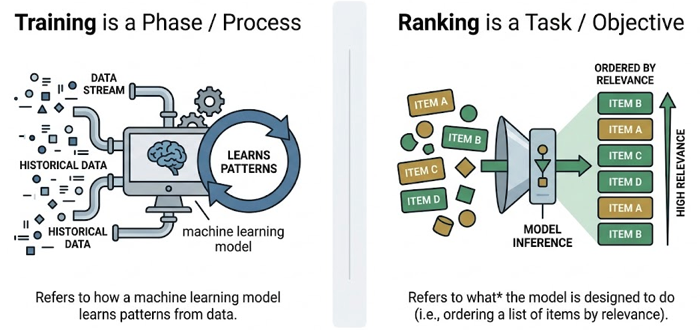
  • *Training is a Phase / Process: It refers to how a machine learning model learns patterns from data.
  • Ranking is a Task / Objective: It refers to what* the model is designed to do (i.e., ordering a list of items by relevance).
DimensionTrainingRanking
What is it?A foundational phase in the ML lifecycle.A specific application/problem type in ML.
AnalogyStudying for an exam: Reading books, doing practice tests, and correcting mistakes.Grading candidates: Arranging job applicants from most qualified to least qualified.
Key FocusOptimization, parameter tuning, pattern recognition.Sorting, prioritization, candidate ordering.
ScopeApplies to almost all ML models (Classification, Regression, Generation, Ranking).Applies specifically to Information Retrieval, Search, and Recommendation Systems.

Machine Learning: Training vs. Ranking


Does the above explanation make it more confusing?


2. Deep Dive: What is Training?

Training is the computational process of teaching an algorithm to make accurate predictions or decisions by exposing it to historical data.


Key Characteristics of Training

  • Iterative Optimization: The model makes predictions, measures its mistakes using a Loss Function, and updates its internal weights using algorithms like Gradient Descent.
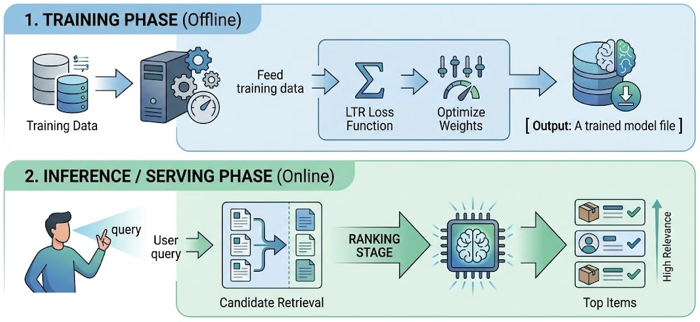
  • Offline Process: Training usually happens offline on powerful computing clusters before a model is deployed.
  • Universal Application: You must train a model whether you are predicting house prices (Regression), detecting spam (Classification), generating text (LLMs), or ordering search results (Ranking).


Example of Training

An algorithm reviews 100,000 historical real estate transactions, adjusts its parameters over 50 iterations (epochs), and minimizes prediction error until it accurately estimates house prices.


3. Deep Dive: What is Ranking?

Ranking (often referred to as Learning to Rank or LTR) is a specialized ML task where the goal is to produce an ordered list of items tailored to a specific query or user context.


Key Characteristics of Ranking

  • Relative Ordering: Unlike classification (Is this item A or B?) or regression (What is the exact numerical value of this item?), ranking focuses on relative position (Is Item A better than Item B for this context?).
  • Context-Dependent: The rank of an item changes based on user preferences, search queries, or real-time signals.
  • Multi-Item Evaluation: Ranking models often evaluate items in relation to one another rather than in complete isolation.


Learning to Rank (LTR) Approaches

  1. Pointwise Approach: Predicts a relevance score for each item individually, then sorts items based on scores (behaves like standard Regression/Classification).
  2. Pairwise Approach: Takes pairs of items and predicts which of the two is more relevant.
  3. Listwise Approach: Evaluates and optimizes the order of an entire list of items at once using metrics like NDCG (Normalized Discounted Cumulative Gain).


Example of Ranking

When a user searches for "running shoes" on an e-commerce platform, the system evaluates thousands of shoes and displays the top 20 most relevant items at the top of the search results page.


4. How Training and Ranking Intersect

confusion often arises because modern systems perform *Training for Ranking tasks*, and large-scale systems use a "Ranking" stage within their inference pipelines.

Machine Learning: Training vs. Ranking


1) Training a Ranking Model

You use the Training process to build a Ranking model. During training, the model is fed user interaction data (clicks, purchases, impressions) and uses specialized "ranking loss functions" (e.g., LambdaMART, SoftRank) to learn how to order items effectively.


2) Ranking as a Stage in Recommendation Systems

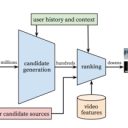
In production pipelines (e.g., YouTube, Netflix), systems are split into stages:

  • Retrieval (Candidate Generation): Filters millions of items down to hundreds.
  • Ranking (Scoring): Takes the hundreds of candidates and uses a trained ML model to score and order them precisely.
  • Re-ranking (Diversity/Business Rules): Applies final business rules (e.g., deduplication, ad insertion).

Here, "Ranking" refers to a specific step in the live execution pipeline, whereas "Training" was the prior step that produced the model driving that stage.


5. Mental Framework to Clear Up Confusion

To keep these concepts clear in future discussions, use these simple rules of thumb:

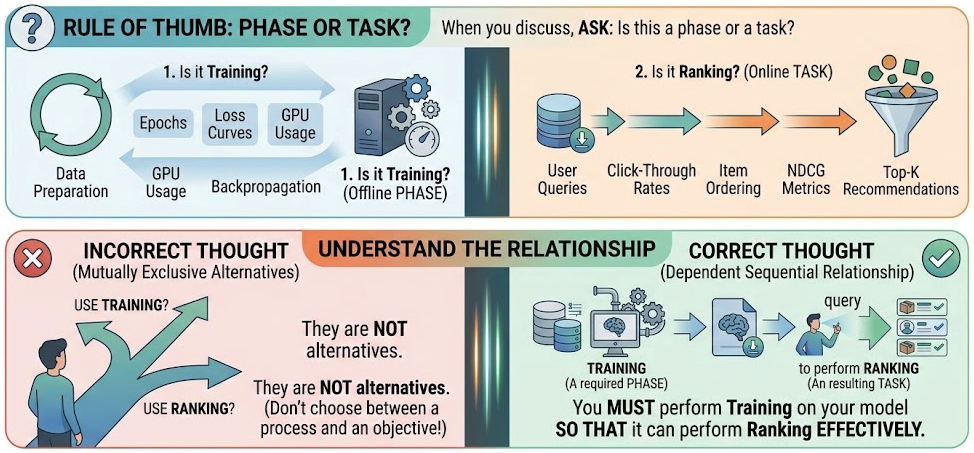
  • Ask: "Is this a phase or a task?"
    • If discussing data preparation, epochs, loss curves, GPU usage, or backpropagation: You are talking about Training.
    • If discussing user queries, click-through rates, item ordering, NDCG, or top-K recommendations: You are talking about Ranking.
  • Understand the relationship:
    • Incorrect thought: "Should I use Training or Ranking for this project?" (They are not mutually exclusive alternatives).
    • Correct thought: “I need to perform Training on my model so that it can perform Ranking effectively.”

Machine Learning: Training vs. Ranking

NDCG = Normalized Discounted Comulative Gain. NDCG measures how good a ranked list of item

Tags Clarification Needed Clear Communication Complex Explanation Confusing Explanation Content Clarity Feedback Request Information Clarity Model Training NDCG Ranking Readability Improvement User Experience User Feedback Facebook X
Comments 0
Similar posts
  1. Why 100% SEO Guarantees Better User Engagement and How to Achieve It in Your Service
    57
  2. Netflix's Recommendation System

    429
  3. YouTube's Recommendation System

    269
  1. Vector Search in Relational Databases (RDBs): Trends & Usage Environments
    303
  2. Designing a Skill Registry Architecture: Minimize Token Usage and Maximize AI Performance
    247
  3. TPU & GPU Cluster Management Tools
    258
  4. The Concept of Scaffolding in AI Agents
    245
  5. Beyond Static Pipelines: Architecting LLM Multi-Agent Systems for Autonomous Workflow Orchestration
    598
  6. AI-DLC vs. AI-SDLC: Model-Centric vs. System-Centric AI Development
    268
  7. Fine-Tuning Open-Weight LLMs: Training, Licensing, and Deploying Custom Models with Ollama

    354
  8. The Continuous Learning Machine: Designing a Loop That Actually Turns
    228
  9. Designing a Data Curation System Around a Vector Database
    230
  10. Designing MLOps Architectures to Handle Seasonal Data Drift in EV Fleet Models
    201
  11. From 15 to 40+ FPS: Accelerating PyTorch Object Detection on Automotive ECUs
    233
  12. Understanding Data Lineage
    272
  13. GPU & LLM Cluster Infrastructure & Task Scheduling Architecture
    255
  14. When Do You Need Real-Time Model Registry Versioning Powered by Autonomous Agents?
    242
  15. What ML Labeling Actually Is - And How to Design a Pipeline for It
    352
  16. Bridging the Gap: How Machine Learning Integrates with Infrastructure
    292
  17. Designing an Enterprise ML Experiment Tracking and Reproducibility Platform: System Requirements and Architecture
    318
  18. End-to-End AI/Machine Learning Architecture: AI/ML 6 Layers
    256
  19. Architecting an LLM-Powered Multi-Agent Orchestration System: Design and Requirements
    260
  20. End-to-End Autonomous Vehicle ML Training Pipeline
    341
  21. Building GPU Clusters on GCP, Azure, and AWS: A Practical Guide and Head-to-Head Comparison
    387
  22. Embeddings on the Lakehouse: What Snowflake and Databricks Actually Do (and Don't)
    303
Recently updated
  1. Google OAuth Token Expiration: Causes and Solutions
    31
  2. Why SPF and DKIM Are Essential for Linux Email Servers?
    51
  3. How do I create animated background for Google Meet?
    23,219
  4. MaxMind GeoLite2 vs. DB-IP Lite vs. ip-api.com: Choosing the Right Free IP Geolocation Solution
    273
  5. Meet Valkey: Why Redis Changed Its License, Why Valkey is Better, and How to Use It as a Drop-in Replacement
    104
  6. How Rogue Web Scrapers Are Stealing My Content and Destroying My Server
    170
  7. Array of arguments passed to script in PHP
    99
  8. Invalid Auction Storms in Ad Tech
    107
  9. Building MRC-Compliant Instrumentation in Ad Tech: Implementation Steps and Key Challenges
    208
  10. The Two Clocks of Ad Server Architecture
    78
  11. Frequency Cap Architecture Overview
    527
  12. Collecting Proof-of-Play from 100,000 Screens
    153
  13. What is RedisVL?
    116
  14. Inside the Next-Generation Streaming Architecture: Ultra-Low Latency, SGAI, and AI Codecs
    207
  15. The Next-Gen Low-Latency Standards: LL-HLS & MoQ
    203
  16. Extracting Context from Live Video: The Architecture Got Simpler When We Stopped Building Features
    263
  17. The New Ad Stack Behind Live Sports Streaming: Inside SGAI, EABN, and the Standards Race to Fix Live Monetization
    674
  18. System Requirements and Architecture: Intelligent Priority-Based Scheduler
    176
  19. Java Variant Type
    212
  20. From SDI to MXL: Inside the Cloud-Native Infrastructure Powering Next-Gen Live Broadcast
    582
  21. IAS IP Blocklist: Causes, Resolution, and Detection Strategies
    197
  22. What Is UniversalAdId? The Complete Guide to VAST Video Ad Tracking
    205
  23. End-to-End Contextual Video Processing Architecture for AdTech
    217
  24. What “GPU Clustering” Really Means (And How to Code for It)
    215
  25. Vector Database Integration on Fully Managed Multi-Agent Environment
    319
  26. AWS Multi-Agent Collaboration Approach: Fully Managed vs. Code-based Implementation
    292
  27. Ad Tech Idempotency: Engineering for Reliability and Scale
    369
  28. Conversation Multi-Agent Chatbot with On-the-Fly Code Execition via Microsoft AutoGen
    306
  29. Contributing to the Ethereum Foundation
    3,611
  30. How to Build a Python Chatbot That Writes and Runs Code Using Microsoft AutoGen (With Sample Code)
    244