AI-DLC vs. AI-SDLC: Model-Centric vs. System-Centric AI Development

CK CK 3788 
Created at
Updated at  
269 0 0

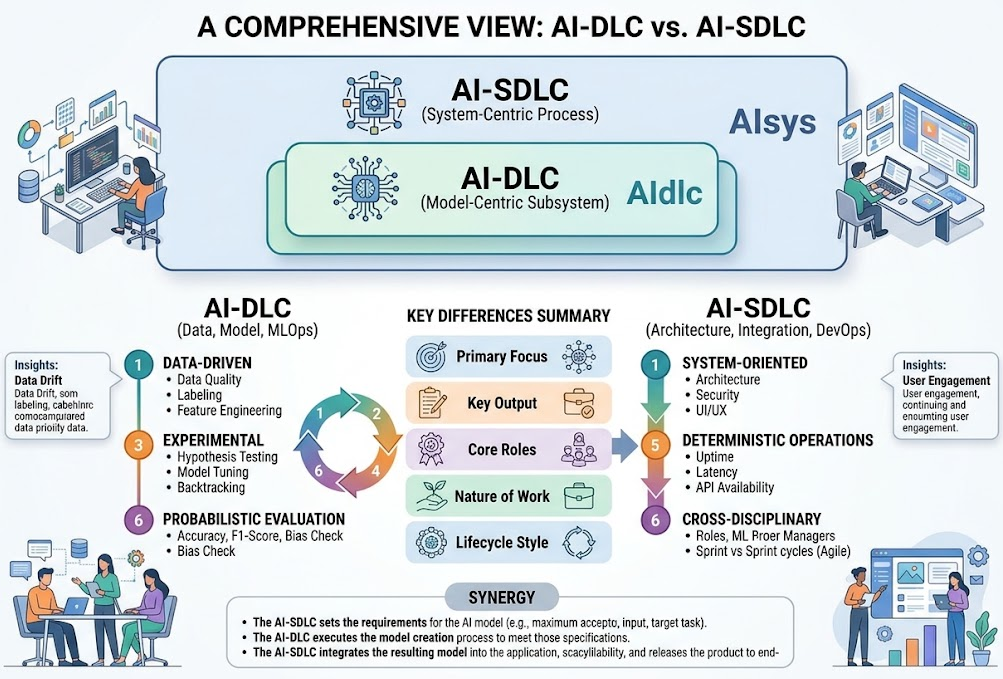
While AI-DLC (AI Development Life Cycle) and AI-SDLC (AI Software Development Life Cycle) sound similar, they represent different scopes in the development of intelligent software solutions:

  • AI-DLC (AI Development Life Cycle): Focuses specifically on the model-centric process. It covers the end-to-end lifecycle of the machine learning (ML) or artificial intelligence model itself—from data gathering to training and model evaluation.
  • AI-SDLC (AI Software Development Life Cycle): Focuses on the system-centric process. It incorporates the AI-DLC into the broader software engineering lifecycle required to build, deploy, integrate, and maintain a functional software application powered by AI.


Deep Dive into AI-DLC (AI Development Life Cycle)

The AI-DLC is driven primarily by data scientists, ML engineers, and data engineers. Its primary goal is to produce an accurate, reliable, and unbiased AI/ML model.


Key Characteristics

  • Data-Driven: Progress depends heavily on data quality, availability, and labeling.
  • Experimental & Non-Linear: Involves heavy experimentation, hypothesis testing, and frequent backtracking to re-train or re-engineer features.
  • Probabilistic: Outcomes are evaluated based on probability, accuracy metrics, precision, recall, and loss functions rather than deterministic pass/fail tests.


Primary Stages of AI-DLC

  1. Problem Formulation: Defining the business objective and determining if an AI/ML solution is appropriate.
  2. Data Engineering: Data collection, ingestion, cleaning, labeling, and feature engineering.
  3. Model Building & Training: Selecting algorithms, training models, and tuning hyperparameters.
  4. Model Evaluation & Validation: Testing performance against benchmarks, checking for bias, and validating explainability/fairness.
  5. Model Deployment (MLOps): Exposing the model via endpoints or embedding it for runtime inference.
  6. Continuous Monitoring & Re-training: Tracking data drift, concept drift, and model performance over time.


Deep Dive into AI-SDLC (AI Software Development Life Cycle)

The AI-SDLC expands traditional software development methodologies (like Agile or DevOps) to build an entire product around an AI core. It manages the integration of the AI model into front-end interfaces, back-end systems, databases, and third-party APIs.

(Note: AI-SDLC can also refer to using AI tools to assist traditional software development, but in comparison to AI-DLC, it refers to the application-level development lifecycle).


Key Characteristics

  • System-Oriented: Focuses on the entire software architecture, security, user experience (UX), and overall performance.
  • Deterministic & Operational: Focuses on traditional software metrics like uptime, latency, API availability, user engagement, and system security.
  • Cross-Disciplinary: Requires collaboration between software developers, DevOps engineers, UX designers, product managers, and data scientists.


Primary Stages of AI-SDLC

  1. Requirements & Architecture Planning: Defining user stories, system architecture, security compliance, and how the AI components will integrate with traditional modules.
  2. Parallel Track Development:
    • Software Track: Developing UI/UX, backend logic, APIs, and databases.
    • AI Track (AI-DLC): Training and optimizing the AI model simultaneously.
  3. Integration & Middleware Engineering: Connecting the AI endpoints/models with the application logic (handling fallback mechanisms, rate limiting, and input/output sanitation).
  4. System Testing & QA: End-to-end integration testing, load testing, security audits, and testing how the application handles incorrect AI outputs.
  5. Deployment (DevSecOps): Deploying the full application stack to production environments using CI/CD pipelines.
  6. Application Maintenance: Monitoring overall application health, system performance, security patches, and managing release cycles.


Key Differences Comparison

DimensionAI-DLC (AI Development Life Cycle)AI-SDLC (AI Software Development Life Cycle)
Primary FocusThe AI/ML ModelThe Complete Application / System
Key OutputA trained, validated model file or inference endpointA fully functional software product (Web, Mobile, Enterprise App)
Primary MetricsAccuracy, F1-Score, Loss, Data Drift, Precision, RecallLatency, Uptime, Security, Scalability, UX, ROI
Core RolesData Scientists, ML Engineers, Data EngineersSoftware Engineers, DevOps, UX Designers, Product Managers
Nature of WorkExperimental, statistical, data-centricDeterministic, architectural, code-centric
Lifecycle StyleIterative loops around data and trainingStructured sprints (Agile/Scrum/DevOps) across the full stack


How AI-DLC and AI-SDLC Interact

In a modern organization, AI-DLC operates as a subsystem within the broader AI-SDLC framework:

AI-DLC vs. AI-SDLC: Model-Centric vs. System-Centric AI Development
  • The AI-SDLC sets the requirements for the AI model (e.g., maximum acceptable latency, input format, target task).
  • The AI-DLC executes the model creation process to meet those specifications.
  • The AI-SDLC integrates the resulting model into the application, ensures security/scalability, and releases the product to end-users.


If you want to know more about, AI-DLC, please refer https://strcpy.com/engineering/923/Why-AIDLC-is-the-New-Paradigm-for-Development/ 

Tags AI Architecture AI Development Lifecycle AI Software Development AI-DLC AI-SDLC AIDLC AISDLC Artificial Intelligence Data-Driven MLOps Machine Learning Lifecycle Model Centric AI Model Deployment Software Engineering System Centric AI System-Oriented Facebook X
Comments 0
Similar posts
  1. Designing a Data Curation System Around a Vector Database
    230
  2. Understanding Data Lineage
    272
  3. When Do You Need Real-Time Model Registry Versioning Powered by Autonomous Agents?
    242
  4. Bridging the Gap: How Machine Learning Integrates with Infrastructure
    292
  5. End-to-End Autonomous Vehicle ML Training Pipeline
    341
  6. The Blueprint of Success: Why System Design and Architecture Matter?
    409
  7. Beyond SDLC: Why the Entertainment Sector Needs an AI Development Life Cycle Now
    299
  8. Why AI-DLC is the New Paradigm for Development?
    343
  9. Cloud-Based AI Architecture Proposals for US Auto Finance Industry
    586
  10. Is PyTorch Dead? Deep Learning's Enduring Role Beyond LLMs & Essential Skills
    699
  11. Building my own ChatGPT based on SageMaker and Milvus that is specialized to Shopping Mall
    281
  12. Your Blueprint for an LLM & Vector DB Insurance Product Q&A
    267
  13. How Netflix Runs Recommendations for Hundreds of Millions of Users Using Amazon SageMaker & Metaflow
    182
  14. MLOps Explained: Spark, Flink, and Reference Architecture Deep Dive
    247
  15. Predicting Buyer Preferences with PyTorch: A Deep Learning Approach
    1,234
  16. PyTorch example to Forcast Stock Price based on 10 days Dataset
    654
  17. TikTok's Recommendation System - Monolith
    302
  18. Forecasting the Weather with PyTorch: A Beginner's Guide to Temperature Prediction
    1,445
  19. Common Recommendation Service Architecture
    539
  20. Getting Started with PyTorch: A Beginner's Guide to Building Your First Neural Network
    801
  1. Vector Search in Relational Databases (RDBs): Trends & Usage Environments
    303
  2. Designing a Skill Registry Architecture: Minimize Token Usage and Maximize AI Performance
    247
  3. TPU & GPU Cluster Management Tools
    258
  4. The Concept of Scaffolding in AI Agents
    245
  5. Beyond Static Pipelines: Architecting LLM Multi-Agent Systems for Autonomous Workflow Orchestration
    598
  6. Fine-Tuning Open-Weight LLMs: Training, Licensing, and Deploying Custom Models with Ollama
    354
  7. Machine Learning: Training vs. Ranking
    230
  8. The Continuous Learning Machine: Designing a Loop That Actually Turns
    228
  9. Designing MLOps Architectures to Handle Seasonal Data Drift in EV Fleet Models
    201
  10. From 15 to 40+ FPS: Accelerating PyTorch Object Detection on Automotive ECUs
    233
  11. GPU & LLM Cluster Infrastructure & Task Scheduling Architecture
    255
  12. What ML Labeling Actually Is - And How to Design a Pipeline for It
    352
  13. Designing an Enterprise ML Experiment Tracking and Reproducibility Platform: System Requirements and Architecture
    318
  14. End-to-End AI/Machine Learning Architecture: AI/ML 6 Layers
    256
  15. Architecting an LLM-Powered Multi-Agent Orchestration System: Design and Requirements
    260
  16. Building GPU Clusters on GCP, Azure, and AWS: A Practical Guide and Head-to-Head Comparison
    387
  17. Embeddings on the Lakehouse: What Snowflake and Databricks Actually Do (and Don't)
    303
  18. Vector Database Integration on Fully Managed Multi-Agent Environment
    319
  19. AWS Multi-Agent Collaboration Approach: Fully Managed vs. Code-based Implementation
    292
  20. Semantic Kernel: Microsoft's GenAI Orchestration SDK
    416
Recently updated
  1. Google OAuth Token Expiration: Causes and Solutions
    31
  2. Why 100% SEO Guarantees Better User Engagement and How to Achieve It in Your Service
    57
  3. Why SPF and DKIM Are Essential for Linux Email Servers?
    51
  4. How do I create animated background for Google Meet?
    23,227
  5. MaxMind GeoLite2 vs. DB-IP Lite vs. ip-api.com: Choosing the Right Free IP Geolocation Solution
    273
  6. Meet Valkey: Why Redis Changed Its License, Why Valkey is Better, and How to Use It as a Drop-in Replacement
    104
  7. How Rogue Web Scrapers Are Stealing My Content and Destroying My Server
    170
  8. Array of arguments passed to script in PHP
    99
  9. Invalid Auction Storms in Ad Tech
    107
  10. Building MRC-Compliant Instrumentation in Ad Tech: Implementation Steps and Key Challenges
    208
  11. The Two Clocks of Ad Server Architecture
    78
  12. Frequency Cap Architecture Overview
    527
  13. Collecting Proof-of-Play from 100,000 Screens
    153
  14. What is RedisVL?
    116
  15. Inside the Next-Generation Streaming Architecture: Ultra-Low Latency, SGAI, and AI Codecs
    207
  16. The Next-Gen Low-Latency Standards: LL-HLS & MoQ
    203
  17. Extracting Context from Live Video: The Architecture Got Simpler When We Stopped Building Features
    263
  18. The New Ad Stack Behind Live Sports Streaming: Inside SGAI, EABN, and the Standards Race to Fix Live Monetization
    674
  19. System Requirements and Architecture: Intelligent Priority-Based Scheduler
    176
  20. Java Variant Type
    212
  21. From SDI to MXL: Inside the Cloud-Native Infrastructure Powering Next-Gen Live Broadcast
    582
  22. IAS IP Blocklist: Causes, Resolution, and Detection Strategies
    197
  23. What Is UniversalAdId? The Complete Guide to VAST Video Ad Tracking
    205
  24. End-to-End Contextual Video Processing Architecture for AdTech
    217
  25. What “GPU Clustering” Really Means (And How to Code for It)
    215
  26. Ad Tech Idempotency: Engineering for Reliability and Scale
    369
  27. Conversation Multi-Agent Chatbot with On-the-Fly Code Execition via Microsoft AutoGen
    306
  28. Contributing to the Ethereum Foundation
    3,612
  29. How to Build a Python Chatbot That Writes and Runs Code Using Microsoft AutoGen (With Sample Code)
    244
  30. Messaging Platform with Limited TPS based on the vendor
    204