| Frequency capping is a critical setting in advertising that restricts the number of times a specific advertisement, creative, or campaign is displayed to an individual user within a defined period. Its primary goal is to optimize advertising effectiveness by balancing reach with user experience and campaign efficiency. 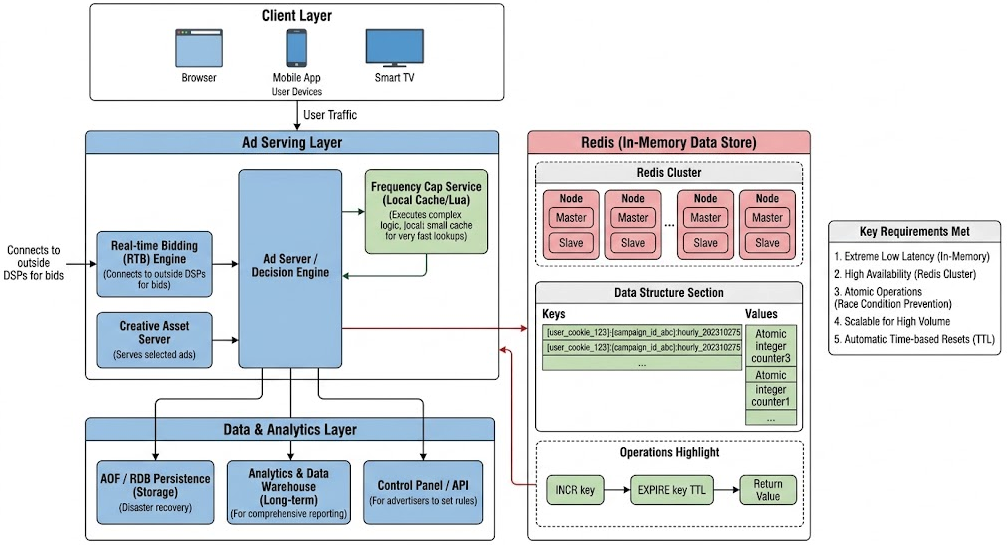
Key Aspects: - User Experience: Prevents "ad fatigue" and annoyance. Repeatedly showing the same ad to a user can lead to negative brand perception, ignored ads, or even users blocking ads altogether.
- Budget Management: Helps advertisers allocate their budget more effectively. Instead of spending money on excessive impressions to a single user, it ensures impressions are distributed across a wider audience, preventing wasted ad spend.
- Ad Effectiveness: By limiting exposure, frequency capping encourages broader reach and potentially higher engagement from a more diverse set of users who haven't yet been overexposed.
- Parameters: Frequency caps are typically defined by:
- Count: The maximum number of times an ad can be shown (e.g., 3).
- Time Period: The duration over which the count applies (e.g., per hour, per day, per week, per month).
- Scope: What specific entity is being capped (e.g., a particular creative ID, an entire campaign, an ad format, or across an ad network).
- User Identifier: How the user is uniquely identified (e.g., cookie ID, device ID, hashed IP address, logged-in user ID).
Example:
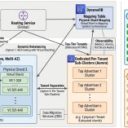
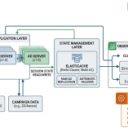
A frequency cap of "2 impressions per user per 24 hours for Campaign X" means that if a user sees any ad from Campaign X twice within a 24-hour window, they will not be shown another ad from Campaign X until that 24-hour period for the first impression has elapsed. Infrastructure for Frequency Capping using RedisImplementing frequency capping at scale requires a high-performance, real-time data store to track impression counts across millions of users and thousands of ads. Redis, with its in-memory architecture, low-latency operations, and atomic data types, is an ideal choice for this purpose. High-Level Architecture:1. Ad Request: A user's browser or app sends an ad request to an Ad Server.
2. Ad Server/Decision Engine: This component processes the request, determines eligible ads based on targeting, bidding, and then consults Redis for frequency capping.
3. Redis Cluster: A distributed, in-memory data store responsible for maintaining and updating impression counts for each user and capped entity. 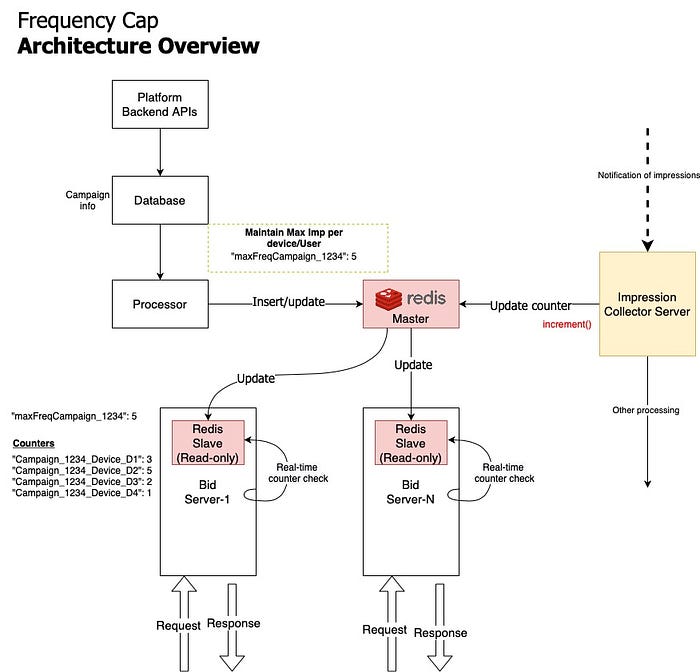
Data Structure in Redis:Frequency cap data is stored as simple key-value pairs where the value is an integer counter. The key design is crucial for efficient lookups and management of different cap types and time windows. - Redis Key Format:
[user_identifier]:[capped_entity_id]:[time_bucket]user_identifier: A unique string identifying the user (e.g., user_cookie_123, device_id_abc). This often serves as the hash tag for sharding in a Redis Cluster to keep all user-specific data on one node.capped_entity_id: The ID of the item being capped (e.g., creative_id_XYZ, campaign_id_PQR).time_bucket: A string representing the current time window. This ensures proper cap resets.- Examples:
daily_YYYYMMDD (e.g., daily_20231027), hourly_YYYYMMDDHH (e.g., hourly_2023102715), weekly_YYYYWW.
- Redis Value Type:
STRING (used as an integer for atomic increments).
Operations Workflow:1. Ad Request Arrival: An ad request is received by the Ad Server.
2. Ad Candidate Identification: The Ad Server identifies potential ads/creatives (C) that match the targeting criteria for the current user (U).
3. Construct Redis Key(s): For each potential ad C and its associated frequency cap rules (e.g., "3 impressions per day for Creative A," "10 impressions per week for Campaign B"), the Ad Server dynamically constructs the corresponding Redis key(s). - Example: For
User U and Creative C with a daily cap, the key might be U:C:daily_20231027.
4. Atomic Check and Increment: - The Ad Server sends an atomic
INCR command to Redis for the constructed key. This command increments the counter by 1 and returns the new value. - Immediately after (or often in the same pipeline/Lua script), an
EXPIRE command is issued for the key. The TTL (Time-To-Live) for the key is set to match the duration of the frequency cap window (e.g., 24 hours for a daily cap, 1 hour for an hourly cap). This ensures keys are automatically deleted when the cap period ends, allowing the count to reset.
5. Evaluate Cap: - The Ad Server compares the
new_counter_value returned by Redis against the predefined frequency cap limit for that ad. - If
new_counter_value <= cap_limit, the ad is considered eligible from a frequency capping perspective. - If
new_counter_value > cap_limit, the ad has hit its cap for the user in the current time window and is excluded from consideration.
6. Ad Decision: Based on the frequency cap evaluation and other business logic (e.g., bidding, targeting), the Ad Server makes the final decision on which ad to serve (or to serve no ad). Key Redis Commands:INCR key: Atomically increments the integer value of key by one. If key does not exist, it is created with a value of 0 before incrementing.EXPIRE key seconds: Sets a timeout on key. After seconds, the key is automatically deleted. Essential for managing time-based caps.GET key: (Less common during the active capping process, but useful for debugging or initial checks). Retrieves the current value of key.
Benefits of using Redis for Frequency Capping:- Extreme Low Latency: As an in-memory data store, Redis provides sub-millisecond response times, crucial for the real-time demands of ad serving.
- Atomic Operations: The
INCR command is atomic, preventing race conditions that could lead to inaccurate counts when multiple ad requests for the same user occur simultaneously. - Automatic Expiration (TTL): The
EXPIRE command simplifies the management of time-based caps by automatically purging old data, preventing memory bloat and ensuring caps reset correctly. - Scalability (Redis Cluster): Redis Cluster allows for horizontal scaling by sharding data across multiple nodes, distributing the load and providing high availability and fault tolerance, which is vital for high-volume ad platforms.
- Simplicity: The straightforward key-value data model and basic integer operations make implementation and maintenance relatively simple.
Production Considerations:- Redis Cluster: Absolutely essential for production environments to handle high traffic volumes, provide high availability, and enable horizontal scaling.
- Sharding Strategy: Implement a robust sharding mechanism (e.g., using consistent hashing on the
user_identifier) to distribute keys evenly across the cluster and ensure all data pertaining to a single user resides on the same node. - Monitoring: Comprehensive monitoring of Redis (latency, memory usage, CPU, connections, hit rate) is critical to proactively identify and address performance bottlenecks.
- Persistence: While frequency cap data is often transient, RDB snapshots or AOF persistence can be configured for disaster recovery, especially if rebuilding all existing caps from scratch upon a full Redis cluster failure is unacceptable.
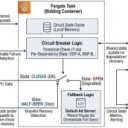
- Error Handling/Graceful Degradation: The ad serving system should be designed to handle potential Redis outages gracefully. This might involve temporarily disabling frequency capping, using a fallback cache, or serving default ads to prevent complete ad serving failures.
- Lua Scripting: For more complex atomic operations (e.g., incrementing a counter and setting its TTL and checking its value in a single, server-side transaction), Redis Lua scripting can be utilized to reduce network round-trips and ensure complex logic executes atomically.
|