Real-Time Geo-Targeting: Balancing Precision, Latency, and Cost
CK 3788 Created at Updated at
28700
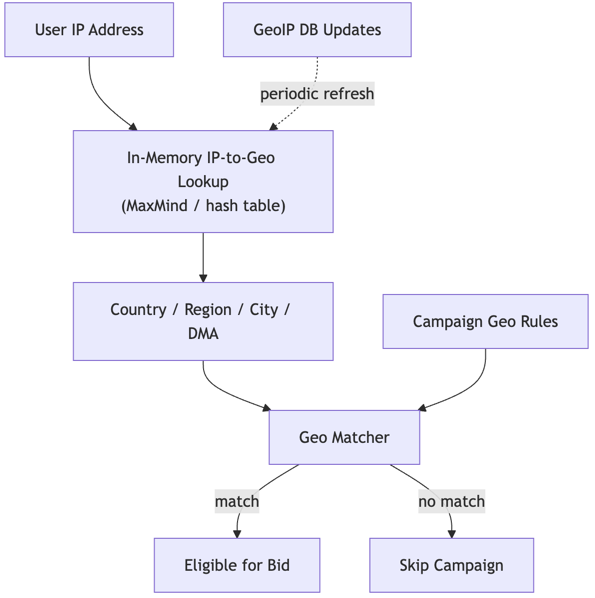
Geo-targeting enables advertisers to show ads only to users in specific geographic regions. A pizza chain wants ads shown only to users within 5 miles of its locations; a luxury car brand targets major metropolitan areas; a regional bank limits ad spend to its service areas. Accurately mapping user IP addresses to geographic locations—and doing so within the 5ms RTB latency budget—is fundamental to ad exchange infrastructure.
The technical challenge is balancing precision, latency, and cost. MaxMind's GeoIP2 database contains ~5 million IP-to-location mappings (country, state, city, latitude/longitude, ISP, etc.), stored as a binary trie. A naive lookup for every incoming bid request requires either (1) a network round-trip to a geo service (adds 10–50ms latency), or (2) embedding the database in the bidder process (adds 100+ MB memory).
The business impact is substantial. Geo-targeting mismatches cost millions: an advertiser paying for US-only impressions but getting served in Canada due to bad geo data files a compliance violation. Conversely, under-geotargeting leaves money on the table: if your geo data is always 1 city off, you lose targeted reach.
Key challenges include: (1) database freshness—IP assignments change daily; a database updated monthly is stale for 3% of IPs; (2) accuracy levels—city-level accuracy is ~90%, county-level ~70%; precision degrades at the edges; (3) latency requirements—geo lookup must add < 1ms to bid latency; (4) operational complexity—updating and distributing geo databases across a global bidding fleet requires careful coordination.
Scale considerations: hyperscale exchanges see 100k–500k bid requests per second, 86.4 billion bids per day. If each bid triggers a geo lookup, that is 100k–500k geo queries per second. A single centralized geo service cannot handle this load without extreme replication.
Key Requirements
Functional Requirements
IP-to-location mapping: Given an IP address, return country, state/province, city, latitude, longitude, ASN (autonomous system).
Hierarchical lookups: Support country-level, state-level, and city-level targeting queries.
IPv4 and IPv6 support: Handle both legacy IPv4 and modern IPv6 addresses.
Bulk updates: Reload geolocation databases without service interruption.
Fallback accuracy: If city data is missing, fall back to state; if state is missing, fall back to country.
Caching and refresh: Cache results for frequently seen IPs; refresh cache periodically (daily or weekly).
Non-Functional Requirements
Lookup latency: < 1ms (time spent in geo lookup; includes in-process data structure search, not network).
Throughput: Support 100k–500k 'query IP' operations per second.
Memory footprint: < 200 MB for full MaxMind GeoIP2 database per bidder instance (compressed storage required).
Database freshness: Update geolocation data at least weekly; daily updates preferred.
Consistency: Strong consistency (all bidders see the same IP-to-location mapping within a few minutes of database update).
Accuracy: >= 95% city-level accuracy for major population centers; >= 99% country-level accuracy globally.
Availability: 99.99% uptime for geo lookups (fallback to country-level acceptable if city data unavailable).
Simplified Architecture
Architecture Proposals
Option 1: Embedded In-Process MaxMind Database via S3 and mmap
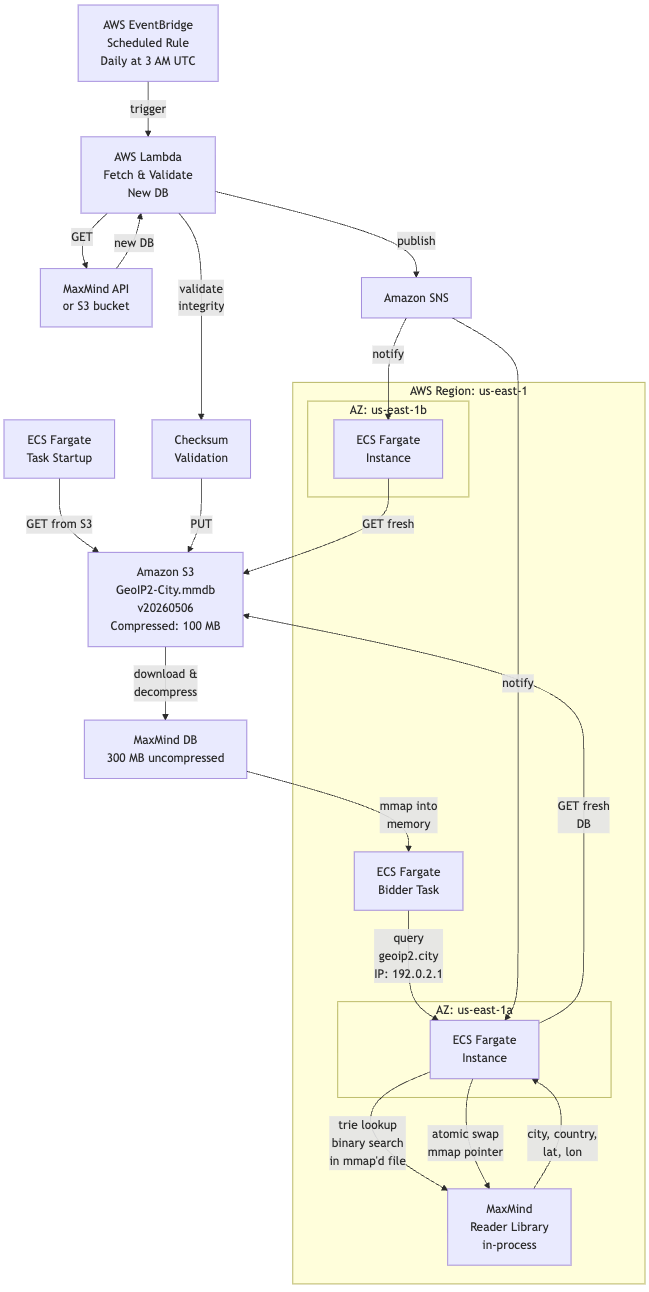
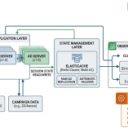
Download MaxMind GeoIP2 database (binary format) from S3, decompress it, and embed it as a memory-mapped file within the bidder ECS Fargate process. The binary format uses a trie structure optimized for IP range lookups. Queries hit the local mmap'd file with zero network latency.
How it works:
MaxMind GeoIP2 Reader database (GeoLite2-City.mmdb file, ~100 MB compressed, ~300 MB uncompressed) is stored on Amazon S3.
On bidder startup, ECS Fargate task downloads the file from S3, decompresses it, and loads using mmap: the OS maps the file into virtual memory, allowing queries without reading the entire file into RAM.
On each auction, call MaxMind reader library: geoip2.city(ip_address) → returns city, state, country, latitude, longitude.
The library internally performs a trie traversal: split IP into 32 bits (IPv4), follow branches in the trie to the matching IP range, return the associated location data.
Daily cron job (via EventBridge) downloads a fresh database, validates it, and atomically swaps the mmap'd pointer.
Why it works:
Extremely fast: trie traversal on mmap'd data is a few microseconds, and the OS kernel handles page faults efficiently.
No network latency: data is local.
Low operational burden: just manage the database file and update it daily via S3 + Lambda.
Pros:
Sub-microsecond latency: mmap'd file access is nearly as fast as in-process memory.
Simple deployment: single file, no external services (MaxMind library is built-in to ECS image).
Natural fallback: if a detailed lookup fails, can return coarser granularity (state or country).
Cost-effective: no extra services or APIs to pay for (beyond MaxMind licensing, ~$500/month).
S3 storage handles versioning; easy to roll back if a database update is bad.
Cons:
Memory overhead: 300 MB per bidder instance. With 100 bidders, that is 30 GB of wasted memory if not shared. Mitigate with memory deduplication (page sharing across processes) or moving to a lighter database (see Option 2).
Database staleness: if an IP is reassigned 2 hours ago, your bidders won't see the change until the next daily update (up to 24 hours later). Mitigate by fetching updates more frequently (every 6 hours, or real-time IP feeds from MaxMind if available).
Crash recovery: if a bidder crashes during database update, the mmap'd pointer might be in an inconsistent state. Mitigate by using atomic file operations (write to a temp file, then rename) and validating database integrity before swap.
Failure Modes & Mitigations:
Database file is corrupted (mmap succeeds but data is invalid): Queries return garbage or crash. Mitigate by validating database integrity (checksums or sanity checks on sample IPs) before swapping. Lambda job tests 100 known IPs before S3 upload.
mmap fails (out of address space or file is too large): Only happens on 32-bit systems or with extremely large databases. Mitigate by using 64-bit systems (ubiquitous now) and capping database size (MaxMind GeoIP2 is always < 500 MB uncompressed).
Bidder's view of database drifts if update fails: One bidder loads a fresh database; another still uses the old version. Geographic targeting decisions are inconsistent across the fleet. Mitigate by staging updates: test new database on 5% of bidders (canary deployment via ECS task definition), monitor for anomalies, then roll out to 100% if successful.
When to Choose: Choose Option 1 for most ad exchanges (small to large). It is the simplest, fastest, and most cost-effective approach. Suitable for greenfield systems and migrations from external geo services.
Option 2: Sidecar Microservice with gRPC and ElastiCache Caching
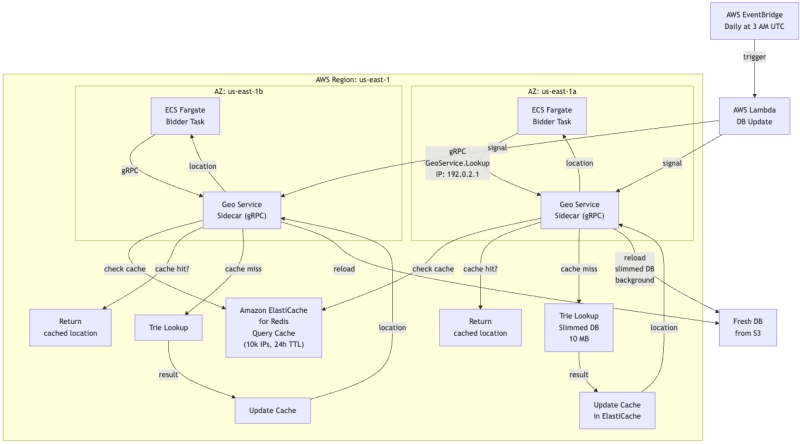
Deploy a lightweight geo service as a sidecar (one per ECS Fargate task or per EC2 instance) or shared service. The service embeds a slimmed-down geolocation database (country and state only, ~10 MB) and caches frequent queries in Amazon ElastiCache for Redis.
How it works:
Deploy a geo service (written in Go or Rust for speed) on each ECS Fargate task or EC2 node.
Service embeds a slimmed MaxMind database: removes city data (saves 200+ MB), keeps country + state + lat/lon + ASN. Database size ~10 MB.
Service maintains a local LRU cache of recent queries (e.g., last 10,000 IPs): { ip → {country, state, lat, lon} } with TTL 24 hours backed by ElastiCache.
Bidder calls service via gRPC (unary RPC): geo_service.Lookup(ip_address) → returns location.
Service does cache lookup first (O(1)). Cache miss: consult local database (trie traversal, ~10 microseconds).
Periodically (daily), service downloads a fresh database and reloads it without interrupting queries using a background thread.
Why it works:
Faster than network RPC to a distant service (gRPC over localhost is ~50 microseconds).
Slimmed database (10 MB) is faster to search than full database and fits entirely in CPU L3 cache on modern processors.
Caching catches "hot" IPs (users from same region or ISP), reducing database hits to 20–30% of auctions.
Natural service boundary: geo lookup is decoupled from bidding logic, making it easier to test and scale independently.
ElastiCache provides shared cache across all sidecars, avoiding duplication.
Pros:
Latency: ~50 microseconds gRPC overhead + (30% of time) × 10 microseconds database lookup = 53 microseconds average, still well under 1ms budget.
Memory: 10 MB database + ~5 MB ElastiCache cache per sidecar = ~15 MB per sidecar. With 100 sidecars, 1.5 GB total, much more manageable than 30 GB.
Cache hit rate: 70–80% (users from same city/region revisit), reducing database lookups proportionally.
Scalability: service is stateless; easily horizontal scale by adding more sidecars.
Version management: can run multiple versions of the geo service (A/B testing new databases), managing rollouts gradually.
Cons:
gRPC latency: 50–100 microseconds per call, even on localhost. With 500k QPS, this is noticeable (P99 might hit 200+ microseconds if there is contention).
Cache coherency: if database is updated on one sidecar but not another, different bidders see different results. Mitigate by coordinating updates (e.g., ECS deployment rolling updates ensure all tasks update within 5 minutes).
Slim database loses city-level precision: if a campaign targets "San Francisco," you can only match "California" via the sidecar. Mitigate by using Option 1 or adding a secondary service for city-level queries on high-value campaigns.
Failure Modes & Mitigations:
gRPC service crashes: Bidder cannot reach it. Mitigate by bundling a fallback embedded database (Option 1) and automatically using it if gRPC fails. Fallback adds ~50 MB overhead but improves resilience.
Corrupted cache leads to wrong results: Cache is memory-resident in ElastiCache and unvalidated. If database is reloaded with a bug, cache may retain old (now incorrect) results. Mitigate by flushing cache on database reload and validating sample IPs against new database before marking as ready.
ElastiCache cache miss during peak traffic: High-volume queries cause ElastiCache node to be overwhelmed. Mitigate by using ElastiCache read replicas or increasing node size.
When to Choose: Choose Option 2 for mid-to-large systems (10k–100k campaigns) where memory overhead is a concern and latency requirements are slightly flexible (can tolerate 50–200 microseconds). Also suitable if you need multi-version testing (rolling out new databases to a subset of bidders).
Option 3: CDN Edge Enrichment with CloudFront and Lambda@Edge
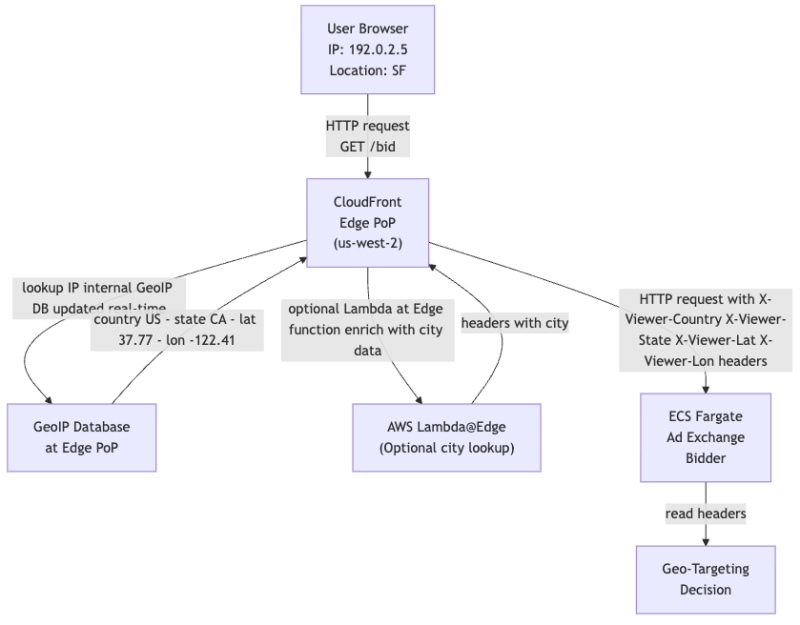
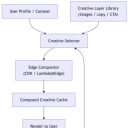
Offload geo-targeting to the CDN or edge layer: Amazon CloudFront with Lambda@Edge enriches the request with geo headers before forwarding to the ad server. CloudFront automatically populates viewer headers (country, latitude, longitude) from its internal GeoIP database. The ad server consumes the header instead of performing a lookup.
How it works:
Publisher or ad exchange configures CloudFront to inject geo headers on every request.
Optionally, Lambda@Edge function enriches headers further (e.g., adds city-level data by querying a thin service or adding derived fields).
Request arrives at CloudFront edge PoP closest to the user. CloudFront appends geo headers to the HTTP request.
Request is forwarded to the ad server (bidder) with geo headers included.
Ad server (bidder) reads headers instead of doing its own lookup.
No latency cost: geo enrichment happens at the edge, before the request reaches the ad server.
Why it works:
Zero latency for ad server: geo enrichment happens upstream, at the CloudFront edge.
High-quality data: CloudFront maintains extremely accurate GeoIP databases and updates them continuously.
No per-bidder overhead: the bidder does not store or update geolocation data; CloudFront handles it.
Decentralized: each edge PoP maintains a local database, avoiding centralized bottlenecks.
No added infrastructure cost: if you are already using CloudFront, geo enrichment is free.
Pros:
Latency: zero overhead to ad server; CloudFront does geo lookup in parallel with request routing.
Accuracy: CloudFront's geo data is extremely accurate (99.9%+ at city level) and updated in real-time.
Scalability: no scaling burden on ad exchange; CloudFront handles it.
Simplicity: bidder just reads headers; no geo libraries or databases to maintain.
Privacy benefits: geo data is enriched at the edge, allowing geo information to be stripped or obfuscated before reaching the ad server (helps with GDPR/CCPA compliance).
Cons:
Dependency on CloudFront: if CloudFront provider changes geo headers or has a regional outage, the ad exchange is affected. Mitigate by maintaining a fallback geo lookup (Option 1 or 2).
Limited geo granularity: CloudFront headers provide country/state/lat/lon; no ISP or ASN. If you need ISP-based targeting, CloudFront enrichment is insufficient. Mitigate by using Option 1 as fallback.
Vendor lock-in: geo header format and accuracy depend on CDN provider (AWS CloudFront vs. Cloudflare vs. Akamai have different headers).
Header trust: ad server must trust that geo headers are accurate and not spoofed. If a user agent can inject fake geo headers, targeting logic breaks. Mitigate by signing headers via CloudFront (CloudFront signs with a private key; ad server verifies signature).
IP privacy concerns: if geo headers include precise location data (latitude/longitude), they might be logged in access logs (exposing user privacy). Mitigate by logging only country/state, not city or lat/lon.
Failure Modes & Mitigations:
CloudFront geo database becomes stale: Requests still routed to ad server, but geo headers contain outdated location. Mitigate by monitoring header accuracy (spot-check sample IPs against a reference database from MaxMind).
CloudFront is unavailable in a region: Edge node cannot enrich geo headers; headers are missing or contain defaults. Mitigate by ensuring ad server has fallback behavior (assume country from IP prefix, use cached copy of MaxMind, or assume country based on billing address).
Header injection is inconsistent: Some requests include geo headers, others don't. Results in incomplete geo targeting. Mitigate by monitoring header presence (alert if > 1% of requests lack headers) and implementing fallback logic in ad server.
When to Choose: Choose Option 3 if you already use CloudFront for ad serving and can trust the CloudFront geo enrichment. Ideal for scenarios where geo accuracy and latency are both critical, and you can offload operational burden to the CDN provider.
Comparison Table
Aspect
Option 1: Embedded mmap'd DB
Option 2: Sidecar gRPC Service
Option 3: CloudFront Edge Enrichment
Lookup Latency
< 1 microsecond (mmap)
50–100 microseconds (gRPC + cache/DB)
0ms (at edge, before ad server)
Throughput
500k+ QPS (no bottleneck)
100k–500k QPS (gRPC dispatch cost)
500k+ QPS (CDN handles)
Memory per instance
300 MB (full DB)
15 MB (slim DB + ElastiCache)
0 MB (offloaded to CloudFront)
Cost
Low ($500–$1k/month for MaxMind)
Low ($300–$800/month: MaxMind + ElastiCache)
Low–High (depends on CloudFront usage; geo enrichment itself is free)
Operational Complexity
Low (manage one database file + S3 + Lambda)
Moderate (manage sidecar, ElastiCache, DB reload)
High (depends on CloudFront API, SLAs, integration)
Geo Granularity
City-level (full data)
State-level (slim data)
Country-level or State-level (depends on CDN)
Accuracy
95%+ city-level
99%+ state-level
99%+ country-level, 95%+ state-level
Database freshness
Daily or weekly
Daily or weekly
Real-time (CDN-dependent, usually hourly)
Recommendation
For startups and small exchanges (< 10k campaigns, < 10k QPS): Use Option 1 (Embedded mmap'd Database). Download MaxMind GeoIP2, embed it, and fetch updates daily via S3. Memory overhead (~300 MB per bidder) is negligible at this scale. Development time: 1 week (including integration with bidding logic and daily update automation via EventBridge + Lambda).
For mid-market exchanges (10k–100k campaigns, 10k–100k QPS): Use Option 1 if you prioritize latency and accuracy. If memory is a constraint (< 200 MB budget per instance), switch to Option 2 (Sidecar gRPC Service) and tolerate the 50–100 microsecond latency (still well under 1ms budget) in exchange for much lower memory footprint (15 MB vs. 300 MB per instance, a 20x reduction).
For hyperscale exchanges (100k+ campaigns, 100k+ QPS) or systems with CloudFront investment: Use Option 3 (CloudFront Edge Enrichment) if your infrastructure already uses CloudFront for ad serving. This offloads all geo infrastructure burden to the CDN and provides the lowest operational complexity. If CloudFront enrichment is insufficient (requires city-level data), layer Option 1 or 2 as a fallback: trust the CloudFront header first; if not present or insufficient, perform a local lookup.
Hybrid approach (recommended for most systems): Deploy Option 1 as primary (embedded database for 99% of cases) and Option 2 as backup (gRPC sidecar for memory-constrained environments or testing). This gives you the best of both worlds: excellent latency from Option 1, graceful degradation to Option 2 if memory is tight, and ease of development.
For all options, implement comprehensive geo accuracy validation: periodically test geo lookups against a reference set of known IPs (e.g., your office's IP, known CloudFront PoP IPs, test ISPs). Log results and alert if accuracy drops below expected thresholds (e.g., < 95% city-level accuracy).
Capacity & Performance Notes
Sizing for a hyperscale exchange:
500k bids per second
100k campaigns
~30% of campaigns have geo targeting (30k geo-targeted campaigns)
Geo lookup required for ~40% of bids (user context includes IP, but not all publishers send IPs)
Option 1 (Embedded mmap'd Database):
Database size: MaxMind GeoIP2-City uncompressed = ~300 MB. Compressed on disk (S3): ~100 MB.
Memory per instance: 300 MB (mmap'd file). With 100 bidder instances, 30 GB total (significant, but modern cloud instances have 128+ GB RAM, so not prohibitive).
Latency per lookup: mmap'd trie traversal = 0.1–1 microsecond (negligible vs. 5ms RTB budget).
Throughput: 500k QPS / 100 bidders = 5k QPS per bidder. Latency adds ~0.1 microseconds per bid, no bottleneck.
Update process: fetch fresh MaxMind database via Lambda (5 minutes), decompress (2 minutes), validate (1 minute), publish to S3 (< 1 second), distribute to bidders via SNS (< 10 seconds). Total: ~10 minutes. Plan updates for off-peak hours (e.g., 3 AM UTC).
Option 2 (Sidecar gRPC Service):
Database size: slimmed MaxMind (country + state only) = ~10 MB per sidecar.
Memory per sidecar: 10 MB database + ~5 MB ElastiCache cache (10k entries × 500 bytes per entry) = 15 MB. With 100 sidecars, 1.5 GB total. Much more manageable.
Cache hit rate: if users are concentrated in major cities (80% of traffic from top 100 cities), cache hits 70–80% of the time. Miss rate: 20–30%, reducing database lookups proportionally.
Throughput: 500k QPS with 53 microseconds latency = 500k × 53e-6 = 26.5 CPU-seconds of work per second. A single CPU core can handle ~1M simple ops/second at this latency, so 100 sidecars (1 per bidder) have plenty of headroom.
Update process: reload database without restarting sidecar. Clear ElastiCache entries (to avoid serving stale results). Total time: < 5 seconds per sidecar, can be rolling (5 sidecars at a time, 2 seconds apart).
Option 3 (CloudFront Edge Enrichment):
Latency impact: 0 (geo enrichment at edge, not at ad server).
Throughput: depends on CloudFront, but major CDNs (AWS CloudFront) easily handle 500k+ QPS with low latency.
Cost: CloudFront data transfer ~$0.085 per GB (varies by region). 500k QPS × 10 KB per request = 5 GB/sec = 432 TB/day. At $0.085/GB = ~$37k/day. If geo header adds 100 bytes, marginal cost is negligible (< 1% of total CDN cost).
Geo header size: country (ISO 2-letter code, 2 bytes) + state (US postal code, 2 bytes) + lat (10 bytes) + lon (10 bytes) = 24 bytes minimum. City would add ~20 bytes. Total: 24–44 bytes depending on granularity.