Contextual Targeting: Hybrid LLM and Tags for Privacy-First Ad Relevance | ||||||||||||||||||||||||||||||||||||
| ||||||||||||||||||||||||||||||||||||
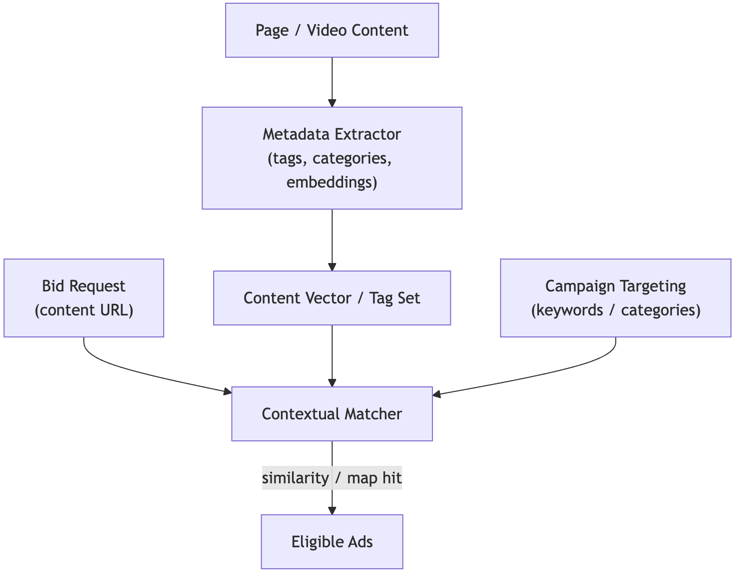
| Contextual targeting matches video and content metadata to relevant advertisements in real time, without relying on user-level data. Rather than targeting based on browsing history or demographic identifiers, the ad server analyzes the current content's attributes—genre, keywords, sentiment, topics—and selects creatives whose advertiser categories align with that context. This shift toward contextual relevance has become critical as privacy regulations (GDPR, COPPA, CCPA) restrict cookie and ID availability and as platforms like YouTube and connected TV increasingly emphasize first-party content signals. The technical challenge is significant: publishers send heterogeneous metadata (free-form text, structured tags, IPTV electronic program guides), while ad inventory numbers in the billions and creative category permutations in the millions. A modern contextual targeting engine must match content to ads in <50ms while maintaining inventory selectivity—too loose a match wastes impressions on irrelevant creatives, too strict and impression fill rates collapse. At scale (Hulu, ESPN, YouTube ad server), this means processing millions of content queries per second against billions of pre-indexed creative records, with hit rates and coverage KPIs that directly impact publisher revenue. Key technical challenges include: (1) semantic distance between free-form publisher tags and discrete ad category taxonomies; (2) real-time updates to both content metadata and creative eligibility; (3) maintaining consistency across multi-geography deployments where creative and inventory indexing may drift; (4) fallback and graceful degradation when sophisticated matching fails. Operational complexity also arises from debugging mismatches (why wasn't Ad X returned for Content Y?) and A/B testing hypothesis-driven changes to matching logic. Scale considerations are substantial: premium video publishers generate 5–10 million content metadata updates daily, each requiring re-indexing; a large ad network serves 100–500M contextual match queries per day per geography; embedding-based similarity search (if used) requires batch re-computation of creative embeddings weekly or on-demand for new creatives, consuming GPU hours. Latency SLAs are tight: RTB auctions allocate <100ms total; contextual matching must complete in 20–30ms to leave headroom for auction mechanics, creative rendering decision, and response serialization.
Key RequirementsFunctional Requirements
Non-Functional Requirements
Simplified Architecture
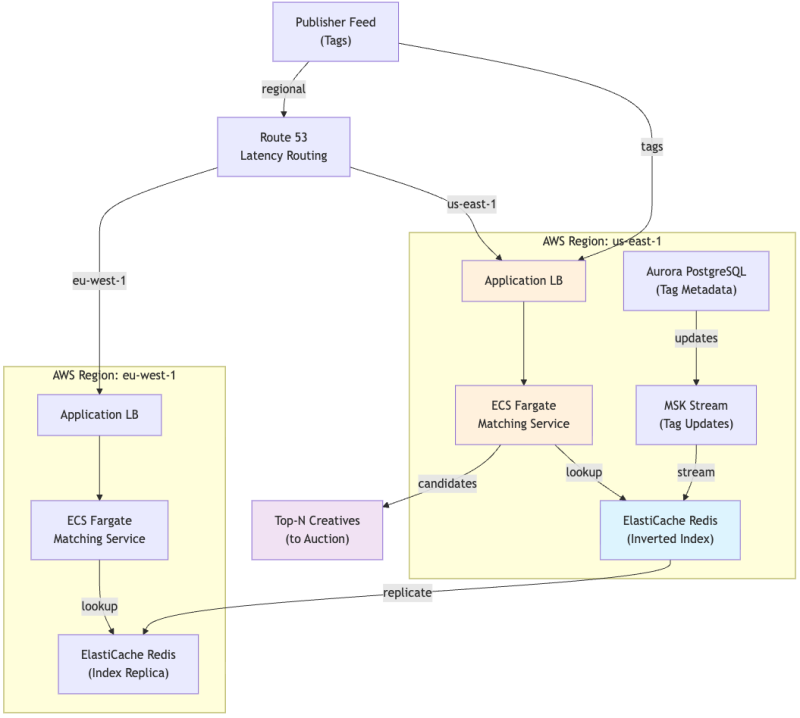
Architecture ProposalsOption 1: Tag-Based Mapping with Inverted IndexThis option treats contextual targeting as an exact-match retrieval problem. Publishers send discrete categorical tags (genre, keywords, content rating) as part of the content metadata; the ad server maintains an inverted index mapping each tag to eligible creatives that have declared affinity for that tag. At match time, the system performs set intersection over the tags present in the content, returning ads whose category constraints are satisfied. Implementation uses a read-optimized inverted index (similar to Lucene or Elasticsearch analyzers) held entirely in memory. On the ingestion path, when a creative is uploaded, an ops team member or algorithm assigns it category tags (e.g., "finance," "luxury," "tech"); these tags are stored as JSON documents in Amazon Aurora for PostgreSQL and also fanned out to the real-time index via Amazon MSK (Managed Streaming for Apache Kafka). The index is rebuilt daily in batch on Amazon EMR and updated incrementally via the stream. On the query path, the publisher sends content tags; the matcher (ECS Fargate behind an Application Load Balancer) performs set intersection with the pre-indexed creatives and returns eligible candidates. Results are cached in Amazon ElastiCache for Redis to reduce downstream load. Pros:
Cons:
Failure Modes & Mitigations:
When to Choose: Use this option for publishers with well-defined, stable content taxonomy (cable TV networks, ESPN+, traditional digital properties) and high editorial standards. Ideal when budget is constrained and you need predictable, maintainable matching without ML infrastructure.
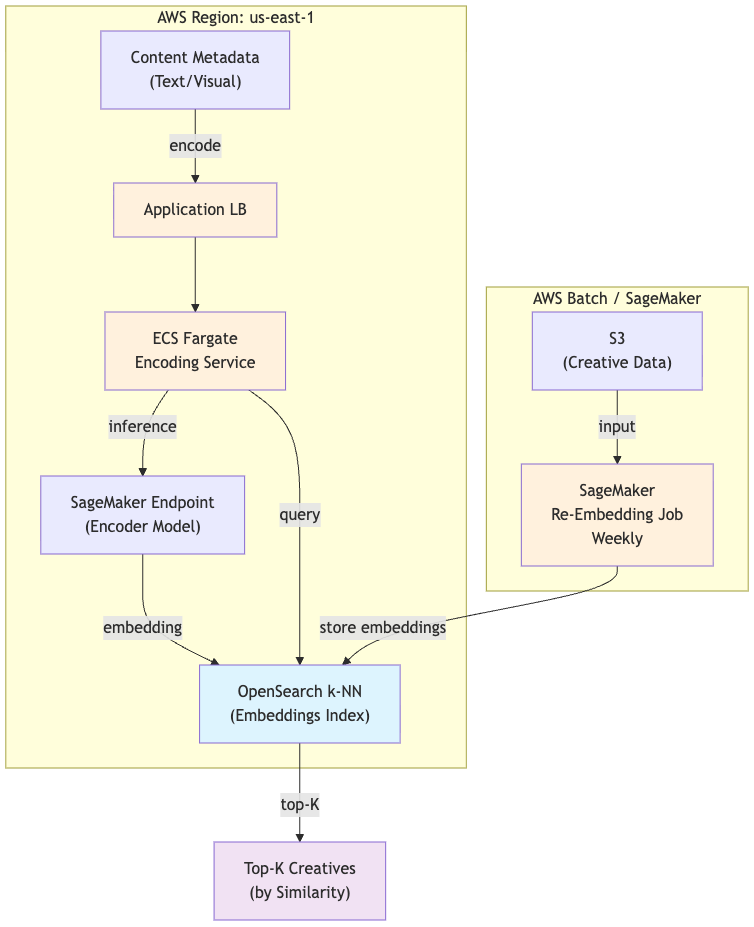
Option 2: Vector Embedding Similarity SearchThis option leverages pre-computed dense embeddings to match content to creatives based on semantic similarity rather than exact category alignment. Each creative is encoded into a high-dimensional embedding (e.g., 512-d via a BERT-style model or fine-tuned vision model for video creatives); content is similarly embedded at runtime or cached from recent ingest. The matcher then performs approximate nearest-neighbor (ANN) search—using Amazon OpenSearch Service with k-NN plugin or Aurora PostgreSQL with pgvector—to find the top-K creatives nearest in embedding space. This approach decouples matching from discrete taxonomy management. Instead of defining creative categories, you encode semantic understanding into the embeddings themselves. For video content, embeddings can be computed from script/description text, visual frames, or both via multi-modal models (CLIP, LLaVA). Creatives are embedded similarly. At query time, a lightweight query encoder runs in <10ms on ECS Fargate or SageMaker, and the ANN index returns relevant results in <20ms from ElastiCache or OpenSearch. Implementation uses a two-path system: (1) Batch re-embedding: Weekly or on-demand, recompute embeddings for all creatives (or new creatives) using AWS SageMaker for model inference or a GPU-accelerated ECS task; store in OpenSearch k-NN index with metadata. (2) Query-time encoding: Content embedding is generated either from real-time text inference via SageMaker endpoint or cached from content metadata if previously seen. (3) Index updates: New creatives are embedded and added to the OpenSearch index within 1–2 hours via async Lambda pipeline. Pros:
Cons:
Failure Modes & Mitigations:
When to Choose: Use this option for diverse, multi-genre publishers (Netflix, YouTube, TikTok) where manual taxonomy is infeasible, or where content semantics are novel/creative (user-generated content, indie creators). Also suitable if you have GPU infrastructure via SageMaker.
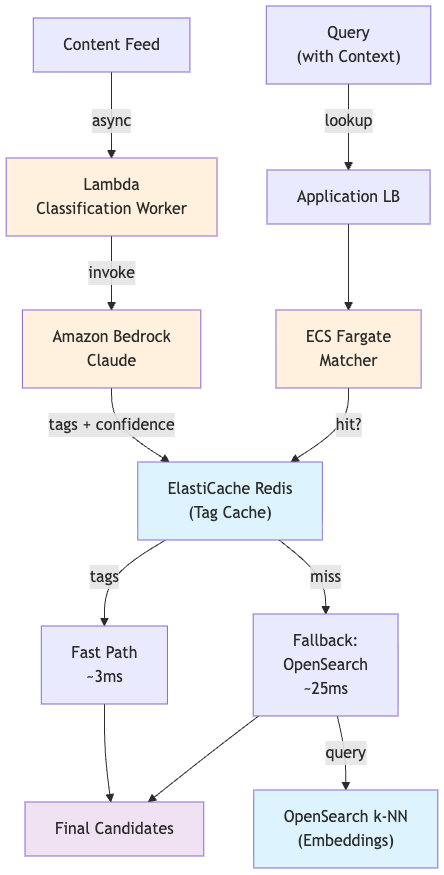
Option 3: Hybrid LLM Classification + Cached Tags with Embedding FallbackThis option combines the operational simplicity of tag-based matching with the semantic power of embeddings. At content ingestion time, an LLM (via Amazon Bedrock offering Claude, or fine-tuned on SageMaker) classifies the content offline into a normalized category set. These category predictions are cached in ElastiCache Redis (hot cache, 10M capacity) and Aurora PostgreSQL (cold store) and used for fast tag-based matching. For novel or edge-case content where confidence is low, or when tag-based match fails, the system falls back to embedding-based similarity search on a smaller candidate set from OpenSearch. Implementation: (1) Ingest-time classification: As publisher sends content metadata, an async worker (AWS Lambda or ECS) invokes Amazon Bedrock Claude API to generate category tags plus confidence scores. Tags are stored in ElastiCache (10M capacity) and Aurora for durability. (2) Query-time matching: ECS Fargate service looks up content in ElastiCache; if found with high confidence, use tag-based match (fast path, ~3ms). If tags are stale or missing, or if tag-based returns few results, invoke embedding search on the full creative index in OpenSearch (slower path, ~25ms). (3) Continuous retraining: Monthly, audit LLM classification quality by comparing predicted tags to human labels or CTR patterns; retrain via SageMaker if needed. Pros:
Cons:
Failure Modes & Mitigations:
When to Choose: Use this option if you have access to LLM inference infrastructure (Amazon Bedrock, SageMaker endpoints), operate a large multi-genre platform, and want to balance latency, operational clarity, and matching quality. Ideal for platforms with high content velocity and heterogeneous editorial standards (YouTube, Meta, TikTok).
Comparison Table
RecommendationStart with Option 1 (Tag-Based Inverted Index) if you are launching a new contextual platform or serving publishers with well-defined genres (cable, sports, news). It is the fastest to implement, requires minimal infrastructure, and provides a clear operational baseline. Invest in publisher dashboards that show tag utilization and offer taxonomy suggestions to increase recall. Transition to Option 3 (Hybrid LLM + Tags) once you reach 100M+ impressions/day and begin experiencing recall gaps (fill rate declining). At that scale, the operational complexity of managing both pathways becomes justified by the revenue impact (higher fill rate, better CPMs via relevance). Use Amazon Bedrock Claude for LLM inference to avoid API costs; monitor LLM accuracy via A/B testing (control: tags only; treatment: tags + embedding fallback). Adopt Option 2 (Embedding-Based) only if you are a large platform (YouTube, Netflix) with GPU infrastructure via SageMaker, high content diversity, and sophisticated ML teams capable of maintaining embedding models in production. The latency and operational cost are significant; justify it with 5–10% CTR improvements or demonstrable coverage gains over hybrid approach. For geographic scale, prioritize co-locating the index with the auction service in each region (Americas: us-east-1, EMEA: eu-west-1, APAC: ap-southeast-1) using Route 53 latency-based routing. Use eventual consistency: daily full index rebuilds on EMR with hourly incremental updates from MSK streams; temporary inconsistency is acceptable if <5 minutes old.
Capacity & Performance NotesInverted Index (Option 1):
Embedding Search (Option 2):
Hybrid (Option 3):
Scalability Boundaries:
| ||||||||||||||||||||||||||||||||||||
| | ||||||||||||||||||||||||||||||||||||
| |