Unwrapping VAST: Architecting for Low-Latency Video Ads
CK 3788 Created at Updated at
82300
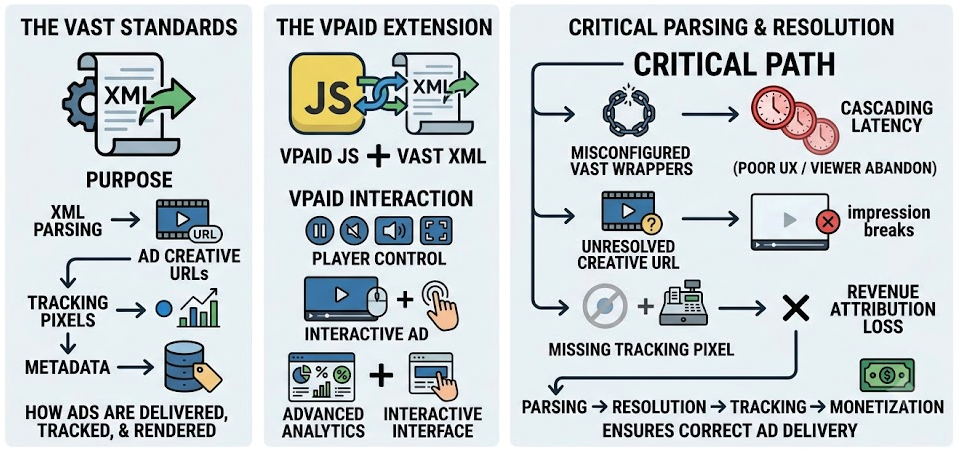
Video Advertising Serving Template (VAST) and Video Player-Ad Interface Definition (VPAID) are XML-based standards that describe how video ads are delivered, tracked, and rendered. VAST specifies the ad creative URLs, tracking pixels, and metadata; VPAID extends this with a JavaScript/Flash interface allowing the ad to interact with the player (pause, mute, fullscreen, analytics). Parsing and resolving VAST/VPAID documents correctly is critical for video monetization: a misconfigured VAST wrapper (ad that points to another ad that points to another ad) can cause cascading latency; an unresolved creative URL breaks impression delivery; a missing tracking pixel loses revenue attribution.
The technical challenge centers on latency. A typical RTB video bid response must include the VAST URL (<100ms total auction time). The player then fetches the VAST document and begins resolving wrappers—potentially 3–5 hops through intermediary ad networks before reaching the final creative. Each hop is a network round-trip; the player blocks video playback until the creative URL is fully resolved. At scale, this introduces human-noticeable lag: if each wrapper hop takes 500ms (DNS + TCP + request/response), five hops consume 2.5 seconds, causing viewers to abandon or seek. This is unacceptable.
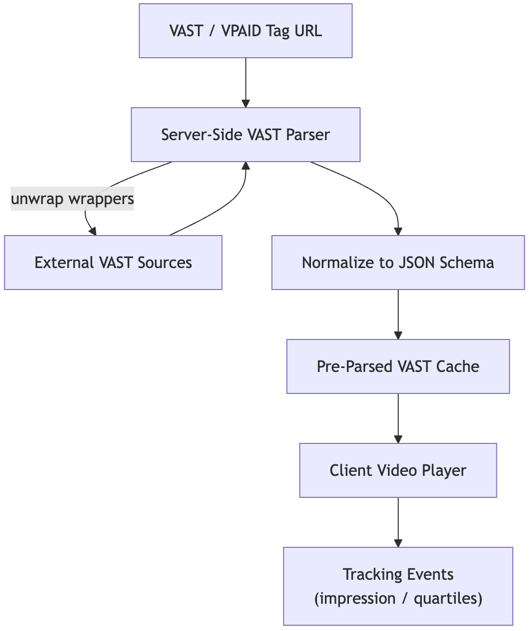
The solution is to move wrapper resolution from the player (client-side) to the ad network infrastructure (server-side), pre-parsing VAST documents and returning a normalized, fully-unwrapped ad to the player. This trades network latency (client perceives <50ms total time) for server-side parse CPU (cheap and batched). Further optimization pushes resolution to the edge (CloudFront/Lambda@Edge), warm-caching unwrapped ads so subsequent requests hit the cache.
A secondary concern is security and deprecation. VPAID (deprecated since 2019 in favor of OMID) introduced XSS risks and player compatibility nightmares; moving away from VPAID toward safer standards (Skippable Video (SIMID), Open Measurement Interface Definition (OMID)) requires careful coordination with creators and players. Any parsing architecture must support the migration path.
Key Requirements
Functional Requirements
Parse VAST XML documents (linear and non-linear ads) and resolve wrapper chains (<5 hops typical)
Extract creative URLs, impression tracking pixels, click-through URLs, and metadata
Support VAST versions 3.0, 4.0, and 4.1; handle non-standard variants gracefully (fallback to best-guess)
Return fully unwrapped ad creative URL ready for immediate playback (no further client-side resolution needed)
Cache unwrapped ads; serve from cache if source document unchanged
Support VPAID (legacy) with deprecation path; migrate to OMID/SIMID for new creatives
Validate ads against brand-safety policies (blocked advertiser, malware domains) before returning to player
Non-Functional Requirements
Latency: parse and resolve VAST document in <50ms (p99), including all wrapper hops
Throughput: 100k VAST parse requests/sec per geography
Availability: 99.95% uptime; graceful fallback if parser is unavailable (player falls back to client-side parsing)
Caching efficiency: 85%+ of parse requests hit cache (same creative, multiple impressions)
Security: no injection attacks via VAST (sanitize URLs, validate XML schema)
Data freshness: cache TTL 24 hours for stable creatives, 1 hour for experimental creatives
Correctness: 100% successful unwrapping for creatives in pre-approved catalog; <0.1% failure for user-generated ads
Simplified Architecture
Architecture Proposals
Option 1: Client-Side VAST Parsing in Player
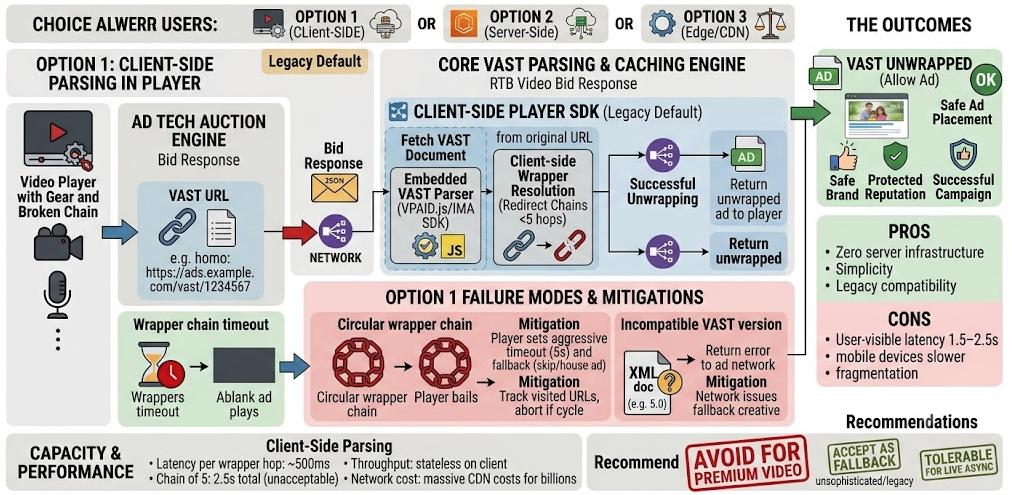
This is the legacy default and still widely deployed: the video player (running in the browser or on device) receives a VAST URL in the bid response, fetches the VAST document, resolves wrappers by following redirect chains, and plays the final creative. The parser logic is embedded in the player SDK (VPAID.js, Google IMA SDK, etc.).
Implementation is straightforward: publisher loads player SDK; SDK handles everything. No server-side infrastructure needed from the ad network. Bidding response simply returns a VAST URL (e.g., https://ads.example.com/vast/1234567).
Pros:
Zero server-side infrastructure: no parsing service, no cache to maintain
Simplicity: player code is self-contained; upgrades are independent of ad network backend
Decentralized: each player resolves independently; no single point of failure for ad network
Legacy compatibility: proven at scale since 2006; libraries (IMA, VPAID.js) are mature
No server latency: all latency is on the client side (already waiting for video to buffer)
Cons:
User-visible latency: each wrapper hop is a network round-trip visible to the player; 3–5 hops = 1.5–2.5 seconds of latency (unacceptable for premium video)
Inconsistent experiences: mobile devices may have slow networks, older players have slow parsing; same ad shows at different speeds on different clients
Debugging difficulty: when an ad fails, ad network cannot determine why (network issue? player bug? misconfigured VAST?)
Player fragmentation: different players (iOS AVPlayer, Android ExoPlayer, web HLS.js) implement VAST parsing differently; same ad might work on one platform, fail on another
VPAID risks: VPAID ads can crash the player or inject malicious content; no server-side validation opportunity
Failure Modes & Mitigations:
Wrapper chain timeout: Player waits 30 seconds for a creative to unwrap, gives up, blank ad plays. Mitigation: Player sets aggressive timeout (5 seconds) and fallback (serve house ad or skip impression).
Circular wrapper chain: Ad A → Ad B → Ad A → ... Player detects cycle and bails. Mitigation: Track visited URLs in wrapper resolution; abort if cycle detected.
Incompatible VAST: Creative uses VAST 5.0 (future) which this player doesn't support. Mitigation: Player returns an error to ad network; ad network issues a fallback creative in older VAST version.
When to Choose: Use this option only for low-priority video inventory (outstream, auto-play video on news sites) where sub-second latency is not critical, or for live streaming where wrapper resolution can happen async while content plays. Do not use for premium on-demand video, CTV, or mobile app environments where latency directly impacts user experience and viewability.
Option 2: Server-Side Pre-Parse with Normalized JSON Envelope
This option moves VAST parsing from the client to the ad network backend. Before sending a bid response, the auction service queries a VAST parser microservice with the creative VAST URL; the parser fetches and unwraps the document, extracts the final creative URL and metadata, and caches the result. The bid response then contains a lightweight JSON envelope (creative URL, impression tracking, metadata) instead of a VAST URL. The player receives a fully resolved, ready-to-play creative; zero client-side wrapper resolution needed.
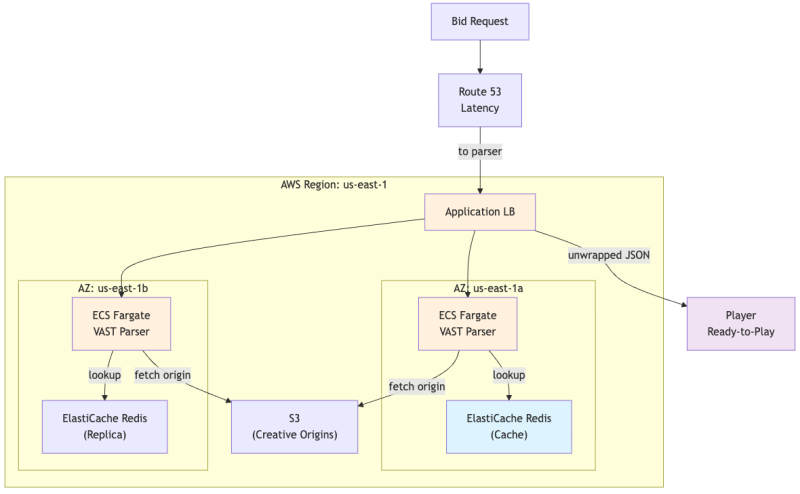
Implementation: VAST parser is a stateless service (ECS Fargate behind an Application Load Balancer) that receives a VAST URL, returns unwrapped creative data (JSON). It maintains a local cache (ElastiCache Redis) of previously parsed VASTs keyed on URL hash. Parser is called from the auction service during bid response construction; adds ~15ms latency but only once per creative (results cached). The parser also validates against brand-safety blocklists (via DynamoDB lookup) before returning. Errors and metrics stream to CloudWatch.
Pros:
Client-side latency eliminated: player receives unwrapped creative; immediate playback
Consistent experience: all players see the same creative URL; no device-dependent latency variance
Operational visibility: ad network logs all VAST parsing via CloudWatch; can debug failures, detect misconfigured creatives
Security: brand-safety validation happens server-side; can reject ads before they reach the player
Analytics: ad network can track which creatives parse correctly, which fail, and optimize accordingly
Future-proof: VPAID phased out on server side; clients never see deprecated VPAID ads
Cons:
Server-side latency added: auction service now calls VAST parser, adding 10–20ms to bid response time (tight <100ms RTB budget)
State management: parser must cache; cache invalidation becomes an operational burden (how long does a cached VAST stay valid? what if creative changes?)
Single point of failure: if parser service is down, auctions either time out or use stale cache; no graceful fallback
Wrapper resolution race condition: if wrapper A points to creative B, and creative B is updated mid-day, client may play stale creative from cache
Bidding complexity: not all bid responses include VAST parsing (e.g., guaranteed deals with pre-known creatives); inconsistent code paths
Failure Modes & Mitigations:
Parser timeout: VAST parser hangs on a slow external wrapper, auction times out. Mitigation: Set per-wrapper timeout (500ms); abort chain if exceeded; fallback to cache or house ad.
Cache stale creative: Creative updated at 2 PM but parser still serving 1 PM version until cache TTL expires. Mitigation: Use short TTL (15 minutes for new creatives, 24 hours for stable ones); provide manual cache invalidation API for ops (Lambda function).
Wrapper external dependency: Parser cannot reach external VAST wrapper (3rd party ad network down). Mitigation: Skip that wrapper, serve next in chain; if no unwrapped creative found, fallback gracefully.
When to Choose: Use this option for large-scale video publishers (YouTube, Netflix, Hulu) where client-side latency is a priority and you control the player SDK. Parser infrastructure cost is justified by improved UX (faster ad playback) and operational visibility. Requires commitment to managing parser uptime and cache consistency.
Option 3: Edge Prefetch with Warm Cache and Progressive Unwrapping
This option combines server-side parsing with edge (CDN/PoP) caching and progressive unwrapping for maximum speed. The ad network operates a global VAST parser fleet deployed at CDN edge locations (Amazon CloudFront + Lambda@Edge). When a player in Europe fetches a creative, it hits the European PoP, which has a warm cache of recently-parsed creatives. If the creative is in cache, the player gets instant response; if not, the edge parser fetches from origin and unwraps while caching for future requests.
Additionally, the system implements progressive unwrapping: instead of blocking on full wrapper resolution, the edge parser returns the first valid creative URL it encounters (even if wrappers hint at a "better" downstream creative), allowing playback to start immediately. Subsequent requests for the same creative hit cache; the system's background job (AWS Lambda scheduled via EventBridge) continues resolving deeper wrappers and updates the cache with final URLs.
Implementation: VAST parser code deployed to edge via Lambda@Edge or CloudFront Functions (lightweight, <50 KB). Parser caches at edge for 24 hours via CloudFront cache headers. On origin (ad network), an EventBridge-triggered Lambda continuously processes creative updates and pre-computes unwrapped VAST, pushing updates to edge cache proactively via CloudFront origin. For frequently accessed creatives, cache is pre-warmed and distributed to all PoPs via CloudFront invalidation API.
Pros:
Lowest possible latency: edge cache hit returns in <5ms (local), no origin hop
Global scalability: each PoP has local cache; no single origin parser becomes a bottleneck
Resilience: if origin is down, edge continues serving from cache; zero client impact
Progressive playback: players don't wait for full wrapper resolution; first creative plays immediately
Cost efficiency: cache hits consume minimal CPU; parser CPU only on cold-miss (10–15% of requests)
Future-ready: easy to swap VAST parser version at edge without redeploying origin
Cons:
Complex operational model: manage code on origin AND edge; deployment coordination required
Cache invalidation at scale: invalidating a creative on all edge nodes takes time; temporary inconsistency
Warm-cache dependency: system performance depends on cache hit rate; poor cache performance (e.g., long-tail creatives) reverts to slow origin parsing
Edge compute constraints: some VAST parsing logic may be too complex for Lambda@Edge runtime (code size <50 KB); must fall back to origin
Debugging difficulty: issues may manifest only at specific edge locations; hard to reproduce locally
Privacy concerns: cached creatives visible across regions; geolocation-specific creatives may leak
Failure Modes & Mitigations:
Cache stampede: Popular creative expires from cache, 1000 requests hit origin simultaneously. Mitigation: Use probabilistic early expiration (refresh cache at 80% TTL in background) to avoid thundering herd.
Edge divergence: Different PoPs have different cache versions of the same creative. Mitigation: Implement version tags in cache keys via CloudFront headers; use global cache layer (ElastiCache) as source of truth; edge serves from global layer on cold-miss.
Stale creative served indefinitely: Creative updated but edge cache never invalidates. Mitigation: Enforce maximum cache TTL (24 hours); push cache invalidation proactively from origin when creative is updated via CloudFront Purge API.
When to Choose: Use this option if you are a global CDN or operate video infrastructure in multiple regions (YouTube, Akamai, Cloudflare). Requires investment in edge compute infrastructure and cross-region cache management. Payoff is sub-10ms latency globally and massive scalability (billions of ads/day). For single-region publishers, Option 2 is sufficient.
Comparison Table
Aspect
Option 1: Client-Side
Option 2: Server-Side Pre-Parse
Option 3: Edge Prefetch + Warm Cache
Client-Side Latency
1.5–2.5s (wrapper hops)
<100ms (single response)
<10ms (cache hit) / <100ms (miss)
Server-Side Latency Added
None
+15ms (parse service)
+2ms (edge lookup)
Cache Hit Rate
N/A (no server cache)
70–85%
90%+ (edge + warm cache)
Throughput
N/A (client-side)
100k parse reqs/sec
1M+ edge lookups/sec
Infrastructure Cost
Low (none)
Medium (parser service + Redis)
High (CloudFront + global cache)
Operational Complexity
Low (player SDK only)
Medium (cache management)
High (edge deployment + sync)
Security/Brand Safety
Post-playback (too late)
Pre-playback (can block)
Pre-playback (can block)
Debugging
Hard (client logs opaque)
Easy (full audit trail in CloudWatch)
Medium (distributed logs)
VPAID Deprecation
Hard (clients may not upgrade)
Easy (server controls)
Easy (edge controls)
Scalability
Limited (client resource)
Medium (origin bottleneck)
Excellent (edge distributed)
Recommendation
Start with Option 2 (Server-Side Pre-Parse) if you operate a significant video platform (100M+ impressions/day) and want to improve user experience. The infrastructure investment is moderate (ECS Fargate + ElastiCache), and the latency improvement (1.5s → <100ms) directly impacts viewer satisfaction and completion rates. Deploy parser in 1–2 regions initially; expand to 3–5 regions once operational model stabilizes. Use CloudWatch for operational observability.
Migrate to Option 3 (Edge Prefetch) once you reach 1B+ impressions/day and operate globally. Edge compute becomes cost-effective at that scale; the 10x latency improvement (100ms → 10ms cache hits) justifies the operational complexity. Coordinate with Amazon CloudFront to co-deploy Lambda@Edge code; they provide scaffolding for custom logic.
Avoid Option 1 (Client-Side) for premium video. Accept it as a fallback for unsophisticated publishers or legacy players, but deprecate it as clients upgrade. For live-streaming scenarios where wrapper resolution can happen async, Option 1 is tolerable.
Key operational practices:
Maintain a blocklist of known-bad VAST URLs and wrapper patterns; reject before parsing (stored in DynamoDB)
Version your VAST parser; track which version parsed each creative (via CloudWatch metrics)
Monitor parse latency by version and creative type (multi-wrapper chains vs. single-hop); alert via CloudWatch if trending upward
Implement cache-aside pattern: parser checks cache first; on miss, fetches from origin and populates cache
For cache invalidation, use time-based TTL (24 hours default) plus manual purge API (Lambda) for ops