Ad Tech Edge Architectures: Reducing Latency and Offloading Work - Edge Computing
CK 3788 Created at Updated at
33600
Modern ad exchanges serve users globally; a request originating in Tokyo takes 150–300 ms to reach a data center in us-east-1 and back. By the time the ad server evaluates targeting criteria, calls DSPs, and renders the decision, the user-facing latency budget (often 100–200 ms) is exhausted. Edge computing moves computation closer to users—at CloudFront edge locations (600+ global POPs), regional PoPs with ECS clusters, or client-side via Lambda@Edge—to reduce latency and offload work from the central auction engine.
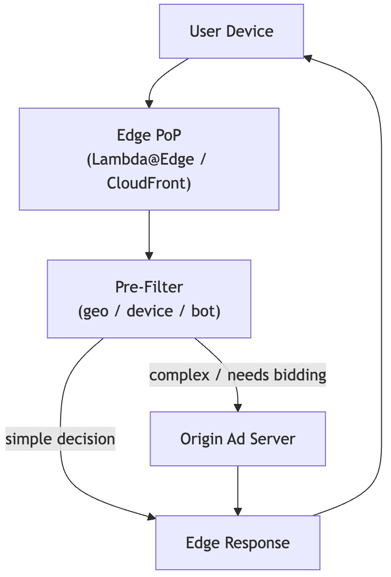
In ad tech, edge decisions are coarse: pre-filter impressions by country, device type, audience segment, or browser attributes (collected from bid request headers). Fine-grained auction logic (real-time bidding, pacing, creative selection) remains in the central engine. This two-stage model reduces central load by 30–50% and improves user-facing latency by 50–100 ms.
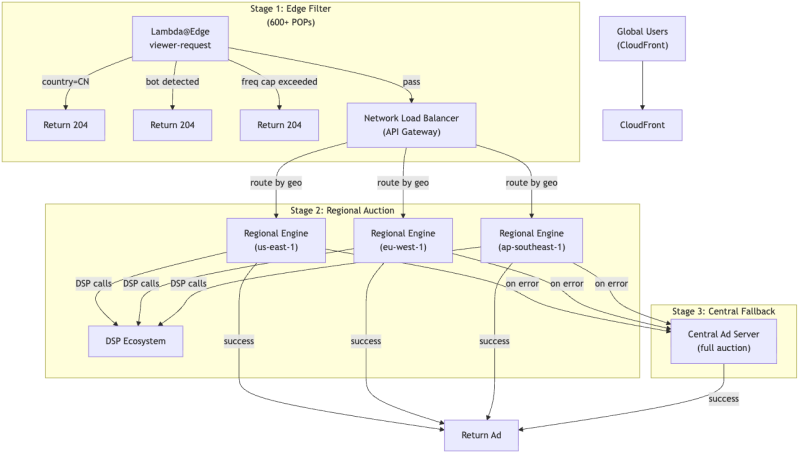
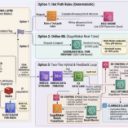
Three architectures scale edge decisions: simple header-based filtering at CloudFront edge (CloudFront Functions or Lambda@Edge), distributed regional micro-engines with replicated campaign data (ECS Fargate in 4–6 AWS regions), and hierarchical decision-making (Lambda@Edge pre-filter + regional ECS auction + central fallback).
Key Requirements
Functional Requirements
Fast edge decision: Decide pass/filter within 10–50 ms; don't reintroduce latency.
Campaign data freshness: Edge must have up-to-date campaign criteria (targeting rules, budgets, creative assets) or risk serving stale ads. Freshness SLO: < 5 minutes staleness.
Consistent filtering: A user in country X must see consistent filtering logic whether the request hits CloudFront edge in Frankfurt or Tokyo; no divergence in what's considered "eligible."
Graceful fallback: If edge data is stale or unavailable, fall through to central engine rather than filtering prematurely.
Revenue preservation: Edge filtering must not accidentally drop high-value impressions; be conservative in rejection logic.
Non-Functional Requirements
Minimal infrastructure overhead: Edge functions (CloudFront Functions, Lambda@Edge) are serverless and stateless; no new service to operate.
Sub-100 MB memory footprint: CloudFront Functions have memory limits (10 KB); Lambda@Edge has 128–512 MB; campaign data must be compact or cached in S3 / ElastiCache.
Data replication latency < 2 seconds: When campaign changes in central system, replicate to edge within 2 seconds so filtering rules reflect intent.
Graceful degradation: If edge data replication fails, edge should serve all traffic (no filtering) rather than blocking or erroring.
Simplified Architecture
Architecture Proposals
Option 1: CloudFront Edge Function (Lambda@Edge / CloudFront Functions)
Description
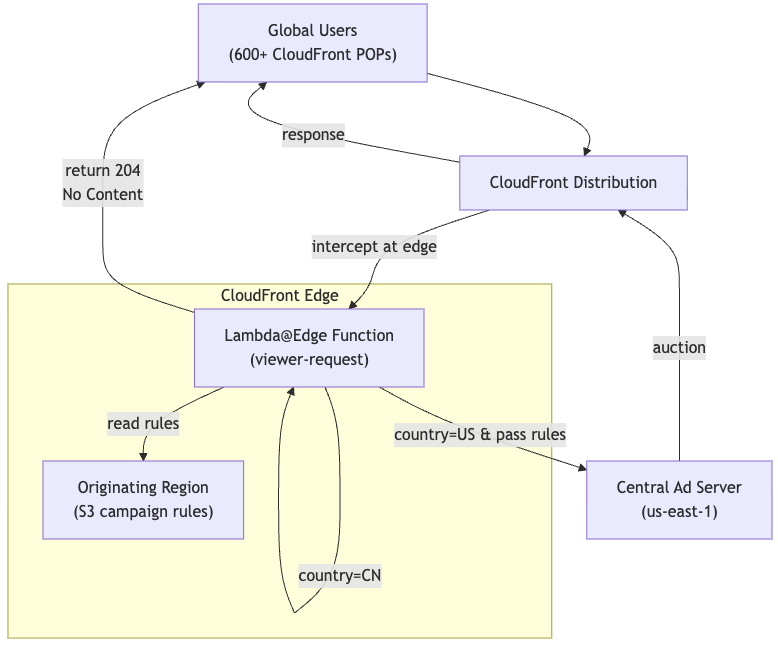
Deploy a serverless function at CloudFront edge that intercepts each request at 600+ global POPs. The function reads request headers (User-Agent, country via CloudFront geolocation headers), evaluates simple rules (block if country not in allow-list, block if user has frequency cap, pass otherwise), and either returns early with a filtered response or forwards to the origin (central ad server). Campaign rules are embedded in the function code or fetched from CloudFront origin access (campaign data cached in S3 or ElastiCache).
For example:
If country = "CN", return empty response (ads not served in China).
If User-Agent contains "bot", return empty response.
If header "X-User-Frequency" > 5, return passthrough response (let central engine decide).
Otherwise, forward to central ad server.
Pros
Near-zero latency: Filtering happens at edge, ~ 5–10 ms additional latency vs. direct central call.
Zero operational overhead: AWS CloudFront provider manages infrastructure; no new servers to run.
Global reach: Edge functions run at 600+ POPs worldwide; filtering is applied closest to the user.
Simple to deploy: Update function code or S3 campaign rules without rolling out application; decoupled from ad server releases.
Cost-efficient: Filtering at edge offloads work from central servers; fewer central auctions reduce compute costs.
Cons
Limited expressiveness: Lambda@Edge has memory/CPU limits; only simple rules (country, bot detection, frequency cap check) are practical. Complex targeting (look up user in a graph database, evaluate contextual rules) requires central logic.
Campaign data refresh lag: Updating rules in S3 and propagating to all CloudFront POPs takes seconds to minutes; brief window where filtering is inconsistent.
Debugging and testing overhead: Edge functions are harder to test and debug than central services; requires staging CloudFront distribution or careful production testing.
AWS vendor lock-in: Lambda@Edge differs from CloudFront Functions; both require AWS. Different CDN (Cloudflare) would require rewriting.
Failure Modes & Mitigations
S3 campaign data unavailable: If S3 fetch fails, function either uses cached data or falls back to default (allow all). Mitigate by caching rules in Lambda@Edge memory for 5 seconds, and setting S3 object versioning + TTL.
Over-aggressive filtering: If rules are misconfigured (e.g., accidentally block all US traffic), impressions are silently dropped. Mitigate by canary: apply new filter rules to 5% of edge traffic (via CloudFront weighted routing or traffic shifting) before 100% rollout, monitor CPM drop.
When to Choose
Choose this option if you want the simplest edge setup: filter by country, bot detection, frequency caps only. Suitable for early-stage deployments or secondary ad networks where targeting is coarse. CloudFront + Lambda@Edge is the default for AWS-based ad servers.
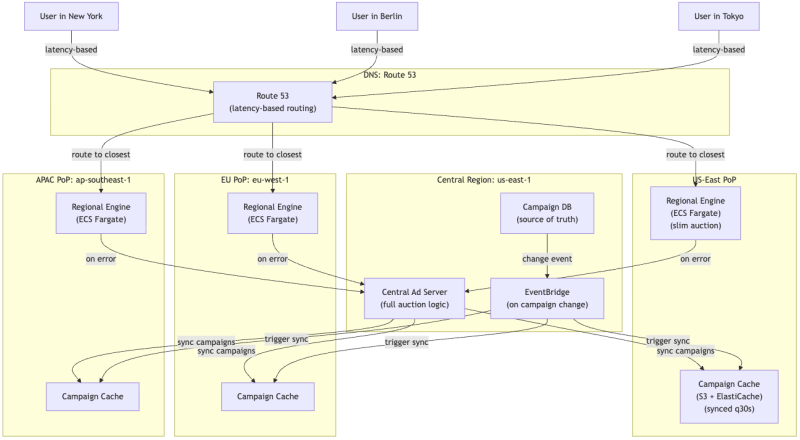
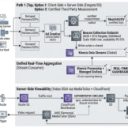
Distribute slim ad-decision engines to regional hubs (us-east-1, us-west-2, eu-west-1, ap-southeast-1, etc.). Each regional engine has the same campaign data as the central engine (synced every 30 seconds via EventBridge + S3) and can make full auction decisions without calling the central engine. A request is routed to the nearest regional engine based on Route 53 latency-based routing; the regional engine performs the auction and returns the ad. Central engine is a fallback for regional engine failures.
Regional engines run lighter-weight versions of the central auction logic: reduced DSP call concurrency, in-memory campaign cache (no database calls), simplified reporting (batch to central for analytics).
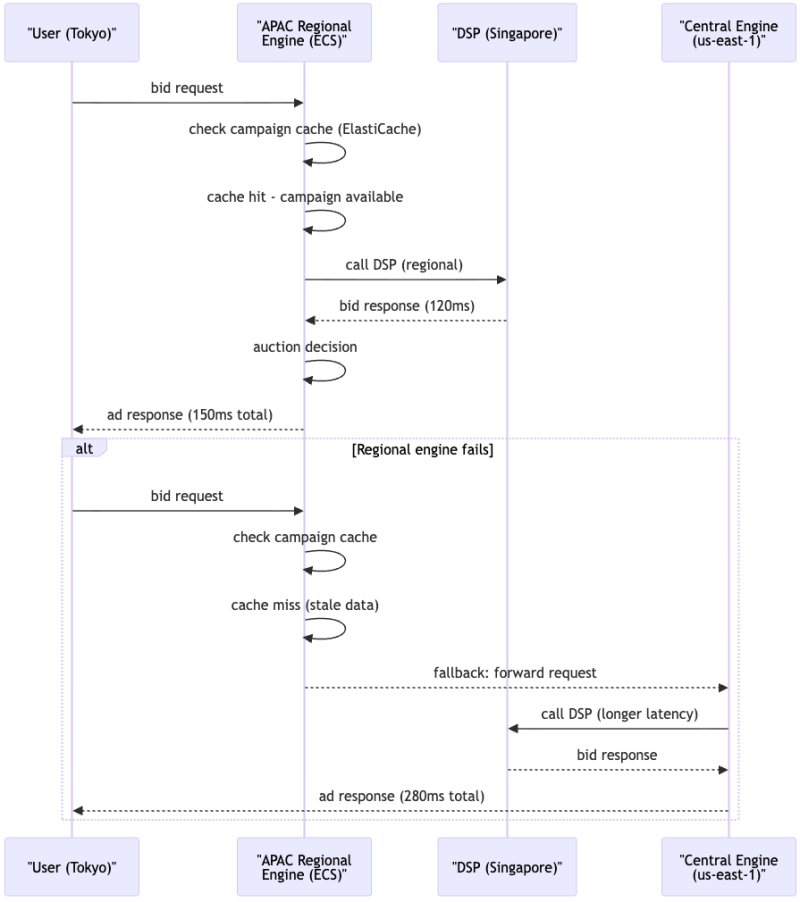
Sequence for regional auction with fallback
Pros
Significant latency reduction: Nearby regional engines reduce round-trip latency from 150–300 ms (central) to 100–150 ms (regional).
Load distribution: DSP calls are made from regional engines, reducing load on central ad server by 60–80%.
Graceful fallback: If regional engine is down, request falls back to central; no lost impressions.
Flexible tuning: Each region can tune concurrency, timeout, DSP selection independently.
Revenue preservation: Full auction logic (pacing, budget, creative selection) runs regionally; no coarse pre-filtering errors.
Cons
Campaign data sync complexity: Keeping regional caches in sync with central DB (target: < 30 sec staleness) requires messaging infrastructure (EventBridge, SNS) and careful conflict resolution.
Operational overhead: Deploying and maintaining N regional engines (N = 4–6 regions) increases operational burden; more ECS services to monitor, patch, and scale.
Double the bugs: Each region runs the same auction logic; bugs in campaign evaluation or pacing must be fixed in all regions.
State inconsistency: If pacing happens regionally, a user might see different bid prices in different regions due to cached pacing state being slightly stale.
Failure Modes & Mitigations
Campaign cache stale: If sync pipeline breaks, regional engines serve outdated rules. Mitigate by aging out old campaigns: after 2 hours without a sync update, filter out campaigns to reduce false positives.
Deadlock in region failover: If central engine becomes bottleneck during cascading regional failures (all regions down, all fallback to central), central gets overloaded. Mitigate by rate-limiting fallback traffic: if fallback requests > 20% of normal central load, shed excess.
When to Choose
Choose this option if you have a global user base and latency is a primary concern. Suitable for large ad exchanges (> 1 billion impressions/day) where latency reduction translates to higher CTR and revenue. Requires investment in replication infrastructure and regional operations.
Combine Options 1 and 2: Lambda@Edge performs coarse filtering (country, bot, frequency cap), reducing candidate set by 30–50%. Regional ECS engines run fine-grained auction on the reduced set (pacing, budget, creative selection). Central engine is the fallback and also runs full auction for requests that bypass edge (e.g., direct API calls).
Pros
Best of both worlds: Lambda@Edge provides massive load shedding (30–50% of requests filtered), regional engines handle fine-grained logic, central handles failures.
High availability: Three layers of fallback; only a fraction of traffic hits central during failures.
Latency optimization: Most requests complete at edge (30–50 ms) or regional (100–150 ms); only failures escalate to central (250–300 ms).
Simple edge logic: Edge rules are easy to understand and test; regional/central logic is standard auction code.
Cons
Operational complexity: Three layers to maintain, sync, and monitor. Debugging production issues requires understanding data flow across all three stages.
Filtering inconsistency risk: If Lambda@Edge filters out a campaign but regional engine expects to find it, inconsistency can cause auctions to fail. Requires careful testing of filtering + auction stages.
Cascade failure: If edge filters wrongly (blocks high-value inventory), revenue loss cascades across all affected regions.
Failure Modes & Mitigations
Edge filtering too aggressive: Accidentally block 50% of requests due to misconfigured rule. Mitigate by canary: apply new filter rules to 5% of CloudFront requests (via weighted routing), monitor fill rate drop. If > 2% drop, roll back.
Regional cache stale, edge filter passes invalid requests: Lambda@Edge passes a request for campaign X (in cache), but regional cache is stale and doesn't have campaign X. Regional engine ignores it, falls back to central. Mitigate by ensuring regional cache TTL matches edge filter update frequency (both < 5 minutes).
When to Choose
Choose this option if you have global users, high traffic (> 1 billion impressions/day), and want to maximize latency reduction while keeping edge logic simple. Standard for large ad exchanges with mature operations. Requires replication infrastructure and multi-layer monitoring.
Comparison Table
Aspect
Lambda@Edge
Regional PoPs (ECS)
Two-Stage Hierarchical
User-facing latency (p99)
100–150 ms
100–150 ms
80–120 ms (most at edge)
Central server load reduction
30–50% (pre-filtering)
60–80% (full auction regional)
70–90% (edge + regional)
Campaign targeting expressiveness
Low (country, bot, frequency)
High (full auction logic)
Medium (edge: coarse, regional: fine)
Operational complexity
Low (CDN-managed)
High (run N regional ECS clusters)
Very High (3 layers)
Campaign data sync overhead
Low (S3 rules cache)
High (full sync every 30s via EventBridge)
High (edge rules + regional cache)
Debuggability
Fair (limited edge runtime)
Good (standard ECS service logic)
Challenging (multi-layer tracing)
Revenue preservation
Medium (aggressive filtering risk)
High (full auction logic)
High (multi-stage filtering)
MTTR on bugs
Hours (redeploy Lambda@Edge)
Minutes (scale down bad region, restart ECS)
Minutes (roll back edge rules)
Recommendation
For most ad tech platforms, choose Option 2 (Regional Ad-Decision PoPs with ECS Fargate) if you have global traffic and 7-figure operational budget. Here's why:
Simplicity vs. complexity trade-off: One layer of regional logic is easier to understand than edge functions + regional + central fallback.
Revenue-safe: Regional engines run full auction logic; no risk of accidentally filtering high-value impressions.
Operationally familiar: Regional engines are full ad servers; your team already understands the code, logging, and debugging.
Effective latency gains: Regional engines reduce user-facing latency by 100–150 ms, which translates to 3–5% CTR improvement.
Use Option 1 (Lambda@Edge) only for simple filtering:
You want to block entire countries (geo-blocking).
You want to detect and drop bots early.
You have existing CloudFront distribution with Lambda@Edge infrastructure.
Adopt Option 3 (Two-Stage) if:
Your edge has complex targeting rules (> 10 conditions).
Your regional engines are under CPU pressure and need load shedding.
After 3 months of stable operation, add Option 1 (Lambda@Edge filtering) for additional load shedding.
Progressively move more logic to edge as rules mature and testing hardens.
Capacity & Performance Notes
Assume 10 billion impressions/day globally, distributed across time zones:
US: 40% (4B/day = 46k req/s avg, 70k peak)
EU: 30% (3B/day = 35k req/s avg, 52k peak)
APAC: 20% (2B/day = 23k req/s avg, 35k peak)
Other: 10% (1B/day = 11.5k req/s avg, 17k peak)
Option 1 (Lambda@Edge) overhead: 10–20% of CloudFront request volume. At 10B impressions, assume 2B hit edge (20%); processing each request costs ~0.1 ms CPU + S3 fetch (10 ms cached, 100 ms on miss). Total cost: negligible for CloudFront / Lambda@Edge (pay per 0.6M requests, ~$0.60 per 1M requests).
Option 2 (Regional PoPs): 4 regions, each handling 25% of global traffic in aggregate (with locality skew). us-east-1 handles 46k req/s peak. Assume each regional engine (ECS Fargate) can handle 10k req/s (slightly lighter than central). Cluster size per region: 5 tasks (10k / 2k per task). Total: 20 regional tasks across 4 regions (4 VCPUs, 8 GB RAM each).
Campaign data sync for regional engines: 10,000 active campaigns, each ~5 KB of targeting rules/budget state. Sync message: ~50 MB per update. Update frequency: every 30 seconds or on campaign change (batch changes, send every 5 seconds). Network cost: 50 MB / 60 sec = 833 KB/s per region; negligible on inter-region links (high-speed AWS backbone).
Central engine fallback overhead: During normal operation, 5% of traffic falls back to central (regional engine failures, DSP timeouts). At 10B impressions/day, central handles 500M fallback requests/day = 5.8k req/s. Sized for 2 tasks (2.9k req/s each) as baseline, with autoscaling to 10 tasks during cascading failures.
Lambda@Edge latency budget: Total latency 100–150 ms includes: network to edge (10–30 ms), edge processing (5–20 ms), network to regional engine (20–40 ms), regional processing (40–80 ms), network back to user (20–40 ms). With edge filtering, median latency becomes 80 ms (30 ms saved by pre-filtering + off-loading to region).