AI-Powered Ad Fraud Detection: Architectural Strategies
CK 3788 Created at Updated at
33500
Ad fraud—invalid clicks, bot traffic, viewability spoofing, and impression laundering—consumes 5–15% of programmatic ad spend annually, costing the industry billions in wasted budget. Real-time detection is critical because fraud signals compound: a single bot network can generate millions of fake impressions, inflate CTR metrics, and poison attribution models. Effective fraud detection must balance precision (avoid blocking legitimate users) with recall (catch sophisticated attacks), operate within RTB latency budgets (100–150 ms), and adapt as attackers evolve.
The detection challenge spans multiple dimensions: IP reputation (known bot farms, datacenter IPs, VPN/proxy abuse), click pattern anomalies (inhuman speed, clustering, identical user agents), mouse movement biometrics (absence of realistic motion), device fingerprinting inconsistencies, and behavioral signals (repeat click from same user within seconds, zero site engagement). Post-hoc analysis—batch clawback, billing adjustments, feedback loops—complements real-time filtering, allowing heavy ML models to refine rules and catch sophisticated fraud that evades initial detection.
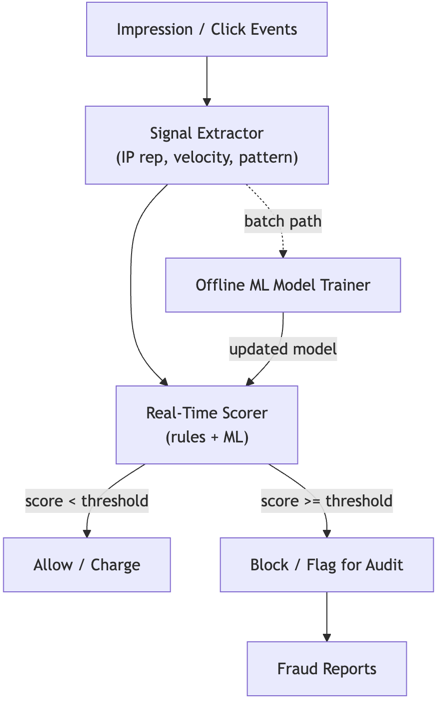
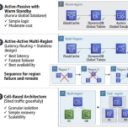
This case explores three architectural approaches: lightweight rule engines with IP feeds via ElastiCache (deterministic, sub-millisecond overhead, limited adaptability), online ML scoring at serve time via SageMaker real-time endpoints (responsive to evolving fraud patterns, respects RTB latency, moderate infrastructure cost), and a two-tier hybrid combining cheap rules in the hot path with heavy batch ML and automated feedback loops (balances cost and accuracy, enables continuous improvement).
Key Requirements
Functional Requirements
Real-time detection: Flag fraud candidates within RTB serving latency (target: <5 ms overhead per impression).
Multi-signal correlation: Integrate IP reputation, click patterns, device signals, and behavioral anomalies into a unified decision.
Adaptive feedback: Capture ground-truth fraud labels post-hoc (user reports, viewability failure, engagement metrics) and retrain models weekly or daily.
Configurable thresholds: Allow campaigns to tune false-positive tolerance (e.g., stricter for brand-safe advertisers, looser for performance campaigns).
Billing adjustments: Identify fraudulent impressions retrospectively and reconcile publisher and advertiser invoices.
Alert & escalation: Notify security team when fraud rate exceeds baseline (e.g., >2% invalid traffic for a publisher).
Whitelist/exception handling: Support trusted partners, internal IP ranges, and regression testing without triggering fraud flags.
Non-Functional Requirements
Latency: <10 ms p99 for fraud scoring in the critical serving path.
Throughput: Handle 500K–2M impressions/sec (depending on scale) with <1% detection overhead.
Availability: 99.95% uptime; fall back to conservative rules if ML service degrades.
Cost efficiency: Rules-based baseline ~$500/month (IP feed + compute); ML baseline ~$5K–15K/month (inference + data storage).
Consistency: Reproducible scoring; same impression should receive same fraud score if re-evaluated.
Auditability: Log all fraud signals and decisions for compliance audits (FTC, publisher SLA reviews).
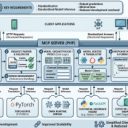
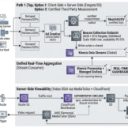
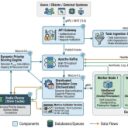
Simplified Architecture
Architecture Proposals
Option 1: Rule Engine + IP Reputation Feed via ElastiCache
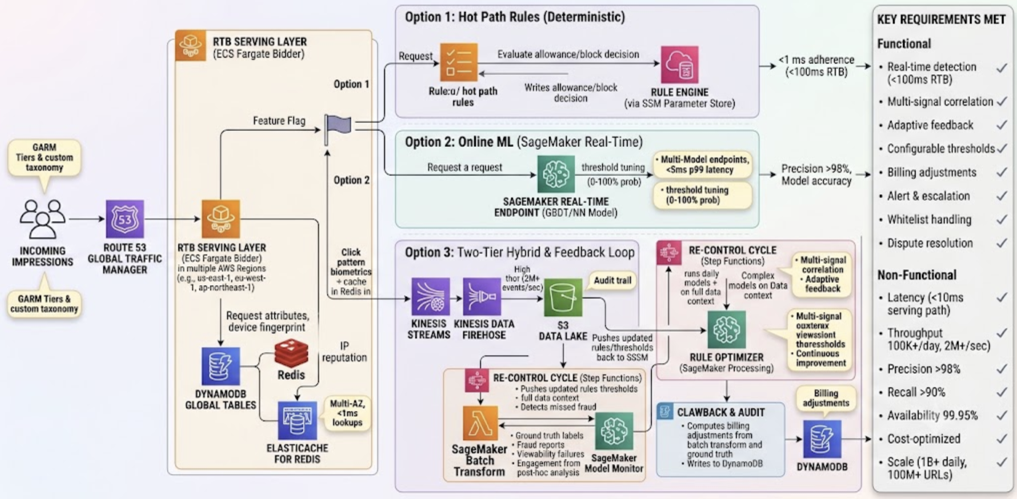
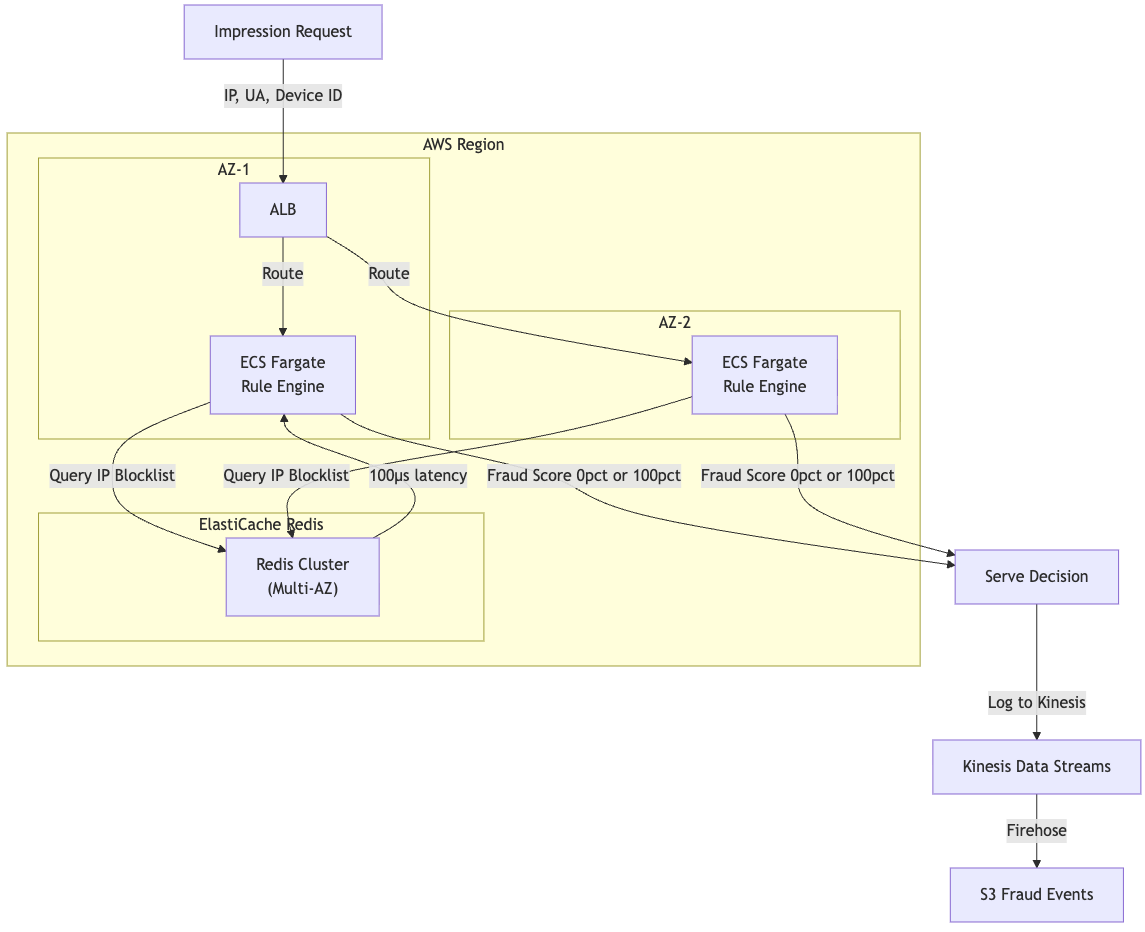
Description: A deterministic, policy-based classifier that runs at impressions serve time on ECS Fargate. Incoming impressions are evaluated against rules checking IP reputation (blocklists, VPN detection, datacenter ASNs), click velocity (clicks-per-session, inter-click timing), device consistency, and user-agent parsing. IP reputation is sourced from external feeds (MaxMind GeoIP2, Akamai) updated daily and cached in Amazon ElastiCache for Redis (10 GB cluster across two availability zones). Rules engine consults Redis for IP lists at <100 μs latency; rules are updated weekly by analyst team via AWS Systems Manager Parameter Store. Decisions are binary (block or allow) with no probabilistic scoring.
Pros:
Extremely fast: <1 ms per impression; no model inference overhead.
Fully deterministic: same input always produces same output (audit-friendly).
Low operational cost: static configuration via Systems Manager Parameter Store, minimal compute (ECS Fargate auto-scales from 2–10 tasks).
Transparent to stakeholders: rule logic is human-readable and explainable.
Offline update cycle: no downtime during rule deployments; use blue-green deployment.
Limited adaptability: fraud patterns evolve daily, but rules update weekly or slower.
High false-positive risk: legitimate users behind shared corporate IPs or VPNs get blocked.
No probabilistic confidence: hard to tune trade-offs between precision/recall without adding complexity.
Requires external feeds: IP reputation quality depends on third-party vendors (cost, freshness lag).
Limited pattern discovery: rules are manually coded; subtle multi-signal patterns are hard to capture.
Failure Modes & Mitigations:
IP feed staleness: Attacker rotates IP, evades blocklist for 12–24 h. Mitigation: use multiple vendor feeds refreshed to Redis daily via Lambda; set Redis TTL to 4 hours for each entry.
Residential proxy abuse: Attacker uses residential proxy networks (appear as home ISPs). Mitigation: integrate residential proxy detection via third-party API, store results in DynamoDB with 24-hour TTL for quick lookup.
Overly aggressive rules: Block legitimate traffic from corporate/university networks. Mitigation: whitelist high-volume legitimate ASNs in Systems Manager, allow advertiser exceptions via DynamoDB whitelist table.
When to Choose:
Starting point for fraud prevention; acceptable baseline cost and latency.
Publishers with <100K impressions/sec where uptime and simplicity matter more than sophistication.
Campaigns that tolerate 5–10% fraud loss if it avoids false positives blocking real users.
Option 2: Online ML Scoring via SageMaker Real-Time Endpoint
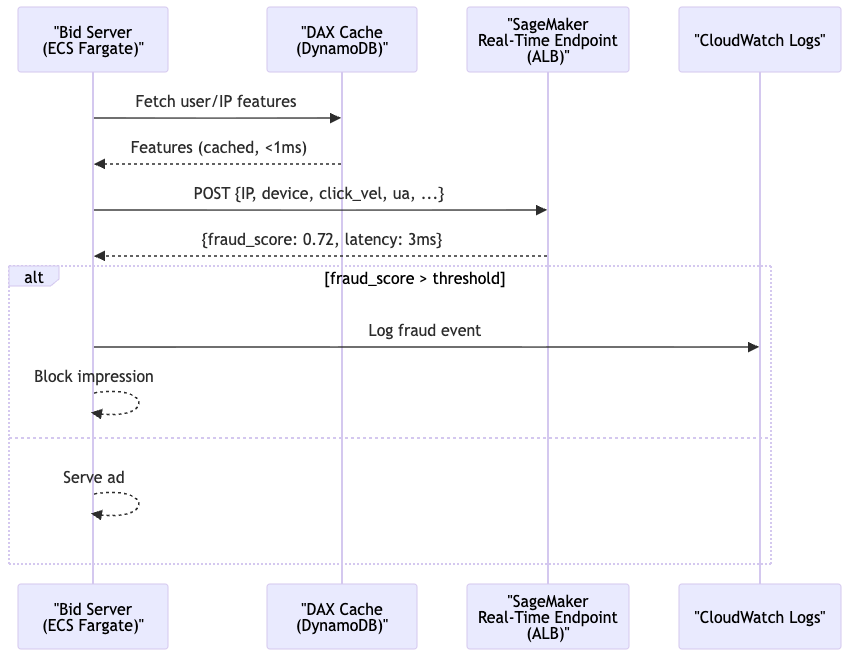
Description: A lightweight ML model (Gradient Boosted Decision Tree or shallow neural network) is deployed as a SageMaker real-time endpoint behind an Application Load Balancer (ALB). The bidder ECS Fargate service queries the endpoint during impression serving. The model ingests features: IP reputation score, click velocity percentile, device fingerprint entropy, session length, engagement proxy (scroll depth or click-to-serve ratio from prior events), and behavioral signals (user entropy, geographic consistency). Features are cached in DynamoDB with DAX (DynamoDB Accelerator) for sub-millisecond reads. The model returns a fraud probability (0–100%) in real time; the serving logic applies a threshold (e.g., >80% → block) with campaign-level tuning. Model is retrained daily on ground-truth labels (fraud confirmed via post-hoc analysis) using SageMaker Pipelines.
Pros:
Responsive to evolving patterns: daily retraining via SageMaker Pipelines captures new attack vectors.
Cold-start problem: new IP or device has no history; model must gracefully degrade or use priors.
Explainability challenge: GBDT/NN outputs are harder to audit than rule logic; regulatory scrutiny possible.
Failure Modes & Mitigations:
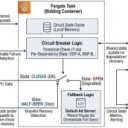
Model latency tail: SageMaker endpoint p99 latency spikes to 50 ms, breaks RTB timing. Mitigation: configure ALB timeout (5 ms), fall back to rules if timeout triggers; use SageMaker endpoint autoscaling policy to scale on latency (p99 > 10 ms triggers scale-up).
Data drift: Attacker changes tactics; model accuracy drops 10%. Mitigation: CloudWatch dashboard monitors fraud rate weekly; trigger SageMaker retraining job if AUC drops >2%; implement automated drift detection via SageMaker Model Monitor.
Feature availability: Feature store (DynamoDB) is slow or down. Mitigation: cache frequently accessed features in DAX with 5-minute TTL; pre-compute session aggregates hourly via Lambda; use fallback static features if DAX is unavailable.
When to Choose:
Mid-to-large scale (>500K impressions/sec) where sub-5 ms latency is achievable.
Publishers willing to invest in ML infrastructure for 20–30% fraud detection lift over rules.
Cases requiring transparency into fraud confidence (e.g., for publisher negotiation, SLA clauses).
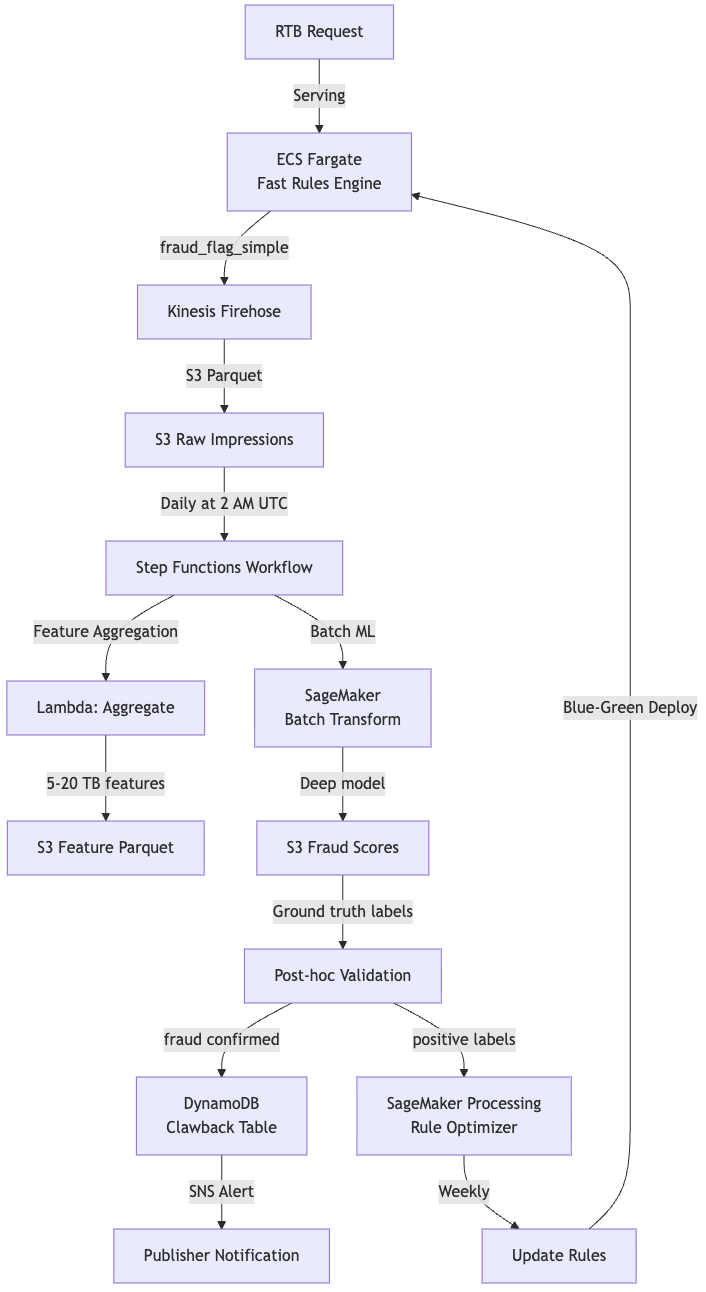
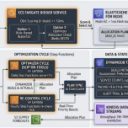
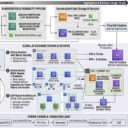
Description: Fast, cheap rules run in the hot path (serve time via ECS Fargate + ElastiCache), catching obvious fraud (known bad IPs, bot signatures). All impressions are logged with their rule-based decision and features to Kinesis Data Streams, then persisted to S3 via Kinesis Firehose. Nightly, a batch ML pipeline processes the previous day's impressions using AWS Step Functions: a SageMaker batch transform job runs an expensive model (deep neural network, gradient boosting with extensive feature engineering, ensemble) over the full dataset stored in S3. The batch model identifies fraud the rules missed and learns from post-hoc ground truth (user reports, engagement metrics, retargeting failures) captured in DynamoDB. Fraud labels from batch analysis feed into an automated rule optimizer (SageMaker Processing job) that tunes thresholds and adds new rules weekly. High-confidence fraud from batch is stored in a DynamoDB "clawback" table, triggering billing adjustments and publisher notifications via SNS.
Pros:
Cost optimized: simple rules in hot path (<1 ms); expensive ML runs offline (amortized cost).
Precision improved: batch model has full session context, can detect subtle patterns (e.g., coordinated multi-IP fraud rings).
Billing reconciliation built-in: clawback process automated; DynamoDB tracks all clawback events; SNS alerts publishers.
Continuous learning: feedback loop from ground truth (engagement, retargeting success) improves model without manual labeling.
Graceful degradation: if batch pipeline is slow, real-time decisions are unaffected; batch results are advisory (inform next cycle's rules).
Explainability: rules remain human-readable; batch model provides confidence and reasoning for audits; SageMaker Clarify provides SHAP explanations.
Cons:
Operational complexity: three pipelines (serving rules via ECS, batch model via SageMaker, rule optimizer via Lambda/SageMaker) to maintain and monitor.
Clawback latency: fraud is detected and reconciled 24–48 h after occurrence; attackers can exploit the lag.
Label bias: post-hoc ground truth may be incomplete (users don't report all fraud) or noisy.
Feature engineering overhead: requires both real-time features (for rules) and rich offline features (for batch model).
Coordination risk: misalignment between rules and batch model can lead to double-blocking or missed fraud.
Failure Modes & Mitigations:
Batch pipeline delay: Overnight Step Functions workflow fails (SageMaker batch job error), feedback loop stalls. Mitigation: CloudWatch alarms on Step Functions completion; fallback to previous day's rules if new rules don't deploy within 4 hours of 2 AM.
Clawback false positives: Batch model incorrectly flags legitimate impressions, overbills publishers. Mitigation: DynamoDB table enforces high-confidence threshold (>95%) for clawback; manual review queue in DynamoDB for borderline cases.
Label leak: Post-hoc validation is biased (fraud users differ from non-fraud in engagement). Mitigation: SageMaker Processing job implements propensity score matching to correct for selection bias; validate on held-out set.
When to Choose:
Large-scale operations (>1M impressions/sec) where batch processing is natural and cost-efficient.
Publishers wanting continuous improvement without real-time latency trade-offs.
Cases where billing reconciliation and clawback are critical (high-margin direct deals, SLA-driven contracts).
Comparison Table
Aspect
Rules + ElastiCache
Online ML (SageMaker)
Hybrid (Rules + Batch ML)
Latency
<1 ms (serving)
2–5 ms (serving)
<1 ms (serving); 24 h clawback
Throughput
2M+ impressions/sec
500K–1.5M impr/sec (endpoint bottleneck)
2M+ impr/sec
Cost/Month
$500–1K (IP feeds, ECS)
$5K–15K (SageMaker endpoint, inference, data)
$3K–8K (ECS + batch SageMaker, lighter inference)
Operational Complexity
Low (static rules)
Medium (SageMaker training, Model Monitor drift)
High (three pipelines, Step Functions orchestration)
Consistency
Fully deterministic
High variance (model retrains)
Rules deterministic, batch advisory
Scalability
Excellent (ECS scales linearly)
Moderate (endpoint scales, training is batch)
Excellent (rules scale; batch scales with time)
Fraud Detection Lift
70% baseline
85–90% (vs rules)
88–95% (vs rules)
False Positive Rate
3–5% (overbroad rules)
0.5–2% (threshold tuning)
1–3% (hybrid miss rate)
Adaptability
Weekly (rule updates)
Daily (SageMaker retraining)
Daily (batch) + weekly (rules)
Auditability
Excellent (transparent)
Good (SageMaker Clarify/SHAP)
Excellent (rules + batch reasoning)
Recommendation
For most publishers at scale, adopt Option 3 (Hybrid) as the production architecture, with Option 2 (Online ML) as a roadmap for sensitive campaigns.
The hybrid approach offers the best balance: real-time rules catch obvious fraud with minimal latency cost via ECS Fargate + ElastiCache, batch ML (SageMaker batch transform) refines detection and finds sophisticated attacks without impacting serving, and the automated feedback loop (Rule Optimizer via SageMaker Processing) ensures the system adapts as attackers evolve. At 1M+ impressions/sec, batch processing via SageMaker is natural and cost-effective; the 24-hour clawback latency is acceptable for billing reconciliation and is offset by the precision gains from full-context analysis.
For high-value direct deals or brand-safe campaigns where real-time fraud confidence is critical (e.g., to reject fraudulent impressions mid-request), layer Option 2 online ML as an optional enrichment for high-value traffic via SageMaker real-time endpoints and ALB. Use a feature flag to enable Online ML for campaigns where conversion rates are high and fraud loss is material.
Start with Option 1 (Rules + ElastiCache) if you are pre-scale (<100K impr/sec) or have limited ML infrastructure. Rules are fast, cheap, and provide a solid baseline for learning the fraud landscape. Transition to Option 3 as you scale and clawback reconciliation becomes material to your business (typically when fraud loss exceeds $100K annually).
AWS Integration Notes:
ElastiCache Redis: Multi-AZ cluster with automatic failover; monitor via CloudWatch for eviction rate and latency.
SageMaker Endpoints: Configure auto-scaling policy on invocations/min; use SageMaker Multi-Model Endpoints to serve multiple model versions.
Kinesis Firehose: Buffer to 100 MB or 5 min before flushing to S3; compress with Snappy for cost savings.
CloudWatch Dashboards: Real-time fraud rate by publisher/hour; SageMaker Model Monitor drift detection; SNS for alerts.
Cost Management: Use Spot instances for SageMaker batch jobs (70% savings); reserved capacity for ECS Fargate.
Capacity & Performance Notes
Serving Path (RTB Critical):
Rules engine (ECS Fargate): <1 ms p50, <2 ms p99 (single-threaded lookup in memory; IP reputation fetched from ElastiCache Redis, ~100 μs per lookup).
Feature fetch for ML (if deployed via DAX): ~1 ms p50 (DynamoDB Accelerator with 5-minute TTL); requires caching and pre-warming to meet <5 ms p99 overall.
ML inference (SageMaker endpoint): 1–3 ms p50 for GBDT; 2–5 ms p99 for neural network (batch size 64–128 on GPU); single inference <500 μs but batching adds queue latency.
Decision & logging to Kinesis: <500 μs (in-process).
Batch Pipeline (Off-peak, ~2–4 AM UTC):
Feature aggregation via Lambda: 50–200 TB/day raw impressions → 5–20 TB features; 4–6 h compute on SageMaker Processing with 100-node Spark cluster.
ML training via SageMaker: 2–4 h on GPU (re-ranking ensemble of 10 GBDT models, hyperparameter tuning on 10% holdout).
Model evaluation: 1 h (precision, recall, SageMaker Clarify SHAP importance on 1M test set).
Rule optimization via SageMaker Processing: 30 min (genetic algorithm or grid search over threshold space).
Clawback computation: 1–2 h (join batch fraud scores with previous day's rules via Athena or Spark; identify misses, compute billing adjustments; write to DynamoDB).
Storage:
Impressions log (S3): ~100 bytes/impression (IP, device, click_time, outcome) → 100 GB/day at 1M impr/sec; partition by date/hour for efficient querying.
Feature Store (DynamoDB + DAX): ~1 KB per unique user; 10M active users → 10 GB DynamoDB on-demand; DAX cache 5 GB, refresh every 4 h via Lambda.
Batch feature Parquet (S3): 1 year of daily aggregates → ~5–10 TB (compressed); query-optimized partitioning by date/publisher; use Athena for ad-hoc queries.
Monitoring:
Real-time fraud rate by publisher, by hour via CloudWatch: target <2–3% for performance campaigns, <1% for brand-safe.
Model AUC (daily, on 1M holdout) via SageMaker Model Monitor: alert if drops >2%.
Clawback volume and dollar value: daily SNS reports to accounting and publishers; DynamoDB scan for audit.
False-positive rate: sample 1K daily decisions (export to S3 Parquet), manual review to estimate; target <1.5%.