The Future of Programmatic Advertising: Privacy-First Strategies and Trade-offs
CK 3788 Created at Updated at
51700
Privacy regulation has fundamentally reshaped programmatic advertising. GDPR (EU, 2018) requires explicit consent for tracking; CCPA (California, 2020) grants users rights to data deletion and opt-out; iOS 14.5+ (2021) deprecated Apple's IDFA (Identifier for Advertisers) in favor of App Tracking Transparency; and browsers are phasing out third-party cookies. The industry has lost the foundational targeting signals (persistent user IDs, browsing history, demographic lookalike pools) that powered high-value campaigns for over a decade.
Targeting must now operate under hard constraints: no persistent cross-site user identifiers, no collection without affirmative consent, no sale of personal data without opt-in. Publishers and DSPs pivoted to contextual targeting (what content is the user reading right now?) and cohort-based targeting (aggregate groups of users with similar interests, not individual profiles). Emerging solutions—Topics API, Google's Privacy Sandbox, AWS Clean Rooms with federated learning—aim to restore advertiser precision without exposing individual user data.
This case explores three strategies: pure contextual targeting (page semantics only via Amazon Comprehend), cohort-based targeting (Privacy Sandbox Topics API + SageMaker batch clustering), and clean room / federated learning (AWS Clean Rooms for advertiser data + publisher data joined securely). Each involves trade-offs on targeting precision, compliance surface area, and operational complexity.
Key Requirements
Functional Requirements
Consent Management: Integrate with CMP (Consent Management Platform) to check user consent before targeting, tracking, or passing data; store consent signals in DynamoDB.
GDPR Compliance: Support right to know, right to access, right to delete, right to data portability; maintain records of lawful basis (consent, legitimate interest) in DynamoDB and Aurora.
CCPA Compliance: Honor opt-out requests; disclose data collection practices; support consumer requests (deletion, disclosure) via Lambda-triggered S3 Object Lambda.
Targeting without IDs: Deliver relevant ads using contextual signals (page features in OpenSearch / Aurora), cohort membership (SageMaker batch jobs), or clean room insights (AWS Clean Rooms)—without persistent user IDs.
Audit Trail: Log all data flows, consent decisions, and user requests to S3 (Parquet) and CloudWatch for compliance audits.
Third-Party Restrictions: Do not pass PII to demand partners without consent; anonymize or pseudonymize data transfers via KMS encryption.
Non-Functional Requirements
Latency: Consent lookup <10 ms via DynamoDB DAX; targeting decision <50 ms (consent must not break RTB).
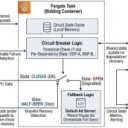
Availability: CMP and consent APIs must be 99.9% available via Route 53 health checks; degrade gracefully (assume opt-out if CMP is slow).
Data Security: Encrypt data in transit (TLS) and at rest (KMS); no unencrypted PII in logs or backups; use AWS Secrets Manager for API keys.
Scope Creep Prevention: Hard limits on data retention (e.g., delete impressions after 90 days per GDPR) via S3 Object Lifecycle Policies; no re-use of data for unapproved purposes.
Cost: Compliance infrastructure (CMP, consent enforcement, audit logging) ~$50–500K/year depending on scale and complexity.
Vendor Management: Third-party demand partners, analytics vendors, and data providers must be contractually bound to privacy obligations (Data Processing Agreements); document in Systems Manager.
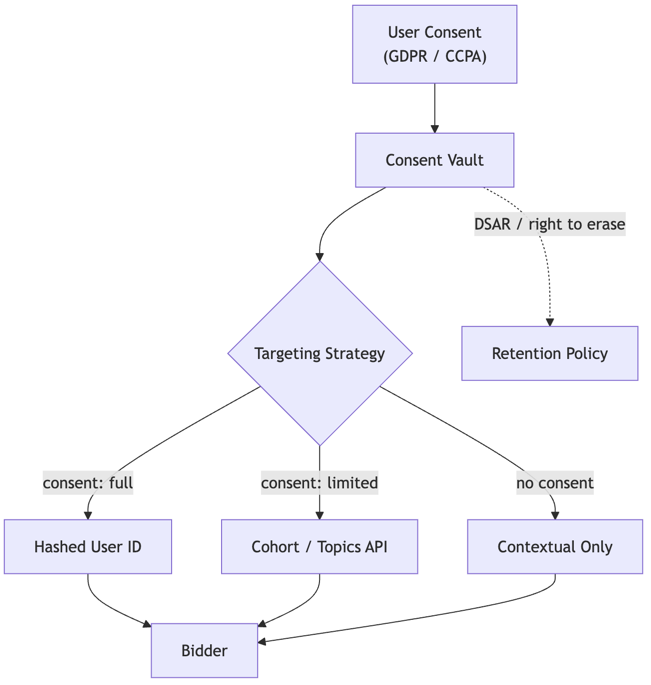
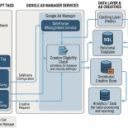
Simplified Architecture
Architecture Proposals
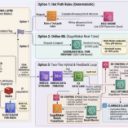
Option 1: Pure Contextual Targeting via Amazon Comprehend
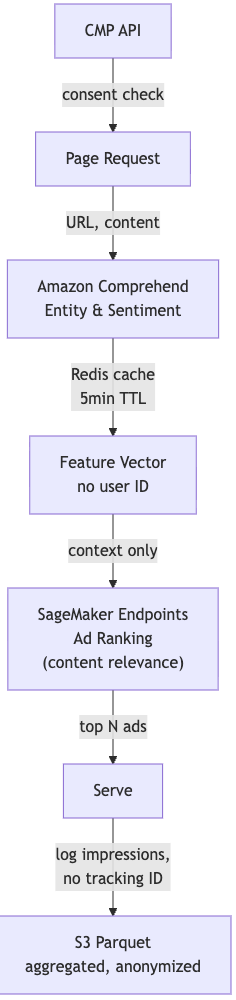
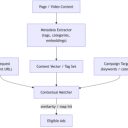
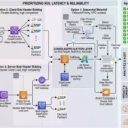
Description: No user ID tracking; targeting relies solely on page context and first-party signals available at request time. The ECS Fargate bidder service receives: page URL, page content (extracted via NLP with Amazon Comprehend), publisher category (IAB taxonomy), device type, geography (coarse, city-level only via Route 53 geolocation), and browser language. Amazon Comprehend extracts entities and sentiment in real-time; results are cached in ElastiCache Redis (5-minute TTL). Demand-side ML models (SageMaker notebooks, deployed as Lambda endpoints) rank ads based on content relevance: if the page is about "sports news," show sports drinks and equipment ads. No historical profile is maintained; each impression is scored independently. Consent is not required (contextual targeting is not personal data processing per GDPR). First-party data (user subscribed to publisher newsletter) can be used if publisher has lawful basis, stored in Aurora with encryption via KMS.
Pros:
Privacy by design: no user ID, no consent needed (contextual targeting is not personal data processing per GDPR).
Regulatory simplicity: no GDPR/CCPA legal risk; no right-to-access/delete requests triggered.
Vendor-agnostic: no dependency on third-party IDs (Google AAID, IDFA, email hashes).
Sustainable: works equally well post-cookie, post-IDFA; future-proof.
Fast: targeting decision is stateless; no lookup to identity service; <50 ms RTB timing.
Cost-effective: no CMP backend, no consent orchestration overhead; Amazon Comprehend is pay-per-unit (<$0.0001 per unit).
Amazon Comprehend handles NLP at scale: managed service, auto-scaling.
Cons:
Precision loss: ~40–50% lower relevance vs. user-profile targeting (historical benchmarks).
CPM impact: advertisers pay 20–40% less for contextual vs. behavioral (audience premium exists).
Rich media limitation: creative optimization (dynamic product ads, retargeting) is impossible without user IDs.
Cold context: homepage with generic category has no targeting signal.
No frequency capping: user sees same ad 10 times if they visit same page 10 times (ad fatigue, brand damage); would require session ID (privacy risk).
Churn risk: demand partners may prefer publishers with audience data; audience-less publishers lose auction competition.
Failure Modes & Mitigations:
Precision drift: Comprehend makes mistakes (sports blog misclassified as health); ads are irrelevant. Mitigation: maintain confusion matrix on classifier results; retrain Comprehend model via SageMaker if accuracy drops >2%; human review top misclassifications (sample weekly via Lambda).
Genre homogenization: All news sites show same ads; user sees identical "car insurance" ad across 10 publishers. Mitigation: add intent signals (keyword search on publisher site, if available); allow some frequency capping within same site via session ID only (max 3 impressions/hour, session expires after 30 min).
Demand drop: Advertisers prefer audience-targeted platforms; CPM falls 30%. Mitigation: segment contextual inventory (premium contextual = brand-safe categories like news, finance; bundled discount for long tail); market to advertisers as "privacy-first" premium.
When to Choose:
Publishers averse to privacy risk (compliance-first strategy).
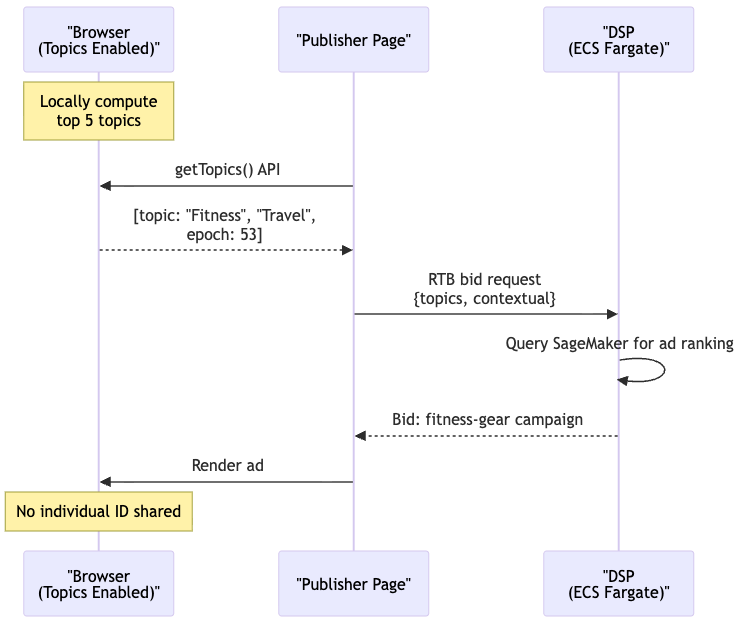
Description: Instead of tracking individual users, place users into cohorts (1000–10000 users per cohort) based on browsing history or interests. Google Topics API is the current standard for web: browser locally computes user's top 5 topics (from Taxonomy of 300+ topics like "Fitness," "Travel Booking") based on browsing history; shares only the topic names with ad servers on request, never the full history. DSP ECS Fargate service receives: Topics (list of 3), contextual signals from Comprehend, and makes targeting decisions via SageMaker endpoints ("show fitness ads to users in Fitness topic"). On mobile, SageMaker batch jobs run nightly to cluster users into privacy-preserving cohorts based on aggregated browsing signals stored in DynamoDB; cohort IDs are pre-computed and cached in ElastiCache.
Pros:
Privacy middle ground: users grouped, not tracked individually; no persistent ID across sites.
Regulatory alignment: Topics API designed to comply with GDPR (topics computed on-device, user can audit/reset).
Browser-native: Chrome/Chromium support; no third-party SDK required (unlike older FLoC).
Precision better than contextual: cohort proxy for audience (1000s of "Fitness" users are more likely converters than random contextual match).
Sustainable: built into Privacy Sandbox roadmap; expected to be standard for years.
Advertiser feedback loop: DSP can optimize SageMaker model bids for high-converting cohorts over time.
SageMaker batch jobs cluster mobile users nightly, pre-compute cohort assignments stored in DynamoDB + ElastiCache.
Cons:
Cohort coarseness: Topics API provides 3 topics per request; precision limited vs. full profile.
Cold start: new user has no topics; first 5 weeks of usage are untagged.
Browser dependency: Topics API only in Chrome; Firefox, Safari, mobile browsers have separate schemes (not standardized).
Advertiser resistance: many demand partners view cohorts as "too low resolution"; expect lower adoption than behavioral targeting.
Reporting complexity: DSP can't report "visited travel sites" to advertiser (only topic name); attribution to campaign is indirect.
Opt-out risk: users can reset Topics; cohort membership is unstable.
Implementation latency: Topics API call adds 5–10 ms to RTB; must be parallelized with Comprehend call; Lambda cold starts can introduce jitter.
Failure Modes & Mitigations:
Topic taxonomy mismatch: Advertiser wants "Luxury Fashion" targeting; Topics API provides only "Fashion." Mitigation: SageMaker model maps advertiser audiences to closest Topics; accept precision loss, optimize on conversion lift over time via SageMaker Autopilot.
Cold-start CPM drop: New users (no topics) have 20% lower CPM. Mitigation: fall back to contextual targeting for untagged users; treat as secondary audience via SageMaker decision logic.
Cohort imbalance: Popular topics (Entertainment) are overcrowded; niche topics (Beekeeping) are tiny. Mitigation: DSP adjusts bid prices per topic popularity (cached in ElastiCache); publishers may offer topic skew as premium (guarantee 100K Gardening users).
When to Choose:
Publishers with significant Chrome traffic (>60%) targeting utility users.
Advertisers comfortable with cohort-level precision (performance marketers may tolerate; brand advertisers may resist).
Mid-term strategy (2–3 years) while Privacy Sandbox stabilizes.
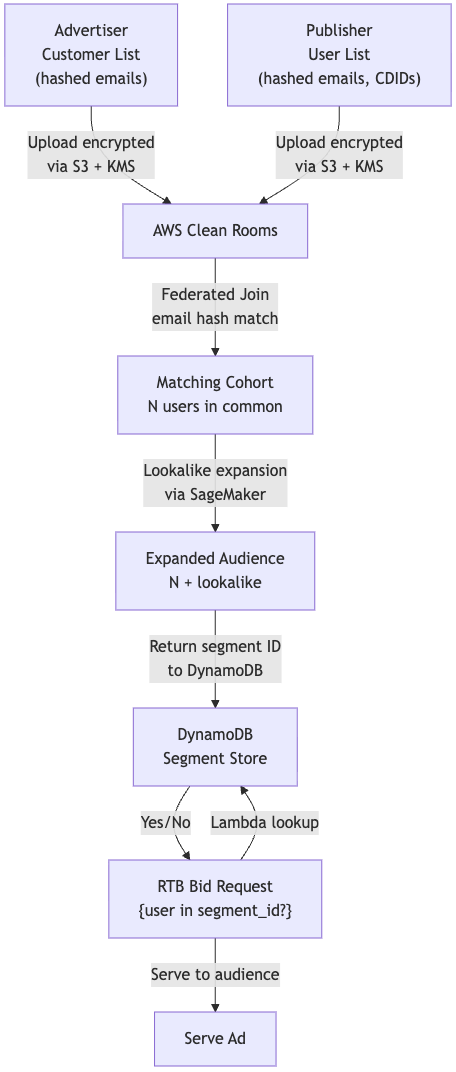
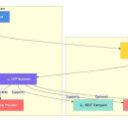
Description: Advertiser uploads their customer list (anonymized: hashed email, phone, salted with KMS-generated salt) or lookalike seed (cohort of converters). Publisher uploads their user list (anonymized: hashed email, cross-device ID from Aurora). AWS Clean Rooms (managed service, SOC 2 certified) joins the two datasets inside the clean room (no raw data leaves the clean room). The join produces: "users matching advertiser's audience" or "lookalike cohort derived from advertiser data and publisher audience" via federated learning on SageMaker (training jobs run in isolated AWS accounts). Publisher receives only aggregate insights: "your audience has 50K users matching advertiser A's lookalike." Targeting decisions happen at the clean room (no individual user IDs are shared); segment membership is stored in DynamoDB and queried at RTB time via Lambda.
Pros:
Precision maintained: leverages advertiser's best-performing customer data; lookalike cohorts can achieve 50–70% of behavioral targeting precision.
No individual data leakage: publisher never sees advertiser customer list; advertiser never sees publisher user data; AWS Clean Rooms encrypts all data at rest (KMS) and in transit (TLS).
Regulatory alignment: AWS Clean Rooms provides Data Processing Agreements; data minimization is built-in; audit logs stored in CloudTrail.
Deterministic: join is repeatable and auditable; fraud/mis-targeting is detectable via CloudTrail logs.
Scalable: federated learning on SageMaker can operate on billions of users with aggregation happening in-place (no raw rows exposed).
Advertiser trust: advertisers get "provable" audience match without sharing data; legal alignment with GDPR.
Cons:
Infrastructure complexity: Clean Rooms setup requires weeks and significant engineering (data ingestion, hashing schemes via KMS, join optimization, SageMaker training setup).
Vendor lock-in: AWS Clean Rooms tie publisher to AWS; migration is expensive (though Clean Rooms is increasingly industry standard).
Latency: clean room query adds 100–500 ms to RTB (not always acceptable); requires pre-computation/materialization of segments into DynamoDB.
Cost: AWS Clean Rooms charges per TB scanned (typically $0.01–0.10 per user match); at scale, can be $100K+/month; SageMaker federated learning adds compute cost.
Data dependencies: publisher and advertiser must agree on hashing scheme (SHA256 of email + KMS-managed salt); misalignment causes join failures.
Privacy theater risk: users may see it as a backdoor for re-identification (hashed email is reversible if someone obtains email list; salt mitigates but not eliminated).
Limited reach: only works for users with email or cross-device IDs; mobile-only or anonymous users are excluded.
Failure Modes & Mitigations:
Hash collision: Two different emails hash to same value; false positives in join. Mitigation: use industry-standard hashing (SHA256 + salt managed via KMS), validate hash distributions before production (run sample join on test data).
Data stale: Advertiser customer list is 2 months old; matches miss recent converters. Mitigation: set SLA on data freshness (refresh advertiser segments weekly); monitor match rate decline over time via CloudWatch dashboard.
Privacy breach: Clean Room is compromised; hashed lists are exposed. Mitigation: request SOC 2 certification from AWS Clean Rooms; audit logs of all queries stored in CloudTrail; implement data retention limits (delete segment after 30 days via S3 Object Lifecycle).
Scale bottleneck: Clean Rooms processes 10B impressions/day, query latency spikes to 1 sec. Mitigation: materialize segments daily (pre-compute "users in segment X" via SageMaker batch job); RTB queries are DynamoDB lookups (sub-millisecond), not joins.
When to Choose:
Large-scale direct deals (advertiser budgets >$1M/month) where precision is critical.
Publishers with first-party email/CRM data and advertiser relationships mature enough to share data.
Strategic partnerships where data pooling (publisher + advertiser) creates differentiated insight; legal agreements in place (DPA).
Comparison Table
Aspect
Contextual
Cohort (Topics API + SageMaker)
Clean Room (AWS)
Targeting Precision
50–60% vs. behavioral
70–80% vs. behavioral
85–95% vs. behavioral
CPM Impact
-20% to -40%
-5% to -15%
-2% to -5% (premium for accuracy)
Privacy Risk
None
Low (on-device, auditable)
Moderate (hash collision risk, data breach)
Regulatory Burden
Minimal
Low (Topics API transparent)
Medium (DPA, audit logs, CloudTrail)
Cold Start
Good (contextual always available)
Poor (5 weeks to accumulate topics)
Medium (depends on advertiser list size)
Latency
<5 ms (Comprehend + cache)
5–15 ms (Topics API call)
100–500 ms (pre-computation mitigates)
Throughput
Unlimited (stateless)
~500K/sec (Topics API rate limit)
~100K/sec (clean room query bottleneck; solved via materialization)
High (vendor integration, data pipelines, SageMaker)
Frequency Capping
Within-site only (session ID)
Between-cohort possible (Topics stable 1 week)
Full cross-site possible (segment IDs in DynamoDB)
Rich Media
Limited (no user ID)
Possible via segment ID
Possible via segment ID
Demand Partner Support
Weak (advertisers prefer audience)
Growing (Privacy Sandbox adoption)
Strong (advertiser-driven)
Sustainability
High (future-proof)
High (Privacy Sandbox standard)
Medium (vendor-dependent, but AWS-led standard)
Recommendation
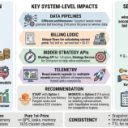
Adopt a three-phase strategy: Phase 1 (now–6 months) pure contextual via Comprehend + CMP for baseline compliance. Phase 2 (6–18 months) integrate Topics API and SageMaker cohort clustering for Chrome traffic and early Privacy Sandbox adoption. Phase 3 (18+ months) pilot AWS Clean Rooms with top 5–10 advertisers to prove lookalike precision and ROI.
Phase 1: Contextual + CMP Foundation Deploy a Consent Management Platform (e.g., Osano, OneTrust, TrustArc; costs $100–200K/year) to collect and store user consent in DynamoDB via Lambda hooks. Implement contextual targeting for all users via Amazon Comprehend; target ads based on page category, keywords, and intent signals only. Deploy SageMaker endpoints for ad ranking per content category. This phase costs $50–100K in engineering (Comprehend integration, consent enforcement, SageMaker endpoint setup) but requires zero third-party ID dependencies and establishes regulatory baseline. Store consent signals in Aurora (encrypted via KMS) and DynamoDB for <10 ms lookup during serving. CMP reduces GDPR/CCPA legal risk immediately.
Phase 2: Topics API Integration As Chrome Topics API stabilizes (already supported in Chrome 101+), integrate the browser API call into RTB bidding via JavaScript in publisher ad tag. Deploy SageMaker batch jobs nightly to cluster mobile users into privacy-preserving cohorts (alternative to Topics API for non-Chrome). This phase is engineering-light (API integration is <1K lines of code, Lambda jobs <2K lines) and adds 5–10 ms latency (acceptable if parallelized with Comprehend calls). Topics provide 15–20% precision improvement over pure contextual with minimal compliance complexity; rollout to 100% of Chrome traffic over 3 months. SageMaker cohorts are cached in DynamoDB + ElastiCache for sub-millisecond RTB lookup.
Phase 3: Clean Rooms for Direct Deals Negotiate AWS Clean Rooms integrations with top advertisers (those with high budgets and email/CRM data). Start with AWS Clean Rooms (established, compliant, SOC 2 certified, AWS-native). Begin with 5–10 advertisers; materialize audience segments daily via SageMaker batch jobs; store segment IDs in DynamoDB; measure lift vs. contextual baseline. Federated learning on SageMaker trains lookalike models in isolated AWS accounts (data never leaves advertiser/publisher accounts). If lookalike audiences show 20%+ conversion lift, expand to 50+ advertisers. Cost per user query will be via DynamoDB (sub-millisecond, negligible); Clean Rooms cost is per TB scanned for initial join (one-time, then cached).
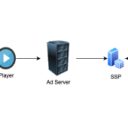
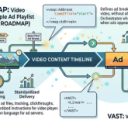
For video/VAST inventory, Topics API is unavailable (mobile VAST SDKs don't support it). For those placements, contextual + Clean Room are the only options; accelerate Phase 3 for video.
CMP + Consent Integration: All three phases require a unified consent signal. Use IAB TCF (Transparency & Consent Framework) v2 as the standard. Deploy Lambda functions to query CMP API before processing user data; if no consent, fall back to contextual/cohort-based. TCF signals are also exchanged via GPP (Global Privacy Platform) header on RTB requests, enabling buyers to honor seller's consent declarations. Store consent decisions in DynamoDB with 90-day TTL (GDPR retention limit); audit logs in CloudWatch and S3 Parquet.
Data Deletion (Right to Delete): Implement S3 Object Lambda to intercept GDPR delete requests; trigger Aurora cascading deletes (user ID → all rows in impressions/events tables) and DynamoDB scans. Set S3 Lifecycle Policies to auto-delete impressions/events after 90 days. Lambda function processes delete requests asynchronously, logs completion to CloudTrail.
Data Residency (GDPR): Use Route 53 geolocation routing to serve different AWS regions based on user's inferred location (via IP). EU users → eu-west-1 (Ireland); US users → us-east-1 (N. Virginia). DynamoDB global tables replicate consent and targeting data across regions with encryption via regional KMS keys.
Capacity & Performance Notes
Contextual Targeting (Phase 1):
Amazon Comprehend: NLP pipeline processes page HTML via batch API; ~50 ms per page offline, results cached in ElastiCache (5-min TTL).
Feature vector: category + keywords + sentiment + entities; ~200 bytes per page; store in DynamoDB with 1-day TTL.
SageMaker inference endpoints: lightweight model (logistic regression or decision tree) ranks ads by relevance; <1 ms per impression; auto-scaling from 1–10 instances.
Topics API Integration (Phase 2):
Topics API call latency: 5–10 ms (browser local computation); parallelize with Comprehend call via Lambda concurrency.
Topics caching: cache Topics per session_id (temporary, expires after 30 min) in ElastiCache; reduces API call overhead for returning users.
Storage: Topics data is write-only (Topics list + epoch); no retention needed beyond current epoch.
SageMaker batch cohort jobs: nightly, 1–2 hours; cluster 100M–1B mobile users into 10K–100K cohorts; store cohort IDs in DynamoDB.
Clean Room (Phase 3):
Advertiser upload: weekly batch, 50M–500M hashed records per advertiser; S3 + Lambda trigger AWS Clean Rooms ingestion via encrypted S3 bucket (KMS-managed key).
Publisher user list: daily refresh, 100M–1B users; SageMaker dataset stored in S3, registered with AWS Clean Rooms.
Join operation: AWS Clean Rooms federated hash join, ~30 min for 1B publisher × 100M advertiser records; results: matching cohort (10M–50M users typically) + lookalike expansion via SageMaker federated learning.
Segment materialization: daily SageMaker batch job pre-compute all audience segments; store segment membership in DynamoDB (<1 ms lookup at RTB time).
Query cost: AWS Clean Rooms ~$0.01 per GB scanned; initial join is one-time; RTB queries are DynamoDB lookups (on-demand pricing ~$1.25 per million RCU).
Consent Management (All Phases):
CMP API latency: <50 ms via Lambda (local cache of consent decision per user_id/IP in DynamoDB with 1-hour TTL).
Consent storage: 100M active users × 500 bytes per consent record = 50 GB (DynamoDB on-demand, auto-scales); daily archive to S3 Parquet for audit.
Right-to-delete requests: Lambda batch process nightly; delete from Aurora (cascading deletes via FK constraints), DynamoDB (scans partitioned by user_id), S3 (Object Lambda intercepts GetObject calls). SLA: 30 days (GDPR requirement).
Monitoring & Compliance Logging:
Consent decisions: CloudWatch logs all "user consent = Yes/No" decisions; CloudTrail logs all API calls to Comprehend, SageMaker, Clean Rooms.
Data flows: log all advertiser/demand partner API calls; track which partners received consent-requiring data; stored in S3 Parquet for audit.
Audience metrics: report viewability, CPM, conversion by audience type (contextual vs. cohort vs. clean room) to assess business impact; dashboard via Managed Grafana.
GDPR audit reports: Lambda monthly report (S3 Parquet): all delete requests processed, all consent records, all third-party data transfers; exported to DLP tool for compliance review.