Brand Safety: AI-Driven Content Moderation on AWS

CK CK 3788 
Created at
Updated at  
738 0 0

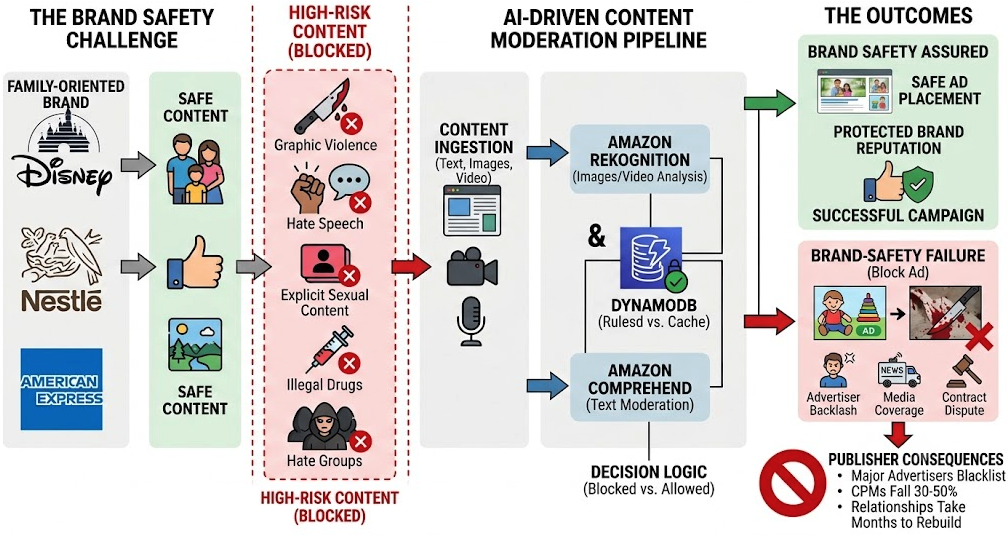
Brand safety—preventing ads from appearing next to inappropriate, offensive, or illegal content—is a critical advertiser concern. A family-oriented brand (Disney, Nestle, American Express) will not tolerate ads appearing on pages containing violence, hate speech, explicit sexual content, illegal drugs, or hate groups. A single brand-safety failure (ad for children's toy next to graphic violence) triggers advertiser backlash, media coverage, and contract disputes. Publishers suffer: major advertisers blacklist them, CPMs fall 30–50%, and relationships take months to rebuild.

Brand Safety: AI-Driven Content Moderation on AWS

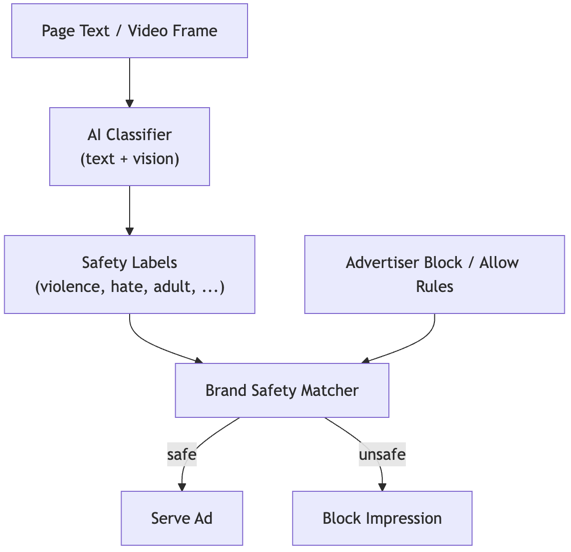
The detection challenge combines content understanding (is this page safe?), real-time decision latency (block/allow within RTB <100 ms), and continuous adaptation (new unsafe content types emerge daily). Solutions range from static allowlist/blocklists (pre-classified URLs stored in DynamoDB) to real-time AI classification via Amazon Comprehend (text moderation), Amazon Rekognition (image/video moderation), and Amazon Bedrock (LLM-based nuanced classification) to hybrid approaches combining pre-classified known content with dynamic fallback. Advertiser-defined keyword and content exclusion lists add a second layer: allow advertiser to block "weapons," "cryptocurrency," "alcohol" even if not inherently unsafe.

This case examines three architectures: pre-classified allowlist/blocklist (simple, fast, limited coverage), real-time AI inference via AWS services (comprehensive, latency-sensitive, requires ML infrastructure), and hybrid (fast known content + real-time fallback + keyword filters).

Brand Safety: AI-Driven Content Moderation on AWS


Key Requirements

Functional Requirements

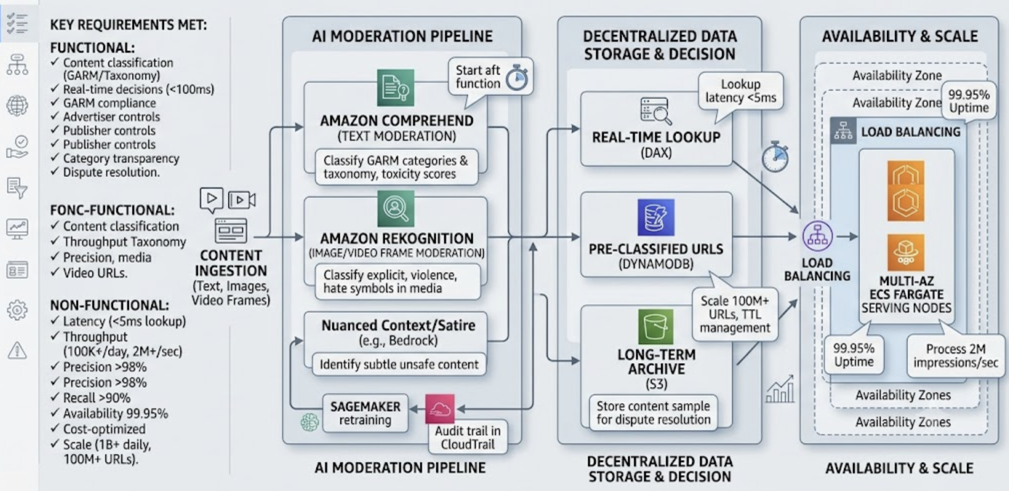
  • Content classification: Automatically classify web pages and video frames as safe/unsafe (GARM categories or custom taxonomy).
  • Real-time decisions: Flag unsafe content within RTB latency (<100 ms bid timeout); serve-time blocking via ECS Fargate.
  • GARM compliance: Support Global Alliance for Responsible Media (GARM) categories (13 brand-safety tiers: hate speech, violence, sexual content, obscenity, misinformation, etc.).
  • Advertiser controls: Allow advertisers to define custom exclusion lists (e.g., "no alcohol," "no political content," "no low-quality sites") stored in DynamoDB per advertiser.
  • Publisher controls: Allow publishers to self-classify sensitive inventory (e.g., "news politics" → lower brand-safety tier) stored in Aurora.
  • Category transparency: Return content category with ad decision for audits and reporting.
  • Dispute resolution: Maintain content sample (screenshot, text excerpt) in S3 for advertiser/publisher review.

Non-Functional Requirements

  • Latency: <5 ms for pre-classified content lookup via DynamoDB; <20 ms for real-time classification (must not break RTB).
  • Throughput: Classify 100K–500K URLs/day via SageMaker batch; handle 500K–2M impressions/sec.
  • Accuracy: Precision >98% (false positives are costly—blocking safe content = lost revenue); recall >90% (miss <10% of unsafe).
  • Availability: 99.95% uptime; degrade gracefully to conservative (allow-all) if AI service fails.
  • Cost: Classification and filtering ~$20–100K/month (AWS services + SageMaker).
  • Scale: Handle 1B+ daily impressions; maintain pre-classification cache of 100M+ URLs.


Simplified Architecture

Brand Safety: AI-Driven Content Moderation on AWS


Architecture Proposals

Option 1: Pre-Classified URL/Content Allowlist + Blocklist via DynamoDB

Description:
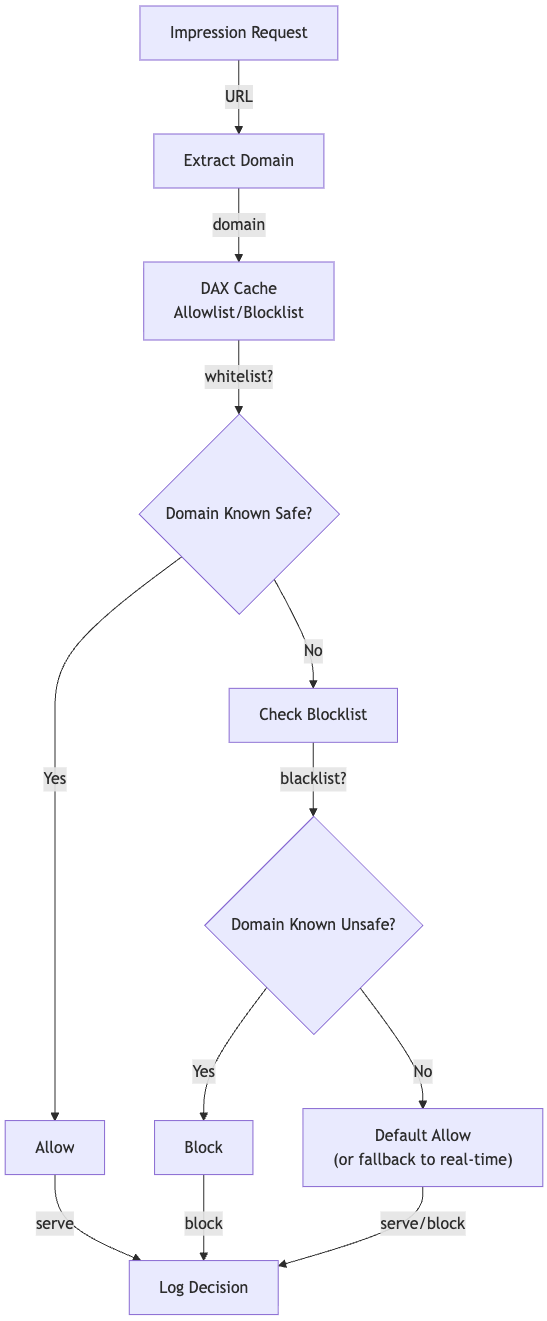
Maintain offline allowlist (whitelist of known-safe domains and publishers, stored in DynamoDB) and blocklist (blacklist of known-unsafe sites, malware hosts, etc., also in DynamoDB). URLs are classified once, stored with TTL (7 days), and queried at serve time via ECS Fargate services with DynamoDB DAX (DynamoDB Accelerator) for <5 ms lookup. Additional signals: domain reputation (WHOIS age via Lambda enrichment, SSL certificate validity), ASN blocklist (known hosting providers for spam, updated daily from external feed), and manual reports from users/vendors (logged to DynamoDB). Updates occur daily via Lambda ingesting external feeds; classification is deterministic (same URL always gets same decision). Blue-green deployment for rule updates.

Brand Safety: AI-Driven Content Moderation on AWS

Pros:

  • Extremely fast: <1 ms per lookup via DAX (O(1), no network call overhead).
  • Cost-effective: no ML infrastructure; only DynamoDB storage and update Lambda function.
  • Deterministic: reproducible decisions; easy to audit and explain.
  • No latency tail: fixed lookup time; scales to billions of impressions.
  • External feeds available: MX Toolbox, Spamhaus, Akamai provide pre-classified lists; Lambda ingests daily.
  • Privacy-friendly: no analysis of page content; only URL domain (no crawling required).
  • DynamoDB DAX: multi-AZ cache, automatic failover, CloudWatch monitoring.

Cons:

  • Limited coverage: only domains with explicit classification are handled; long tail is defaulted.
  • Update lag: new unsafe content is available 24–48 h after discovery; attackers exploit the gap.
  • False positives: domains are not content-specific (example.com may have safe news and unsafe forum sections).
  • Rich media limitation: can't classify video frames, embedded content, or dynamically loaded pages without headless browser.
  • Advertiser frustration: can't block specific topics (e.g., "alcohol") if not on blocklist; requires keyword filtering as fallback.
  • Cat-and-mouse: malicious actors register new domains constantly; classification lags behind.

Failure Modes & Mitigations:

  • Allowlist false positive: Domain is on allowlist but content was hacked/changed to unsafe. Mitigation: monitor user reports via Lambda; remove domain from allowlist if abuse reports spike (threshold: >10 reports/day); set DynamoDB TTL to 7 days, refresh weekly.
  • Blocklist bloat: Maintain 10M domains on blocklist; lookup becomes slow. Mitigation: use DynamoDB hash set with DAX caching (O(1) lookup); partition by first 2 chars of domain for efficient scans.
  • Domain migration: Unsafe domain redirects to new domain not on blocklist. Mitigation: Lambda crawler tracks redirect chains; classify final destination domain.

When to Choose:

  • Starting point for brand safety; low cost and complexity.
  • Publishers with limited ML infrastructure (no SageMaker).
  • Categories where domain-level classification is sufficient (e.g., B2B software, finance).


Option 2: Real-Time AI Inference via AWS Services (Comprehend, Rekognition, Bedrock)

Description:
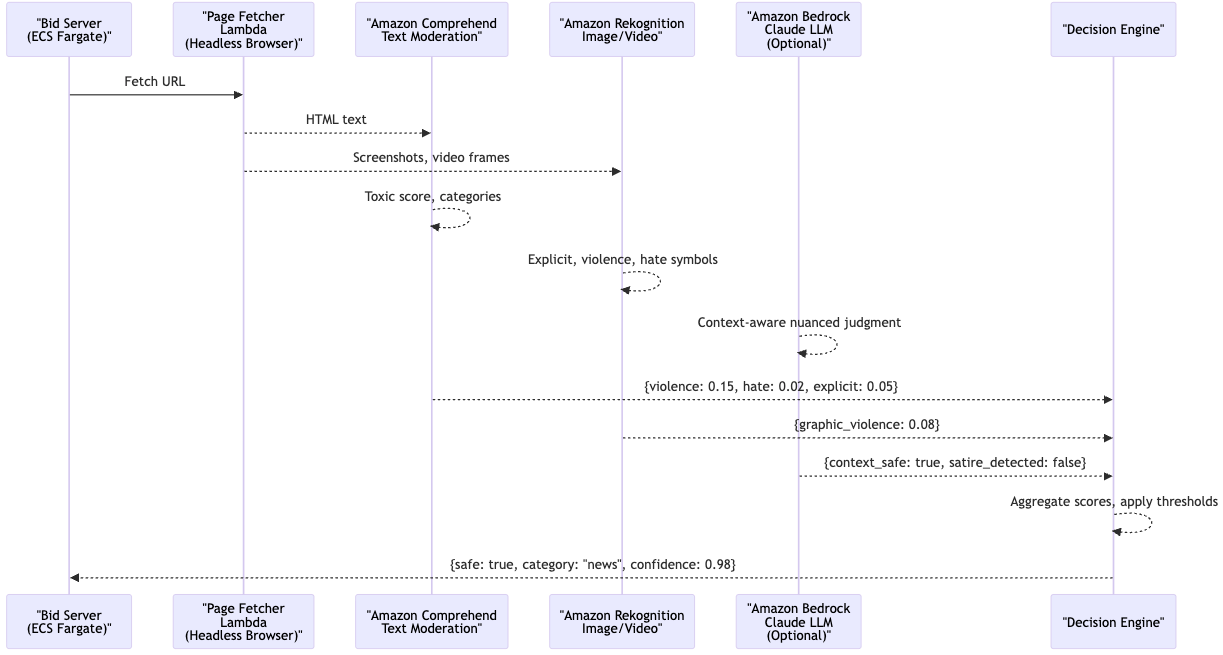
Deploy a content classification pipeline as an ECS Fargate microservice queried during RTB. When an impression is requested, the serving platform fetches the page content (via headless browser Lambda or API) and passes it to AWS managed services: Amazon Comprehend for text moderation (toxic comments, profanity, abuse), Amazon Rekognition for image/video frame moderation (explicit, graphic violence, hate symbols), and optionally Amazon Bedrock (Claude LLM) for nuanced classification (satire detection, context understanding). The models return toxicity/safety scores (0–100%) and GARM category (violence, hate speech, explicit, etc.). The serving logic applies advertiser-specific thresholds: brand A allows "violence" ≤20%; brand B blocks all "hate speech." Scores are cached in DynamoDB (7-day TTL) and ElastiCache (5-min TTL) to avoid re-classification. Classification results are retrained via SageMaker Autopilot weekly on ground-truth labels (user reports, advertiser feedback).

Brand Safety: AI-Driven Content Moderation on AWS

Pros:

  • Comprehensive: classifies page text, images, video frames; handles all media types.
  • Adaptive: Amazon Comprehend and Rekognition continuously improve (AWS-managed models); SageMaker retraining adds custom tuning.
  • Granular: returns per-category scores; advertiser can block specific topics ("no violence" but allow "controversial news").
  • Flexible: advertiser can tune thresholds per campaign via DynamoDB allowlist/denylist tables.
  • Future-proof: learns from evolving content (deepfakes, new hate speech slang) via Bedrock + SageMaker.
  • Transparent: Amazon Comprehend and Bedrock provide reasoning; SageMaker Clarify provides SHAP explanations.
  • AWS-managed: no model training burden; Comprehend and Rekognition APIs handle scale.

Cons:

  • Latency cost: page fetch (500 ms headless browser) + classification (Comprehend 50 ms + Rekognition 100–200 ms + Bedrock 500+ ms) = 800+ ms overhead; breaks RTB timing unless async.
  • Model drift: safety definitions change; models become stale; requires monitoring and custom tuning via SageMaker.
  • False positives: ML models can misclassify satire/news as unsafe; requires manual review queue (DynamoDB + Lambda).
  • Cold start: new URLs have no history; model must make decision on first impression (high confidence risk).
  • Adversarial attacks: bad actors craft content to evade classifier (pixel noise, text obfuscation); AWS services have mitigation but not perfect.
  • Cost: Comprehend (~$0.0001/unit), Rekognition (~$0.10–1 per image), Bedrock (~$0.01 per request); at scale, $50–200K/month for inference.
  • Bedrock cost: Claude 3 Opus is expensive for high-volume; recommend for spot checks, not all impressions.

Failure Modes & Mitigations:

  • Inference latency spikes: Rekognition or Bedrock API reaches capacity, classification queues; RTB timeouts increase. Mitigation: implement request queue with 200 ms timeout, fall back to pre-classified blocklist if timeout triggers; use SQS for async classification, cache results in DynamoDB.
  • Model accuracy drop: New adversarial attack emerges; model accuracy drops from 96% to 88%. Mitigation: CloudWatch dashboard monitors user report rate (may spike if model is confused); trigger SageMaker retraining if accuracy drops >3%; require model performance review before production deployment.
  • Content extraction failure: Page is JavaScript-heavy; Lambda headless browser can't render. Mitigation: set timeout on page fetch (5 sec), fall back to static HTML/text extraction if JS rendering fails; implement retry logic.

When to Choose:

  • Premium publishers (high-value brand advertisers) prioritizing brand safety over latency.
  • Complex content (video, images, rich media) requiring frame-by-frame analysis.
  • Large advertiser base with diverse safety policies (need flexibility).


Option 3: Hybrid — Pre-Classified + Real-Time Fallback + Keyword Filters

Description:
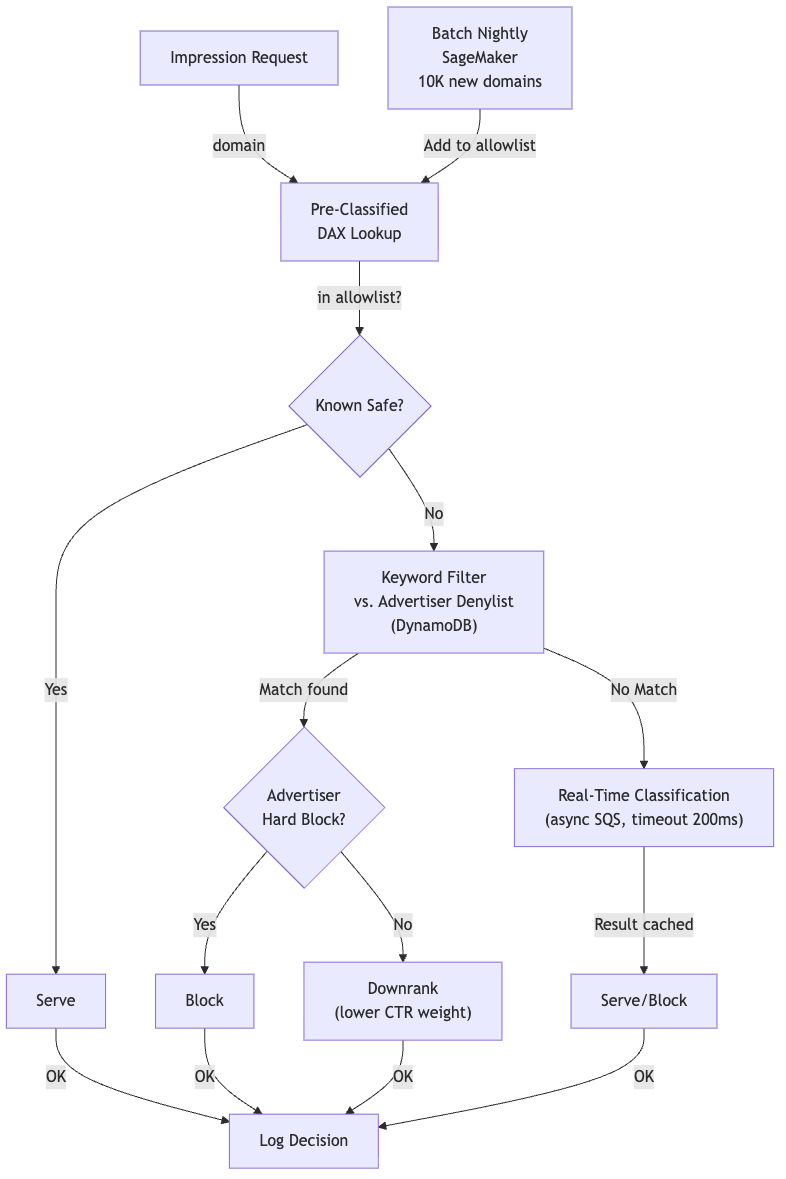
Fast DynamoDB + DAX lookup for known content (allowlist/blocklist): if domain is on allowlist, serve immediately. If unknown domain, trigger asynchronous real-time classification (Lambda + Comprehend + Rekognition, cache results in DynamoDB with 7-day TTL). Meanwhile, apply keyword filters (advertiser-defined exclusion list stored in DynamoDB per advertiser: "weapons," "alcohol," "gambling") against page text extracted via Comprehend. Keyword match blocks immediately. If all checks pass, serve; if any fail, respect advertiser threshold (hard block or downrank). Batch overnight process picks top 10K new domains (tracked in DynamoDB), pre-classifies them via SageMaker batch transform job, and adds to allowlist. Advertiser denylist management via ECS Fargate UI service.

Brand Safety: AI-Driven Content Moderation on AWS

Pros:

  • Cost balanced: simple rules handle 90% of requests (<1 ms via DAX); expensive ML handles 10% (unknown domains, async).
  • Fast common case: known domains serve in <5 ms; RTB latency is unaffected.
  • Coverage improved: pre-classification catches easy cases; real-time classification via Comprehend/Rekognition catches edge cases.
  • Advertiser flexibility: keyword filters allow custom exclusions without model retraining; managed via DynamoDB UI.
  • Graceful degradation: if real-time service is slow, keyword filter is fallback; don't block until confident.
  • Learning loop: nightly SageMaker batch pre-classifies trending domains (via Comprehend, store results), reducing real-time load.
  • Multi-AZ resilience: DynamoDB DAX replicates across AZs; SQS queue for async classification has DLQ for retries.

Cons:

  • Operational complexity: three systems (pre-classifier DynamoDB, keyword filter Lambda, real-time ML via SQS/Lambda) to maintain and monitor.
  • Coordination risk: conflict between systems (keyword filter allows, real-time blocks) requires arbitration logic in decision function.
  • Keyword list maintenance: advertiser lists grow unbounded; keyword matching becomes expensive (Aho-Corasick automaton scales to 10K keywords, but setup required).
  • Caching challenges: domain classification changes (site is hacked, becomes unsafe); 7-day cache is stale.
  • Integration complexity: keyword extraction via Comprehend is separate pipeline; NLP cost adds up.

Failure Modes & Mitigations:

  • Cached classification stale: Domain was safe, now hacked to unsafe; cached label persists 7 days. Mitigation: set TTL to 1 day; monitor abuse reports via CloudWatch SNS alerts; DynamoDB stream triggers cache invalidation on report spike.
  • Keyword false positive: Advertiser keyword "gun" blocks legitimate "gunsmoke western" movie review. Mitigation: use phrase matching (require "gun violence" not just "gun"); allow advertiser to maintain negative keyword exceptions in DynamoDB.
  • Real-time service overload: 15K new domains/day trigger real-time classification; SQS queue grows, latency spikes. Mitigation: prioritize by traffic volume (high-traffic unknown domains classified first via SQS priority queue); batch classify tail of low-traffic domains offline nightly.

When to Choose:

  • Large-scale publishers (>500K impr/sec) where latency is critical.
  • Complex advertiser base with diverse safety policies.
  • Long tail inventory where pre-classification doesn't cover all domains.


Comparison Table

AspectPre-Classified (DynamoDB)Real-Time AI (AWS Services)Hybrid
Latency<1 ms (DAX)800+ ms or async (breaks RTB)<5 ms common; 200 ms timeout fallback
Throughput2M+ impr/sec10K–50K impr/sec (inference bottleneck)1M+ impr/sec
Accuracy85–90% (domain-level)95–98% (per-content)92–97% (hybrid)
Coverage50–70% (known domains)100% (all content)90%+ (known + fallback)
False Positive Rate2–3%0.5–2% (depends on model)1–2%
Advertiser FlexibilityLow (binary allow/block)High (per-category thresholds)Medium-High (keyword + model)
Cost/Month$5K–10K (DynamoDB, Lambda feed ingestion)$50K–200K (Comprehend, Rekognition, Bedrock inference)$20K–80K (hybrid, lighter inference)
Operational ComplexityLowHigh (AWS service integration, drift monitoring)Medium (three pipelines, SQS orchestration)
Update FrequencyDaily (Lambda ingests feeds)Continuous (AWS models improve)Daily (batch) + async (real-time)
Rich Media SupportNo (domain-level only)Yes (Comprehend text, Rekognition images/video)Partial (keywords + fallback classification)
ScalabilityExcellent (O(1) DAX lookup)Moderate (API throttling)Excellent (rules scale, batch scales)
Advertiser OnboardingMinutes (provide domain list)Hours (define thresholds per category)Hours (keywords + thresholds)


Recommendation

For most publishers, adopt Option 3 (Hybrid) as the standard architecture, with Option 2 (real-time AWS services) as a premium tier for high-value brand deals.

The hybrid approach balances speed and coverage: pre-classified domains via DynamoDB + DAX (90% of traffic) are served sub-5 ms, unknown domains are classified asynchronously via Comprehend/Rekognition without breaking RTB timing, and keyword filters provide immediate veto for advertiser-defined exclusions. This scales to 1M+ impr/sec and costs only $30–50K/month (cheaper than full real-time ML). Nightly SageMaker batch pre-classification reduces real-time load.

For premium direct deals (e.g., Ford automotive brand guarantee >99% brand-safe inventory), offer Option 2: page is fetched and scored via Comprehend (text) + Rekognition (images/video) within 200 ms async (cached, avoids RTB impact); optionally use Bedrock Claude for nuanced satire/context detection. This provides per-content granularity (e.g., "no violence <10%" or "no hate speech <1%") and strong audit trail (Bedrock reasoning + Comprehend confidence scores) for contract compliance.

Option 1 (pre-classified only) is acceptable for small publishers (<10K impr/sec) with limited advertiser diversity, but limits upside (major advertisers increasingly demand rich safety controls and keyword filtering).

GARM & IAB Taxonomy Integration:
Standardize on GARM's 13 brand-safety tiers (Hate Speech, Violence, Sexual Content, Obscenity, Misinformation, etc.) and IAB's content taxonomy (400+ categories including brand-appropriate segmentation). Use GARM as advertiser-facing classification; map internal Comprehend/Rekognition categories to GARM for reporting and disputes. Store category mapping in DynamoDB.


Capacity & Performance Notes

Pre-Classification (Option 1):

  • Domain space: ~1B unique domains on internet; pre-classify top 100M (covers 95% of ad traffic).
  • DynamoDB tables: allowlist (10M domains, ~20 GB), blocklist (10M domains, ~20 GB).
  • DAX cluster: 3 nodes (multi-AZ), 10 GB cache; handles 100K+ RPS with <1 ms latency.
  • Lookup latency: <100 μs (DAX in-memory, single hash lookup).
  • Update pipeline: nightly Lambda (2 AM UTC) ingests domain reports, updates DynamoDB, propagates to DAX within 5 min.

Real-Time Classification (Option 2):

  • Page fetch: Lambda with headless Chromium renders page, extracts text + images; ~200–500 ms per URL.
  • Comprehend: text classification (toxicity, profanity, abuse); ~50 ms per page; auto-scales via API.
  • Rekognition: image classification (explicit, graphic, symbols); sample 3–5 frames per 30s of video; ~100 ms per page.
  • Bedrock: Claude classification (context-aware judgment); ~500+ ms per page; use sparingly (spot checks, high-value deals).
  • Cache (DynamoDB + ElastiCache): domain + category cached; 100M cached entries = 5 GB (LRU, 7-day TTL in DynamoDB, 5-min TTL in Redis).
  • API quota: Comprehend ~10K requests/sec, Rekognition ~20K requests/sec (sufficient for async, not real-time critical path).

Hybrid Pipeline (Option 3):

  • Pre-classification DAX lookup: <1 ms.
  • Keyword matching: Aho-Corasick finite automaton over page text (via Comprehend); ~10 ms for 1K keywords on 10 KB text.
  • Real-time async: SQS queue buffers classification requests; Lambda workers process 5K–10K new domains/day; processed results cached in DynamoDB by 6 AM.
  • Cache hit rate: target >90% (known domains); if <85%, trigger batch SageMaker pre-classification to improve hit rate.
  • SageMaker batch job: nightly, processes 10K new domains via Comprehend/Rekognition in parallel; ~1 hour; results merged into allowlist.

Monitoring:

  • Brand-safety rate by advertiser (hourly via CloudWatch): alert if drops >2% (may indicate classification error or real unsafe traffic spike).
  • Keyword false-positive rate: manual sample review weekly (1K impressions); target <1%; DynamoDB stores review queue.
  • DAX cache hit rate: daily report; if dropping <85%, trigger batch pre-classification run.
  • Model accuracy (if real-time used): daily AUC on holdout set via CloudWatch; alert if drops >2%; CloudWatch SNS to ops team.
  • API error rates: Comprehend, Rekognition, Bedrock error monitoring; alert if >5% errors.
Tags AI Moderation AI Moderation Pipeline AWS Solutions Ad Safety Brand Safety Content Moderation Machine Learning Real-Time Bidding Facebook X
Comments 0
Similar posts
  1. Ad Pacing Unpacked: Architecting Guaranteed Delivery
    368
  2. AI-Powered Ad Fraud Detection: Architectural Strategies
    337
  3. Ad Tech Edge Architectures: Reducing Latency and Offloading Work - Edge Computing
    338
  4. Ad Impression Forecasting (aka Ad Inventory Forecasting): Architecting for Scale, Speed, and Accuracy
    334
  5. Predictable Ad Spend: Architecting Pacing at Hyperscale
    427
  6. Mastering Ad Budget Throttling: Static, PID, and ML Strategies
    325
  7. Real-Time Geo-Targeting: Balancing Precision, Latency, and Cost
    294
  8. Predicting Buyer Preferences with PyTorch: A Deep Learning Approach
    1,234
  9. PyTorch example to Forcast Stock Price based on 10 days Dataset
    653
  10. Milvus & FAISS: Decoding Their ML Synergy
    286
  11. FAISS Already Does ANN... So Why Do Top Teams Still Pay for SageMaker?
    314
  12. A Deep Dive Into Internet Advertising Ecosystem on Video Streaming Industry
    651
  13. Machine Learning Models for Ad Detection from a Video Stream
    194
  14. Building a MCP server in PHP
    638
  15. Architecting ML/LLM Ad Targeting with Kafka, Flink, FAISS, and Milvus
    284
  16. Python ML Technologies used for the target Segmentation
    380
  17. Vector Databases: From Embeddings to Application
    322
  18. Coding Revolution with Claude Code & MoAI ADK(Agent Development Kit)
    738
  19. Demystifying FAISS: Your Guide to ANN(Approximate Nearest Neighbor) Search
    326
  20. Netflix's Recommendation System
    429
  21. Arm Kernel DNNs: Powering Efficient AI at the Edge
    229
  22. Autonomous Vehicle Machine Learning (AV ML): An Architectural Review
    421
  23. Designing an Enterprise ML Experiment Tracking and Reproducibility Platform: System Requirements and Architecture
    318
  24. End-to-End Contextual Video Processing Architecture for AdTech
    216
  25. Extracting Context from Live Video: The Architecture Got Simpler When We Stopped Building Features
    263
  26. Forecasting with Linear Regression and KNN Regression in Python
    929
  27. Forecasting the Weather with PyTorch: A Beginner's Guide to Temperature Prediction
    1,444
  28. YouTube's Recommendation System
    269
  29. Mastering Model Persistence: Saving and Loading Trained Machine Learning Models in Python
    1,165
  30. Harnessing the Power of Random Forest Algorithm in Python
    658
  1. The Two Clocks of Ad Server Architecture
    77
  2. Collecting Proof-of-Play from 100,000 Screens
    152
  3. The New Ad Stack Behind Live Sports Streaming: Inside SGAI, EABN, and the Standards Race to Fix Live Monetization
    672
  4. IAS IP Blocklist: Causes, Resolution, and Detection Strategies
    196
  5. What Is UniversalAdId? The Complete Guide to VAST Video Ad Tracking
    205
  6. UCP for AVOD: Standardizing Ad Monetization
    354
  7. Advertiser Universal Commerce Protocol (UCP) Readiness Checklist
    449
  8. SEO is dying, AEO is coming
    1,238
  9. Conditional AdSense Script Loading in Confluence
    1,422
  10. What is VAST? What is VMAP? How VAST/VMAP works?
    903
  11. Render Ad creatives using setSafeFrameConfig in Google IMA
    1,084
  12. AWS Real-Time Dashboards: Druid, ClickHouse, or Lambda?
    627
  13. Ad Tech Multi-Tenancy: A Spectrum of Isolation Architectures on AWS
    337
  14. Attribution's New Blueprint: Balancing Performance and Privacy
    507
  15. Ad Auction Architectures: A Publisher's Guide to Optimal Monetization
    686
  16. The Future of Programmatic Advertising: Privacy-First Strategies and Trade-offs
    523
  17. Measuring Ad Viewability: AWS Architectures for Programmatic Accountability
    479
  18. AWS Ad Exchange Disaster Recovery: Active-Active, Active-Passive, and Cell Strategies - Disaster Recovery
    1,361
  19. Architecting Ad Tech's Terabyte Log Pipeline - Log Aggregation
    331
  20. Achieving Zero-Downtime Deployment for Stateful Ad Servers
    1,232
  21. Ad Tech Circuit Breakers: Architectures for Resilient Bidding Engines - Circuit Breaker
    358
  22. Balancing Real-Time Ad Stats and Billing Accuracy - Eventual vs Strong Consistency
    647
  23. Scaling Sharded Databases: Taming Hot Shards with Dynamic Rebalancing
    552
  24. Navigating the Ad Tech Cold Start: Simple Solutions for a Complex Problem
    338
  25. Ad Tech Idempotency: Engineering for Reliability and Scale
    368
  26. Exactly-Once Delivery: The Ad Tech Blueprint for Accurate Billing
    299
  27. The AI Powering Billions of Tailored Ads - Dynamic Creative Optimization
    288
  28. Unwrapping VAST: Architecting for Low-Latency Video Ads
    823
  29. The Ad Tech Auction Wars: First-Price, Second-Price, and the Hybrid Frontier
    301
  30. Mastering Ad Frequency: Strategies for High-Scale Capping
    318
Recently updated
  1. Google OAuth Token Expiration: Causes and Solutions
    29
  2. Why 100% SEO Guarantees Better User Engagement and How to Achieve It in Your Service
    55
  3. Why SPF and DKIM Are Essential for Linux Email Servers?
    49
  4. How do I create animated background for Google Meet?
    22,901
  5. MaxMind GeoLite2 vs. DB-IP Lite vs. ip-api.com: Choosing the Right Free IP Geolocation Solution
    271
  6. Meet Valkey: Why Redis Changed Its License, Why Valkey is Better, and How to Use It as a Drop-in Replacement
    103
  7. How Rogue Web Scrapers Are Stealing My Content and Destroying My Server
    168
  8. Array of arguments passed to script in PHP
    97
  9. Invalid Auction Storms in Ad Tech
    106
  10. Building MRC-Compliant Instrumentation in Ad Tech: Implementation Steps and Key Challenges
    207
  11. Frequency Cap Architecture Overview
    526
  12. Vector Search in Relational Databases (RDBs): Trends & Usage Environments
    302
  13. What is RedisVL?
    114
  14. Designing a Skill Registry Architecture: Minimize Token Usage and Maximize AI Performance
    246
  15. TPU & GPU Cluster Management Tools
    257
  16. The Concept of Scaffolding in AI Agents
    244
  17. Beyond Static Pipelines: Architecting LLM Multi-Agent Systems for Autonomous Workflow Orchestration
    596
  18. AI-DLC vs. AI-SDLC: Model-Centric vs. System-Centric AI Development
    267
  19. Fine-Tuning Open-Weight LLMs: Training, Licensing, and Deploying Custom Models with Ollama
    353
  20. Inside the Next-Generation Streaming Architecture: Ultra-Low Latency, SGAI, and AI Codecs
    206
  21. Machine Learning: Training vs. Ranking
    229
  22. The Continuous Learning Machine: Designing a Loop That Actually Turns
    228
  23. The Next-Gen Low-Latency Standards: LL-HLS & MoQ
    202
  24. Designing a Data Curation System Around a Vector Database
    230
  25. Designing MLOps Architectures to Handle Seasonal Data Drift in EV Fleet Models
    200
  26. From 15 to 40+ FPS: Accelerating PyTorch Object Detection on Automotive ECUs
    232
  27. Understanding Data Lineage
    271
  28. System Requirements and Architecture: Intelligent Priority-Based Scheduler
    175
  29. GPU & LLM Cluster Infrastructure & Task Scheduling Architecture
    255
  30. Java Variant Type
    210