AWS Real-Time Dashboards: Druid, ClickHouse, or Lambda?

CK CK 3788 
Created at
Updated at  
620 0 0

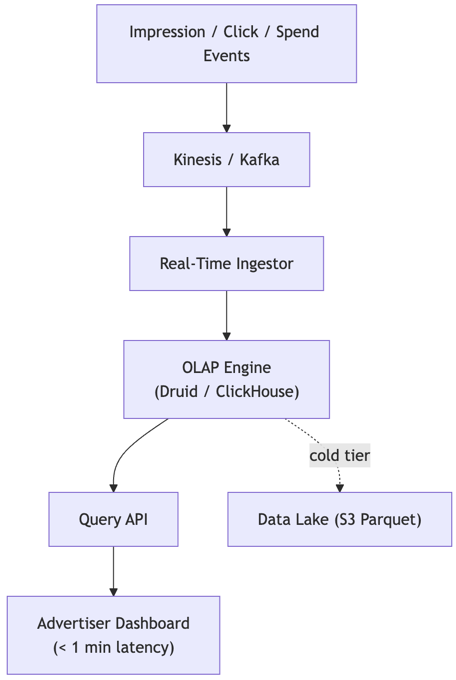
Advertisers and publishers demand live dashboards showing metrics updated within minutes: impressions, clicks, conversions, spend, CPM. Real-time reporting requires an OLAP (Online Analytical Processing) engine that ingests high-volume event streams, aggregates them on the fly, and serves slice-and-dice queries to dashboards. The challenge is balancing freshness (sub-minute latency), cardinality (thousands of dimensions per event), and query flexibility (arbitrary drill-down) while keeping costs manageable.

Three approaches dominate on AWS: Druid (columnar OLAP purpose-built for high-cardinality, roll-up aggregation, deployed on EC2 ASG or EKS), ClickHouse (raw-event columnar store with Kafka native support and powerful SQL, deployed on EC2 ASG), and Lambda architecture (Kinesis micro-batch into pre-aggregated cubes with Pinot or Aurora/Redshift). Druid excels at metrics slicing (impressions by date, country, campaign, audience, device); ClickHouse at raw-event queries; Lambda at hybrid (real-time summary + archived detail). This case examines the three, their operational trade-offs, and guidance on schema design, Kinesis ingestion, and GDPR compliance.

AWS Real-Time Dashboards: Druid, ClickHouse, or Lambda?


Key Requirements

Functional Requirements

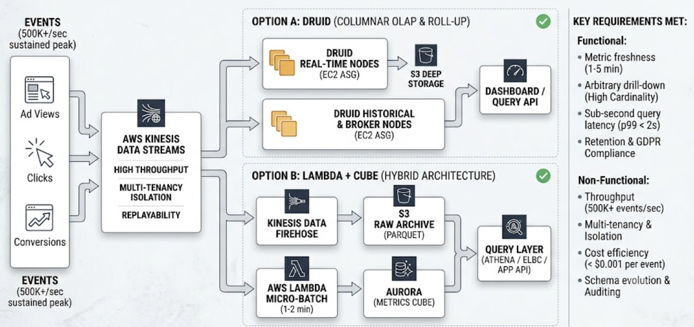
  • Metric freshness: Dashboard metrics updated within 1–5 minutes of event occurrence.
  • Arbitrary drill-down: slice metrics by any combination of dimensions (date, country, campaign, audience, creative, device, OS, browser).
  • Sub-second query latency: p99 query response <2 seconds even at 100M events/day scale.
  • Cardinality support: handle 1000+ distinct values per dimension (e.g., 50,000 unique campaigns + 200 countries + 100 audiences = high cardinality).
  • Retention policy: keep 7-day detailed data, 90-day daily rollups, 2-year monthly rollups.
  • Segmentation: support complex cohort filtering (e.g., "impressions from users in USA who saw video ads from campaign X").
  • GDPR compliance: delete all events for a user upon deletion request without impacting other users' data.

Non-Functional Requirements

  • Throughput: ingest 500K+ events/sec sustained during peak hours.
  • Tail latency resilience: infrastructure failures must degrade gracefully; query timeout >5 seconds acceptable, but p95 <1 second target.
  • Multi-tenancy: isolate metrics per advertiser/publisher; no data leakage across tenants.
  • Cost efficiency: keep per-event cost <$0.001 (100M events/month ≈ $100k budget).
  • Schema evolution: add new dimensions without downtime or full re-index.
  • Audit: who accessed which reports; track metric changes.


Simplified Architecture

AWS Real-Time Dashboards: Druid, ClickHouse, or Lambda?


Architecture Proposals

Option 1: Druid (Time-Series OLAP with Roll-Up, EC2 ASG)

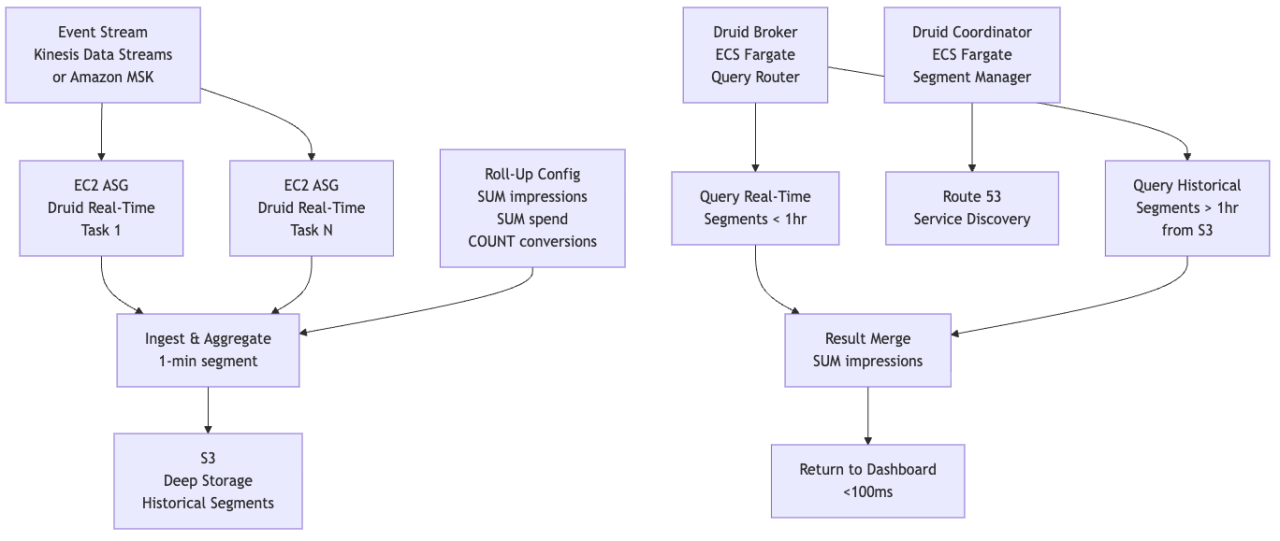
Druid is a columnar OLAP datastore designed for metrics aggregation. Events flow into Kinesis Data Streams (or Apache Kafka on Amazon MSK); Druid real-time ingestion tasks (deployed on EC2 ASG or EKS) consume from Kinesis and aggregate events into immutable segments (e.g., 1-minute segments). Historical segments are stored in S3 deep storage. Query engine (Druid broker) slices aggregated metrics by dimensions without touching raw events. Druid's roll-up feature pre-aggregates (COUNT, SUM, AVG) at ingestion time, drastically reducing storage.

AWS Real-Time Dashboards: Druid, ClickHouse, or Lambda?

Pros:

  • Roll-up efficiency: pre-aggregate COUNT, SUM at ingestion; 100M raw events collapse to 10M rolled-up rows (90% compression).
  • Fast queries: querying aggregates (already summed) much faster than raw-event scan.
  • High cardinality: designed for 1000+ dimensions; query planner optimizes to avoid full table scan.
  • Mature ecosystem: widely used in ad-tech (Airbnb, Twitter); native integrations with Kafka, S3.
  • AWS Kinesis native: Kinesis Data Streams integration via custom firehose consumer; automatic scaling.

Cons:

  • Complex semantics: roll-up configuration upfront; cannot change aggregations retroactively without re-ingestion.
  • Approximate for percentiles: COUNT aggregation exact; MEDIAN/p95 not native (requires approximation or HyperLogLog).
  • Cardinality limits: if dimension has 10M unique values (e.g., user IDs), roll-up cardinality explodes; storage not practical.
  • Schema change friction: adding new dimension requires new segment version; re-ingestion for backfill.
  • Operational complexity: managing segment indexing, handoff from real-time to historical tier, balancing across EC2 ASG nodes.

Failure Modes & Mitigations:

  • Roll-up key missing: query asks for metric not included in roll-up config. Mitigate: pre-define all likely metrics; publish roll-up schema to team; CI/CD validation.
  • Cardinality explosion: dimension has 50M unique values; roll-up becomes huge. Mitigate: exclude high-cardinality dimensions from roll-up; store raw or use approximate count distinct (HyperLogLog).
  • Kinesis lag: Druid real-time task falls behind; freshness degrades. Mitigate: multiple ingestion tasks (EC2 ASG scale-out), Kinesis partitioning per campaign to parallelize.
  • Schema evolution: new dimension added; backfill required. Mitigate: design schema with 20 custom dimensions reserved for future use; store as JSON.
  • S3 slowness: historical segment queries to S3 timeout. Mitigate: cache frequently-accessed segments in local SSD via EC2 instance store; S3 Select for pushdown filtering.

When to Choose:

  • Metrics pre-aggregated (SUM impressions by date/country/campaign) is primary use case.
  • Cardinality moderate (1,000–100,000 combinations of dimensions).
  • Team familiar with Druid operations (Apache ecosystem maturity, EKS experience).
  • Can tolerate roll-up schema upfront.


Option 2: ClickHouse (Raw-Event Columnar Store, EC2 ASG)

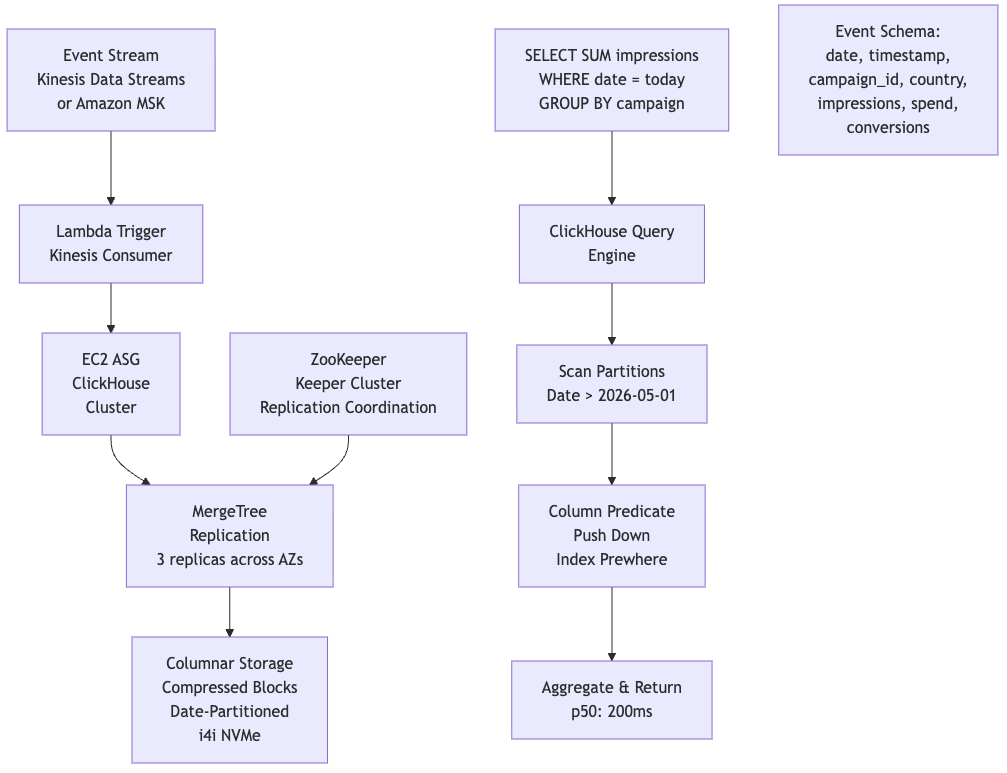
ClickHouse stores raw events as-is in a columnar format, making it ideal for flexible analytics. Kafka table engine (or Kinesis-via-Lambda) allows direct ingestion; MergeTree table engine automatic sorting and compression. Queries execute against raw data; no pre-aggregation required. Cost per event higher than Druid, but schema changes trivial (add column, resume ingestion). Deployed on EC2 ASG with i4i NVMe instances for fast local storage; replicated across AZs via MergeTree replication.

AWS Real-Time Dashboards: Druid, ClickHouse, or Lambda?

Pros:

  • Raw flexibility: store raw events; query any column combination without pre-aggregation.
  • Schema evolution: add column to table, resume ingestion; no re-indexing.
  • Native Kinesis/Kafka: Kafka table engine pulls directly; minimal latency (~5-30 seconds for MergeTree background merge).
  • Compression: columnar + LZ4/ZSTD often 10x better than row-based storage.
  • Powerful SQL: full SQL support; JOIN, subqueries, window functions, UDFs.
  • Materialized views: pre-aggregated views updated incrementally; hybrid speed + flexibility.

Cons:

  • Higher storage: raw events larger than rolled-up metrics; 100M events ≈ 500 GB vs Druid 50 GB.
  • Query cost: scan more data; queries slower than Druid aggregates (500 ms–2 sec vs 100 ms).
  • Late binding: aggregations computed at query time; scales with query volume and data size.
  • Eventual consistency: Kafka/Kinesis table buffers; visible data lags ~5 seconds behind Kinesis offset.
  • Operational overhead: auto-merging background tasks; tuning table settings (merge parameters, memory) needed. ZooKeeper coordination complexity.

Failure Modes & Mitigations:

  • Kinesis lag: ClickHouse Kafka/Kinesis table falls behind offset. Mitigate: multiple consumers on EC2 ASG, dedicated Kinesis shards per table, increase consumer batch size.
  • Query timeout: scanning 100M rows for single-day query takes >2 seconds. Mitigate: date-based partitioning (scan only relevant date); pre-materialized views for common aggregates; Prewhere optimization.
  • Schema evolution mismatch: new event format breaks old queries. Mitigate: add new columns as nullable; handle null in application query.
  • Storage growth: 500 GB raw events fill disk. Mitigate: TTL policies (delete 90+ day data); archive to cold S3 via Tiered storage.

When to Choose:

  • Schema evolving rapidly; cannot pre-define aggregations.
  • Need to answer ad-hoc questions (pivot arbitrary dimensions).
  • Team comfortable managing large datasets; has ClickHouse expertise.
  • Can tolerate higher cost per event for flexibility.


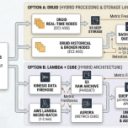
Option 3: Lambda + Cube Pre-Aggregation (Kinesis Micro-Batch to Aurora/Redshift)

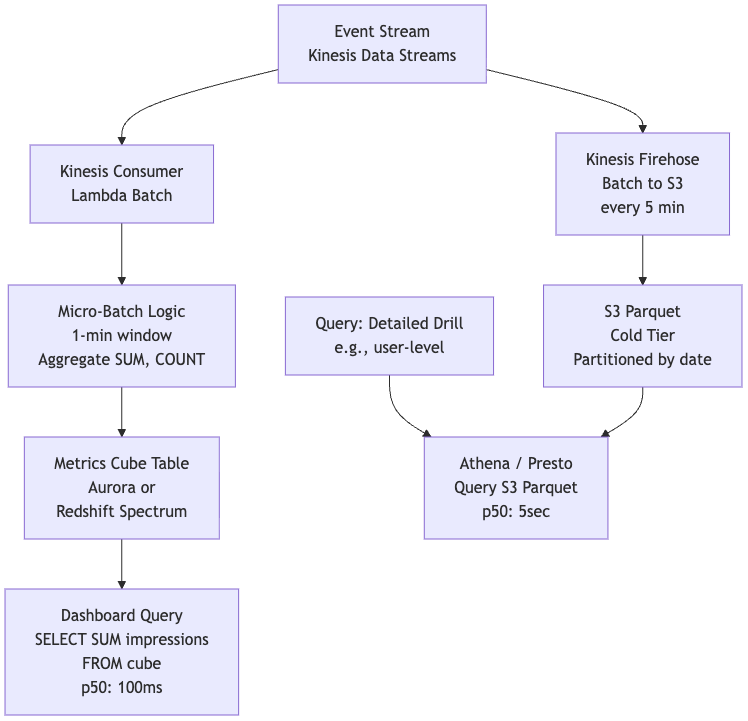
Kinesis Data Streams routes events to two paths: real-time micro-batch Lambda (every 1–2 minutes) pre-aggregates into a "metrics cube" (Aurora PostgreSQL or Redshift materialized view), and raw events archived to S3 (Parquet via Kinesis Firehose). Query layer chooses: fresh metric from cube (p50 <100ms latency), or detailed drill-down from S3 (higher latency, but fully flexible). Cube updated every micro-batch cycle; raw archive updated hourly or daily via Glue jobs.

AWS Real-Time Dashboards: Druid, ClickHouse, or Lambda?

Pros:

  • Hybrid best-of-both: real-time dashboard from cube (fast), detailed analysis from S3 (flexible).
  • Cost-effective: cube stores aggregates (cheap Aurora storage); raw S3 Parquet cold tier (very cheap, $0.005/GB/mo).
  • Flexible schema: raw S3 data stores all events; add custom dimensions without concern.
  • Decouples latency: dashboard refresh independent from drill-down data availability.
  • Easy GDPR compliance: delete user from cube (re-aggregate next cycle) + delete from S3 (Parquet rewrite via Glue).
  • Serverless (Lambda): no EC2/Kubernetes management; auto-scales with Kinesis shard count.

Cons:

  • Operational complexity: managing two data paths (cube + S3), two query engines (fast + flexible).
  • Eventual consistency: cube updates every 1–2 minutes; during cycle, stale data.
  • Cardinality constraints: cube still has dimension limits; if too many dimensions, cube explodes.
  • Data duplication: raw events in Kinesis, cube, S3; increases storage 2–3x.
  • Query routing logic: application must decide: use cube or S3? adds latency to decision; client-side logic or API gateway routing.

Failure Modes & Mitigations:

  • Cube aggregate lag: micro-batch Lambda fails; metrics stale for 2+ minutes. Mitigate: retry logic via Lambda DLQ; fall back to previous cycle's data with "as-of" indicator.
  • S3 query too slow: drill-down query on 100M+ parquet rows takes 10+ seconds. Mitigate: partition S3 by date/campaign; Athena projection-based partitioning; pre-cache common drill-downs in ElastiCache.
  • Cube + S3 divergence: metrics in cube don't match detail in S3 (e.g., due to replay/retransmit). Mitigate: daily reconciliation Lambda; alert on mismatches >0.1%; automated recompute on divergence.

When to Choose:

  • Need fast dashboard + flexible drill-down simultaneously.
  • Budget allows dual storage (cube + S3).
  • Can manage two query engines (Aurora SQL + Athena/Presto).
  • GDPR compliance simple (separate user records from metrics).
  • Prefer serverless (Lambda) over managing EC2/EKS clusters.


Comparison Table

DimensionDruid (EC2 ASG)ClickHouse (EC2 ASG)Lambda + Cube
Query Latency (p50)100 ms300–500 ms100 ms (cube), 5s (S3)
Query Latency (p99)500 ms1–2 sec200 ms (cube), 20s (S3)
Storage per Event~1 byte (rolled-up)~50 bytes (raw)~1 byte (cube) + ~40 bytes (S3)
Schema FlexibilityLow (fixed roll-ups)High (raw events)High (raw S3)
Aggregation Cardinality100K–1M combosNo limit (scan)100K–500K (cube)
Operational ComplexityMedium (EC2 ASG, coordinator)Medium-High (ZooKeeper, merges)High (Lambda + 2 engines)
Cost per Event$0.0001$0.0005$0.0003 (hybrid)
Ad-Hoc Query SupportLow (pre-defined)HighMedium (cube or slow S3)
Real-Time Freshness1–5 min5–30 sec1–2 min (cube)
AWS Service IntegrationKinesis, S3, EC2 ASGKinesis, EC2 ASG, ZooKeeperLambda, Kinesis, Aurora, S3, Athena


Recommendation

For advertiser dashboards (performance metrics): Use Lambda + Cube architecture (Option 3). Cube (Aurora or Redshift) serves hot metrics (impressions, clicks, spend by date/campaign/country) updated every minute; S3 cold tier stores raw events for detailed user-level drill-down via Athena. Advertisers get <100ms dashboard refresh and can still debug campaign performance ad-hoc. Serverless Lambda scales automatically; no EC2 management.

For publisher ad-ops dashboards: Use Druid (Option 1) if reporting is stable (standard metrics, fixed dimensions). Roll-up ensures sub-100ms query latency and low storage cost. Deploy on EKS for simplified operations; Kinesis auto-scales shards. Invest in upfront schema design; changes are painful but rare.

For product analytics / data science: Use ClickHouse (Option 2) if iterative analysis common. Raw-event storage (500 GB for 100M daily events) acceptable cost for schema flexibility. Team can afford slower queries (p50 500 ms) for one-off exploration. Materialized views can accelerate common aggregations.

Migration path (scaling):

  • Start: Lambda + Aurora cube (simple, proven, serverless).
  • Scale: Add Druid for performance-critical dashboards; keep Lambda for flexibility.
  • Mature: Multi-engine (Druid for metrics, ClickHouse for exploration, Lambda for hybrid).


Capacity & Performance Notes

Druid Cluster (EC2 ASG):

  • Ingestion: 500K events/sec into Kinesis → 10 real-time tasks (50K/sec each, m5.2xlarge instances).
  • Storage: 100M events/day with 5:1 roll-up compression = 2 GB/day indexed segments.

  • Retention: 7 days hot (14 GB) + 90 days rollup (4.5 GB) + archive to S3 cold.

  • Query latency baseline: p50 50–100 ms (aggregates), p99 200–500 ms (high cardinality).
  • Infrastructure: 3 data nodes (EC2 m5.4xlarge, 16 vCPU, 64 GB RAM, 500 GB EBS gp3 each), 2 query brokers (ECS Fargate, 4 vCPU), 1 coordinator (ECS Fargate).
  • Cost: ~$20k/month (EC2 ASG + Kinesis + S3).

ClickHouse Cluster (EC2 ASG):

  • Ingestion: 500K events/sec from Kinesis (via Lambda consumer or Kafka connector).
  • Storage: 100M events/day ≈ 5 GB/day (0.05 bytes/event after compression; i4i NVMe SSDs).
  • Retention: 7 days hot (35 GB) + cold S3 archive via TTL.
  • Query latency: p50 300–500 ms (table scan), p99 1–2 sec (multi-column filter).
  • Infrastructure: 3 shards × 2 replicas (EC2 i4i.2xlarge, 8 vCPU, 64 GB RAM, 1 TB NVMe), ZooKeeper cluster (3 nodes, m5.large).
  • Cost: ~$25k/month (EC2 ASG + Kinesis + ZooKeeper).

Lambda + Cube (Hybrid, Serverless):

  • Cube (Aurora): 100K rows aggregated every 1 min = 144M rows/day. Aurora burstable db.t4g.2xlarge can handle (16 vCPU, 32 GB RAM).
  • S3 raw events: 100M events/day = 5 GB Parquet (LZ4 compression) = 150 GB/month, ~$2.25/month storage.
  • Lambda: 1–2 Lambda functions per shard; concurrent execution auto-scales; avg 5 sec per 60-sec batch.
  • Query latency: cube p50 50 ms (Aurora), S3 p50 2–5 sec (Athena startup + scan).
  • Infrastructure: 1 Aurora burstable instance (db.t4g.2xlarge), Kinesis Data Streams (1–10 shards), Lambda (on-demand), Athena (on-demand), S3 (auto-scaled).
  • Cost: ~$15k/month (cheapest; Aurora ~$3k + Kinesis ~$2k + Lambda ~$1k + Athena ~$2k + S3 <$0.5k).

GDPR Compliance Example:

  • User requests deletion.
  • Druid: rebuild affected day's segments without user's events (1–4 hour job via batch task); segments re-published to S3.
  • ClickHouse: run mutation to delete user; compaction in background; ~30 minute latency.
  • Lambda + Cube: delete from Aurora (instant) + delete/rewrite Parquet in S3 (Glue job, acceptable next day).
Tags ClickHouse Druid Event Streaming Lambda Architecture OLAP Engine Real-Time Analytics Real-Time Dashboards Facebook X
Comments 0
Similar posts
  1. Architecting Ad Tech's Terabyte Log Pipeline - Log Aggregation
    324
  1. Building MRC-Compliant Instrumentation in Ad Tech: Implementation Steps and Key Challenges
    198
  2. The Two Clocks of Ad Server Architecture
    63
  3. Collecting Proof-of-Play from 100,000 Screens
    141
  4. Extracting Context from Live Video: The Architecture Got Simpler When We Stopped Building Features
    229
  5. The New Ad Stack Behind Live Sports Streaming: Inside SGAI, EABN, and the Standards Race to Fix Live Monetization
    649
  6. IAS IP Blocklist: Causes, Resolution, and Detection Strategies
    184
  7. What Is UniversalAdId? The Complete Guide to VAST Video Ad Tracking
    190
  8. End-to-End Contextual Video Processing Architecture for AdTech
    202
  9. UCP for AVOD: Standardizing Ad Monetization
    339
  10. Advertiser Universal Commerce Protocol (UCP) Readiness Checklist
    439
  11. SEO is dying, AEO is coming
    1,207
  12. Conditional AdSense Script Loading in Confluence
    1,412
  13. Architecting ML/LLM Ad Targeting with Kafka, Flink, FAISS, and Milvus
    279
  14. What is VAST? What is VMAP? How VAST/VMAP works?
    894
  15. Render Ad creatives using setSafeFrameConfig in Google IMA
    1,075
  16. Ad Tech Multi-Tenancy: A Spectrum of Isolation Architectures on AWS
    328
  17. Attribution's New Blueprint: Balancing Performance and Privacy
    499
  18. Ad Auction Architectures: A Publisher's Guide to Optimal Monetization
    679
  19. Ad Pacing Unpacked: Architecting Guaranteed Delivery
    352
  20. Brand Safety: AI-Driven Content Moderation on AWS
    710
  21. The Future of Programmatic Advertising: Privacy-First Strategies and Trade-offs
    513
  22. Measuring Ad Viewability: AWS Architectures for Programmatic Accountability
    474
  23. AI-Powered Ad Fraud Detection: Architectural Strategies
    331
  24. AWS Ad Exchange Disaster Recovery: Active-Active, Active-Passive, and Cell Strategies - Disaster Recovery
    1,354
  25. Architecting Ad Tech's Terabyte Log Pipeline - Log Aggregation
    324
  26. Ad Tech Edge Architectures: Reducing Latency and Offloading Work - Edge Computing
    333
  27. Achieving Zero-Downtime Deployment for Stateful Ad Servers
    1,218
  28. Ad Tech Circuit Breakers: Architectures for Resilient Bidding Engines - Circuit Breaker
    350
  29. Balancing Real-Time Ad Stats and Billing Accuracy - Eventual vs Strong Consistency
    642
  30. Scaling Sharded Databases: Taming Hot Shards with Dynamic Rebalancing
    547
Recently updated
  1. Why 100% SEO Guarantees Better User Engagement and How to Achieve It in Your Service
    27
  2. Why SPF and DKIM Are Essential for Linux Email Servers?
    24
  3. How do I create animated background for Google Meet?
    19,728
  4. MaxMind GeoLite2 vs. DB-IP Lite vs. ip-api.com: Choosing the Right Free IP Geolocation Solution
    217
  5. Meet Valkey: Why Redis Changed Its License, Why Valkey is Better, and How to Use It as a Drop-in Replacement
    85
  6. How Rogue Web Scrapers Are Stealing My Content and Destroying My Server
    153
  7. Array of arguments passed to script in PHP
    85
  8. Invalid Auction Storms in Ad Tech
    93
  9. Building MRC-Compliant Instrumentation in Ad Tech: Implementation Steps and Key Challenges
    198
  10. The Two Clocks of Ad Server Architecture
    63
  11. Frequency Cap Architecture Overview
    509
  12. Collecting Proof-of-Play from 100,000 Screens
    141
  13. Vector Search in Relational Databases (RDBs): Trends & Usage Environments
    280
  14. What is RedisVL?
    105
  15. Designing a Skill Registry Architecture: Minimize Token Usage and Maximize AI Performance
    224
  16. TPU & GPU Cluster Management Tools
    234
  17. The Concept of Scaffolding in AI Agents
    222
  18. Beyond Static Pipelines: Architecting LLM Multi-Agent Systems for Autonomous Workflow Orchestration
    576
  19. AI-DLC vs. AI-SDLC: Model-Centric vs. System-Centric AI Development
    253
  20. Fine-Tuning Open-Weight LLMs: Training, Licensing, and Deploying Custom Models with Ollama
    328
  21. Inside the Next-Generation Streaming Architecture: Ultra-Low Latency, SGAI, and AI Codecs
    197
  22. Machine Learning: Training vs. Ranking
    213
  23. The Continuous Learning Machine: Designing a Loop That Actually Turns
    217
  24. The Next-Gen Low-Latency Standards: LL-HLS & MoQ
    189
  25. Designing a Data Curation System Around a Vector Database
    215
  26. Extracting Context from Live Video: The Architecture Got Simpler When We Stopped Building Features
    229
  27. The New Ad Stack Behind Live Sports Streaming: Inside SGAI, EABN, and the Standards Race to Fix Live Monetization
    649
  28. Designing MLOps Architectures to Handle Seasonal Data Drift in EV Fleet Models
    185
  29. From 15 to 40+ FPS: Accelerating PyTorch Object Detection on Automotive ECUs
    207
  30. Understanding Data Lineage
    252