Advertiser Universal Commerce Protocol (UCP) Readiness Checklist

CK CK 3776 
Created at
Updated at  
439 0 0

What is UCP?

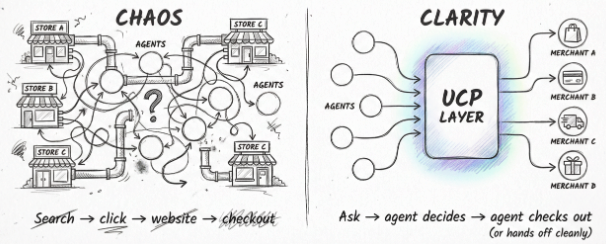
Announced in January 2026, the Universal Commerce Protocol (UCP) is a groundbreaking global standard designed to revolutionize e-commerce by creating a unified framework for digital transactions. It aims to eliminate fragmentation across various online marketplaces, payment gateways, and logistics providers by standardizing data formats for product listings, order processing, inventory management, and customer interactions. UCP seeks to foster seamless interoperability, allowing businesses of all sizes to expand their reach across diverse platforms with minimal integration effort, while providing consumers with a more consistent and secure shopping experience regardless of the vendor or platform used. This protocol is envisioned as a foundational layer for the next generation of digital commerce, driving efficiency and innovation worldwide.

Advertiser Universal Commerce Protocol (UCP) Readiness Checklist


The Universal Commerce Protocol (UCP) functions by establishing a standardized framework and common language for digital transactions, enabling seamless data exchange among various commerce participants like buyers, sellers, and service providers. It defines a unified set of rules and data formats for product information, order processing, payment instructions, and shipping updates, allowing disparate e-commerce platforms, marketplaces, and supply chain systems to interoperate efficiently, automate transactions, and streamline the entire commercial workflow without proprietary communication barriers.

Advertiser Universal Commerce Protocol (UCP) Readiness Checklist


An onboarding scorecard for OTT advertising operators to evaluate advertisers (merchants) in their ad pool and determine whether shoppable / zero-click advertising can run end-to-end without breaking.

For "see it and buy it" to work in shoppable CTV advertising, the advertiser's data must be flawless. Unlike humans, AI agents won't overlook a price mismatch or a missing policy — if the data is incomplete, the agent excludes that advertiser from agentic checkout entirely. Use this checklist to score each advertiser and sort them into Premium Shoppable Pool / Standard Pool / Remediation Required.


Scoring System (100 points total)

AreaPointsNature
A. Manifest Published (gate)Pass/FailWithout this, shoppable is impossible — scored as 0
B. Product Data Completeness30Foundation for discovery & recommendation
C. Checkout Data Completeness25Foundation for completing the transaction
D. Cross-Surface Consistency25Key to avoiding agent exclusion
E. Google Surface Signals12Activates the Buy button
F. Conversational Discovery Attributes8Strengthens recommendation visibility

Classification thresholds

  • Premium Shoppable Pool: Passes A + total ≥ 80 → premium slots, higher CPM or performance-based pricing
  • Standard Pool: Passes A + total 50–79 → standard shoppable, data improvement recommended
  • Remediation Required: Fails A, or total < 50 → data cleanup required as a condition of onboarding


A. Manifest Published (Gate — Pass/Fail)

If this fails, the advertiser is excluded from shoppable regardless of the remaining score.

Pass criteria: A1–A4 all satisfied. If any are missing, the agent excludes the site from agentic checkout, so the advertiser fails the gate.


The Universal Commerce Protocol (UCP) aims to provide a standardized, machine-readable way for services to declare their commerce offerings, making it easier for third-party clients (like smart TVs, aggregators, or voice assistants) to discover and interact with them.

For a common streaming service providing video content, the /.well-known/ucp manifest would list its various subscription tiers, rental options, or content purchases.

Here's an example of such a JSON manifest:

{
  "$schema": "https://ucp.schema.org/manifest-v1.json",
  "id": "https://www.exampleflix.com/.well-known/ucp",
  "name": "ExampleFlix Streaming Service",
  "description": "Your ultimate destination for movies, TV shows, and exclusive originals. Stream ad-free, download for offline viewing, and watch on multiple devices.",
  "homepageUrl": "https://www.exampleflix.com",
  "currency": "USD",
  "locale": "en-US",
  "contactEmail": "support@exampleflix.com",
  "offers": [
    {
      "id": "exampleflix-basic-monthly-ads",
      "name": "Basic (Ad-Supported) - Monthly",
      "description": "Access our extensive library with occasional ads. Stream in HD on one device.",
      "type": "Subscription",
      "price": {
        "amount": 7.99,
        "currency": "USD"
      },
      "billingCycle": "P1M",
      "trialPeriod": "P7D",
      "features": [
        {"name": "Resolution", "value": "HD (720p/1080p)"},
        {"name": "Ad-supported", "value": true},
        {"name": "Simultaneous streams", "value": 1},
        {"name": "Offline downloads", "value": false},
        {"name": "User profiles", "value": 3}
      ],
      "availability": [
        {"region": "US"},
        {"region": "CA"}
      ],
      "purchaseUrl": "https://www.exampleflix.com/subscribe/basic",
      "termsUrl": "https://www.exampleflix.com/terms#basic"
    },
    {
      "id": "exampleflix-premium-annual-adfree-4k",
      "name": "Premium (Ad-Free, 4K) - Annual",
      "description": "Enjoy the best quality, ad-free streaming in stunning 4K UHD. Download content and watch on up to 4 devices simultaneously.",
      "type": "Subscription",
      "price": {
        "amount": 119.99,
        "currency": "USD"
      },
      "billingCycle": "P1Y",
      "trialPeriod": "P14D",
      "features": [
        {"name": "Resolution", "value": "4K UHD"},
        {"name": "Ad-free", "value": true},
        {"name": "Simultaneous streams", "value": 4},
        {"name": "Offline downloads", "value": true},
        {"name": "User profiles", "value": 5}
      ],
      "availability": [
        {"region": "US"},
        {"region": "CA"},
        {"region": "GB"},
        {"region": "DE"}
      ],
      "purchaseUrl": "https://www.exampleflix.com/subscribe/premium",
      "termsUrl": "https://www.exampleflix.com/terms#premium"
    },
    {
      "id": "movie-space-odyssey-rental",
      "name": "Space Odyssey - Rental",
      "description": "Rent the classic sci-fi masterpiece 'Space Odyssey' for 48 hours. Available in HD.",
      "type": "Rental",
      "price": {
        "amount": 4.99,
        "currency": "USD"
      },
      "rentalDuration": "PT48H",
      "contentMetadata": {
        "title": "Space Odyssey",
        "contentType": "Movie",
        "releaseYear": 1968,
        "imageUrl": "https://www.exampleflix.com/images/space_odyssey.jpg",
        "genres": ["Sci-Fi", "Drama"]
      },
      "features": [
        {"name": "Resolution", "value": "HD (1080p)"},
        {"name": "Ad-free", "value": true}
      ],
      "availability": [
        {"region": "US"}
      ],
      "purchaseUrl": "https://www.exampleflix.com/movie/space-odyssey/rent"
    },
    {
      "id": "movie-epic-adventure-purchase",
      "name": "Epic Adventure - Purchase",
      "description": "Own 'Epic Adventure' forever. Stream in 4K UHD or download for offline viewing.",
      "type": "Purchase",
      "price": {
        "amount": 19.99,
        "currency": "USD"
      },
      "accessDuration": "P0Y0M0D", 
      "contentMetadata": {
        "title": "Epic Adventure",
        "contentType": "Movie",
        "releaseYear": 2023,
        "imageUrl": "https://www.exampleflix.com/images/epic_adventure.jpg",
        "genres": ["Action", "Adventure", "Fantasy"]
      },
      "features": [
        {"name": "Resolution", "value": "4K UHD"},
        {"name": "Ad-free", "value": true},
        {"name": "Offline downloads", "value": true}
      ],
      "availability": [
        {"region": "US"},
        {"region": "CA"}
      ],
      "purchaseUrl": "https://www.exampleflix.com/movie/epic-adventure/buy"
    }
  ]
}

Explanation of Fields:

  • $schema: (Optional but recommended) Defines the schema version used for validation. The URL is a placeholder as UCP is still evolving.
  • id: A unique URI identifying this specific UCP manifest.
  • name: The human-readable name of the service.
  • description: A brief overview of what the service offers.
  • homepageUrl: The main website of the streaming service.
  • currency: The default currency for offers in this manifest (individual offers can override).
  • locale: The default language and region for the manifest content.
  • contactEmail: An email for support or inquiries.
  • offers: An array containing details for each product or service offered.

Within Each offer Object:

  • id: A unique identifier for this specific offer within the manifest.
  • name: The human-readable name of the offer (e.g., "Premium Subscription").
  • description: Detailed information about what the offer includes.
  • type: The classification of the offer (e.g., Subscription, Rental, Purchase).
  • price: An object detailing the cost:
    • amount: The numeric price.
    • currency: The currency code (e.g., "USD", "EUR").
  • billingCycle: (For Subscription type) An ISO 8601 duration string specifying the billing frequency (e.g., P1M for 1 month, P1Y for 1 year).
  • trialPeriod: (For Subscription type) An ISO 8601 duration string for any free trial period (e.g., P7D for 7 days).
  • rentalDuration: (For Rental type) An ISO 8601 duration string specifying how long the content is accessible after rental (e.g., PT48H for 48 hours).
  • accessDuration: (For Purchase type) An ISO 8601 duration string for how long the content is accessible. P0Y0M0D or similar indicates indefinite access.
  • contentMetadata: (For Rental or Purchase types) Specific details about the media content being offered.
    • title: The title of the movie/show.
    • contentType: "Movie", "TV Show", etc.
    • releaseYear: The original release year.
    • imageUrl: A URL to a thumbnail or poster for the content.
    • genres: An array of content genres.
  • features: An array of key features included with the offer. Each feature is an object with name and value.
  • availability: An array specifying geographical regions where the offer is available (using ISO 3166-1 alpha-2 country codes).
  • purchaseUrl: The direct URL where a user can go to purchase or subscribe to this specific offer.
  • termsUrl: A URL linking to the terms and conditions specific to this offer.

This manifest would be served by the streaming service at https://www.exampleflix.com/.well-known/ucp.


B. Product Data Completeness (30 points)

For product discovery and recommendation to work, up-to-date product information must be queryable via standard APIs.

Pass criteria: Full points when each item is satisfied. Partial fulfillment (e.g., only some products carry variant data) is prorated. If custom metafields are used, they must be mapped to standard UCP fields to count (e.g., fabric_type → Material).


C. Checkout Data Completeness (25 points)

For the agent to complete payment, every checkout rule must be provided as structured data.

Pass criteria: C1–C4 are mandatory; C5 and C6 are evaluated only where they apply to the business model (if not applicable, exclude their points and re-normalize rather than awarding full marks).


D. Cross-Surface Data Consistency (25 points) — Most Important

A hard requirement for inclusion in agentic shopping. Humans overlook mismatches; agents don't.

Pass criteria: Full points when an audit finds zero mismatches. Deduct in proportion to the number of mismatches found. Use the Merchant Center Markup report to check valid / error / missing markup.


E. Google Surface Signals (12 points)

Signals that make the UCP Buy button appear in Google's AI Mode and Gemini.

Pass criteria: Mandatory if Google surfaces are used as the entry path. If targeting other surfaces only, exclude these points and re-normalize.


F. Conversational Discovery Attributes (8 points)

New attributes that strengthen the agent's recommendation visibility. Bonus-point in nature.

Pass criteria: Optional enhancement items. Their absence isn't a gate failure, but they're the differentiator that determines whether an advertiser reaches the Premium Pool (80 points).


Security & Technical Pre-Check (when the advertiser implements directly)

When an advertiser implements on their own, advise them to confirm the following beyond the data items.


Operational Application Guide

  1. Score at onboarding — Score new and existing advertisers with this table and sort into the three pools.
  2. Favor the Premium Pool — Assign premium shoppable slots to advertisers scoring ≥ 80, applying higher CPM or performance-based pricing.
  3. Guide Remediation-Required advertisers — Provide this checklist as a cleanup guide to advertisers who fail A or score < 50; promote them once they pass.
  4. Periodic re-audit — Since prices and inventory change in real time, re-check cross-surface consistency (Area D) on a regular cadence.
  5. Tie to measurement — UCP transactions leave no pageviews, sessions, or events on the advertiser's site, so build attribution separately from UCP transaction data plus your own viewing data.


This checklist is based on the UCP specification, Google Merchant Center documentation, and Shopify engineering materials published between January and May 2026. UCP is an evolving standard and feature support on Google surfaces continues to expand, so verify the latest documentation at ucp.dev and Google for Developers before applying.


Tags Advertiser Checklist CTV Advertising Data Quality Merchant Onboarding Shoppable Ads UCP UCP Readiness Universal Commerce Protocol Zero-Click Commerce Facebook X
Comments 0
Similar posts
  1. UCP for AVOD: Standardizing Ad Monetization

    337
  2. What ML Labeling Actually Is - And How to Design a Pipeline for It
    320
  3. The New Ad Stack Behind Live Sports Streaming: Inside SGAI, EABN, and the Standards Race to Fix Live Monetization
    646
  4. Why Reranking is Crucial for RAG and Agentic AI Systems?
    256
  1. Invalid Auction Storms in Ad Tech
    91
  2. Building MRC-Compliant Instrumentation in Ad Tech: Implementation Steps and Key Challenges
    194
  3. The Two Clocks of Ad Server Architecture
    61
  4. Collecting Proof-of-Play from 100,000 Screens
    139
  5. Extracting Context from Live Video: The Architecture Got Simpler When We Stopped Building Features
    228
  6. The New Ad Stack Behind Live Sports Streaming: Inside SGAI, EABN, and the Standards Race to Fix Live Monetization
    646
  7. IAS IP Blocklist: Causes, Resolution, and Detection Strategies
    183
  8. What Is UniversalAdId? The Complete Guide to VAST Video Ad Tracking
    190
  9. End-to-End Contextual Video Processing Architecture for AdTech
    202
  10. UCP for AVOD: Standardizing Ad Monetization
    337
  11. SEO is dying, AEO is coming
    1,202
  12. Conditional AdSense Script Loading in Confluence
    1,411
  13. Architecting ML/LLM Ad Targeting with Kafka, Flink, FAISS, and Milvus
    279
  14. What is VAST? What is VMAP? How VAST/VMAP works?
    893
  15. Render Ad creatives using setSafeFrameConfig in Google IMA
    1,074
  16. AWS Real-Time Dashboards: Druid, ClickHouse, or Lambda?
    619
  17. Ad Tech Multi-Tenancy: A Spectrum of Isolation Architectures on AWS
    327
  18. Attribution's New Blueprint: Balancing Performance and Privacy
    498
  19. Ad Auction Architectures: A Publisher's Guide to Optimal Monetization
    678
  20. Ad Pacing Unpacked: Architecting Guaranteed Delivery
    349
  21. Brand Safety: AI-Driven Content Moderation on AWS
    703
  22. The Future of Programmatic Advertising: Privacy-First Strategies and Trade-offs
    512
  23. Measuring Ad Viewability: AWS Architectures for Programmatic Accountability
    473
  24. AI-Powered Ad Fraud Detection: Architectural Strategies
    331
  25. AWS Ad Exchange Disaster Recovery: Active-Active, Active-Passive, and Cell Strategies - Disaster Recovery
    1,354
Recently updated
  1. Why SPF and DKIM Are Essential for Linux Email Servers?
    3
  2. How do I create animated background for Google Meet?
    19,014
  3. MaxMind GeoLite2 vs. DB-IP Lite vs. ip-api.com: Choosing the Right Free IP Geolocation Solution
    193
  4. Meet Valkey: Why Redis Changed Its License, Why Valkey is Better, and How to Use It as a Drop-in Replacement
    75
  5. How Rogue Web Scrapers Are Stealing My Content and Destroying My Server
    151
  6. Array of arguments passed to script in PHP
    83
  7. Invalid Auction Storms in Ad Tech
    91
  8. Building MRC-Compliant Instrumentation in Ad Tech: Implementation Steps and Key Challenges
    194
  9. The Two Clocks of Ad Server Architecture
    61
  10. Frequency Cap Architecture Overview
    505
  11. Collecting Proof-of-Play from 100,000 Screens
    139
  12. Vector Search in Relational Databases (RDBs): Trends & Usage Environments
    276
  13. What is RedisVL?
    102
  14. Designing a Skill Registry Architecture: Minimize Token Usage and Maximize AI Performance
    219
  15. TPU & GPU Cluster Management Tools
    229
  16. The Concept of Scaffolding in AI Agents
    217
  17. Beyond Static Pipelines: Architecting LLM Multi-Agent Systems for Autonomous Workflow Orchestration
    568
  18. AI-DLC vs. AI-SDLC: Model-Centric vs. System-Centric AI Development
    246
  19. Fine-Tuning Open-Weight LLMs: Training, Licensing, and Deploying Custom Models with Ollama
    321
  20. Inside the Next-Generation Streaming Architecture: Ultra-Low Latency, SGAI, and AI Codecs
    196
  21. Machine Learning: Training vs. Ranking
    200
  22. The Continuous Learning Machine: Designing a Loop That Actually Turns
    212
  23. The Next-Gen Low-Latency Standards: LL-HLS & MoQ
    188
  24. Designing a Data Curation System Around a Vector Database
    212
  25. Extracting Context from Live Video: The Architecture Got Simpler When We Stopped Building Features
    228
  26. The New Ad Stack Behind Live Sports Streaming: Inside SGAI, EABN, and the Standards Race to Fix Live Monetization
    646
  27. Designing MLOps Architectures to Handle Seasonal Data Drift in EV Fleet Models
    181
  28. From 15 to 40+ FPS: Accelerating PyTorch Object Detection on Automotive ECUs
    203
  29. Understanding Data Lineage
    251
  30. System Requirements and Architecture: Intelligent Priority-Based Scheduler
    159