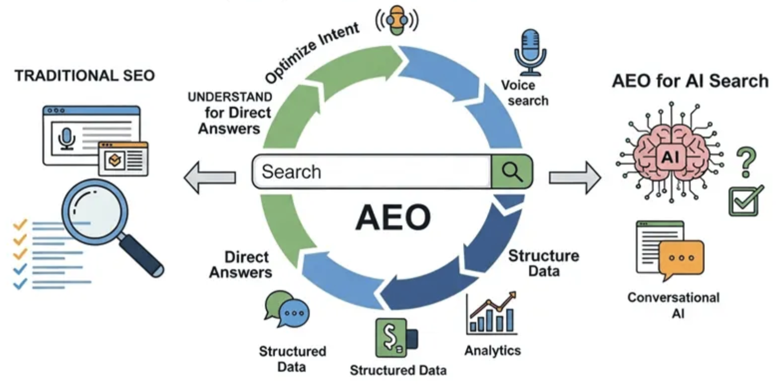
You may assume that AEO would be something like AI… AEO stands for Answer Engine Optimization. It's an evolution beyond traditional SEO, focusing on optimizing content to be directly consumed and understood by AI-powered search engines, large language models (LLMs), chatbots, and voice assistants. The primary goal of AEO is to provide immediate, precise, and accurate answers to user queries, often without requiring a click-through to a website.
Driven by the rise of generative AI in search (e.g., Google's Search Generative Experience, Bing Chat/Copilot, ChatGPT), AEO acknowledges that users increasingly seek direct solutions and summaries rather than just a list of links. It's about ensuring your information is the source an AI chooses to synthesize and present as the answer.
How AEO Differs from SEO?
While SEO and AEO share the ultimate goal of connecting users with relevant information, their methodologies, focus, and desired outcomes diverge significantly.
Feature
Traditional SEO (Search Engine Optimization)
AEO (Answer Engine Optimization)
Primary Goal
Drive organic traffic to a website via clicks on search engine results pages (SERPs).
Provide direct, concise, and accurate answers to user queries, often without a click-through.
Focus
Ranking for keywords, backlinks, technical SEO, user experience on a webpage, click-through rates.
Providing direct answers, contextual understanding, data accuracy, structured data, entity recognition, voice search.
Output
A list of blue links, rich snippets, featured snippets, knowledge panels leading to a website.
A summarized answer, a paragraph, a list, a direct response generated by an AI model.
Content Strategy
Create comprehensive articles, blog posts, product pages designed for user engagement and keyword density.
Create precise, factual, easily extractable, and verifiable information that directly answers specific questions.
User Intent
Users search for information and click through to a site to find the answer.
Users ask a question and expect an immediate, synthesized answer.
In the past, it was a model where users clicked on search results from search portals like Google or Yahoo to access a site. Now, by building data well and making AI pick it up, it will ultimately become the method to generate Ad Revenue through user clicks. It increasingly feels like a situation is being created where it's getting harder to make money with Display Ads.
What is Going to Be Important in AEO?
To effectively optimize content for AI models, prioritize clarity, conciseness, and factual accuracy, ensuring all information is verifiable, contextually rich, and adheres to E-E-A-T guidelines to establish authority. Implement robust structured data and schema markup, optimize for specific entities beyond keywords, and design content for natural language voice queries using a Q&A format with atomized, easily digestible answers. This strategic approach will enhance brand awareness and trustworthiness as AI sources your content, potentially leading to future integration via data feeds and APIs for dynamic information.
As answer engines become prevalent, optimizing for them will require a shift in strategy and a focus on the following key areas:
Clarity and Conciseness: AI models prioritize direct answers. Content must be easy for an AI to parse and extract key information from. Get straight to the point without excessive jargon or fluff.
Accuracy and Factual Verifiability: AI systems aim to provide truthful information. Content must be highly accurate, well-researched, and ideally backed by verifiable sources to be trusted by generative models.
Structured Data and Schema Markup: Implementing robust schema markup (e.g., Q&A schema, How-To schema, FAQPage schema, Article schema) helps AI models understand the context, relationships, and types of information on your page, making it easier to extract precise answers.
Entity Optimization: Move beyond just keywords to optimizing for "entities" – specific people, places, organizations, products, or concepts. Ensure that search engines and AI models understand who or what your content refers to as a distinct, recognized entity.
Contextual Understanding: While concise, answers still need to provide sufficient context. AI models are good at understanding nuance, so provide well-rounded yet focused answers that address the full scope of a user's query.
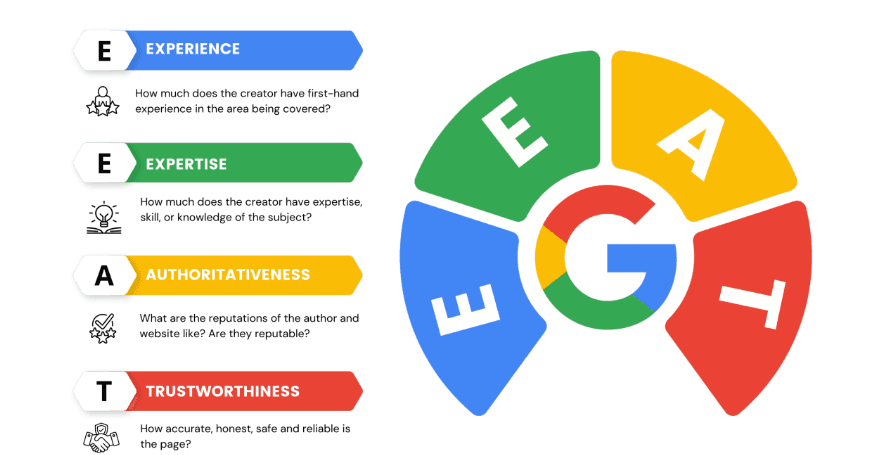
Authority and Trustworthiness (E-E-A-T): Google's E-E-A-T (Experience, Expertise, Authoritativeness, Trustworthiness) guidelines will become even more critical. AI models will prioritize information from reputable, expert sources. Build your brand's authority in your niche.
Voice Search Optimization: Design content for natural language queries common with voice assistants. This means using conversational language, answering questions directly, and focusing on long-tail, question-based keywords.
Q&A Format and FAQs: Directly addressing common questions in a clear, concise, and structured FAQ format makes content incredibly valuable for AEO. Each question should have a definitive, easy-to-understand answer.
Content Atomization: Breaking down large pieces of content into smaller, independent, answerable chunks. This allows AI models to pull out specific pieces of information without having to process an entire article.
Brand Mentions & Unattributed Awareness: While direct traffic might decrease for some informational queries, being the consistent source from which AI draws its answers can significantly boost brand awareness, reputation, and authority, even without a direct click.
Data Feeds and APIs (Future Consideration): For some businesses, especially those with frequently updated factual information (e.g., product specs, event schedules), direct data feeds or APIs to AI systems might become a method to ensure information is always current and accurate.