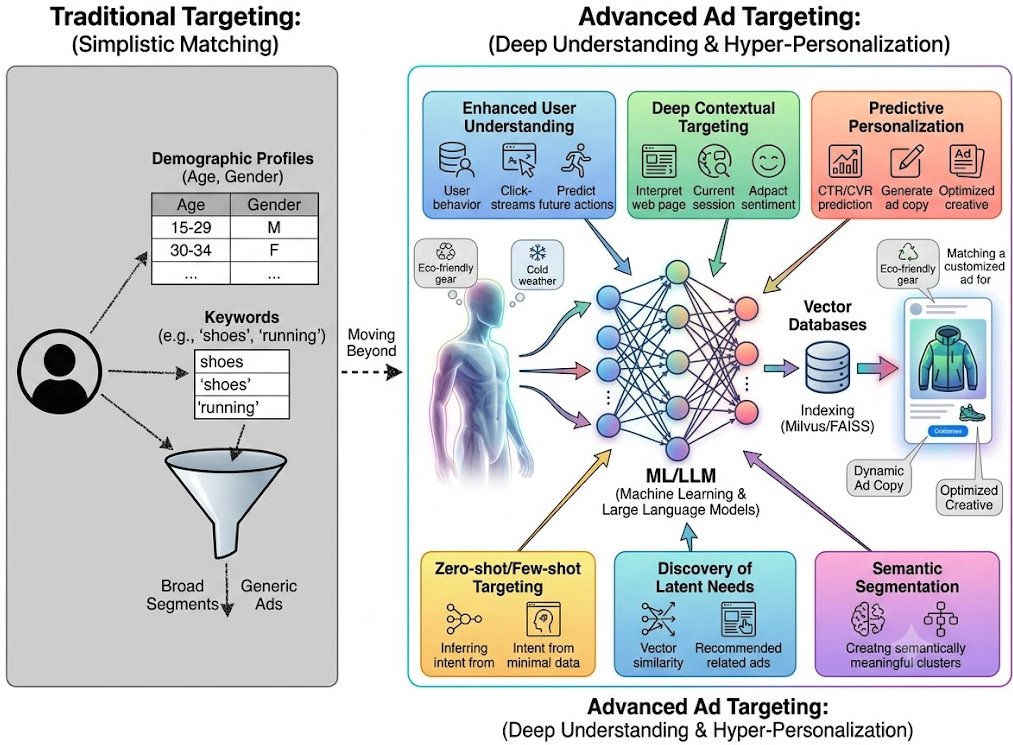
| Leveraging Machine Learning (ML) and Large Language Models (LLMs) fundamentally transforms ad targeting by moving beyond simplistic demographic and keyword matching to deep contextual understanding, intent prediction, and hyper-personalization. - Enhanced User Understanding: ML models can analyze vast amounts of user behavior data (clicks, searches, purchases, interactions) to build rich profiles, predict future actions, and identify subtle patterns. LLMs further augment this by understanding natural language queries, user-generated content, and unstructured data, extracting nuanced intent, sentiment, and latent interests that traditional methods miss.
- Dynamic Contextual Targeting: Instead of static profiles, ML/LLM systems can adapt to real-time user context (current browsing session, location, time of day, device) to serve highly relevant ads. LLMs can interpret the overall "topic" or "sentiment" of a web page or app session, allowing for precise contextual ad placement.
- Predictive Personalization: ML models predict the likelihood of a user engaging with or converting on an ad, optimizing for various KPIs (CTR, CVR, ROAS). LLMs can assist in generating highly personalized ad copy and creative variations that resonate with specific user segments or even individual users based on their inferred preferences and communication style.
- Discovery of Latent Needs: By vectorizing user interactions and ad content into high-dimensional embeddings, the system can discover connections and recommend ads for products/services users didn't explicitly search for but are implicitly interested in, based on similarity in the vector space.
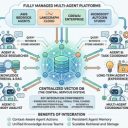
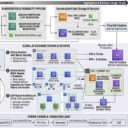
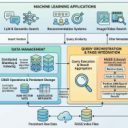
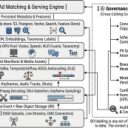
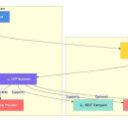
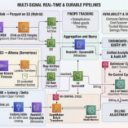
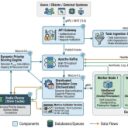
Architectural OverviewA robust architecture for ML/LLM-based ad targeting integrates real-time data processing, advanced machine learning, and scalable vector search capabilities. 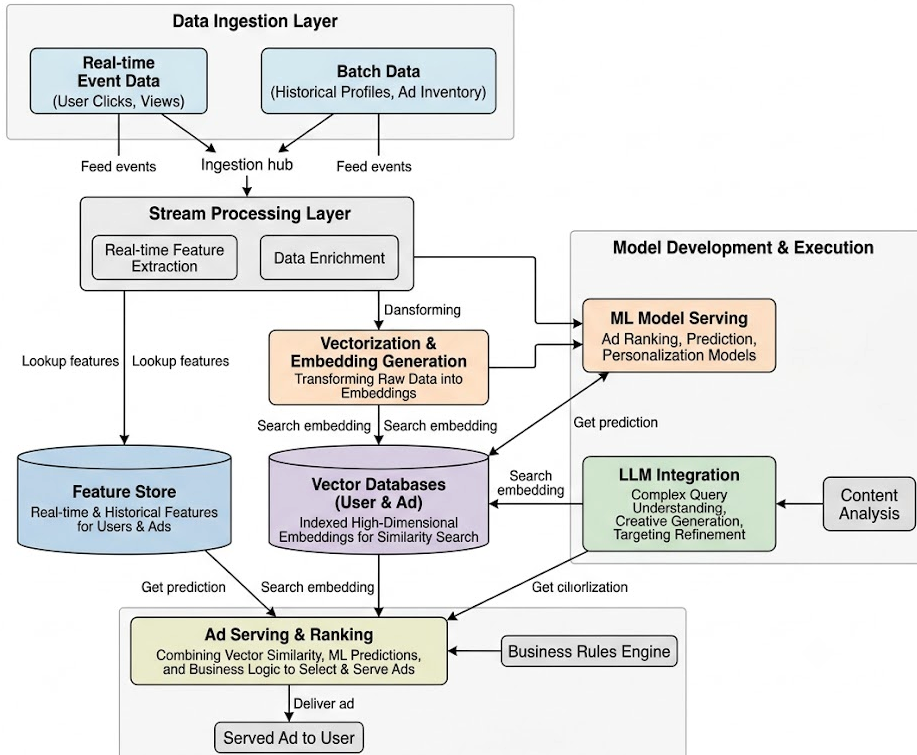
- Data Ingestion Layer: Collects real-time events and batch data.
- Stream Processing Layer: Processes real-time events, extracts features, and enriches data.
- Feature Store: Stores real-time and historical features for users and ads.
- Vectorization & Embedding Generation: Transforms raw data into high-dimensional vectors (embeddings).
- Vector Databases (User & Ad): Stores and indexes these embeddings for fast similarity search.
- ML Model Serving: Deploys trained models for ad ranking, prediction, and personalization.
- LLM Integration: For understanding complex queries, generating creative, and refining targeting.
- Ad Serving & Ranking: Combines vector similarity, ML predictions, and business logic to select and serve ads.
Integrating KafkaPurpose: Kafka serves as the central nervous system for real-time data ingestion and event streaming across the ad targeting ecosystem. It provides a highly scalable, fault-tolerant, and durable way to publish and subscribe to streams of records. 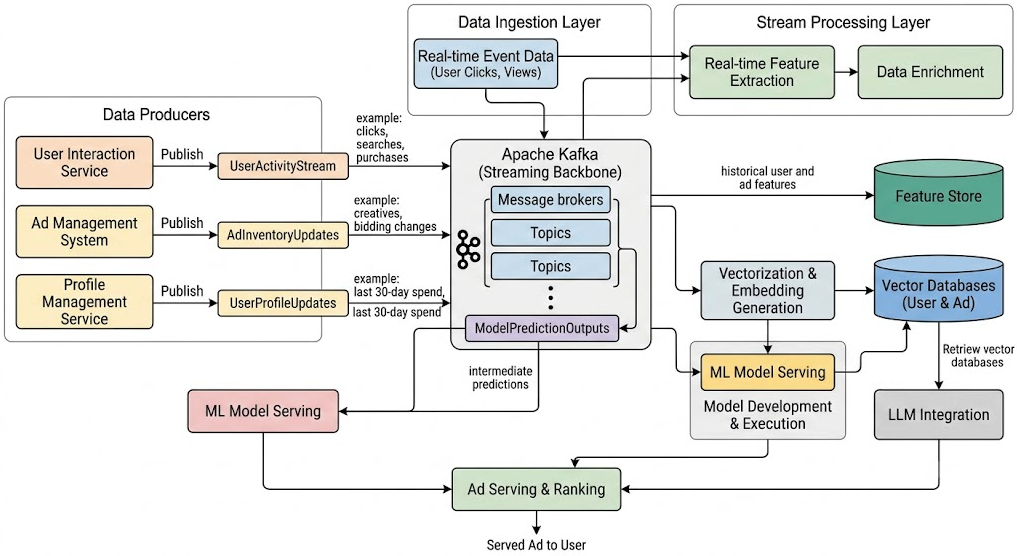
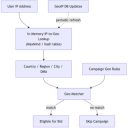
How it's used: - User Activity Stream: All user interactions (page views, clicks, searches, purchases, app usage, session start/end) are published as events to Kafka topics. This forms the primary input for real-time user profiling and feature engineering.
- Ad Inventory Updates: New ad creations, updates to existing ad creatives, bidding changes, and campaign status changes are streamed into Kafka. This ensures the ad vector database and ranking models have the most up-to-date ad information.
- User Profile Updates: Changes to user demographics, declared interests, or historical aggregate features (e.g., "total spend in last 30 days") can be pushed to Kafka for consumption by other services.
- Model Prediction Outputs: Sometimes, intermediate model predictions or feature calculations are pushed back to Kafka for consumption by other services or for audit/logging purposes.
- Decoupling Services: Kafka effectively decouples data producers from consumers, allowing different services to operate independently and scale autonomously.
Integrating FlinkPurpose: Apache Flink is a powerful stream processing framework ideal for real-time data transformation, enrichment, and feature extraction. It excels at stateful computations over data streams, making it perfect for building real-time user profiles and ad context. 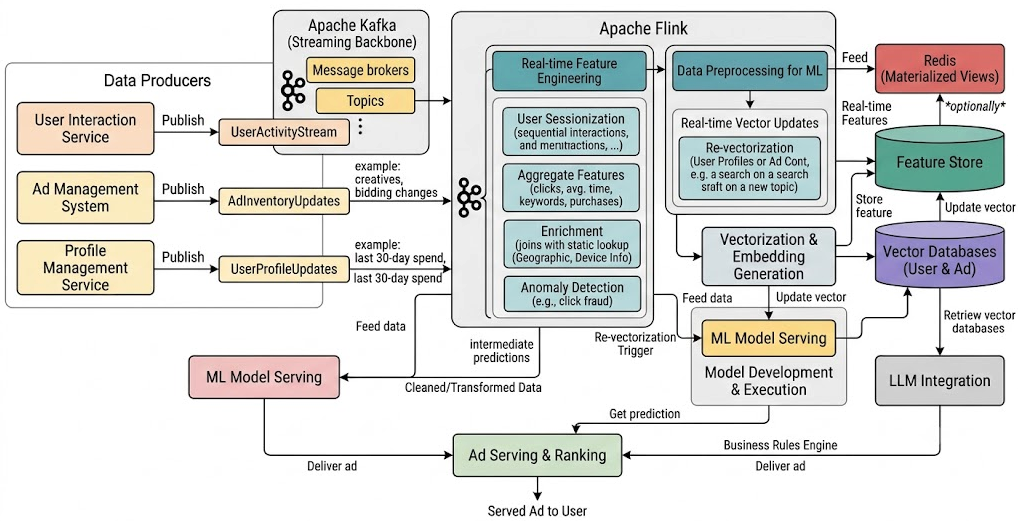
How it's used: - Real-time Feature Engineering: Flink consumes events from Kafka and performs continuous calculations:
- User Sessionization: Groups user events into coherent sessions to understand sequences of interactions.
- Aggregate Features: Calculates real-time features like "number of clicks in the last 5 minutes," "average time spent on product pages," "most recent search keywords," or "sum of purchases in the last hour."
- Enrichment: Joins user activity streams with static lookup data (e.g., geographic data, device information) to enrich events.
- Anomaly Detection: Identifies unusual user behavior (e.g., click fraud) in real time.
- Real-time Vector Updates: Flink can trigger the re-vectorization of user profiles or ad content based on new data or events. For example, if a user performs a series of searches on a new topic, Flink can update their user embedding in the vector database almost instantly.
- Data Preprocessing for ML: Cleans, filters, and transforms raw event data into formats suitable for ML model inference or feature storage.
- Materialized Views: Flink can maintain materialized views of user states or ad performance metrics, storing them in a low-latency key-value store (e.g., Redis) or pushing updates to vector databases.
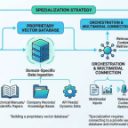
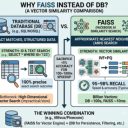
Integrating FAISS / Milvus (Vector Databases)Purpose: FAISS (Facebook AI Similarity Search) and Milvus are specialized vector databases designed for efficient storage and similarity search of high-dimensional vectors. They are crucial for performing fast lookups of relevant users or ads based on their semantic embeddings. 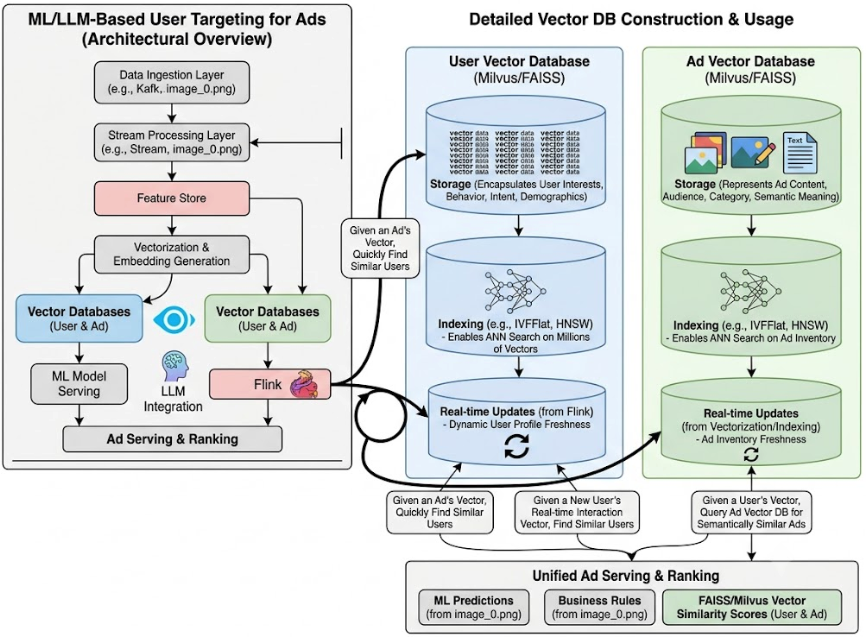
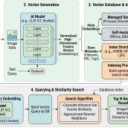
How they are used together: User Vector Database (Milvus/FAISS):- Storage: Stores high-dimensional vectors representing individual users. Each vector encapsulates a user's interests, historical behavior, demographic information, and current intent.
- Indexing: Utilizes efficient indexing algorithms (e.g., IVFFlat, HNSW) to enable approximate nearest neighbor (ANN) search on millions or billions of user vectors.
- Real-time Updates: User vectors are dynamically updated (e.g., by Flink) as new user behavior data arrives, ensuring the profiles are always fresh.
- Use Case: Given an ad's vector, we can quickly find similar users who are likely to be interested, or given a new user's real-time interaction vector, find similar users to provide personalized recommendations.
Ad Vector Database (Milvus/FAISS):- Storage: Stores high-dimensional vectors for every ad in the inventory. Each vector represents the ad's content (text, image, video), target audience, product category, and semantic meaning.
- Indexing: Similar to the user vector DB, it uses ANN indexes for fast retrieval.
- Real-time Updates: New ads or updates to existing ads are vectorized and indexed, ensuring the ad inventory is always current.
- Use Case: Given a user's vector (representing their current intent or long-term interest), we can efficiently query the Ad Vector DB to find the most semantically similar ads, even across different languages or modalities.
Detailed Vector DB ConstructionUser Vectorization StrategyThe goal is to create a dense, high-dimensional vector for each user that accurately represents their multifaceted profile, including interests, intent, and purchasing power. 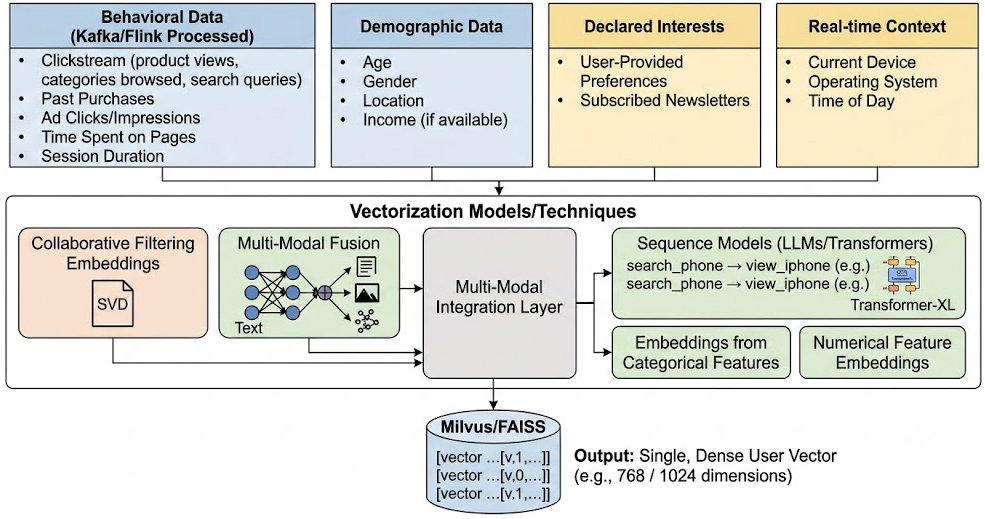
Input Data:- Behavioral Data (Kafka/Flink processed): Clickstream (product views, categories browsed, search queries), past purchases, ad clicks/impressions, time spent on pages, session duration.
- Demographic Data: Age, gender, location, income (if available).
- Declared Interests: User-provided preferences, subscribed newsletters.
- Real-time Context: Current device, operating system, time of day.
Vectorization Models/Techniques:- Sequence Models (LLMs/Transformers): For behavioral data, encode user interaction sequences (e.g.,
search_phone -> view_iphone_15 -> add_to_cart_airpods) using models like BERT, Transformer-XL, or custom-trained sequence encoders. This captures temporal dependencies and implicit intent. The final hidden state or an aggregated representation of the sequence can form the user vector. - Embeddings from Categorical Features: One-hot encoding or learned embeddings for categorical features (gender, location, device type).
- Numerical Feature Embeddings: Scale numerical features (age, income, purchase frequency) and potentially pass them through small neural networks to generate dense embeddings.
- Collaborative Filtering Embeddings: Embeddings derived from matrix factorization (e.g., SVD) on user-item interaction matrices.
- Multi-Modal Fusion: Combine embeddings from different data sources (e.g., combining text embeddings of search queries with image embeddings of viewed products) into a single, comprehensive user vector using deep learning fusion layers.
Output: A single, fixed-size dense vector (e.g., 768 or 1024 dimensions) for each unique user, stored in Milvus/FAISS. Ad Vectorization StrategyThe goal is to create a dense, high-dimensional vector for each ad that captures its content, context, and potential relevance. 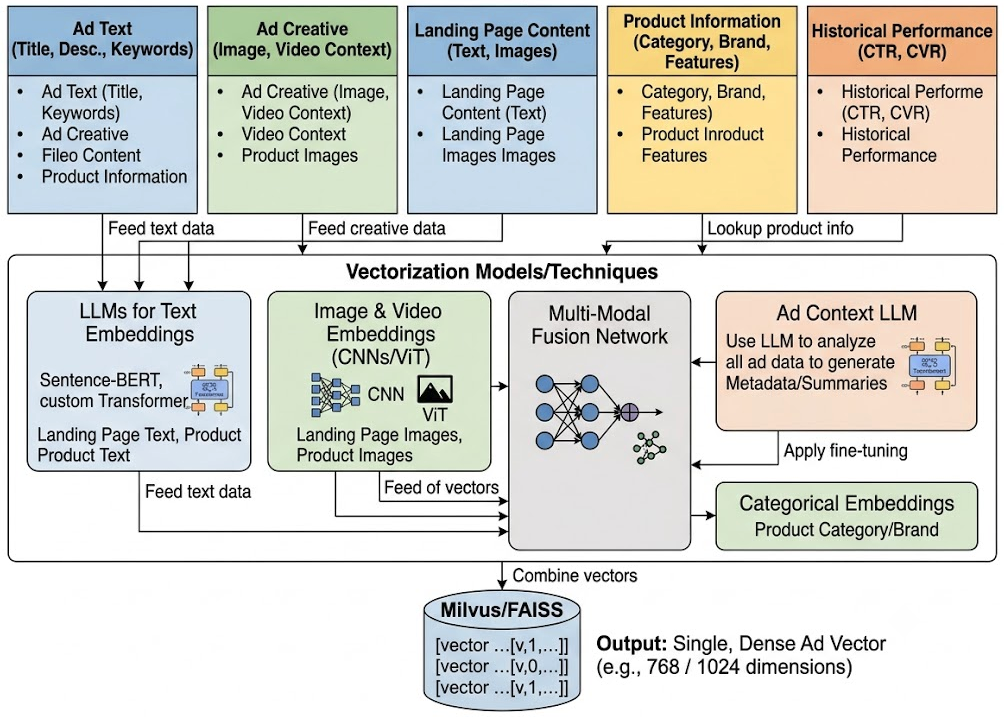
Input Data:- Ad Text: Title, description, call-to-action, associated keywords.
- Ad Creative: Image content, video content (thumbnails, keyframes).
- Landing Page Content: Text and images from the linked landing page.
- Product Information: Product category, brand, features, price, user reviews.
- Historical Performance: CTR, CVR, conversion value (can be used to fine-tune embeddings or as separate features).
Vectorization Models/Techniques:- Text Embeddings (LLMs): Use pre-trained or fine-tuned LLMs (e.g., Sentence-BERT, OpenAI Embeddings, custom transformers) to generate embeddings from ad titles, descriptions, and landing page text. This captures semantic meaning and intent.
- Image Embeddings (CNNs/Vision Transformers): Use pre-trained Convolutional Neural Networks (e.g., ResNet, EfficientNet) or Vision Transformers (ViT) to extract features from ad images and video keyframes, generating dense visual embeddings.
- Multi-Modal Embeddings: For ads with both text and images/videos, use models that combine these modalities (e.g., CLIP-like models or custom fusion networks) to create a single, unified ad vector that captures the synergy between text and visual elements.
- Categorical Embeddings: For structured ad attributes like product category, brand, or industry, use learned embeddings or one-hot encoding.
- LLM for Contextual Ad Understanding: An LLM can be used to summarize complex ad content, extract key selling points, or even categorize ads into nuanced target segments, which can then be vectorized.
Output:A single, fixed-size dense vector (e.g., 768 or 1024 dimensions) for each unique ad, stored in Milvus/FAISS. LLM's Role in Ad Targeting Beyond VectorizationWhile LLMs are crucial for generating high-quality embeddings, their utility extends further in an advanced ad targeting system: 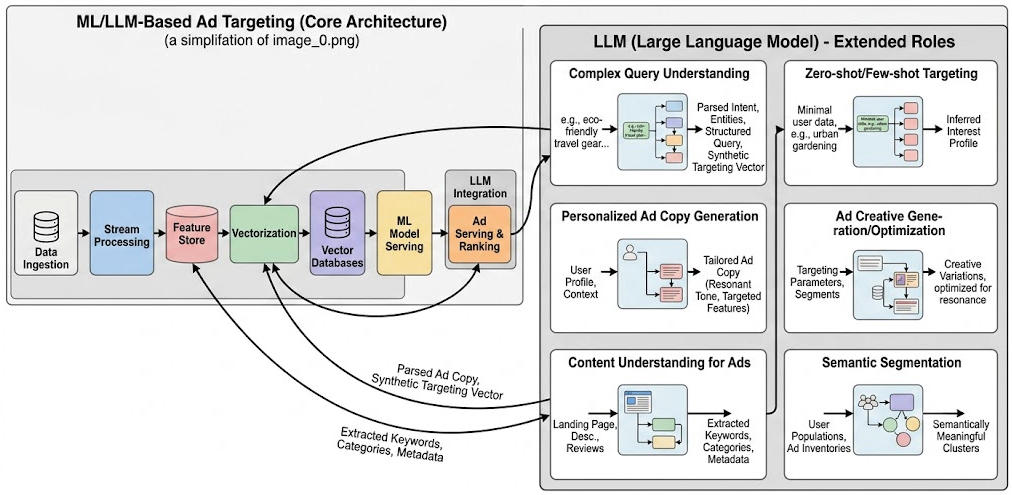
- Complex Query Understanding: When a user expresses a nuanced need (e.g., "eco-friendly travel gear for cold weather in mountainous regions"), an LLM can parse this complex natural language query, extract entities and intent, and translate it into a structured query or a synthetic vector for targeting.
- Zero-shot/Few-shot Targeting: LLMs can infer user interest based on minimal data or broad descriptions. For example, if a new user visits a page about "urban gardening," an LLM could infer a wide range of related interests without explicit rules.
- Personalized Ad Copy Generation: Based on a user's profile and current context, an LLM can dynamically generate tailored ad copy that is more likely to resonate. This includes adjusting tone, highlighting specific features, or addressing inferred pain points.
- Ad Creative Generation/Optimization: LLMs, often combined with generative AI models (image/video generation), can suggest or create variations of ad creatives that align with specific targeting parameters or user segments.
- Content Understanding for Ads: For new ads, an LLM can analyze the ad's landing page, description, and even product reviews to automatically extract keywords, categorize the ad, and generate metadata that improves its vectorization and targeting.
- Semantic Segmentation: LLMs can help segment user populations or ad inventories into semantically meaningful clusters beyond traditional categories, revealing new targeting opportunities.
By combining the real-time processing power of Kafka and Flink with the efficient vector search of Milvus/FAISS and the deep understanding capabilities of LLMs, an ad targeting system can achieve unprecedented levels of personalization, relevance, and performance. |