End-to-End Contextual Video Processing Architecture for AdTech
CK 3788 Created at Updated at
21600
A six-layer production architecture designed to ingest raw video streams and files, extract multimodal semantic insights, enforce brand safety and regulatory compliance, and output structured, ad-targetable metadata in sub-hundred-millisecond response windows.
1. System Overview & Architecture Diagrams
Contextual advertising serves as the primary privacy-compliant targeting vector following the deprecation of third-party cookies and increasing global privacy regulations (e.g., GDPR, CCPA). This platform converts unstructured pixel and audio data into structured, machine-readable metadata formatted for real-time bidding (RTB) auctions and ad-serving engines.
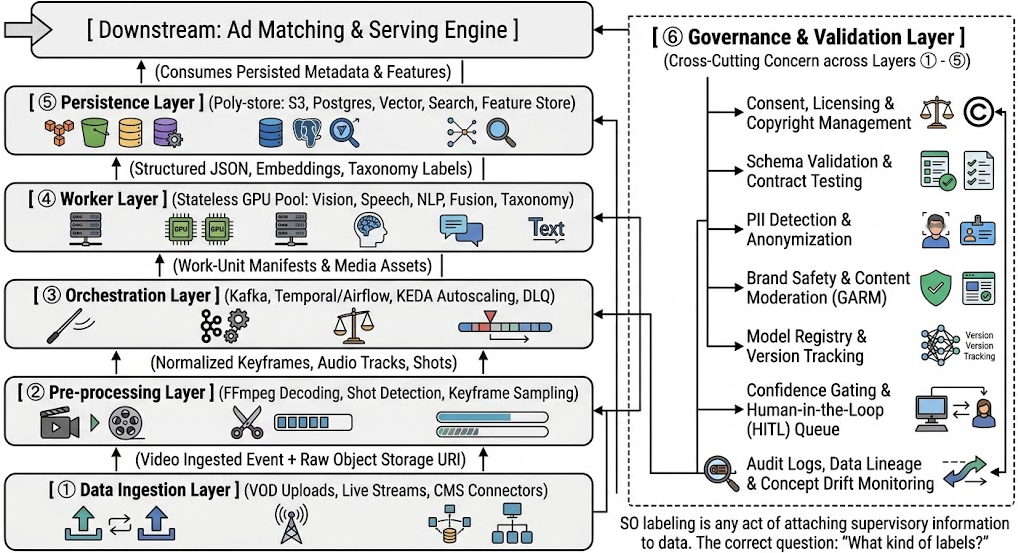
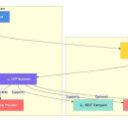
Figure 1: High-Level Architecture Flow
Data Flow (Solid Path): Unidirectional transformation pipeline from ingestion to downstream consumption.
Governance Enforcement (Cross-Cutting): Policy enforcement points intercept data transitions at every layer, feeding serving telemetry back into drift monitoring and retrain queues.
PII Detection (Personally Identifiable Information Detection): The process of automatically identifying sensitive data within text, audio, images, or video that could be used to distinguish or trace an individual's identity.
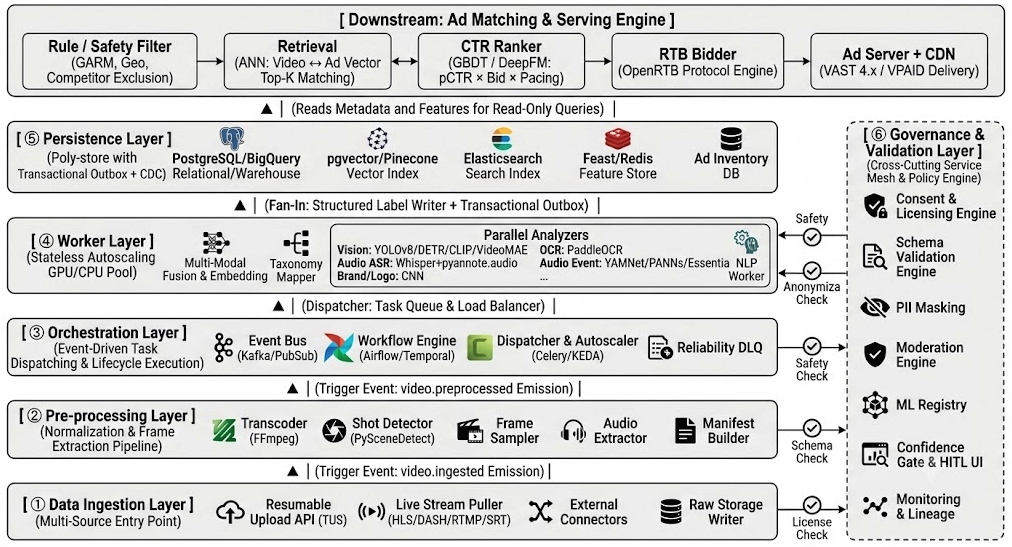
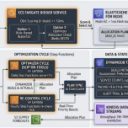
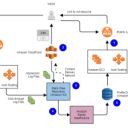
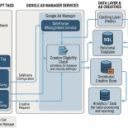
Figure 2: Detailed Technical Components & Data Pipelines
2. Deep-Dive: The 6-Layer Architecture
① Data Ingestion Layer
Function: Primary interface for receiving unstructured video content across heterogeneous ingestion channels.
Key Components:
Ingest Interfaces: Resumable upload protocols (tus), signed URL endpoints for direct client-to-bucket transfers, and live stream connection handlers (HLS, DASH, RTMP, SRT) capable of parsing embedded SCTE-35 ad-insertion cues.
Integrations: Webhook handlers and CDC pollers connected to third-party Content Management Systems (CMS) and platform APIs.
Raw Storage Writer: Persists incoming binaries as immutable objects in object storage (AWS S3, Google Cloud Storage) hashed via SHA-256 for content deduplication.
Output: Publishes a video.ingested event containing object storage URIs and metadata to the central event bus.
② Pre-processing Layer
Function: Converts raw binary video streams into standardized, granular work-units required by downstream ML models.
Key Components:
Transcoder: FFmpeg-based worker fleet standardizing variable container formats, codecs, and frame rates into unified representations (e.g., standard H.264, normalized resolution).
Shot Boundary Detector: Combines color-histogram delta analysis (HSV thresholds) with lightweight deep learning models (e.g., PySceneDetect) to identify logical scene cuts instead of fixed time slices.
Adaptive Sampler: Extracts static keyframes at variable rates (default 1–2 fps, increasing during high-motion scenes) and decouples audio into normalized 16 kHz mono PCM WAV files.
Manifest Builder: Compiles extracted asset paths, scene boundary timestamps, and stream properties into an immutable work-unit JSON manifest.
Output: Publishes a video.preprocessed event referencing the output manifest.
③ Orchestration Layer
Function: Coordinates system execution pipelines, dynamically routes workloads, manages compute infrastructure, and ensures system resilience.
Key Components:
Event Bus: Apache Kafka or cloud-native event routers handling event delivery across topics.
Workflow Orchestrators: Apache Airflow managing deterministic VOD processing DAGs; Temporal managing persistent, stateful sagas for live streams.
Dynamic Autoscaler: Kubernetes Event-driven Autoscaling (KEDA) monitoring queue depth (Kafka lag or SQS message counts) to scale worker pods dynamically.
Reliability Engine: Circuit breakers, exponential backoff retries, and Dead Letter Queues (DLQ) to quarantine malformed binaries or unparsable frames without stopping processing pipelines.
④ Worker Layer
Function: Stateless, specialized machine learning inference pool processing components of the work-unit manifest in parallel.
Key Components:
Vision Analyzers: Object detection models (YOLOv8, DETR), scene classification networks (CLIP, VideoMAE), optical character recognition engines (PaddleOCR), and specialized logo/brand recognition CNNs.
NLP & Fusion Engine: Merges temporal outputs (speech transcripts, OCR text, visual labels) into a single timeline. Applies Named Entity Recognition (NER) and sentiment models, outputs time-aligned hierarchical representations, and generates dense multimodal embeddings.
Taxonomy Mapper: Maps raw inferred labels to structured industry frameworks, specifically the IAB Content Taxonomy 3.0 and the Global Alliance for Responsible Media (GARM) Brand Safety Framework.
Function: Multi-model storage architecture (Poly-store) supporting concurrent transactional, analytical, vector, and search read patterns required by ad-serving subsystems.
Key Components:
Object Storage: S3/GCS hosting long-term raw video assets, derivative keyframes, and audio chunks with lifecycle automated transitions to cold storage (e.g., Glacier).
Relational/Warehouse Database: PostgreSQL for system transactional state and BigQuery/Snowflake for analytical processing and historical reporting.
Vector Database: High-density vector store (pgvector, Pinecone) indexing temporal embeddings using HNSW or IVF-PQ index patterns for Approximate Nearest Neighbor (ANN) vector searches.
Feature Store: Feast driving low-latency online feature retrieval (via Redis) for real-time ranking engines and offline feature exports (Parquet) for model training.
Ad Inventory Database: Dynamic store managing ad creatives, targeting parameters, advertiser balance caps, and delivery pacing configurations.
Consistency Pattern: Implements a Transactional Outbox pattern backed by Change Data Capture (CDC, via Debezium) to synchronize updates asynchronously across database instances without distributed locks.
Function: Policy enforcement framework maintaining operational control, legal compliance, output safety, and quality control across layers ① through ⑤.
Key Components:
Consent & Licensing: Validates content distribution licenses, regional permissions, and user privacy flags (GDPR, CCPA) prior to data ingestion.
Schema Validator: Enforces schema contracts (JSON Schema / Apache Avro) on all inter-layer event payloads.
PII Anonymization: Automated processing pipelines blurs detected human faces, obscures license plates, and redacts sensitive personally identifiable information (PII) from speech transcripts.
Brand Moderation: Real-time evaluation against GARM safety categories to tag or flag unsafe/sensitive inventory (e.g., violence, adult content, hate speech).
Model Registry & HITL: MLflow tracking model lineage and deployment tags. A confidence-gating threshold automatically routes ambiguous or low-confidence inference results to a Human-in-the-Loop (HITL) review queue.
Observability & Audit: OpenLineage providing end-to-end data provenance tracking, coupled with monitoring systems tracking model accuracy, data distribution shifts (concept drift), and operational Service Level Objectives (SLOs).
3. System Requirements
Functional Requirements (FR)
ID
Capability
Detailed Description
FR-1
Multi-Source Ingestion
Ingest VOD media uploads, live distribution streams (HLS/DASH/RTMP/SRT), and external CMS sources.
FR-2
Visual Entity Extraction
Extract bounding boxes, timestamps, and confidence scores for objects, scene types, logos, and OCR text.
FR-3
Audio Entity Extraction
Perform ASR transcription, speaker diarization, audio event identification, and background music/mood profiling.
FR-4
Multi-Modal Fusion
Align time-stamped vision, speech, and textual outputs into a unified, consolidated metadata document.
FR-5
Taxonomy Mapping
Translate raw inferred features into IAB Content Taxonomy 3.0 and GARM Brand Safety Framework entries.
FR-6
Multi-Tiered Storage
Persist generated metadata at video-level, segment-level, frame-level, and dense multi-modal vector formats.
FR-7
Ad-Serving API Interfaces
Expose performant read endpoints for hard-rule filters, vector ANN retrieval, ranking engines, and OpenRTB interfaces.
FR-8
Human-in-the-Loop Engine
Divert inference outputs falling below configured confidence thresholds to an internal annotation UI for human verification.
FR-9
Model & Data Lineage
Maintain verifiable mappings linking raw input files, specific model versions, and output label documents.
FR-10
Continuous Feedback Loop
Process downstream impression, click-through, and conversion telemetry to trigger drift alerts and retrain pipelines.
FR-11
Brand Safety Enforcement
Automatically flag or restrict ad serving on content containing unsafe material based on customizable policy levels.
FR-12
Consent & Rights Engine
Check licensing rules and user consent preferences prior to ingestion, indexing, or ad delivery.
Non-Functional Requirements (NFR)
ID
Metric / Attribute
Target Requirement
NFR-1
System Throughput
Batch processing capacity exceeding 5,000 video hours per day; concurrent real-time stream processing capabilities.
NFR-2
End-to-End Latency
VOD Processing: p95 < 5 minutes for a 10-minute video asset. Live Streams: p95 < 10 seconds behind play-head. Ad Match API: p99 < 100 milliseconds.
Full real-time metrics tracking latency, accuracy, compute cost, data lineage, and model concept drift per inference model.
NFR-9
Inference Determinism
Immutable model registry entries ensuring deterministic output reproduction when re-running identical input binaries.
NFR-10
Architecture Extensibility
Support pluggable addition of new worker analyzers without schema migration downtime or orchestration overhauls.
NFR-11
System Security
Least-privilege Identity and Access Management (IAM), dynamic secret management via Vault, and full encryption in transit and at rest.
NFR-12
Data Residency
Dynamic job routing engines capable of enforcing physical storage and processing locality within specified geographic jurisdictions (e.g., EU-only nodes).
4. Production Design Trade-Offs & Architectural Decisions
1. Execution Architecture: Real-time Streaming vs. Batch Pipelines
The Trade-off: Streaming architectures (Kafka + Temporal) provide low latency required for live broadcasts but introduce high operational overhead and runtime instance costs. Batch architectures (Airflow + Spot GPUs) maximize compute efficiency and lower infrastructure spending for historical archives but introduce processing latency.
Production Decision: Implement a dual-plane compute topology. Utilize an asynchronous streaming control plane (Kafka + Temporal) dedicated to live content feeds and high-priority VOD ingest. Parallelly run a batch execution plane (Airflow + Kubernetes Spot Pools) optimized for throughput to process historical catalogue backfills and routine model re-indexing.
2. Computer Vision Frame Extraction: Sampling Density vs. Compute Cost
The Trade-off: Dense frame sampling (e.g., 10 fps) minimizes the risk of missing brief product placements and enables precise mid-roll ad placement boundaries. However, GPU inference costs scale linearly with processed frame volume.
Production Decision: Deploy content-adaptive sampling. Process videos at a baseline low rate (1 fps). Automatically increase sampling rates (up to 8 fps) only when shot-boundary algorithms detect high-motion transitions or lightweight secondary filters flag commercial relevance (e.g., identifying faces, visual logos, or targeted product categories).
3. Targeting Signal Mix: Contextual Signals vs. Behavioral Profiles
The Trade-off: Purely contextual targeting relies exclusively on extracted video metadata, offering full privacy compliance at the expense of historical user intent data. Behavioral targeting offers precise personal profile alignment but faces increasing regulatory and platform limitations.
Production Decision: Adopt Context-First, Behavioral-Secondary Ranking. Use deep contextual video labels as the primary retrieval filter (candidate generation stage). Apply privacy-compliant user behavioral profiles as a downstream re-ranking adjustment layer only when explicit user consent is verified.
4. Indexing Granularity: Video vs. Segment vs. Frame Level
The Trade-off: Storing precise bounding boxes and object frame-by-frame outputs enables micro-segment ad positioning and exhaustive safety audits, but generates massive JSON payloads that slow database performance. Video-level aggregation yields small payloads but loses granular spatial-temporal context.
Production Decision: Utilize a three-tiered persistence schema:
Video-Level: Low-latency analytical database fields (Postgres/BigQuery) used for initial top-level catalog filtering.
Segment-Level: Mid-tier index structured around scene boundaries used by ad rankers to select specific mid-roll insertion points.
Frame-Level: Cold compressed storage (S3 Glacier) retaining detailed raw output matrices exclusively for compliance verification and model re-training.
5. Brand Safety Tuning: High Precision vs. High Recall
The Trade-off: Optimizing for high precision minimizes false positives, keeping ad inventory available to maximize publisher revenue, but risks occasional ad placements alongside brand-unsafe content. Optimizing for high recall guarantees brand safety by blocking ambiguous content, but drastically reduces monetizable ad inventory.
Production Decision: Implement advertiser-configurable risk profiles. Rather than enforcing a static global safety threshold across the system, publish normalized risk scores along standard GARM categories. Allow individual advertisers to set custom tolerance thresholds within campaign definitions.
6. Model Compute Strategy: Managed Vision APIs vs. Self-Hosted Models
The Trade-off: Third-party managed APIs (e.g., Google Cloud Video Intelligence) offer fast initial setup but quickly become cost-prohibitive at high video processing volumes. Self-hosted models (e.g., YOLO, Whisper running on Triton Inference Server) lower unit economics at scale but require dedicated MLOps, deployment, and model maintenance resources.
Production Decision: Implement an abstraction layer pattern. Launch early-stage models or niche analysis capabilities using external managed APIs behind standardized interface contracts. Migrate high-volume processing modules (ASR, Object Detection) to self-hosted, autoscaling Triton GPU inference clusters once processing volume crosses economic break-even thresholds (~1,000 GPU-hours/month).
7. Poly-Store Consistency: Distributed Transactions vs. Eventual Consistency
The Trade-off: Coordinating synchronous distributed transactions (Two-Phase Commit) across relational DBs, vector indexes, and search engines guarantees strict cross-system state consistency, but introduces system fragility and latency spikes. Eventual consistency reduces system friction but allows temporary search index mismatches.
Production Decision: Implement the Transactional Outbox Pattern with Change Data Capture (CDC). Primary state changes write atomically to the relational database alongside an outbox log entry. A CDC engine (Debezium) asynchronously processes log entries to populate vector databases, search clusters, and feature stores. This preserves high system throughput while keeping cross-database propagation delays under one second.
8. Quality Assurance Strategy: Fully Automated Inference vs. Human-in-the-Loop (HITL)
The Trade-off: Fully automated model inference yields fast, low-cost processing, but risks degrading ad suitability when handling edge cases or localized content nuances. Manual human review guarantees high metadata quality, but adds processing latency and operational labor costs.
Production Decision: Deploy confidence-gated routing. Inference outputs scoring above predefined confidence limits bypass manual queues and transition directly to active persistence stores. Payloads yielding low confidence metrics are automatically routed to human reviewer queues, with validated corrections appended to system gold-standard evaluation datasets for model fine-tuning.
9. Taxonomy Standardization: Industry Standards vs. Internal Custom Vocabularies
The Trade-off: Custom internal taxonomies provide granular, platform-specific content classifications that can optimize specialized internal ad matchers. However, external Demand-Side Platforms (DSPs), Supply-Side Platforms (SSPs), and standard RTB bidders operate exclusively using standard industry formats (IAB, GARM).
Production Decision: Maintain a dual-emission label engine. Map internal metadata outputs to standardized IAB Content Taxonomy 3.0 and GARM frames for external programmatic RTB bidding, while simultaneously storing detailed internal granular labels to power custom downstream matchers and internal ad products.
10. Creative Processing Cold-Start: Embeddings vs. Historical Click Performance
The Trade-off: Newly introduced ad creatives lack historical interaction data (CTR, completion rates), causing statistical scoring models to deprioritize them in favor of established creatives.
Production Decision: Use multimodal vector space projection with contextual exploration budgets. Map incoming ad creative assets directly into the shared vector space using visual/text embeddings (CLIP) to enable semantic matching on day one. Allocate a dynamic exploration budget (via Multi-Armed Bandits / Thompson Sampling) to deliver new ad creatives to target contexts and rapidly capture empirical performance metrics.
11. Feature Computation: Real-time On-demand vs. Batch Pre-computation
The Trade-off: Extracting contextual features on-demand upon receiving an ad request is impossible within sub-100ms RTB response constraints. Conversely, pre-computing all features creates a unavoidable indexing delay for live breaking streams.
Production Decision: Use tiered feature generation. VOD pipelines leverage fully pre-computed and indexed feature profiles. Live content streams utilize a fast-path pipeline that extracts coarse, high-level features within seconds, followed by an asynchronous deep-pass pipeline that updates the active feature store with granular metadata over time.
12. Geographic Data Operations: Global Replication vs. Regional Data Residency
The Trade-off: Replicating processed contextual metadata across global datacenters optimizes downstream lookup latencies for worldwide bidders, but risks breaching strict regional data privacy laws (e.g., GDPR data localization mandates).
Production Decision: Enforce regionally-pinned PII with global non-PII replication. Strip, blur, and store localized personal identifiable information and raw video binaries exclusively within their home geographic jurisdictions. Anonymized, non-PII contextual labels and mathematical vector embeddings are globally replicated across edge caches to optimize programmatic bidding latency.
5. Strategic Conclusion
Building an enterprise video-to-metadata processing pipeline requires balancing model accuracy, low-latency execution, operational scalability, and cost efficiency.
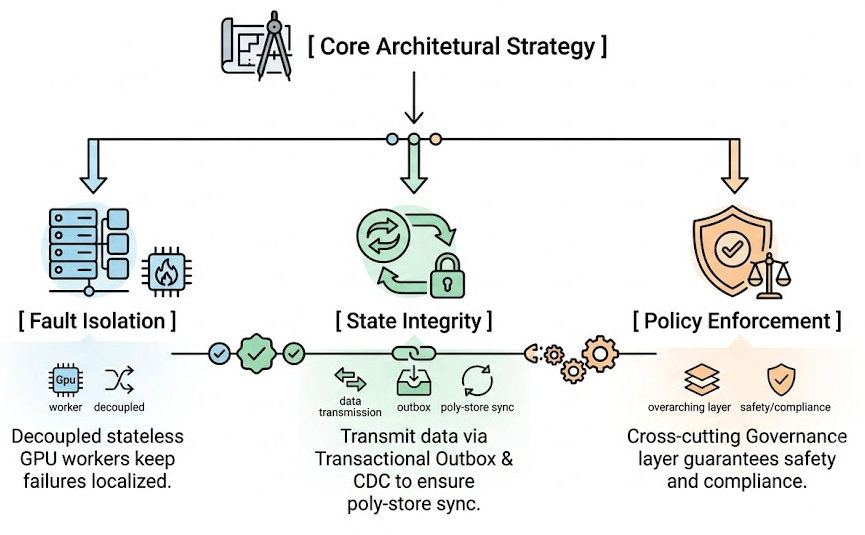
By decoupling stateless machine learning inference modules, relying on robust event-driven orchestration platforms, synchronizing poly-store databases via transactional outbox patterns, and embedding compliance governance directly into every step of the pipeline, this architecture converts unstructured video into ad-safe, monetization-ready data assets at production scale.