What Is UniversalAdId? The Complete Guide to VAST Video Ad Tracking
CK 3788 Created at Updated at
20600
What is UniversalAdId?
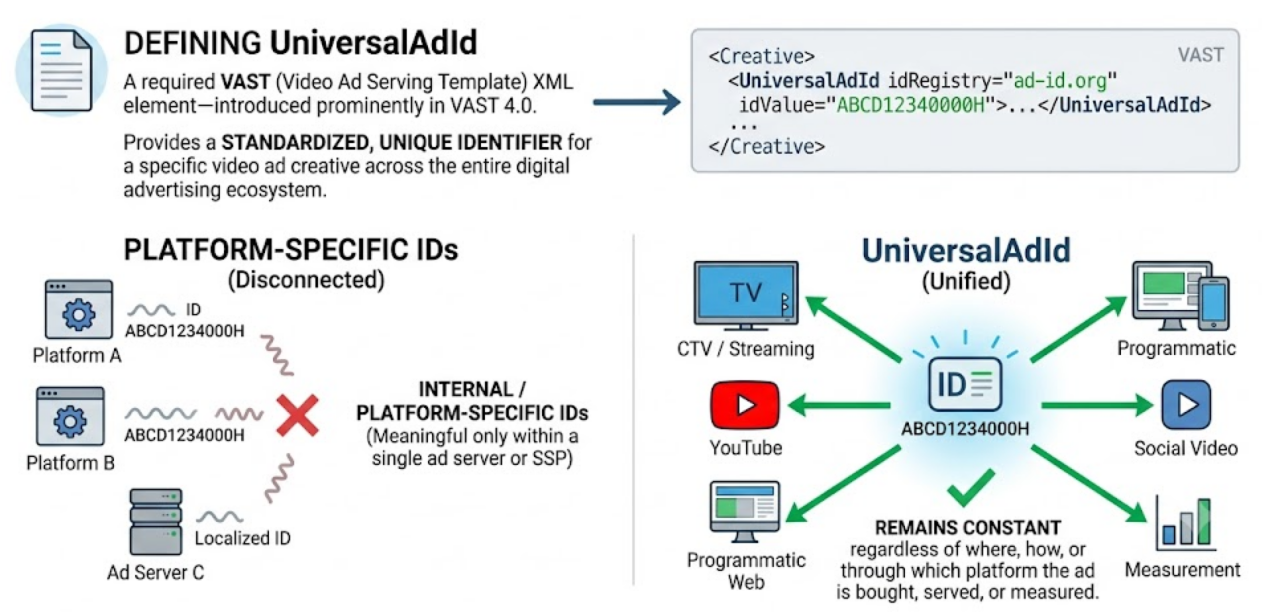
UniversalAdId is a required VAST (Video Ad Serving Template) XML element—introduced prominently in VAST 4.0—that provides a standardized, unique identifier for a specific video ad creative across the entire digital advertising ecosystem.
Unlike an internal ID or a platform-specific ID (which only have meaning within a single ad server or Supply-Side Platform), a UniversalAdId remains constant regardless of where, how, or through which platform the ad is bought, served, or measured.
VAST XML Structure
In a VAST tag, the UniversalAdId element is nested directly under the node:
<Creative id="12345" sequence="1">
    <UniversalAdId idRegistry="ad-id.org" idValue="ABCD1234000H">
        ABCD1234000H
    </UniversalAdId>
    <Linear>
        <!-- MediaFiles and TrackingEvents go here -->
    </Linear>
</Creative>
Why is UniversalAdId Important?
As video advertising migrated toward programmatic ecosystems, Connected TV (CTV), and multi-platform distribution, tracking individual ad assets became fragmented. The UniversalAdId solves key industry challenges:
1. Cross-Platform Ad Tracking and Deduplication
An advertiser might run the exact same video creative across YouTube, Hulu, linear TV, and programmatic web inventory. Without a universal identifier, each platform assigns its own local ID, making it impossible to unify reporting. UniversalAdId allows advertisers to track performance, reach, and frequency of a specific creative across all channels.
2. Frequency Capping across Supply Paths
To avoid ad fatigue, publishers and Supply-Side Platforms (SSPs) need to limit how many times a user sees the same ad. If an ad is routed through multiple Demand-Side Platforms (DSPs) or ad networks, local IDs fail to prevent over-exposure. UniversalAdId enables cross-system frequency capping.
3. Competitive Separation and Podding
In CTV and streaming environments, ad pods mimic traditional TV commercial breaks. Publishers use UniversalAdId to enforce rules such as:
Preventing two identical ads from playing back-to-back in the same pod.
Ensuring competing brands (e.g., two rival automotive companies) do not appear in the same commercial break.
4. Creative Verification and Quality Control
Publishers and automated systems use the ID to audit ads for brand safety, policy compliance, malware, or audio loudness standards before serving them. Once an ID is flagged or approved, that status can apply everywhere the ad appears.
Is There a Standard Format?
The structure of the UniversalAdId element is defined by the IAB (Interactive Advertising Bureau) VAST specification, but the formatting of the ID value itself depends on the Registry that issues it.
Required Attributes
The element relies on two key attributes:
idRegistry: Identifies the organization, system, or authority issuing the ID.
idValue: The specific unique alphanumeric string assigned to the creative by that registry.
Common Standard Registries
Registry (idRegistry)
Domain / Authority
Description
Ad-ID
ad-id.org
The primary standard used in North America (jointly developed by 4A's and ANA). Typically 12 alphanumeric characters (e.g., ABCD1234000H).
Clearcast
clearcast.co.uk
The standard registry used heavily in the UK commercial broadcasting industry.
ARPP
arpp.org
The French regulatory authority for advertising content.
Unknown / Custom
unknown
Used as a fallback when no official registry ID is available.
Default / Fallback Format
If an ad does not have a registered ID from a recognized body, VAST 4.x specifications require the registry attribute to be set to unknown and the value to be set to unknown or a proprietary internal string:
The process for acquiring a UniversalAdId depends on your role in the supply chain:
1. For Advertisers and Agencies (Creation Phase)
Register with an Ad Authority: Sign up with an official advertising registry such as Ad-ID (in the US) or Clearcast (in the UK).
Generate the ID: During the post-production/trafficking phase, create a new asset record in the registry system by entering metadata (brand, campaign title, media type, runtime).
Assign to Asset: The system generates a unique identifier (e.g., ACME1234000H). This ID is permanently attached to the slate of the video file and entered into the ad-server platform.
2. For Ad Servers and DSPs (Distribution Phase)
Automated Injection: When trafficking a campaign, the ad server pulls the registered ID from the creative asset metadata and automatically populates the tag when rendering the VAST XML response.
Fallback Generation: If an agency does not supply an official Ad-ID, modern DSPs and ad servers automatically populate the field using internal unique identifiers or automated digital fingerprinting algorithms (e.g., generating an MD5/SHA256 hash of the video file) paired with idRegistry="unknown".
3. For Publishers and SSPs (Ingestion Phase)
Publishers do not generate this ID. Instead, their video players and ad servers parse the incoming VAST XML file to extract the idRegistry and idValue from the node for ad decisioning, deduplication, and analytics.