The New Ad Stack Behind Live Sports Streaming: Inside SGAI, EABN, and the Standards Race to Fix Live Monetization | ||
| ||
| Ninety-six of the hundred most-watched U.S. television broadcasts of 2025 were live sports. eMarketer projects that by 2030, one-quarter of every ad delivered to a U.S. television screen will be tied to live sports or the programming that surrounds it. Sports advertising is expected to reach $25 billion in the U.S. by 2030 — growing nearly four times faster than the overall linear and streaming TV market. That is the demand side of the story. The supply side is that most of this content is no longer arriving through a broadcast cable — it is arriving through streaming apps. Amazon Prime Video runs the NBA and NFL Thursday Night Football. Peacock carries Sunday Night Football, Premier League, and the Olympics. Apple TV+ runs MLB, MLS, and starting in 2026, Formula 1. YouTube TV holds the NFL Sunday Ticket. Paramount+ has UFC. Netflix has WWE Raw and NFL Christmas Day games. Fifty percent of U.S. connected sports viewers now watch live sports mostly via streaming apps, up 29% year-over-year, while traditional TV usage has fallen 18%. The technical problem this creates is not obvious from the outside: the ad-insertion stack that streaming platforms have used for the last decade was not designed for live sports. It was designed for video-on-demand, where breaks are predictable, timing is generous, and concurrent audiences do not spike into the tens of millions in a single second. Live sports breaks every one of those assumptions. This post is about what the industry is building to fix that — the architecture called Server-Guided Ad Insertion (SGAI), the operational technique that makes it stable in production (Early Ad Break Notification and its cousins), the standards bodies rewriting the specs to support it, and the technical barriers that still keep it from being universal.
Part 1: Why SSAI Breaks Under Live SportsTo understand SGAI, you have to understand what it is replacing. Digital video ad insertion has evolved through three architectures. Client-Side Ad Insertion (CSAI) was the original approach. The player holds two sources — content and ads — and when it reaches a break, it calls the ad decision server, downloads the ad, and plays it, then resumes content. CSAI gave you accurate client-side measurement and interactivity, but it lost ads to ad blockers, struggled on smart TVs, and produced visible playback seams at every break. Server-Side Ad Insertion (SSAI) emerged to fix those problems. In SSAI, a streaming origin rewrites every viewer's manifest in real time to splice personalized ad segments into the same byte stream the content itself rides on. From the player's perspective, ad-enhanced content looks like one continuous program — no buffering, no "content then ad." SSAI became the dominant monetization path for connected TV, FAST channels, and pay-TV-style OTT because it survives ad blockers, plays on every device without a custom SDK, and produces a TV-like viewing experience. The problem is that SSAI was optimized for video-on-demand's constraints. Ads are planned in advance. There is no room to adjust or cancel a break in real time. The pipeline — ad decisioning, creative fetch, transcoding, and stitching — takes time. In low-latency live streams, there is no room for delays. Trying to make last-minute changes risks interrupting the stream. This rigidity makes SSAI structurally unable to respond to what actually happens in a live sports broadcast: a sudden timeout, an injury review, a pitching change, breaking news, a spike in concurrent viewers when the game gets close. Server-Guided Ad Insertion (SGAI) is the industry's answer.
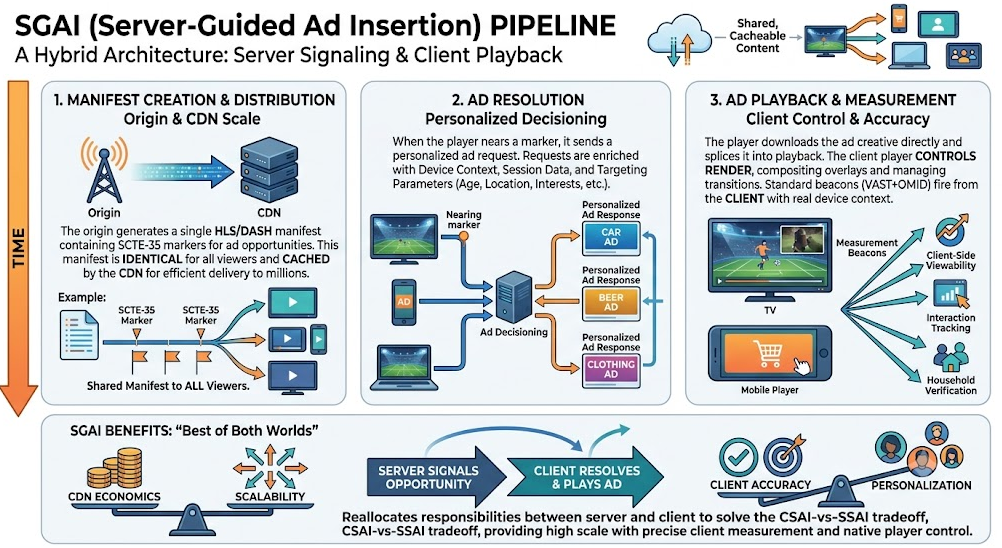
Part 2: What SGAI Actually IsSGAI is a hybrid. The server signals where the ad opportunity is — via SCTE-35 markers surfaced through HLS Interstitials or MPEG-DASH events in a shared, cacheable manifest — and the client-side player resolves and plays the ad. The split matters: shared content stays cacheable at CDN scale, while each viewer's ad experience is personalized on the device. Concretely, the pipeline runs in three stages:
Because the player controls rendering, it can composite overlays, honor interactive formats, and manage the transition natively. Because the manifest is shared, the CDN economics of SSAI are preserved. Because measurement fires from the client, it matches CSAI's accuracy. This is why the phrase "best of both worlds" keeps showing up in the industry literature. It is not marketing hyperbole. It is describing an actual reallocation of responsibilities between server and client that solves the CSAI-vs-SSAI tradeoff the industry has been stuck with for a decade.
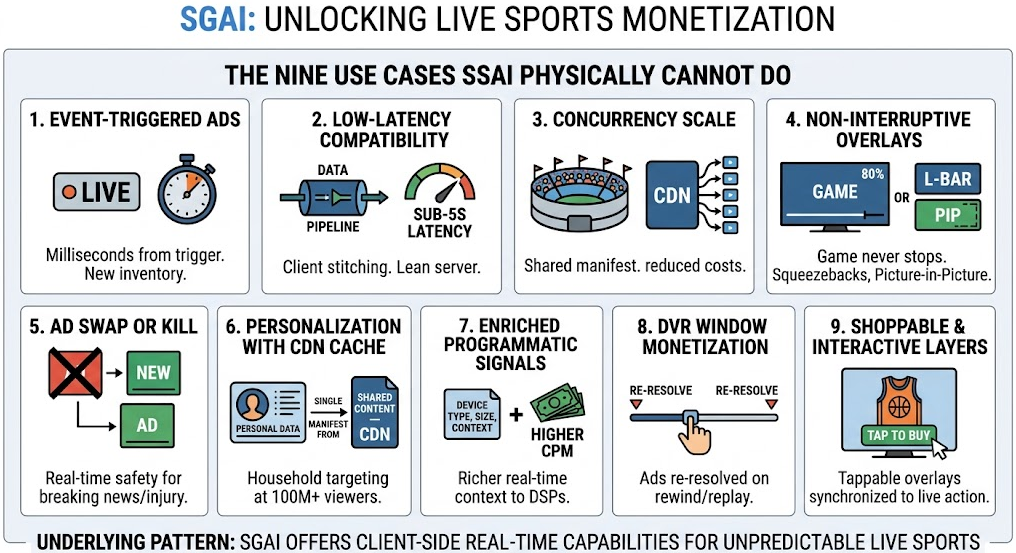
Part 3: The Nine Use Cases SGAI Unlocks for Live SportsEvery reason to run SGAI on a live sports stream traces back to something SSAI physically cannot do. Nine matter in production. 1. Event-triggered ads at natural game breaks. Live games do not have fixed three-minute commercial pods. They have timeouts, injuries, pitching changes, VAR reviews, substitutions, and halftimes that arrive when they arrive. SSAI's 15–30 second stitching latency means by the time an ad is prepped, the break is over. SGAI, paired with Google's Early Ad Break Notification API, can insert an ad within milliseconds of a live trigger — creating incremental inventory that literally did not exist before. 2. Low-latency streaming compatibility. Live sports is racing toward sub-five-second glass-to-glass latency to keep pace with social spoilers and betting integrations. SSAI's stitching hops fight against low-latency architectures. SGAI offloads stitching to the client, keeping the server path lean. 3. Concurrency scale for tentpole events. Super Bowl, World Cup final, NBA Finals Game 7. SSAI requires per-viewer manifest manipulation for each concurrent stream. SGAI eliminates that requirement by keeping the content manifest shared, dramatically reducing origin and CDN cost per viewer at peak. 4. Non-interruptive overlay formats. SSAI can only do full-frame ad breaks — you cut away from the game. SGAI unlocks L-bars, squeezebacks, picture-in-picture ads, and in-play overlays that share the frame with live action. A squeezeback shrinks the game to 80% of the screen during a free throw; an L-bar wraps sponsor branding around a football snap. The game never actually stops. 5. Late-breaking ad swap or kill. If a player gets injured on-camera or breaking news hits, brands do not want their beer or car ad running against that footage. HLS Interstitials let a broadcaster add a new DateRange with the same ID and set 6. Personalization without sacrificing CDN cache. At tentpole scale, SSAI's per-viewer manifest rewriting destroys CDN cacheability — millions of unique manifests instead of one shared one. SGAI keeps the content manifest shared and cacheable while personalizing only the ad resolution. This is what makes household-level targeting economically viable at 100M-concurrent-viewer scale. 7. Enriched programmatic signals for higher CPMs. Because the client participates in the ad decision, SGAI can send richer real-time context to DSPs — player size, device type, budget thresholds, content type — than SSAI's server-only call. On live sports inventory already commanding $30–65 CPMs, richer signals translate directly to higher fill and higher clearing prices. 8. DVR window monetization. Sports viewers scrub back constantly. Ads originally stitched into the live edge often make no sense on replay 20 minutes later. SGAI lets the ad be re-resolved every time the DVR playhead crosses a break marker. Around 12% of live streams enter DVR mode, so this is meaningful additional inventory. 9. Shoppable and interactive layers tied to live moments. This is where NBA on Prime lives. The client player is holding the ad decision, so it can also render interactive overlays synchronized to what is happening on the field — a jersey shown on screen becomes tappable, a betting prompt appears during a timeout, a poll pops up before a free throw. SSAI cannot do this because the ad is baked into the pixel stream by the time it hits the player. SGAI keeps the ad as a first-class object the client can decorate. The underlying pattern in all nine: live sports has unpredictable timing, high concurrency, tight latency budgets, and demands non-interruptive formats. SSAI was designed for VOD, where none of those constraints applied. SGAI is the industry rebuilding the split of responsibilities so the client can do what only a client can do in real time.
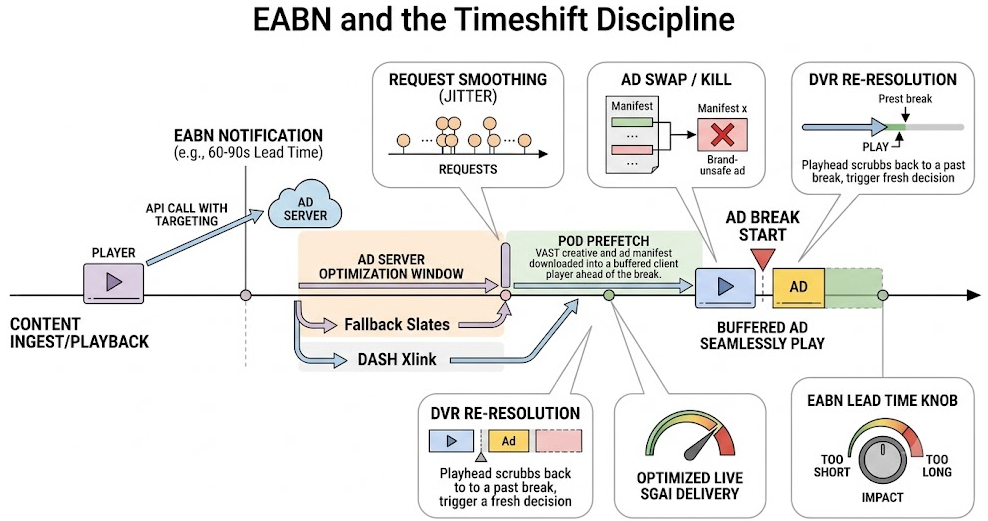
Part 4: EABN and the Timeshift DisciplineGoogle's Early Ad Break Notification (EABN) API is not a standard — it is a Google Ad Manager product feature — but it has become the reference implementation for a broader technique that every serious SGAI deployment now uses. The core idea is straightforward: instead of asking the ad server to decide an ad at the moment the break starts (which is what SSAI effectively does and what creates the "knife-edge" surge problem), push that decision earlier in time. Google recommends calling EABN approximately one minute or more before each scheduled ad break, with targeting information attached. That advance notice lets the ad server prepare and optimize delivery, improving fill rate, relevance, and the smoothness of transitions. That one-minute window is the fundamental timeshift. Everything else layers on top of it. Prefetching the ad pod. Once EABN fires, the ad server runs the auction, resolves the VAST creative, and hands the resulting ad pod manifest to the client early. The client can start downloading ad segments into buffer while the live content is still playing, so when the break arrives, playback is seamless. Without prefetch, EABN moves the decision earlier but leaves fetch latency at the break. Request smoothing. This is the anti-thundering-herd technique. When 30 million people are on a Super Bowl stream, every player firing EABN at the exact same moment would just move the surge earlier rather than eliminate it. Production implementations jitter the EABN calls across a window — say, 45 to 75 seconds before break — so the ad-tech backend sees a smooth request curve rather than a spike. DVR window re-resolution. SGAI plus EABN lets the ad be re-resolved when the DVR playhead crosses the break marker again. Every playback position gets a fresh decision, decoupled from the ingest timeline. Session-level manifest patching. If a brand-unsafe moment occurs between the EABN call and the break, the ad can be killed or swapped via manifest updates. HLS and DASH both allow this. Live edge offset tuning. Many streams deliberately hold a small buffer behind true live to give ad systems a working window. Sports producers now pre-signal upcoming unscheduled breaks through out-of-band APIs, giving EABN something to fire on. DASH Xlink and remote resolution. On the DASH side, a comparable timeshift technique uses Xlink references for ad periods in the initial manifest so ads are resolved by the player only when approaching the ad pod — spreading load across the DVR window rather than concentrating it at the live edge. Fallback slates. If EABN fires but the auction fails or the creative arrives late, a house slate or pre-cached filler drops in without stuttering. This turns "no fill" from a playback failure into a merely unmonetized break. The tuning of the EABN lead time is the single most consequential operational knob in a live SGAI service. Too short and auctions do not complete; fill collapses. Too long and targeting freshness degrades — the viewer left, the context moved. Most implementations target 60–90 seconds for scheduled breaks and drop to 15–30 seconds for event-triggered breaks where you simply do not have more warning.
Part 5: The Technical Barriers Still in the WayIf SGAI is this compelling, why is it not everywhere? Eight barriers, in rough order of severity. Player compatibility is the real gating factor. A legacy player that ignores HLS Interstitials or DASH events simply will not act on the ad opportunity. CTV device fleets are heterogeneous — Roku, Fire TV, Samsung Tizen, LG webOS, Vizio, older smart TVs — and updating players across all of them is slow and expensive. This is why publishers run SGAI and SSAI in parallel: SGAI for compatible players, SSAI as fallback. Standards fragmentation between HLS and DASH. SGAI depends on two parallel signaling mechanisms. SVTA and DASH-IF are still harmonizing them. Implementation support varies by player and device. The dual-player architecture problem on HLS. With Apple's Interstitials approach, two HLS player instances need to work in coordination — one for content, one for ad segments. This works fine on Apple devices but has proven inefficient on low-powered environments like cheap FAST-channel devices. Ad-tech scaling under "knife-edge" request surges. SSAI spreads out ad requests because the server pre-resolves them; SGAI pushes them to the moment of the break. Without EABN pre-warming and jitter, the resulting bursts can overwhelm SSPs and downstream DSPs, causing VAST timeouts and low fill rates during peak audiences — the exact wrong failure mode during Super Bowl or a World Cup final. Measurement and tracking are still being defined. Because ads are resolved client-side, VAST beacons and viewability tracking need new plumbing. SVTA is still finalizing SVTA2053 (Ad Creative Signaling in DASH and HLS). Until it is broadly deployed, publishers face a "no tracking, no money" problem — buyers will not pay premium CPMs for impressions they cannot verify. Ad-blocker resistance is weaker than SSAI. SSAI's whole appeal was that ad and content ride the same byte stream, invisible to blockers. SGAI's ad segments are fetched separately by the client — technically visible and blockable. Not fatal on CTV, where blockers are rare, but a real regression for browser-based streams. DRM and mixed-content pipelines. Live sports streams are DRM-protected; ad creatives usually are not. Coordinating DRM key rotation across content-and-ad boundaries in a two-player setup, without stutter, is fiddly implementation work. SCTE-35 to Interstitial / DASH-event mapping. Live sports still uses SCTE-35 for cue signaling from the broadcaster feed. Translating those cues into SGAI's late-bound manifest markers — fast enough for sub-second event-triggered ads — requires a manifest manipulation layer that many broadcasters have not built yet. The short version: the server-side spec is essentially solved. The hard problems are on the client (player fleet), on ad-tech scaling (knife-edge surges), and on the missing standards for tracking. Whoever solves the player-compatibility problem at CTV fleet scale wins the next phase.
Part 6: Who Leads WhatThere is no single "number one" in SGAI. Different layers have different leaders. Ad decisioning and orchestration: Google. Google Ad Manager's Pod Serving DAI with EABN has become the reference architecture that Amazon, Paramount, and others have converged on. It is the closest thing to a market anchor at this layer. Client-side standard: Apple. HLS Interstitials, introduced by Apple in 2021, is the most widely deployed foundation for SGAI. Apple owns HLS, and its choices propagate. Incumbent DAI operations: Yospace. Yospace, the DAI arm of RTL Group, stitched 5.4 billion addressable ads during the Milano Cortina 2026 Winter Olympics — a 35.7% increase over Paris 2024. But its first customer SGAI deployment only went live in 2026. The SSAI incumbent is still catching up on SGAI in production. Aggressive SGAI-native challengers. AWS Elemental MediaTailor (SGAI via HLS Interstitials with per-session hybrid selection), Dolby OptiView Ads (SGAI-first product), Harmonic VOS360, Castlabs PRESTOplay, and StreamLayer (purpose-built for live sports SGAI-native inventory). Publishers deploying SGAI at scale. Amazon Prime Video, Peacock/NBCU, and Paramount have all publicly stated their SGAI plans, and their upfront announcements for 2026 emphasized agentic AI layers built on top of SGAI-capable pipelines. The honest answer to "who leads SGAI" is: Google leads decisioning, Apple leads the client standard, Yospace leads incumbency, and Dolby/AWS/StreamLayer are the aggressive challengers building SGAI-first.
Part 7: The Standards EcosystemSGAI is unusual in that it is being co-developed across multiple standards bodies from the start. SSAI was largely a vendor pattern that got standards patched on afterward. SGAI is being defined through the standards. IAB Tech Lab covers the ad-metadata, measurement, and tracking side. VAST 4.x for ad responses. OMID (Open Measurement SDK) for client-side viewability — version 1.6 is current, with Device Attestation using an adaptation of the IETF Privacy Pass protocol to address CTV spoofing. LEAP (Live Event Ad Playbook) is a five-phase initiative for scalable live ad delivery. The Concurrent Streams API is at v1.0; the Forecasting API completed public comment in March 2026. IAB Tech Lab is reported to have formally recognized SGAI as a standard in late 2025. SVTA (Streaming Video Technology Alliance) is where SGAI is most concretely defined at the media layer. SVTA2053 "Ad Creative Signaling in DASH and HLS" is the central specification — the second edition expands scope to cover ad tracking for both SSAI and SGAI streams without requiring secondary information sources. SVTA maintains the formal SGAI reference architecture in its wiki, runs the Advertising Working Group, and offers a "Streaming Advertising 101" curriculum through SVTA University. Apple contributed HLS Interstitials ( MPEG (ISO/IEC 23009-1) — the core MPEG-DASH standard — has incorporated SGAI methodologies into its 6th edition. This is significant because it moves SGAI from vendor and alliance documents into a core ISO standard. DASH-IF publishes the interoperability guidance that operators actually implement against. SCTE (Society of Cable Telecommunications Engineers) owns SCTE-35, the cue language every SGAI implementation ultimately consumes. Every layer above — HLS Interstitials, DASH events, EABN, ATSC 3.0 event streams — is triggered by an SCTE-35 splice message somewhere upstream. Old plumbing, still fundamental. CTA (Consumer Technology Association) contributes on client telemetry. CMCD v2 (Common Media Client Data) provides structured client playback telemetry to delivery and analytics systems, complementing OM SDK's ad-focused measurement. IETF hosts formal briefings from SVTA at its MOPS (Media Operations) working group. Some SVTA work becomes IETF RFCs. IAB Tech Lab's device attestation adapts IETF Privacy Pass. W3C standards for HTML5 media, MSE, and EME define the browser player behaviors that SGAI relies on for web playback. MRC (Media Rating Council) does not write SGAI specs but audits measurement methodologies. MRC accreditation is what turns client-side beacon data into a currency buyers will pay premium CPMs against. The clean mental model: SGAI sits at the intersection of three standards domains. Media delivery (HLS, DASH, ROUTE/DASH) defines how the opportunity is signaled inside the stream. Ad standards (VAST, OMID, SVTA2053) define how the decision, creative, and measurement are carried. Cue/splice standards (SCTE-35) define the upstream trigger. Vendor-specific pieces — Google's EABN, individual DSP APIs, particular manifest-manipulation schemes — layer on top.
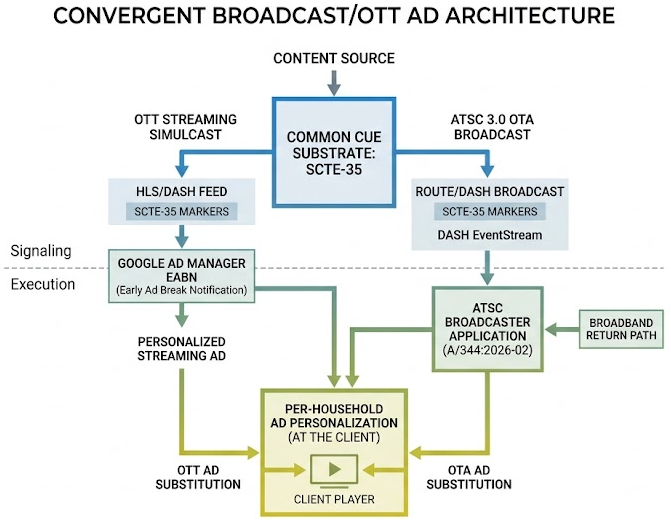
Part 8: The Broadcast ConvergenceA quick note that matters more than it seems: ATSC 3.0, the current U.S. terrestrial broadcast standard (current version A/300:2026-04, approved April 2026), is increasingly borrowing from streaming DAI patterns. ATSC 3.0 is a hybrid broadcast/broadband standard. Over-the-air delivery reaches every TV in a coverage zone with the same bytes, so per-household personalization has to happen at the client via broadband return path. The signaling mechanism is SCTE-35 embedded in the DASH Under the hood, vendors like Triveni Digital, Mirakulo, Ateme, and Harmonic are applying SSAI and SGAI patterns to broadcast — treating SCTE-35 markers in the ATSC 3.0 stream the way an OTT stitcher would treat SCTE-35 markers in an HLS or DASH origin feed. The two worlds are converging on a common substrate. For any broadcaster running an ATSC 3.0 over-the-air service and an OTT simulcast, the sane architecture is to keep SCTE-35 as the common cue substrate and let each downstream path — Google Ad Manager EABN for streaming, ATSC broadcaster application for over-the-air — consume it independently.
Part 9: A Practitioner's ChecklistIf you are evaluating a vendor, an implementation, or a rights package, the questions worth asking break down into four groups. Signaling and standards support. Does the stack support SCTE-35 ingest, HLS Interstitials, MPEG-DASH events, SVTA2053, VAST 4.x, OMID 1.6, and CMCD v2? A vendor hitting five or six of these is credible. One that claims "SGAI support" without naming any is probably running proprietary signaling. Operational timeshift discipline. What is the EABN (or equivalent) lead-time window? Is there jitter to smooth request bursts? Does the stack prefetch ad segments to the client? How is DVR-window re-resolution handled? These four answers tell you most of what you need to know about stability under real load. Player fleet coverage. Which CTV devices, browsers, and mobile OSes have full SGAI support today? Which fall back to SSAI, and what is the coverage split by concurrent audience? This is where most claims collapse under scrutiny. Measurement chain. Are client-side beacons MRC-audited? Are OMID device attestation and CMCD v2 in the pipeline? Can measurement partners (DoubleVerify, IAS, MOAT) receive the client signals directly?
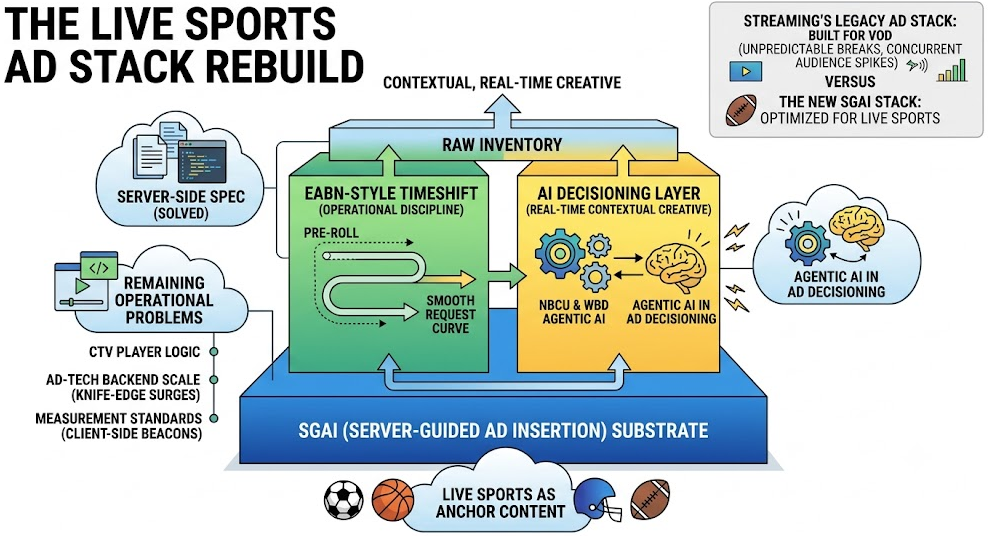
Where This Is HeadingLive sports has become the anchor content category for streaming — and streaming's ad stack was built for content that behaves nothing like live sports. SGAI is the industry rebuilding that stack. The server-side spec is essentially solved. The remaining problems are operational: getting SGAI-capable player logic onto every CTV device in circulation, keeping the ad-tech backend from collapsing under knife-edge request surges, and finishing the measurement standards so client-side beacons carry the same currency weight as server-side impressions. The interesting near-term development is agentic AI in ad decisioning. At the 2026 upfronts, both NBCU and Warner Bros. Discovery announced agentic products that let brands use AI agents to create real-time messaging tied to what audiences are watching. Those agents run on top of SGAI pipelines — they need the client-side flexibility SGAI provides to react in real time to live events. This is the shape of where the stack is heading: SGAI as the substrate, EABN-style timeshift as the operational discipline, and AI decisioning as the layer that turns raw inventory into contextual, real-time creative. Sports are not growing as just another content category. They are the reason the ad stack is being rebuilt. In 2026, the platforms that ship stable SGAI implementations against the standards described here will capture the incremental inventory the format unlocks. The rest will keep serving VOD ads into a live audience and wondering why the CPMs are not what the upfront promised.
| ||
| | ||
| |