Building MRC-Compliant Instrumentation in Ad Tech: Implementation Steps and Key Challenges
CK 3788 Created at
20900
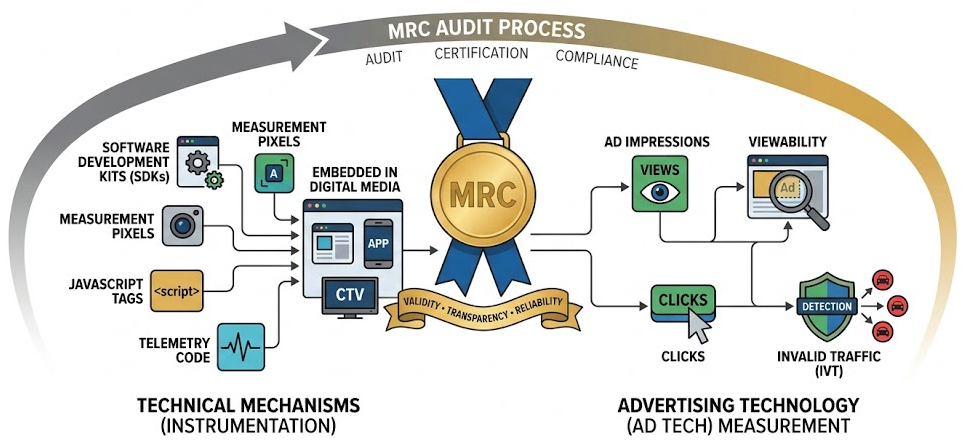
In Advertising Technology (Ad Tech), MRC (Media Rating Council) compliance represents the gold standard for ad measurement validity, transparency, and reliability. Instrumentation refers to the technical mechanisms—such as Software Development Kits (SDKs), measurement pixels, JavaScript tags, and telemetry code—embedded into digital media to track ad impressions, viewability, clicks, and invalid traffic (IVT).
Achieving MRC-compliant instrumentation requires strict adherence to standardized measurement definitions, robust data hygiene, and rigorous third-party auditing.
Key Requirements: What Needs to Be Done
To build and maintain MRC-compliant instrumentation, an Ad Tech company must execute across technical, operational, and auditing domains.
1. Implementation of Measurement Standards
Viewability Measurement:
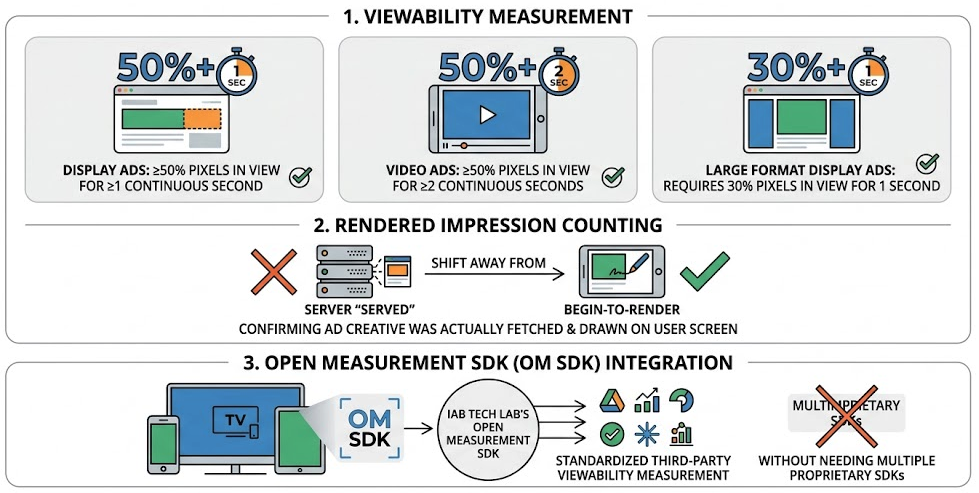
Display Ads: At least 50% of the ad's pixels must be in the viewable space of the browser/device for at least 1 continuous second.
Video Ads: At least 50% of the ad's pixels must be viewable for at least 2 continuous seconds.
Large Format Display Ads: Requires 30% of pixels in view for 1 second.
Rendered Impression Counting: Measurement must move away from server-side "served" impressions to "rendered" or "begin-to-render" impressions, confirming that the ad creative was actually fetched and drawn on the user's screen.
Open Measurement SDK (OM SDK) Integration: In mobile app and Connected TV (CTV) environments, platforms must integrate the IAB Tech Lab's Open Measurement SDK to allow standardized, third-party viewability measurement without needing multiple proprietary SDKs.
2. Invalid Traffic (IVT) Detection and Filtration
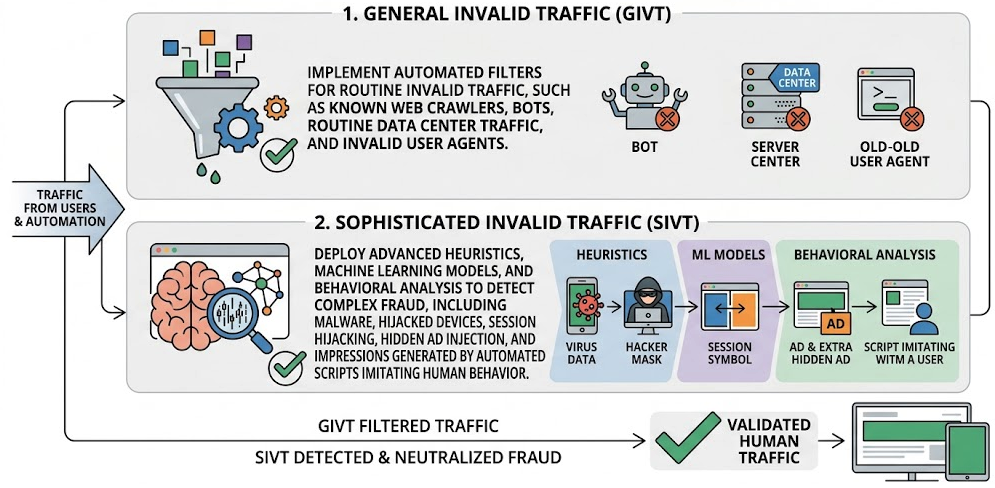
General Invalid Traffic (GIVT): Implement automated filters for routine invalid traffic, such as known web crawlers, bots, routine data center traffic, and invalid user agents.
Sophisticated Invalid Traffic (SIVT): Deploy advanced heuristics, machine learning models, and behavioral analysis to detect complex fraud, including malware, hijacked devices, session hijacking, hidden ad injection, and impressions generated by automated scripts imitating human behavior.
3. Architecture and Data Integrity
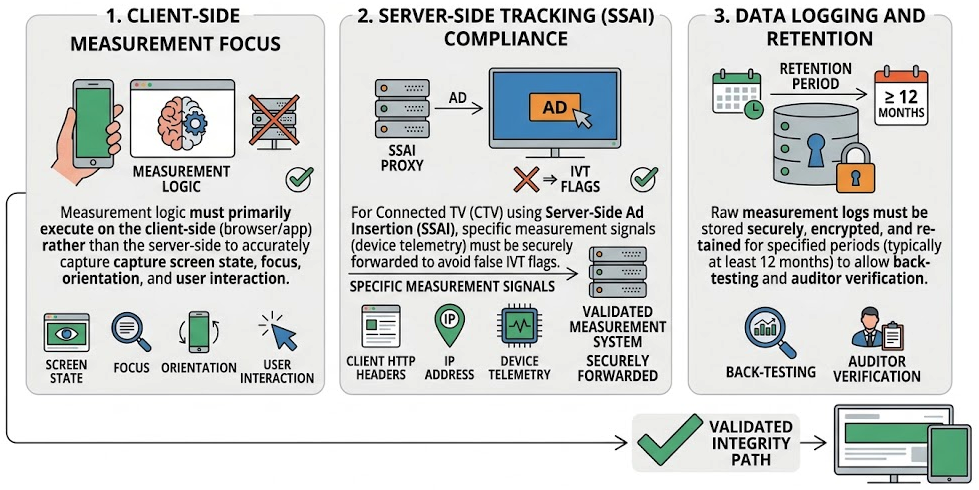
Client-Side Measurement Focus: Measurement logic must primarily execute on the client-side (browser/app) rather than the server-side to accurately capture screen state, focus, orientation, and user interaction.
Server-Side Tracking (SSAI) Compliance: For Connected TV (CTV) using Server-Side Ad Insertion (SSAI), specific measurement signals (e.g., client HTTP headers, IP pass-through, device telemetry) must be securely forwarded to avoid false IVT flags.
Data Logging and Retention: Raw measurement logs must be stored securely, encrypted, and retained for specified periods (typically at least 12 months) to allow back-testing and auditor verification.
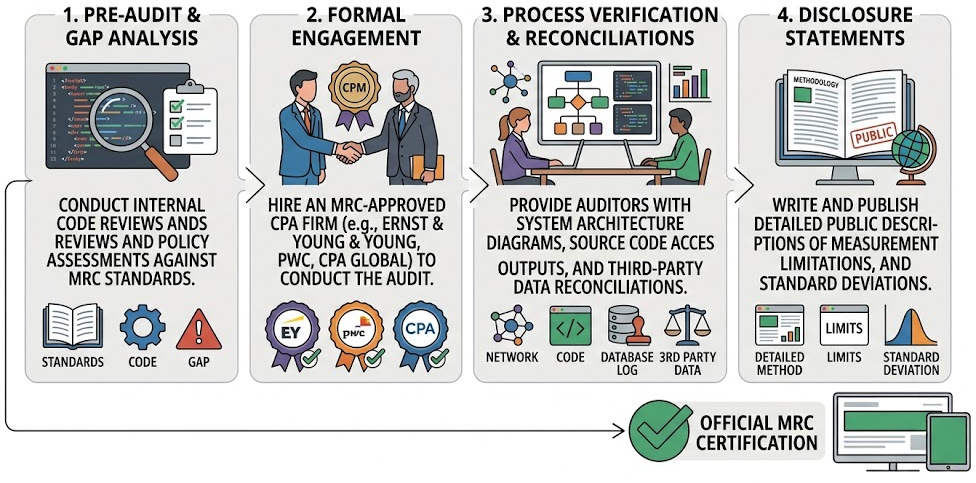
4. The Official MRC Audit Process
Pre-Audit & Gap Analysis: Conduct internal code reviews and policy assessments against MRC standards.
Formal Engagement: Hire an MRC-approved CPA firm (e.g., Ernst & Young, PwC, CPA Global) to conduct the audit.
Process Verification & Reconciliations: Provide auditors with system architecture diagrams, source code access, sample log outputs, and third-party data reconciliations.
Disclosure Statements: Write and publish detailed public descriptions of measurement methodology, limitations, and standard deviations.
Critical Challenges and Problems
Developing and maintaining MRC-compliant instrumentation involves significant technical, operational, and financial hurdles.
1. Technical Complexity Across Fragmented Environments
Connected TV (CTV) Challenges: CTV environments lack standard browser/app frameworks. Detecting whether a TV screen is actually "on" when an ad plays (the "TV Off" problem) or verifying viewability without standard DOM access is technically difficult.
Cross-Platform Disparity: Maintaining identical measurement precision across Web, In-App (iOS/Android), CTV, and Audio requires custom engineering for every operating system and runtime environment.
2. The Constant Evolution of Sophisticated Ad Fraud (SIVT)
Moving Target: Fraudsters continuously evolve their tactics to bypass SIVT algorithms (e.g., emulating human mouse trajectories, using residential proxy networks, or leveraging AI-generated browsing sessions).
False Positives vs. False Negatives: Overly aggressive IVT filtration risks blocking legitimate user traffic (losing revenue), while overly lenient filtration fails audits and breaches advertiser trust.
3. Privacy Regulations and Signal Deprecation
Loss of Identifiers: The deprecation of third-party cookies, Apple's App Tracking Transparency (ATT), and Android's Privacy Sandbox reduce the availability of persistent signals (IP addresses, Device IDs, User-Agent strings) necessary for SIVT detection and session tracking.
Regulatory Compliance Friction: Balancing data-heavy instrumentation required by MRC with strict privacy frameworks like GDPR, CCPA, and CPRA creates legal and technical friction.
4. System Latency and User Experience Impact
Heavy SDK/Script Overhead: Executing complex, real-time client-side calculations (e.g., geometric intersection checks, frame-rate monitoring) can slow down website page loads or cause frame drops in mobile apps, harming user experience.
Network Overhead: Transmitting high-frequency telemetry events to measurement servers increases bandwidth usage and battery consumption on mobile devices.
5. High Financial and Operational Costs
Direct Audit Expenses: MRC audits conducted by third-party accounting firms cost hundreds of thousands of dollars annually per media type/product.
Dedicated Engineering Effort: Maintenance requires a permanent engineering and data science team dedicated strictly to telemetry, IVT model retraining, and compliance updates, diverting resources from core product innovations.
Summary Matrix: MRC Compliance Path
Phase
Key Actions
Primary Obstacle
Instrumentation
Deploy OM SDK, client-side JS tags, and SSAI telemetry.
Performance overhead and cross-platform fragmentation.
Filtering
Apply GIVT list-based filters and SIVT ML detection models.
High false-positive rates and loss of tracking signals.
Documentation
Draft Methodology Disclosure Statements and log architecture.
Complex data pipelines and strict data retention needs.
Audit
Undergo independent CPA audit and address findings.
High direct financial costs and prolonged review cycles.