AWS

Power of Containerized Deployment with AWS ECS

CK CK 3788 
Created at
Updated at  
10,599 0 0

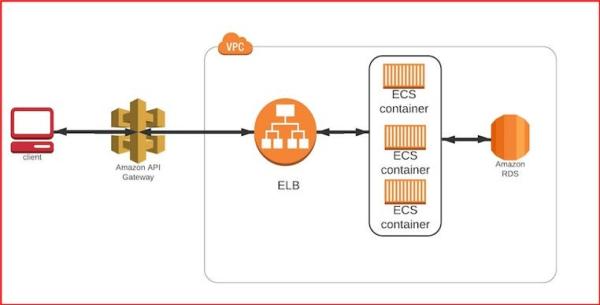
Have you ever wanted to streamline how you develop and deploy applications? Amazon Elastic Container Service (ECS) could be the game-changer you're looking for. This service allows developers to manage Docker containers on a highly scalable and secure platform.

What makes AWS ECS standout is its ability to simplify container management. You don't need to get into the complexities of managing servers or clusters. AWS ECS handles all the heavy lifting, automating deployment, scaling, and management of your container applications. This means you can focus more on building your applications rather than maintaining them.

Scalability is another major advantage of using AWS ECS. It integrates seamlessly with other AWS services like Elastic Load Balancing and Auto Scaling. This integration ensures that your applications can scale up or down automatically depending on their needs without any manual interference. It's particularly useful during unexpected spikes in traffic, making sure your application remains stable and available.

Power of Containerized Deployment with AWS ECS

AWS ECS is not just about handling large workloads. It also offers flexible scheduling options, letting you place containers based on CPU and memory requirements or even compliance and policy needs. This flexibility ensures optimal utilization of resources, helping to manage costs effectively.

When it comes to security, AWS ECS employs AWS IAM (Identity and Access Management) to provide robust security settings. This allows you to control which operations each container can perform, an essential feature for maintaining compliance and securing applications in enterprise environments.

One of the best things about AWS ECS is its cost-effectiveness. Since there are no additional fees for the ECS service itself, you only pay for the AWS resources you use. This makes it a budget-friendly option for businesses of all sizes.

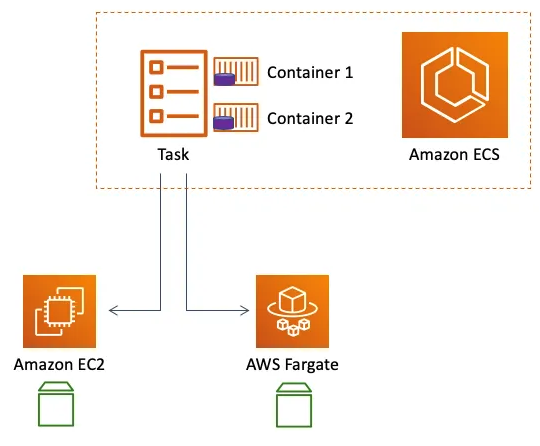
AWS ECS also offers two types of management options to cater to different needs.

Power of Containerized Deployment with AWS ECS

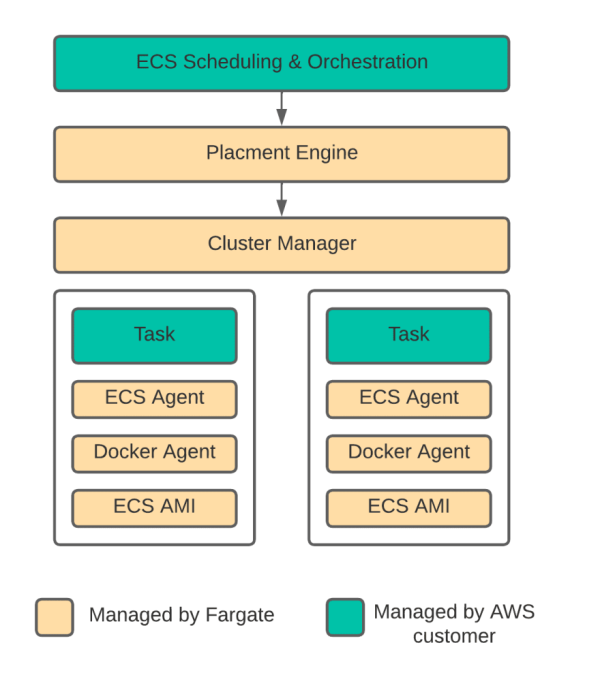
The Fargate launch type is where AWS manages the underlying infrastructure, ideal for those who prefer not to handle server management.

  • Great for spending less time on setup and maintenance.
  • Great for flexibility, as you don’t need to worry about long-term ownership of resources. Once you are done, you can give them back.
  • Bursty workloads: If you have workloads that are bursty and require scaling up and down quickly,
  • Fargate is a good choice. Fargate can automatically scale up and down based on demand, which can help you save costs.

Power of Containerized Deployment with AWS ECS

On the other hand, the EC2 launch type gives you full control over the servers and is perfect for applications requiring specific customizations.

  • If you have existing EC2 hardware that you want to leverage
  • Highly utilized, sustained, and predictable tasks that run for long periods of time can be cheaper on EC2, as Fargate pricing depends on the duration of your tasks. With EC2, you pay only for the hardware behind the scenes, whereas with Fargate, you pay for the duration and amount of resources you allocate, regardless of usage.
  • Great control, as you have complete control over infrastructure, hardware, monitoring, and security.


In terms of reliability, AWS ECS ensures high availability of your applications. It continuously monitors the state of your containers and quickly replaces any that fail. This high level of reliability is crucial for maintaining continuous service and user satisfaction.

Overall, AWS ECS is an excellent solution for anyone looking to adopt containerization. Whether you're building simple web applications or complex microservices requiring high scalability, ECS provides a powerful platform to support rapid development and deployment cycles. It's particularly beneficial in environments that embrace DevOps, microservices, and CI/CD practices.

Tags AWS ECS AWS Services Cloud Computing Containerization Cost-Effective IT Solutions DevOps Docker Microservices Scalability Security Facebook X
Comments 0
Similar posts
  1. How to Set Up and Deploy Containerized Applications with AWS ECS
    10,683
  2. Ad Tech Idempotency: Engineering for Reliability and Scale
    367
  3. All Engineering Software Development How can you prioritize software design trade-offs when developing a new product?
    1,346
  4. Vulnerabilities of MCP
    593
  5. MCP vs A2A
    606
  6. The Ultimate Data Engineering Roadmap
    1,082
  7. Why Amazon VPC satisfies with PCI-DSS and SOC 2 Type on Fintech Industry?
    649
  8. How Netflix Runs Recommendations for Hundreds of Millions of Users Using Amazon SageMaker & Metaflow
    182
  9. Uvicorn, Gunicorn: Proving Your Production Prowess
    401
  10. Architecting Dynamic Scale-Out and Scale-In with Docker Containers
    136
  11. Word counting source program based on MapReduce framework
    692
  12. How to encrypt a string
    468
  1. When you face 504 Gateway Timeout while you wait a response from Bedrock in Fast API
    540
  2. How to overcome the prompt size limit when you use Claude via Bedrock - Chunking / Splitting the Input
    500
  3. Integrating VectorDB stored in S3 with Amazon Bedrock
    429
  4. When you need AWS_ACCESS_KEY_ID and AWS_SECRET_ACCESS_KEY for Amazon Bedrock
    544
  5. You shouldn't use Amazon CloudFront distribution as an origin
    643
  6. Amagi CLOUDPORT Architecture based on AWS for FAST for channel playout on AWS
    1,330
  7. Creating a serverless Apache Kafka publisher using AWS Lambda
    567
  8. AWS System Design Example - Instagram Architecture
    1,928
  9. A Python script to create an EC2 Spot instance using boto3
    1,610
  10. A Python/PHP code to deregister anormalous instaces in Amazon ECS
    1,860
  11. Where to get AWS API Key at AWS Management Console?
    1,077
  12. Understanding Amazon Bedrock Agent for AI-based ChatBot
    647
  13. Media sharing service architecture in AWS
    10,374
  14. Enterprise Data Lake Architecture based on AWS
    10,411
  15. "502 Bad Gateway" Error easy to happen at the combination of nginx and node.js in AWS Elastic Beanstalk
    10,495
  16. FAISS Already Does ANN... So Why Do Top Teams Still Pay for SageMaker?
    314
  17. Recommended Vector DB Structure for Amazon Bedrock Integration
    393
  18. Product Marketing & Recommendation Architecture in AWS for e-commerce website
    10,747
  19. What cause a 502 bad gateway error in AWS environment?
    445
  20. Building an AWS SAM(Serverless Application Model) Project
    901
  21. Teraform from the scratch
    1,362
  22. Check incomplete multipart uploads if AWS S3 storage size is abnormally big huge compared to the origin storage
    11,599
  23. Importing a wild card domain SSL certificate into AWS Certificate Manager
    10,349
  24. AWS Lambda Example based on Teraform
    904
  25. Simple AWS ECS example based on Teraform
    995
  26. Web front-end architecture in AWS for e-commerce website
    370
  27. Web Application Hosting provides the reliable, scalable, secure, and high-performance infrastructure
    10,620
  28. Time series processing architecture in AWS
    10,561
  29. Synchronous online gaming architecutre in AWS - Highly Available, Scalable & Elastic to support Millions of Players
    10,424
  30. Secure and Scalable LAMP Service Architecture in AWS
    10,666
Recently updated
  1. Google OAuth Token Expiration: Causes and Solutions
    29
  2. Why 100% SEO Guarantees Better User Engagement and How to Achieve It in Your Service
    55
  3. Why SPF and DKIM Are Essential for Linux Email Servers?
    49
  4. How do I create animated background for Google Meet?
    22,830
  5. MaxMind GeoLite2 vs. DB-IP Lite vs. ip-api.com: Choosing the Right Free IP Geolocation Solution
    271
  6. Meet Valkey: Why Redis Changed Its License, Why Valkey is Better, and How to Use It as a Drop-in Replacement
    103
  7. How Rogue Web Scrapers Are Stealing My Content and Destroying My Server
    168
  8. Array of arguments passed to script in PHP
    97
  9. Invalid Auction Storms in Ad Tech
    106
  10. Building MRC-Compliant Instrumentation in Ad Tech: Implementation Steps and Key Challenges
    207
  11. The Two Clocks of Ad Server Architecture
    77
  12. Frequency Cap Architecture Overview
    526
  13. Collecting Proof-of-Play from 100,000 Screens
    152
  14. Vector Search in Relational Databases (RDBs): Trends & Usage Environments
    302
  15. What is RedisVL?
    114
  16. Designing a Skill Registry Architecture: Minimize Token Usage and Maximize AI Performance
    246
  17. TPU & GPU Cluster Management Tools
    257
  18. The Concept of Scaffolding in AI Agents
    244
  19. Beyond Static Pipelines: Architecting LLM Multi-Agent Systems for Autonomous Workflow Orchestration
    596
  20. AI-DLC vs. AI-SDLC: Model-Centric vs. System-Centric AI Development
    267
  21. Fine-Tuning Open-Weight LLMs: Training, Licensing, and Deploying Custom Models with Ollama
    353
  22. Inside the Next-Generation Streaming Architecture: Ultra-Low Latency, SGAI, and AI Codecs
    206
  23. Machine Learning: Training vs. Ranking
    229
  24. The Continuous Learning Machine: Designing a Loop That Actually Turns
    228
  25. The Next-Gen Low-Latency Standards: LL-HLS & MoQ
    202
  26. Designing a Data Curation System Around a Vector Database
    230
  27. Extracting Context from Live Video: The Architecture Got Simpler When We Stopped Building Features
    263
  28. The New Ad Stack Behind Live Sports Streaming: Inside SGAI, EABN, and the Standards Race to Fix Live Monetization
    671
  29. Designing MLOps Architectures to Handle Seasonal Data Drift in EV Fleet Models
    200
  30. From 15 to 40+ FPS: Accelerating PyTorch Object Detection on Automotive ECUs
    232